

Oruva’s Christmas lights turn a balcony into a moving holiday display. The photographs suggest a simple upgrade that the whole family can enjoy after dark.
But a seasonal decoration needs to work in your space, with your phone, before the occasion passes. The buying details deserve attention before the excitement takes over.
Overview
The captured selection is a two-unit order, not the headline single item
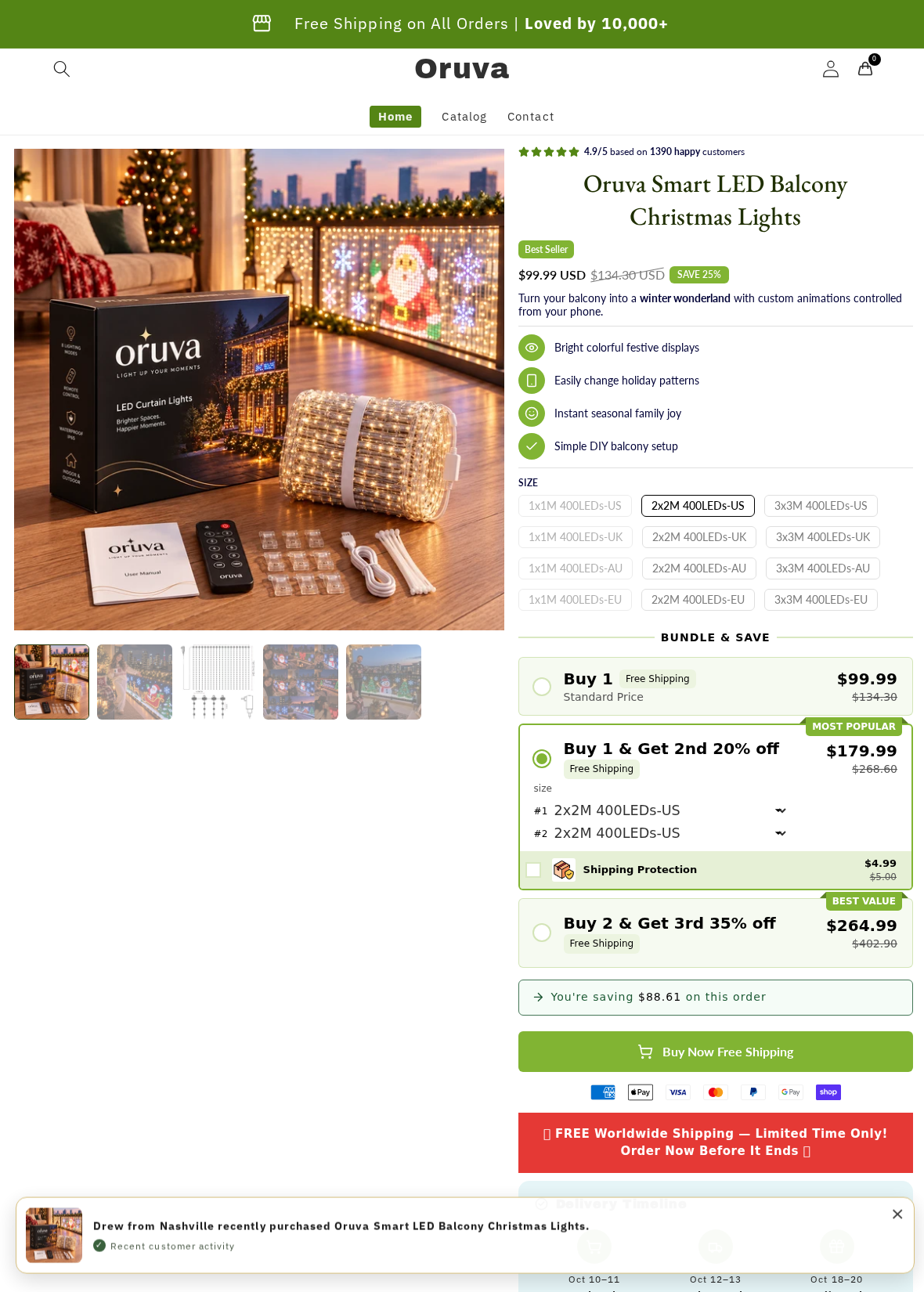
Our Oruva Christmas Lights review found a $99.99 single-unit offer alongside a selected two-unit package at $179.99 in the October 10, 2026, US capture.
Shipping protection at $4.99 was visible but unchecked. We did not establish a forced extra, an unauthorized charge, or post-payment quantity changes.
The first practical concern is getting the intended size, plug, and quantity. Do not assume the highlighted package represents one complete light set.
The main gaps concern documentation and the seller behind the offer
Oruva promises phone-controlled designs and suitability for balcony decoration. Its outdoor-use FAQ supplies reassuring language without explaining the ratings of the individual powered components.
The FAQ offers a return within a month for a refund or exchange. It does not provide enough detail there to calculate return postage or identify the destination.
We would not buy for outdoor installation until the seller supplies the actual manual, component ratings, compatible app, and usable return instructions.
The facts that matter more than the festive photographs
- The original capture selects two 2x2M 400LEDs-US units.
- The storefront claims 4.9/5 from 1,390 happy customers and separately advertises 10,000-plus approval.
- Those customer figures were not independently authenticated.
- The privacy policy publishes contact details beyond the simple contact form.
- No unit, phone app, electrical assembly, or customer return was physically tested.
This is a product and purchasing-risk investigation, not a confirmed fraud finding. The usable verdict is to resolve those specific gaps before spending or installing anything.
What the Oruva Offer Actually Selects
The bundle savings do not make the second unit necessary
The product offer reviewed presents one unit, a discounted second unit, and a three-unit combination.
At the captured prices, two individual $99.99 purchases total $199.98. The $179.99 bundle reduces that total by $19.99, approximately 20% of one unit’s price.
It is not 20% off the entire two-unit total. More importantly, it still requires spending considerably more than the one unit you may need.
The larger three-unit package was shown at $264.99. That option should be assessed by its full quantity and total, not the appealing discount assigned to one component.
These amounts describe the US capture, not all currencies or future offers. Our separate browser visit localized prices to RON, which should not be relabeled as USD.
The screenshot shows a specific size and plug configuration
The package in the screenshot selected two 2x2M 400LEDs-US units. Other listed options combined 1M, 2M, or 3M dimensions with US, UK, AU, and EU variants.
Some displayed options were unavailable. That is why you should confirm the actual selected configuration rather than assuming every visible button represents stock ready to ship.
Measure the installation area first. Two square displays may not suit a long narrow railing, even when the total number of lights sounds adequate.
A regional plug label does not, by itself, identify voltage requirements or adapter safety. Read those specifications separately before ordering across borders.
Protection is optional in the captured state
The visible $4.99 shipping-protection box was unchecked. This finding should not be rewritten into an allegation that Oruva automatically charged that extra.
If you consider adding it, ask what it covers and how a claim works. A protection label is not the same as an independently verified insurance policy.
Check the final summary after making any selection. A correct product-page price cannot establish whether the later basket contains precisely what you intended.
How the Oruva Christmas Lights Purchase Journey Works
Step 1: The holiday scene creates an expectation of easy results
The artwork presents colorful shapes across a decorated balcony. This sells an outcome: a finished festive space, rather than a collection of wires and controls.
Your installation has its own limits, including railing dimensions, outlet location, surrounding light, and a safe cable route. Check those before choosing the package.
A beautiful scene cannot show how long assembly takes or how every included component handles the weather. Those questions need instructions and product-specific evidence.
We did not authenticate how the promotional imagery was created. The investigation does not label it proven AI imagery merely because it looks polished.
Step 2: Customer counts and activity notices add reassurance
The page displays a 4.9/5 customer figure, a larger popularity statement, and recent-purchase notifications. These messages come from the seller’s own presentation.
They do not independently verify the named shoppers, delivery history, or the performance of your chosen model. A familiar-looking rating format is not a third-party audit.
Seek reviews that identify the delivered hardware, app, and use conditions. A statement that the lights look wonderful does not answer whether an adapter was included.
Do not attach complaints about a different similarly named business. Verify the domain and actual product before treating an online account as relevant evidence.
Step 3: The selected package commits you to hardware choices
Review each unit’s size and region within the bundle. Do not change only the top-level selector and assume every line now uses the same configuration.
Save the selected model and total. If one light is for another household, confirm that person’s outlet, installation area, and compatible phone before buying for them.
Ask whether units share one controller or have separate controllers and power adapters. The difference affects installation, storage, and whether both can be programmed independently.
We did not establish the exact controller arrangement. That unresolved specification belongs in a pre-purchase question, not an invented feature in a review.
Step 4: Phone control requires a real app and setup method
The offer promises custom designs controlled from a phone. Establish the app’s exact name, supported operating systems, and connection method before accepting that promise.
Ask whether setup needs Bluetooth, a particular Wi-Fi band, an account, or ongoing internet access. These are questions, not verified specifications of the inspected product.
If additional features require payment, that should be disclosed separately from the hardware price. We did not verify any app subscription or attribute one to Oruva.
Use the genuine app-store listing identified by the manufacturer. Do not install an unknown download merely because an unsolicited message says it activates your lights.
Step 5: Delivery leaves a limited practical season for inspection
The page presents estimated order-ready and delivery dates. Those changing displays are seller estimates, not tracking for a completed purchase made during this investigation.
Allow time to check the equipment before your decorating deadline. A parcel arriving on the occasion itself gives you little chance to resolve a missing controller.
On arrival, identify every component and compare it with the advertised contents. Photograph labels before packing materials disappear into holiday storage.
Test according to the instructions in a safe appropriate environment. Resolve voltage, adapter, and weather-use questions before placing an unfamiliar assembly outside.
Step 6: A return promise must translate into usable instructions
The opened FAQ says an unsatisfactory purchase can be returned within a month for a full refund or exchange. That is the seller’s promise to preserve.
Ask how the period is counted, what condition is required, who pays postage, and where the parcel goes. The FAQ alone did not resolve those details.
For a defective item, record the actual fault rather than presenting an ordinary change of mind. The remedy should address what the equipment failed to provide.
Keep the request date and written instructions. A seasonal product does not become exempt from every remedy merely because the holiday has passed.
Outdoor Use and App Claims Need Better Documentation
Weather suitability belongs to the complete assembly
Decorative artwork may advertise water resistance. The important question is which components that representation covers: light strings, connectors, controller, adapter, or all of them.
The FAQ’s outdoor answer talks about dependable seasonal use without supplying component-level specifications. Ask for the actual manual and markings on the delivered equipment.
A water-resistant light string should not be assumed to make an unrelated power adapter safe in rain. Follow the manufacturer’s instructions for every connection.
If the seller cannot provide those instructions, do not improvise an outdoor installation. Keeping a product indoors is not a substitute for resolving an advertised outdoor-use mismatch.
Complex pictures need a documented display layout
The size labels mention 400 LEDs. To understand the promised designs, ask how those lights are arranged and what patterns the controller actually supports.
Photos do not establish programmable resolution or prove that every pictured scene is a downloadable preset. Request a demonstration of the exact unit displaying a recognizable pattern.
Check the stated spacing against the dimensions you intend to buy. Different sizes carrying the same LED count can have different practical appearance and pattern clarity.
A specific demonstration is more helpful than vague claims of endless animations. You should know whether you are buying basic changing colors or an individually controlled matrix.
Oruva Company, Address, Contact, and Hardware Checks
The brand does not clearly establish a registered contracting entity
The pages reviewed use Oruva as the storefront identity. We did not independently authenticate a legal company registration tied to this specific offer.
Request the business name, registration jurisdiction, and invoice details. A brand printed on promotional packaging does not complete that identity trail.
Compare the response with your payment confirmation. If another merchant name appears, ask what role it performs rather than assuming fraud from the difference alone.
The Sheridan suite is not proof of a lighting warehouse
The privacy policy lists 30 N Gould Street, Suite 4000, Sheridan, Wyoming, 82801.
Public corporate-agent records also use the street address, with other suite designations. That context does not prove Oruva’s listed suite is a factory or return facility.
It also does not prove common ownership with another brand sharing the building. Legal-mail services can serve unrelated businesses.
Obtain the authorized return destination separately. Do not ship a light set to a privacy-policy address without confirmation that it accepts your parcel.
There are published contacts beyond the message form
The privacy disclosure lists oruvausa@gmail.com and +1 833-510-1880. The contact page itself presents a form.
Those contacts are publicly stated, but we did not test them. Neither a Gmail account nor a toll-free number independently establishes responsive support or deliberate nonresponse.
For an order problem, request a clear answer about the model and remedy. Save your submission so any delay can be documented accurately.
Ask for identifiers that survive a changing storefront
The actual manufacturer, controller model, adapter markings, and manual are more useful than the Oruva name when troubleshooting or comparing equipment.
We did not inspect a factory or identify a verified wholesale match. Chinese manufacture, counterfeit parts, and dangerous construction are not established by these checks.
Nevertheless, missing documentation is a valid reason not to buy electrical equipment for an exposed installation. You do not need a fraud verdict to decline that risk.
What to Do If You Ordered Oruva Lights
-
Check your exact selection. Verify quantity, dimensions, plug variant, protection choice, and charged total. Match each bundled unit with the intended installation.
If the confirmation differs from your selection, request a correction before dispatch. Keep the original screenshot so the discrepancy can be explained without guesswork.
-
Ask for the manual before installation. Obtain the app name, connection method, electrical requirements, and outdoor-use instructions for every powered component.
Do not assume a marketing picture answers those questions. If documentation is unavailable, preserve that response and ask about cancellation or return instead of experimenting outside.
-
Inspect the delivery carefully. Photograph contents, model labels, adapter ratings, connectors, and damage. Compare the number of units and included accessories with the invoice.
Keep small parts together. A missing cable or controller should be reported as a fulfillment issue rather than treated as something you must purchase separately.
-
Use a genuine setup route. Confirm the manufacturer’s app-store entry and instructions. Avoid unknown installers or requests for unrelated account credentials.
If someone approaches you with paid activation or refund help, verify independently through the seller’s original contact. Do not treat that person’s message as part of your order.
-
Request the remedy within the stated period. Preserve the within-a-month promise and identify whether your request concerns dissatisfaction, missing contents, or a fault.
State your preferred outcome and obtain the return address, authorization, condition requirements, and postage allocation before sending the package.
-
Document any actual feature mismatch. For nonworking patterns or phone control, record the model, app, error, and steps followed from the instructions.
Do not expose your Wi-Fi password or account details publicly. Give relevant troubleshooting information through a verified private support channel.
-
Follow through on repayment or replacement. Retain tracking, approval, and transaction references. Inspect replacement hardware rather than assuming another parcel resolves the problem.
For an unresolved paid order, consult your payment provider promptly about evidence and deadlines. Explain the specific delivery or representation issue accurately.
Frequently Asked Questions
Is Oruva a confirmed Christmas-lights scam?
Our research established purchasing and documentation gaps, not fraud. The strongest decision is to withhold payment until hardware, seller, and return details are adequately explained.
Was the two-unit package selected in the inspected offer?
Yes. The US screenshot shows two 2x2M 400LEDs-US units at $179.99. Check your own live summary, since selections and localized prices can differ.
Was shipping protection automatically included?
It was visible but unchecked in our capture. Review your own choice and final invoice rather than treating an optional box as proof of an imposed charge.
Can I safely install the complete set outside?
That was not tested. Obtain component-specific ratings and instructions, especially for the power supply and connections. A festive balcony image is not an electrical assessment.
What app controls the lights?
The inspected marketing promises phone control but did not establish a tested compatible app. Ask for its exact official listing and supported setup method before purchasing.
What return period does Oruva advertise?
The opened FAQ promises a return within a month for refund or exchange. Clarify how that period is counted, the condition requirements, postage, and authorized destination.
The Bottom Line
Oruva’s holiday presentation does not resolve the practical questions about its hardware, selected bundle, and seller. Those answers matter before an electrical product reaches your balcony.
Do not buy or install on imagery alone. Obtain documentation and usable return terms first, then make the decision around your actual space, budget, and deadline.








