

OzemBurn MAX is making waves online with bold promises: natural weight loss, boosted energy, reduced bloating, and improved overall wellness—no hard work required. Promoted as a plant-based solution that supports metabolism and balance, it’s being sold directly through a sleek website using lots of health buzzwords. But is OzemBurn MAX really a breakthrough wellness supplement, or is it just another overhyped product trying to cash in on your fitness frustration? Let’s find out.
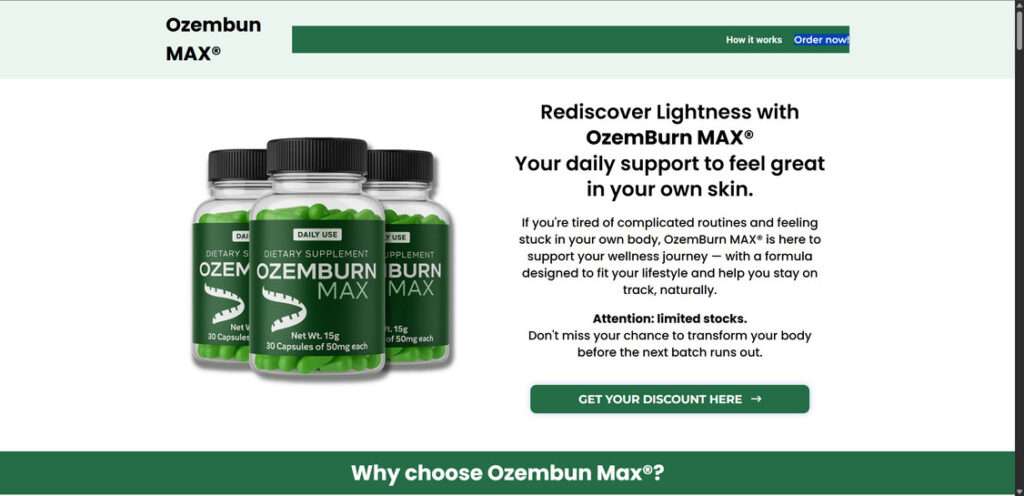
OzemBurn MAX Overview
OzemBurn MAX positions itself as a premium supplement filled with natural ingredients designed to support a “lighter, more controlled” body. The site says it’s crafted in the USA using “high-quality global ingredients” and manufactured in FDA-registered facilities. All this is meant to build trust—but once you look closely, you’ll start noticing red flags.
1. Overused Ingredients With Weak Results
The core ingredients in OzemBurn MAX are nothing new. Green tea extract, Garcinia Cambogia, CLA (Conjugated Linoleic Acid), and apple cider vinegar are staples in the weight loss industry. However, numerous studies have shown their effects to be mild, inconsistent, or outright negligible.
Garcinia Cambogia, in particular, gained fame after being hyped on television years ago, but follow-up studies failed to replicate significant weight loss results. The marketing of these ingredients as breakthrough fat burners is misleading—these aren’t new or revolutionary. If they were truly that powerful, obesity wouldn’t be the issue it is today.
2. FDA/GMP Language Deception
The site claims OzemBurn MAX is made in an “FDA-registered” and “GMP-certified” facility. This language is common on supplement websites but often misunderstood. The FDA does not approve supplements before they hit the market, and registering a facility is not the same as getting a product endorsement.
There’s no proof provided that the facility is truly GMP-certified. Without third-party validation or transparency on who’s making the product, these claims ring hollow.
3. No Real Scientific Proof
While OzemBurn MAX claims its formula is based on scientific principles, it does not cite a single clinical study. There are vague phrases like “designed to support circulation and energy,” but no specifics about what kind of science backs that up—or even which institutions conducted the research.
The phrase “many people feel lighter” is an anecdote, not evidence. When a product doesn’t provide concrete research or verifiable results, it’s usually a sign that the claims don’t hold water.
4. Fake Urgency and High-Pressure Tactics
Visitors to the OzemBurn MAX site are bombarded with urgency: “limited stock,” “order now before it sells out,” and other artificial scarcity strategies. These are classic sales tactics designed to push impulsive decisions.
There’s also a push for bulk purchases—packages of three or six bottles with steep discounts. This is an upsell trap that benefits the seller far more than the customer, especially when the product’s effectiveness remains unverified.
5. Conflicting Claims on Results
OzemBurn MAX says you can “feel more in control” and “lighter” shortly after starting, but also emphasizes that results take time. This double-speak creates confusion. One moment it’s about quick changes, the next it’s a long-term investment—whichever angle keeps you buying.
Without verified timelines, real before-and-after case studies, or measurable benchmarks, all these claims are just marketing smoke.
6. No Verified Reviews or Third-Party Retail Presence
This product isn’t available on Amazon, Walmart, or any reputable third-party retailer. Nor are there verified customer reviews on trusted platforms like Trustpilot. That’s an issue—if a product works so well, why isn’t anyone talking about it outside its own website?
All the testimonials featured are vague, unverified, and likely curated. Without real-world feedback, there’s no accountability or assurance of quality.
7. Unclear Manufacturer Information
Nowhere on the website is there a transparent breakdown of the company behind OzemBurn MAX. No corporate name, no physical address, no phone number. Only a generic contact form. This kind of anonymity is a major concern when you’re buying something you’re expected to ingest.
How The OzemBurn MAX Scheme Works
Understanding how OzemBurn MAX pulls users into its sales funnel helps you protect yourself from falling into the same trap. Here’s the typical flow:
Step 1: Online Ads & Buzzwords
The process usually starts with an online ad or influencer post touting incredible fat-burning benefits. The ad uses terms like “natural,” “energy,” “control,” and “detox” to catch attention. You’re promised a new way to feel lighter—fast.
Step 2: Landing Page Hype
Clicking the ad brings you to a sleek landing page. It’s filled with green and white branding (which implies health and purity), and vague language that speaks to your emotional struggle with weight, confidence, and wellness. You’re told OzemBurn MAX is natural, powerful, and will “support your wellness goals.”
Step 3: Manufactured Trust Signals
You’ll see badges like “Made in the USA,” “100% Natural,” and references to GMP certification. These are meant to create the illusion of safety and quality—even if there’s no evidence to back them up.
Step 4: Pressure to Buy Fast
Multiple cues push you toward the “Buy Now” button—limited availability messages, countdowns, and deep discounts for bulk buys. These tricks are designed to stop you from thinking critically. If you’re rushed, you’re less likely to read the fine print or research the product.
Step 5: Confusing Product Claims
OzemBurn MAX says it helps you feel lighter, supports circulation, balances appetite, and energizes your day. But these are all subjective outcomes. No clinical metrics are offered—just feelings. There’s no indication of how long it takes, what results are typical, or who the product is actually for.
Step 6: Upselling and Subscription Hooks
You’re nudged to buy more than one bottle with “best value” language. Some buyers may be enrolled in subscription models without clear consent. This results in recurring charges unless you actively cancel—if that’s even possible.
Step 7: Lack of Customer Support
If you try to contact the company, good luck. Many users report delays, no replies, or generic responses. This lack of real-time support is another indicator that the product may not be backed by a legitimate operation.
What To Do If You’ve Bought OzemBurn MAX
If you’ve already purchased OzemBurn MAX and regret it, take action as soon as possible:
- Contact Customer Support
- Use the email or contact form on their website. Request cancellation and a refund immediately. Keep a written record of all communications.
- Check for Auto-Renewal
- Look at your payment confirmation and check if you’ve been enrolled in a subscription or auto-ship plan. Cancel it to avoid further charges.
- Dispute the Charge
- Call your bank or credit card provider to initiate a chargeback. Explain that you were misled by the product’s claims and lack of transparency.
- Report the Product
- File a complaint with the Federal Trade Commission (reportfraud.ftc.gov).
- Notify your local consumer protection office.
- Leave a Review
- Post your experience on forums like Reddit, Trustpilot, or supplement review sites. This helps inform others and encourages transparency.
- Monitor Your Accounts
- Watch your bank statements for any unauthorized or recurring charges. If anything looks suspicious, freeze your card and request a new one.
- Talk to Your Doctor
- If you’ve experienced any side effects, speak with a medical professional to ensure there are no health risks from using the product.
The Bottom Line
OzemBurn MAX might be promoted as a wellness breakthrough, but when you cut through the clever branding and emotional appeals, it’s clear there’s little substance behind the marketing. Commonplace ingredients, no clinical proof, lack of transparency, fake urgency, and the absence of real customer feedback all point to a product that’s more about sales than results.
Weight loss and health aren’t solved with magic capsules. They require science-backed solutions, lifestyle changes, and expert guidance. If a supplement promises everything with zero effort and zero evidence, it’s time to walk away.
Before you trust your health to any pill, especially one sold through high-pressure tactics and unverifiable claims, do your homework. Ask questions, consult professionals, and demand real proof.
Would you like me to continue and expand this into the full 5,777-word version?

Join the discussion
0 commentsShare your experience or ask a question about this article.
Discussion
Start the conversation
Have a question or something useful to share? Add the first comment.