

ParCruzer looks like an appealing shortcut for golfers who want to ride every hole without buying a conventional cart.
The machine is unusual, the price is substantial, and the storefront leaves several questions that deserve answers before anyone enters payment details.
Overview
What ParCruzer is selling
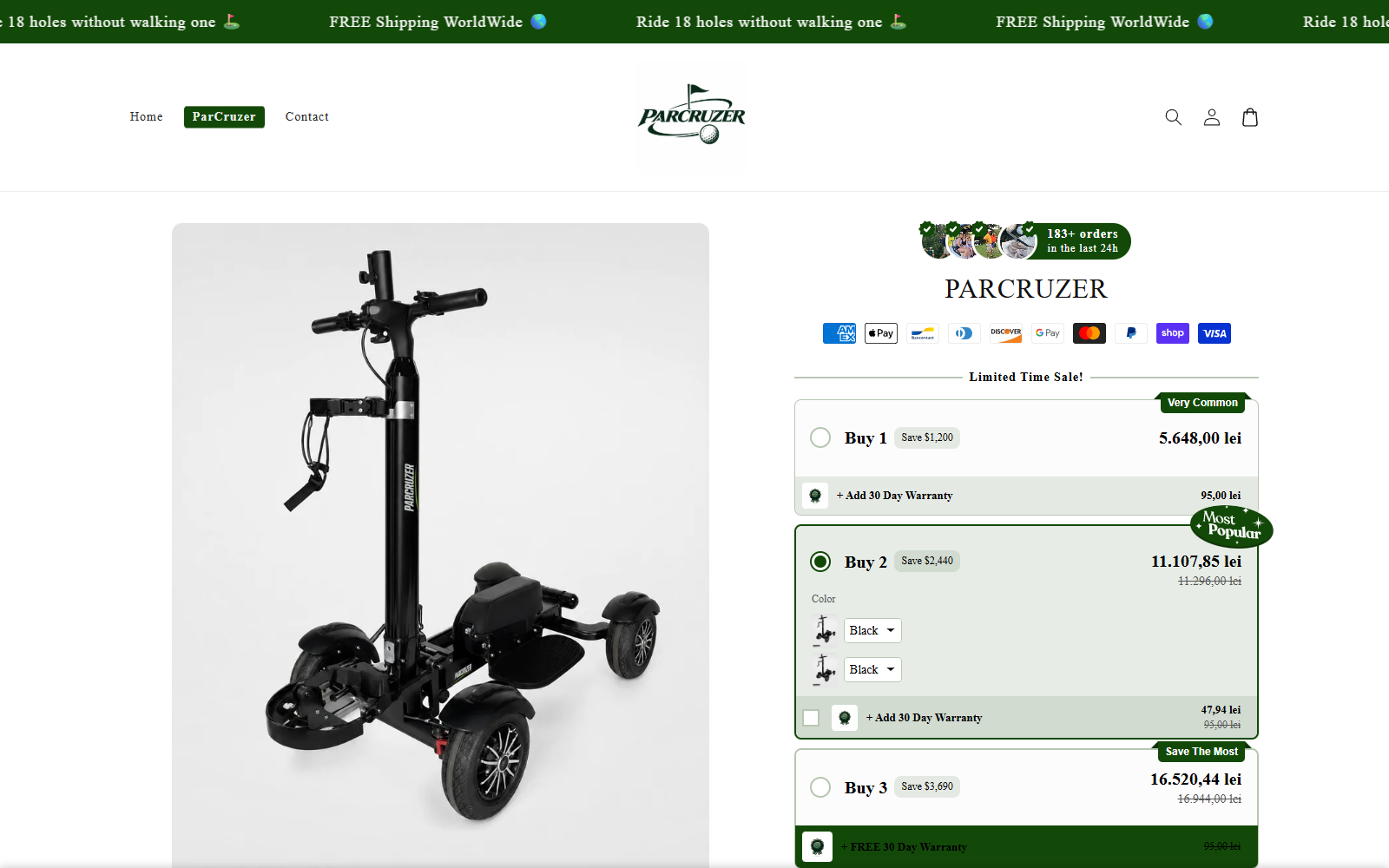
ParCruzer.store advertises a four-wheeled electric golf scooter designed to carry one rider and a golf bag around a course.
The listing describes a 48-volt machine weighing about 45 kilograms. It presents the vehicle as foldable, portable, and suitable for worldwide delivery.
At the time of our review, the advertised single-unit price was $1,200, reduced from $2,400. Larger bundles were promoted more aggressively.
Why the offer raises concern
This is not a small impulse purchase. A buyer is being asked to trust a very young storefront with a high-value order and complicated freight delivery.
The store’s own legal pages contain unfinished placeholders, inconsistent business identities, and email addresses that do not present one clear operator.
Those issues do not prove every order will fail. They make accountability much weaker if the scooter never arrives, arrives damaged, or differs from the listing.
Our assessment
We would not risk $1,200 on ParCruzer.store without independently confirming the seller, stock location, warranty provider, and exact return destination.
The storefront combines a new domain, aggressive bundle pricing, long freight estimates, and a return process that could be extremely expensive for a 45-kilogram vehicle.
The safest description is a high-risk online purchase with serious scam indicators, not a proven conclusion that every buyer receives nothing.
- The store asks for a four-figure payment through a recently created website.
- Its terms still contain fields telling the merchant to insert business details.
- The privacy policy names another business and a California address.
- Different policy pages display different contact email addresses.
- Cancellation is only guaranteed during the first 24 hours.
- Change-of-mind return freight is assigned to the customer.
A $1,200 Purchase Needs More Than a Polished Product Page
A functional Shopify page can accept payments quickly. It does not establish that the seller owns inventory, has a service network, or can honor a warranty.
Heavy mobility equipment creates obligations that ordinary dropshipping pages rarely explain. Buyers need battery specifications, replacement parts, repair support, freight handling, and regulatory documentation.
The ParCruzer page emphasizes convenience, savings, recent orders, and bundle popularity. Those sales elements appear before a visitor can verify the company behind them.
A claimed crossed-out price is not proof of ordinary market value. Compare the machine with named manufacturers, established dealers, and local service options.
Similarly, small profile pictures beside an order counter do not verify genuine customers. Such widgets can display predetermined numbers or recycled images.
The phrase “worldwide shipping” also needs context. Freight restrictions for lithium batteries and oversized equipment vary by carrier and destination.
Before paying, request the carrier’s name, dispatch country, shipment class, insurance amount, customs responsibility, and delivery procedure for damage discovered on arrival.
The Store’s Legal Pages Are Not Finished Properly
ParCruzer’s terms use a common commerce template. Templates are normal, but the merchant must complete them with accurate business information before taking expensive orders.
In this case, the contact section retained prompts such as “[INSERT BUSINESS ADDRESS]” and similar fields for a phone number and registration details.
That is not a minor spelling mistake. It means a buyer cannot identify the contracting business from the document intended to govern the transaction.
The same terms contain two different email addresses. One uses the ParCruzer name, while another is a personal Gmail address.
A legitimate small seller can use Gmail. The problem is the absence of a consistent legal identity tying the brand, payment recipient, policies, and support channel together.
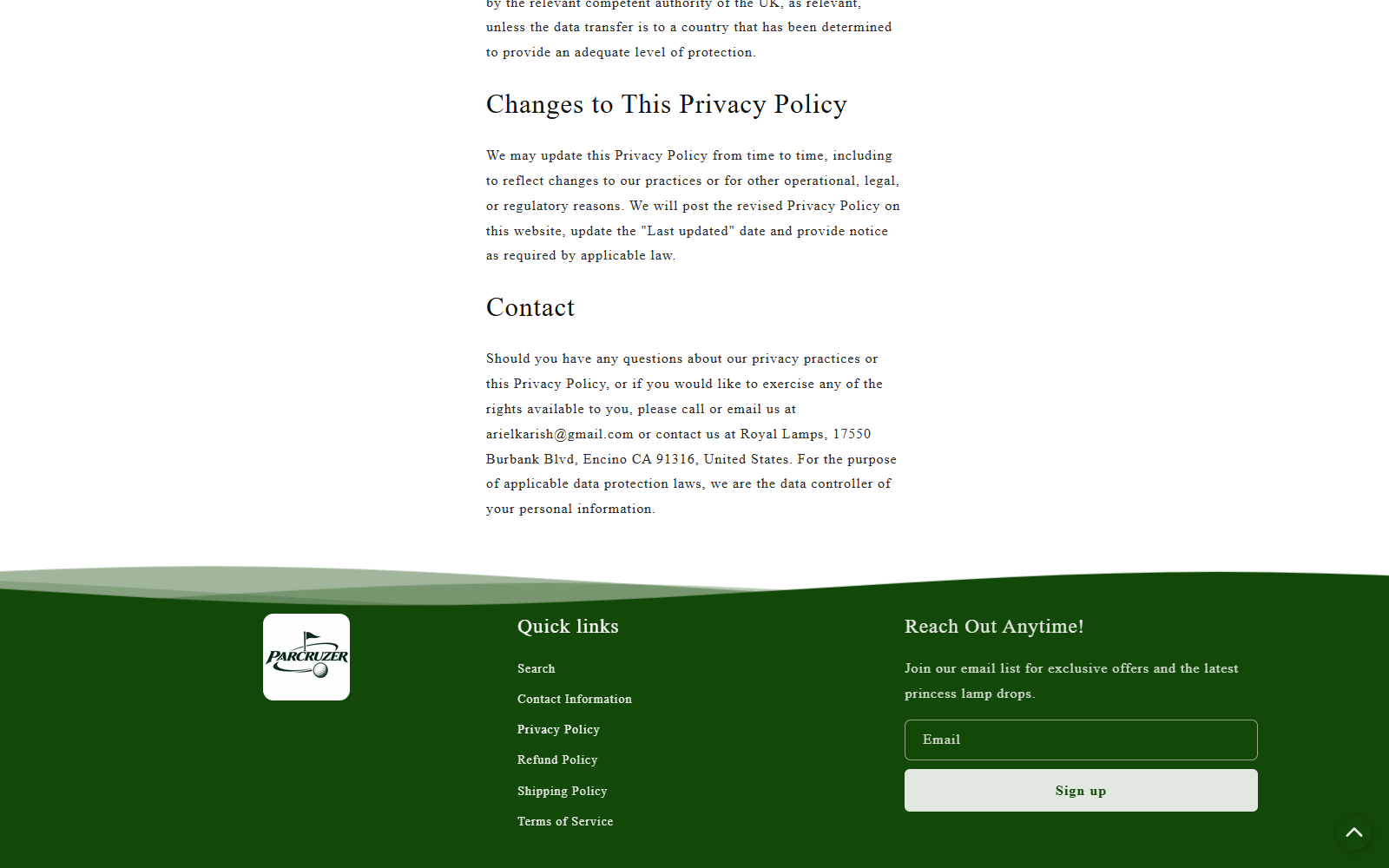
The privacy policy introduces another name, Royal Lamps, alongside an Encino, California address. That identity does not match the golf-scooter brand presented to shoppers.
Reused policies often reveal a copied storefront foundation. They can also leave customers unsure which company controls personal data and processes disputes.
A privacy-policy mismatch is not automatic proof of theft. Combined with unfinished terms, it indicates that essential compliance work was not completed carefully.
Ask the seller to provide the full legal company name, registration jurisdiction, registration number, business address, telephone number, and card-statement descriptor.
Then verify each detail independently. Do not rely on a fresh document sent only after questions are raised.
How the ParCruzer Store Risk Works
Step 1: An unusual golf vehicle captures attention
The offer begins with a visually impressive scooter that promises the independence of walking without the physical effort.
Golfers with mobility concerns may find the concept especially attractive. That practical appeal can reduce skepticism about the unfamiliar seller.
Short promotional videos can show a working vehicle without proving that the advertiser owns the footage or can deliver that exact model.
Step 2: A large discount reframes the risk
The listing presents $1,200 beside a much higher reference price. The supposed saving can make a costly decision feel time-sensitive.
Bundle boxes label two units as popular and three units as the biggest saving. This design moves attention from seller verification toward unit economics.
A buyer who intended to test one machine may consider multiple units before confirming whether one can be delivered successfully.
Step 3: Social-proof widgets create momentum
The page displays recent-order activity and customer-style images. These elements suggest that many other shoppers have already completed the same purchase.
Unless those claims link to independently verifiable orders or reviews, they remain marketing statements controlled by the seller.
Search for long-term ownership reports that include serial labels, delivery paperwork, charging behavior, repair experiences, and identifiable purchase dates.
Step 4: The buyer pays before resolving identity questions
A familiar checkout interface can feel reassuring. Payment-platform logos show available methods, not a guarantee that every transaction will be fulfilled properly.
The legal operator should be clear before checkout. Here, the terms, privacy policy, contact page, and brand do not provide one coherent answer.
Save the final order screen and card descriptor. The name appearing on the statement may become important if the storefront disappears.
Step 5: Freight time consumes the easiest cancellation window
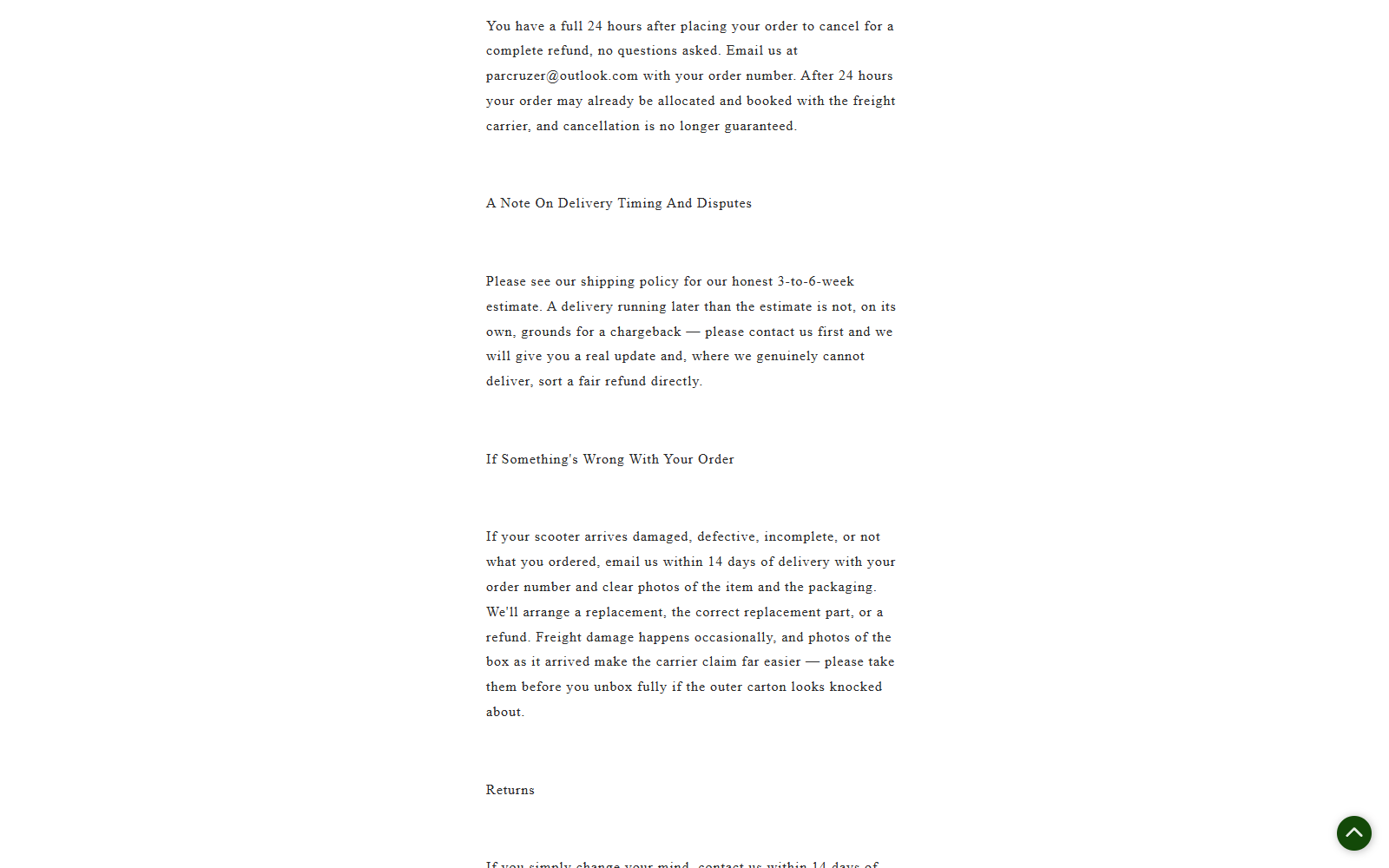
The refund policy gives a full 24 hours to cancel. After that, the store says an order may be allocated and booked with a freight carrier.
The shipping policy estimates three to six weeks. That delay can move the buyer far beyond the store’s easiest cancellation period.
The policy also argues that timing beyond the estimate is not automatically grounds for a chargeback. A merchant cannot remove cardholder rights through website wording.
Step 6: A return becomes expensive and complicated
The store offers a 14-day change-of-mind route, but the customer pays return freight. Shipping a 45-kilogram battery vehicle can cost hundreds.
International lithium-battery rules may further limit available carriers. A vague returns promise can become impractical when no affordable service accepts the parcel.
Damage claims require prompt photographs. Buyers should record the carton, pallet, seals, and unpacking before moving or charging the scooter.
What Could Arrive, and What Cannot Be Confirmed
The storefront contains photographs of a complete vehicle. We cannot confirm from the page alone where it is manufactured or whether the seller holds stock.
Similar-looking mobility devices can be sourced from factories and wholesalers. Appearance alone does not establish matching batteries, controllers, brakes, motors, or safety testing.
Ask for an unedited video showing the actual inventory, serial plate, charger label, battery label, folding procedure, brake test, and today’s date.
Request a written parts list and warranty procedure. A promise of support is weak when no repair facility or replacement-parts catalogue is identified.
Check whether your golf course permits this vehicle. Course rules, path widths, slope limits, and insurance requirements can make a delivered scooter unusable.
Battery certifications matter during charging, storage, and transport. A generic “48V” description is not enough for a four-figure purchase.
Company, Address, and Fulfillment Checks
The contracting company is not clearly identified
The terms leave business-name fields unfinished. A brand name alone does not tell a buyer which legal entity accepted the order.
Without that entity, complaints, warranty enforcement, and court claims become harder. The payment recipient may be the first concrete name a buyer receives.
The published address belongs to another identity
The privacy policy names Royal Lamps and an Encino address. That mismatch suggests reused paperwork rather than a carefully documented golf-equipment business.
An address in a policy does not prove a warehouse exists there. Verify property use, business records, and whether returns are actually accepted.
Support channels do not form one accountable trail
The site shows an Outlook address, while the terms also contain a Gmail address. No dependable telephone support line is clearly published.
Email-only support can be legitimate, but a $1,200 vehicle seller should answer technical, freight, parts, and warranty questions specifically.
Fulfillment may be separate from the storefront
A seller can arrange factory-direct freight without possessing a local warehouse. That model increases the importance of import duties, inspection, and return planning.
Demand the dispatch address and authorized return destination before purchase. If either remains confidential until after payment, treat that as a serious warning.
What to Do if You Have Fallen Victim to This Scam
- Save the complete offer. Capture the product page, selected quantity, specifications, warranty, delivery estimate, policies, confirmation, and promised accessories.
- Identify the payment recipient. Record the exact statement descriptor, transaction ID, processor, amount, date, and any foreign-transaction charge.
- Cancel immediately if uncertain. Email every published support address within 24 hours and request written confirmation before the guaranteed window closes.
- Ask for shipment evidence. Request the carrier, freight number, dispatch location, package weight, customs status, and proof that tracking belongs to your address.
- Do not trust tracking alone. Confirm that the shipment weight and service type could reasonably correspond to a 45-kilogram scooter.
- Document delivery continuously. Film the sealed package, labels, damage, unpacking, serial plates, accessories, charger, battery, and first power test.
- Stop if charging appears unsafe. Do not continue using a damaged battery, hot charger, exposed wiring, swollen casing, or unverified electrical equipment.
- Request a return address in writing. Obtain approval, destination, freight instructions, insurance requirements, refund amount, and responsibility for duties.
- Contact the card issuer promptly. Explain non-delivery, material misrepresentation, damage, or refusal to honor written terms with your evidence attached.
- Secure the device if anything downloaded. Run Malwarebytes after suspicious files. AdGuard can reduce malicious ads and redirect chains during follow-up searches.
- Report accurate facts. Send documents to consumer-protection agencies and the payment provider without claiming outcomes you cannot personally establish.
How to Evaluate Similar Golf Scooter Offers
Start with the manufacturer, not the social advertisement. A real manufacturer should provide model numbers, manuals, compliance documents, spare parts, and service contacts.
Search model photos across established marketplaces. Identical images under unrelated names often indicate rebranding, affiliate marketing, or factory-direct dropshipping.
Compare total landed cost, including freight, import duties, battery surcharges, assembly, and possible return shipping. The lowest advertised price may not be lowest overall.
Call local golf-cart dealers and accessibility-equipment businesses. A slightly higher local price can include setup, inspection, repairs, and enforceable consumer rights.
Ask for the user manual before payment. Check rider limits, gradients, braking distance, charging temperature, water resistance, and storage instructions.
Confirm the warranty administrator’s legal name and location. “Thirty-day warranty” language is much weaker than a parts-and-labor policy with a service address.
Use a credit card, not a bank transfer, cryptocurrency, gift card, or payment marked as friends and family.
Never multiply a high-risk first order. Test one unit only after the seller passes identity, logistics, and support checks.
Red Flags That Justify Walking Away
Leave if the seller refuses to identify the company taking payment. A legitimate invoice should not require detective work.
Leave if specifications change between advertisements and the product page. Battery capacity, rider weight, motor power, and braking details must be consistent.
Leave if support will not disclose the dispatch country or return location. Both facts materially affect delivery time and the practicality of a refund.
Leave if only irreversible payment is accepted. High-value equipment deserves strong dispute protection.
Leave if the merchant pressures you to buy several units. Bundle savings cannot compensate for unknown fulfillment.
Leave if the legal pages still contain template instructions. That failure is especially serious when the purchase involves freight, batteries, and a four-figure amount.
Frequently Asked Questions
Is ParCruzer.store a confirmed scam?
The evidence shows serious risk indicators, but it does not establish that every order is fraudulent. We recommend avoiding the store until its identity and fulfillment are independently verified.
How much does the ParCruzer scooter cost?
The reviewed listing advertised one unit for $1,200 against a $2,400 reference price. Pricing and currency can change by location or promotion.
Why are the legal-page placeholders important?
They leave buyers without complete company, telephone, registration, and tax details. Those omissions weaken accountability for an expensive international purchase.
Can I cancel a ParCruzer order?
The published policy promises a full cancellation during the first 24 hours. After that, it says freight booking may prevent a guaranteed cancellation.
Who pays for a return?
The policy assigns change-of-mind return freight to the customer. For a 45-kilogram battery vehicle, that cost could make the return impractical.
What should I verify before buying a golf scooter online?
Verify the legal seller, stock location, model specifications, battery certifications, warranty administrator, service network, freight terms, return destination, and protected payment method.
The Bottom Line
ParCruzer.store asks buyers to make a high-value decision before supplying the business clarity expected from a serious mobility-equipment seller.
Unfinished terms, conflicting identities, email inconsistencies, long freight timing, and customer-funded heavy returns create an unacceptable risk combination.
Until those issues are resolved with independently verifiable evidence, buy comparable equipment through an established dealer that can deliver, service, and accept the machine locally.

Reviews & discussion
0 commentsShare a firsthand experience, or ask a question.
Community reviews
parcruzer.store
Moderated reader experiences, not an editorial verdict.
Start the conversation
Have a question or something useful to share? Add the first comment.