

Rabsy Bunny is being advertised online as an “AI robot bunny” that reacts like a real pet. The videos are polished, the claims sound advanced, and the checkout pages are built to make the purchase feel safe and urgent.
Before you spend money, it’s worth slowing down and looking at how this product is actually being sold—and what the red flags suggest once you move past the marketing.
Scam Overview
What Rabsy Bunny claims to be
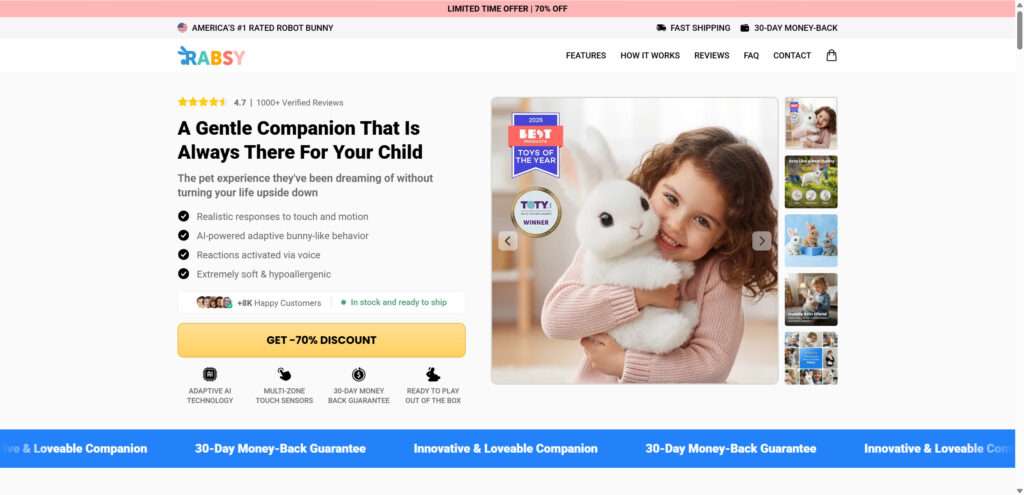
Rabsy is presented as a high-tech, lifelike companion designed for children. The site positions it as a gentle “pet alternative” and lists features that sound like they belong to a real interactive robot:
- “AI powered” interaction and adaptive behavior
- Multi-zone touch response
- Voice-reactive sensors
- Realistic responses to touch and motion
- Nose twitching, ear movement, and “bunny-like” behavior
- “No apps required” and “No WiFi needed”
In short, the marketing wants you to believe you’re buying a responsive robotic pet, not a basic toy.
The awards and “#1 rated” messaging look like decoration, not proof
The Rabsy page uses authority-style claims that are common in scam funnels:
- “America’s #1 rated robot bunny”
- Prominent “Toys of the Year” style badges and a “winner” seal
These badges are presented like real endorsements, but they are not linked to any verifiable award organization, judging body, or external proof. When a product truly wins a recognized award, the brand usually points to a real program, a press page, or a third-party announcement. Here, the badges function as trust graphics.
The review system appears engineered to create pressure and trust
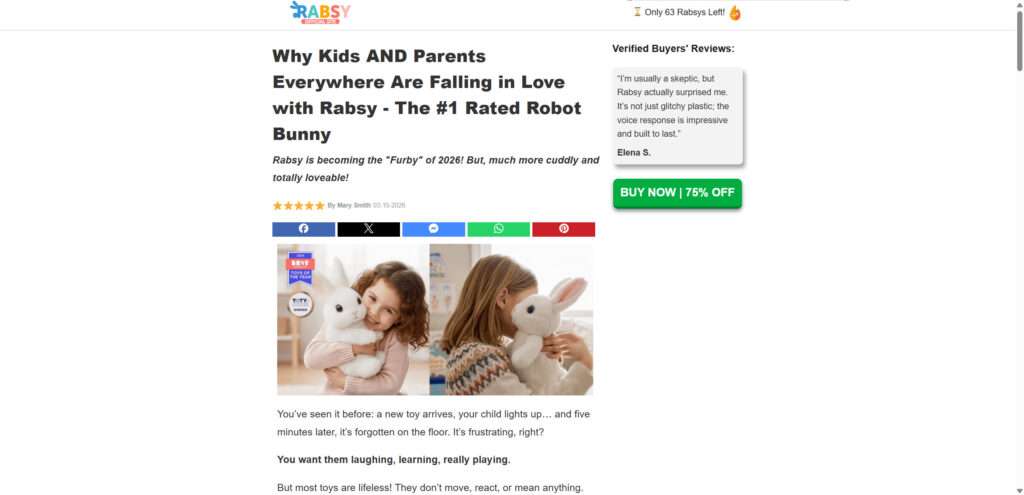
The site shows a heavy emphasis on star ratings and “verified” language:
- A 4.7 rating paired with “1000+ verified reviews”
- A separate floating bar showing 4.7 with a specific review count (for example, 1,527)
- Sidebars labeled “Verified Buyers’ Reviews” with short, polished quotes
- A “A user is leaving a new review…” style notification
This is another recurring pattern in questionable storefronts: reviews are displayed as if they are independent, but they are not clearly tied to a platform that can be audited (like Trustpilot, Google, or a major retailer listing).
It doesn’t prove the reviews are fake on its own, but it does mean you should treat them as marketing content, not evidence.
Scarcity and discount tactics are doing most of the selling
Rabsy repeatedly pushes urgency:
- “Limited time offer” banners (70% off / 75% off)
- “Only X left” stock claims
- A persistent discount call-to-action that follows you down the page
Then the funnel shifts into bundle pricing and upsells. In the checkout flow you shared, the product appears under a different brand label (“Hoppsy”), with an applied discount and tiered pricing:
- 1 unit at a higher per-item price
- 2 units cheaper per item
- 3 units cheapest per item, labeled “best seller”
This is a classic structure used to increase the average order value fast, especially when the buyer is already in a fear-of-missing-out mindset.
The visuals imply capabilities the product may not have
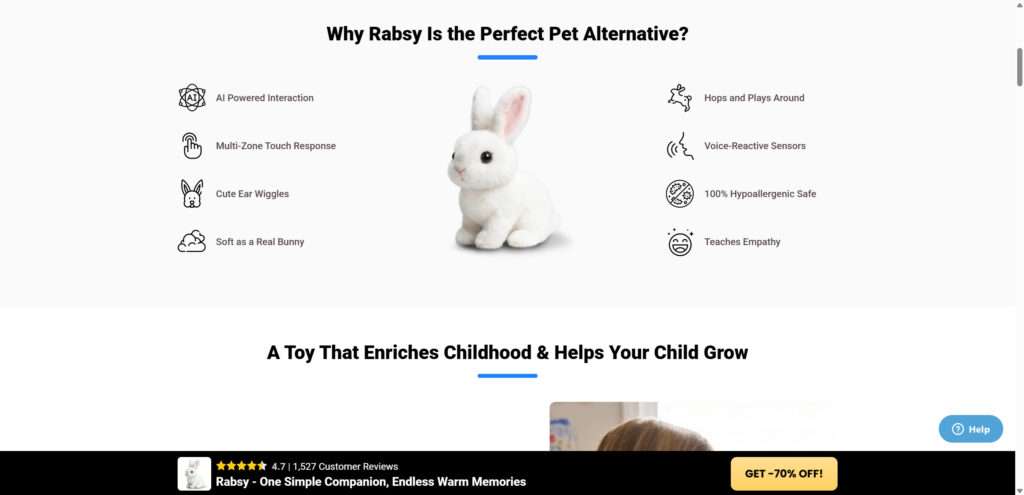
One of the most persuasive images shows the bunny “acting like a real bunny,” with icons that suggest it:
- Hops
- Moves ears
- Walks
The page also uses lifestyle scenes (children hugging the bunny, staged environments) to sell the feeling of a real pet experience.
That matters because movement claims are often the biggest gap between what buyers expect and what they receive. A plush rabbit can be cute and soft, but “walks” and “AI-powered” set a very different expectation.
It’s a generic plush product
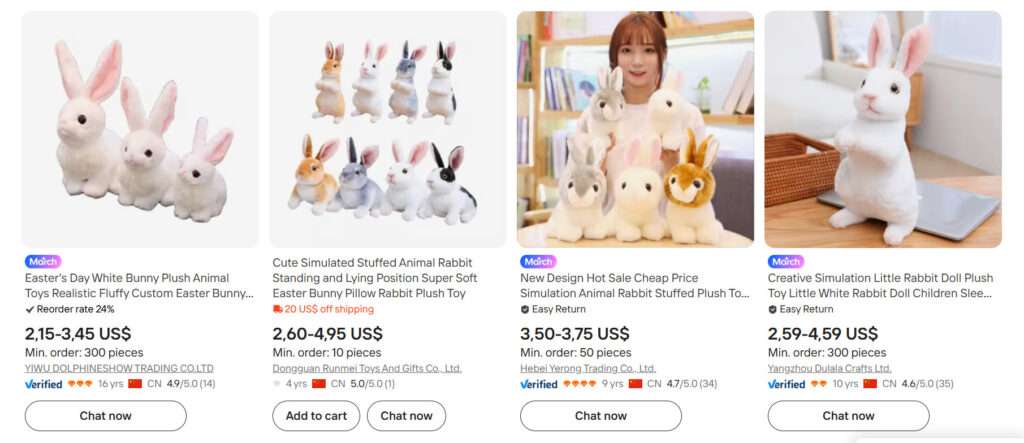
Look at the wholesale listings and then look at Rabsy’s photos. The plush shape, fur texture, posture, and overall styling are essentially the same.
That doesn’t prove the Rabsy seller uses those exact suppliers. But it proves something important: this “lifelike bunny plush” design is not unique. It’s a common, mass-produced product sold in bulk.
And this is not the first time this playbook has shown up online.
We have seen the same pattern with “AI robot puppies,” “AI cats,” and other “smart pet” toys pushed through viral ads. The story changes, the animal changes, but the mechanics stay the same:
- Big “AI” claims with vague specs
- A cheap, generic plush product behind the scenes
- Bundle pricing that nudges you into buying 2 or 3 units
- A “money-back guarantee” that turns into expensive international returns, slow support, or partial refunds
That’s the core concern.
When the item looks like a standard wholesale plush rabbit, the “AI robot bunny” pitch is usually just marketing—used to sell a low-cost product at a premium price while making refunds difficult in practice.
The biggest red flag: “AI-powered” claims without clear hardware proof
If a toy truly has:
- Multi-zone touch sensors
- Voice-reactive sensors
- Responsive motion
You should be able to find clear, specific details such as:
- What sensors are used (and where)
- What movement mechanisms exist (motors, joints, linkages)
- Battery type and expected runtime
- Safety certifications and manufacturer information
- Demonstrations that aren’t just curated ad clips
The Rabsy funnel, as shown, leans on claims and badges—not technical transparency.
How the Scam Works
1) Build an emotional “pet alternative” story
The offer is aimed at parents, grandparents, and gift buyers. The narrative is simple and powerful:
- Your child wants a pet
- A real pet is hard
- Rabsy gives the joy without the responsibility
The page reinforces this with comforting language like “gentle companion,” and child-focused themes like empathy, emotional growth, and safe play.
2) Use “AI” as a credibility shortcut
“AI-powered” has become a marketing cheat code. It signals “smart” without requiring proof.
Rabsy uses phrases like:
- AI-powered adaptive behavior
- Realistic responses
- Voice activation
The goal is to move your brain from “toy” to “robot pet,” even if the underlying product is not built to match that.
3) Flood the page with trust signals that don’t require verification
The funnel stacks persuasion elements:
- Award-style graphics
- “#1 rated” language
- “Verified” review blocks
- Star ratings everywhere
These elements are designed to make the product feel widely loved and socially proven, even if the only “proof” is the seller’s own website.
4) Add scarcity and urgency so you don’t research
Scarcity is repeated throughout:
- Only a small number “left”
- Limited-time discount
- A call-to-action that follows you down the page
This creates a familiar outcome: you buy first, research later.
5) Push bundles to maximize the order
Once you’re convinced, the funnel encourages you to buy multiple units:
- “Best seller” badge on higher-quantity packages
- Lower per-unit price for bundles
- Color selectors that make multiple units feel normal (“one for each child,” “one for gifts”)
This is standard dropshipping optimization.
6) Fulfillment typically comes from low-cost supply chains
In many scam-adjacent toy funnels, the seller isn’t manufacturing anything. They’re running ads, collecting orders, and forwarding fulfillment through a supplier network.
When the underlying product is a common plush design available in bulk for a few dollars, the margin comes from the story, not the toy.
7) Refund friction prevents most people from getting money back
A “30-day money-back guarantee” is prominently advertised.
But in practice, many buyers run into the same obstacles in these funnels:
- Slow support responses
- Partial refund offers instead of full refunds
- Return shipping that costs more than the item
- Return addresses that are difficult or expensive to use
Even when a refund is technically possible, the process is often designed to be exhausting.
8) Rebranding keeps the cycle going
This is another common pattern: when complaints rise under one name, the funnel reappears under another name with the same photos, same page structure, and same claims.
What To Do If You Bought Rabsy Bunny
What To Do If You Bought Rabsy Bunny
If Rabsy Bunny doesn’t match what was advertised, treat it like a misrepresentation case and move quickly. The goal is to lock in proof, give the seller one clean chance to fix it, then escalate through your payment provider.
1) Lock in evidence (do this first)
Save everything before the product page changes.
- Screenshot the claims: “AI-powered,” “reacts to touch,” “walks/hops,” “voice activated,” “award winner,” “#1 rated,” “money-back guarantee,” shipping promises, and any “only X left” scarcity messages.
- Save the page as a file: print-to-PDF (or “Save page”) so you have a timestamped copy.
- Save the ad: screenshot the ad, the account name, and the video stills. If there’s an ad library link, save that too.
- Keep purchase records: order confirmation page, receipt email, invoice, tracking number, and the full product name shown at checkout (even if it changes brands).
2) Document what arrived (proof of mismatch)
Create a clean record your bank can understand in 30 seconds.
- Take well-lit photos of:
- The item from multiple angles
- Any button areas / seams (to show there are no visible mechanisms)
- Packaging, labels, inserts, and barcodes
- Record a short video:
- Show the toy on a flat surface
- Demonstrate it does not do what the ad showed (no hopping/walking/reacting)
- If the ad implied electronics, photograph the battery compartment (or lack of it).
3) Send one direct refund request (written, not phone)
Don’t negotiate. One message, clear demand, and a deadline.
Message template (copy/paste):
Subject: Refund request – item not as described
Hello, I’m requesting a full refund for order #[ORDER]. The product received is not as described/advertised (advertised as an AI/interactive robot bunny; received a basic plush toy that does not perform the advertised functions).
Please confirm a full refund within 48 hours and provide the refund timeline.
Thank you.
If they reply with “partial refund,” “keep it,” or “return to an overseas address at your cost,” don’t argue—move to a dispute.
4) Check for common “extra charge” traps
Before you file a dispute, scan for anything that could hit you again.
- Review your bank statement for:
- Small “test” charges
- A second charge from a different merchant name
- Any subscription-looking charges
- Check your email for words like “subscription,” “VIP,” “protection,” “shipping insurance,” or “membership.”
- If you see recurring charges, contact your bank to block future payments and consider replacing the card.
5) File a dispute/chargeback (this is usually the fastest path)
Use your card issuer or payment provider and choose:
- “Item not as described”
- “Misrepresentation / counterfeit marketing”
- If it never arrives: “Item not received”
What to include in your dispute package:
- The saved PDF/screenshots of the product claims
- The ad screenshots (showing what it promised)
- Your order confirmation/receipt
- Photos/video of what arrived
- A short statement like:
- “Advertised as AI interactive robot bunny with responsive behavior; received a basic plush toy that does not perform advertised functions.”
Important: Dispute windows vary by bank/provider (often 30–120 days). File as soon as you decide it’s misrepresented.
6) Be careful with returns
A lot of these offers use returns to discourage refunds.
- Do not pay expensive international return shipping unless your bank/payment provider explicitly requires proof of return for your dispute.
- If your bank does require a return, ask:
- “What exact evidence do you need?”
- “Does a carrier receipt and tracking number satisfy the requirement?”
- If the seller provides a return address that looks suspicious or keeps changing, document it.
7) Report the ad and storefront
This helps reduce how long the campaign keeps running.
- Report the ad as misleading/scam on Facebook/TikTok/YouTube.
- Report the website/domain through the platform tools if available.
- Optionally report to your local consumer protection authority (especially if many people are being targeted in your country).
8) If you want the highest success rate
These small details help a lot in disputes:
- Use the phrase “item not as described” (not “I don’t like it”).
- Compare one specific promise vs. one observed reality:
- “Claims touch-responsive movement” → “No movement when touched.”
- “AI interactive” → “No sensors/behavior; plush only.”
- Keep your seller communication short and factual.
The Bottom Line
Rabsy Bunny is sold as a lifelike “AI-powered” robot bunny that responds like a real pet.
In practice, the sales page follows a familiar dropshipping playbook: flashy but unverified award badges, constant urgency and “limited stock” pressure, review displays controlled by the site itself, and visuals that closely match generic wholesale plush rabbits that sell for a few dollars.
If you want a genuinely interactive robotic pet, stick with established brands that publish clear specs, offer real warranty support, and have independent reviews. For Rabsy, the lower-risk choice is to pass.
FAQ
Is Rabsy Bunny a real AI robot bunny?
The marketing uses “AI” language, but the page does not provide the kind of technical proof you would expect for a true AI robotic pet. Treat the “AI” claim as marketing unless independently verified.
Does Rabsy Bunny actually walk or hop?
The page implies walking/hopping behavior through icons and visuals. Without clear mechanical details and independent demonstrations, you should assume those claims may be exaggerated.
Why does the site show so many awards and “#1 rated” claims?
This is a common trust tactic. If the awards aren’t tied to a verifiable organization, they are effectively design elements.
Are the on-site reviews reliable?
On-site reviews can be real, manipulated, or entirely fabricated. If reviews aren’t anchored to an independent platform, they shouldn’t be treated as proof.
Why does the checkout show a different brand name?
A mismatched brand name at checkout can indicate a shared funnel, rebranding, or a broader dropshipping network using multiple storefront identities.
What do similar plush rabbits cost wholesale?
Bulk listings often show similar “simulated rabbit” plush products priced around a few dollars per unit, depending on size and quantity.
What’s the fastest way to get your money back?
If the product is not as described, a chargeback/dispute through your payment provider is usually more effective than going back and forth with the seller.
Should I return it if they ask me to ship it internationally?
Be cautious. International return shipping can cost more than the product. Ask your card issuer what they require for a dispute before spending money on returns.
How do I verify a robot pet is legitimate?
Look for a known manufacturer, detailed specs, certification info, a real support footprint, and independent reviews/videos that aren’t ads.
Are there other names for this same rabbit product?
Often, yes. These campaigns are frequently rebranded under new names while keeping the same images, claims, and page layout.








