


The contract names a funeral home you recognize, but it doesn’t tell you who will perform the cremation. That may not seem urgent on the day you sign.
If the paperwork later stops making sense, the missing name matters. It tells you which institution can confirm what happened when you were not there.
Overview
What the federal case established in Colorado
Return to Nature Funeral Home operated in Colorado Springs and Penrose. The federal case involved its former operators, Carie Hallford and Jon Hallford, and misconduct involving that specific business.
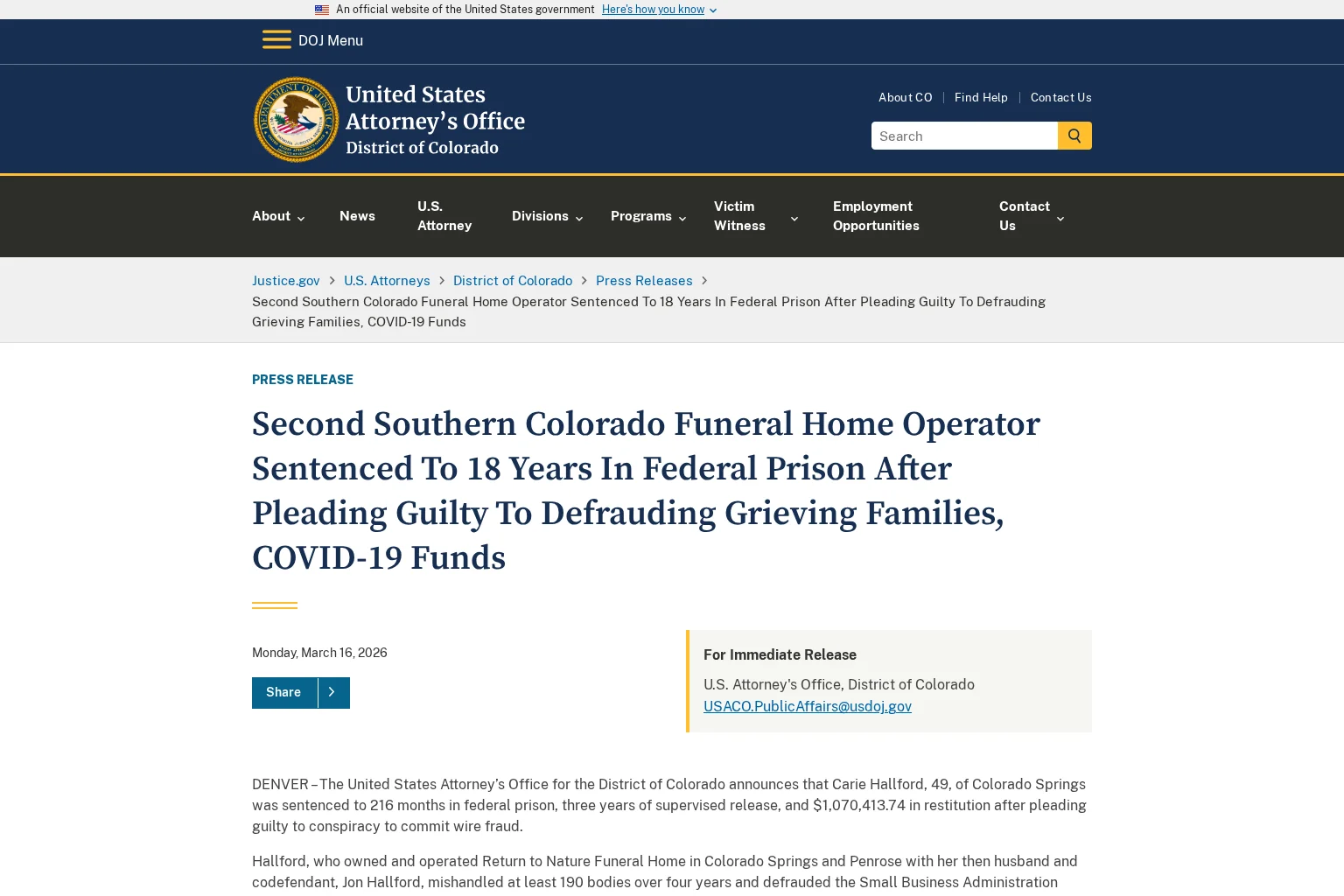
According to the United States Attorney’s Office, Carie Hallford pleaded guilty to conspiracy to commit wire fraud and was sentenced to 18 years in federal prison in March 2026.
The Guardian’s sentencing report describes families who paid for services but received material represented as their loved ones’ remains. It also reported two burials involving misidentified bodies.
The fraud was not that the business offered green burials. It took money for services without carrying them out as represented.
The court’s restitution figure is not an individual refund
The federal prosecutor announced a restitution order of $1,070,413.74. The case involved fraud against families and a separate fraud involving pandemic assistance through the Small Business Administration.
That total does not tell a family what it could receive. Ask for the relevant court instructions before treating a headline figure as an individual award.
The Justice Department lists its own Return to Nature case contact. It is the starting point for someone with a specific question about that federal case.
If you used another business with a similar name, confirm the company and location first. This article does not connect a different provider to the Colorado prosecution.
What families should record while making arrangements
Write down who receives custody, who performs the contracted service, and how the funeral home will tell you it is complete. Try to do this while the provider can answer.
- The facility performing the burial or cremation, even if its name is different from the business taking payment.
- The written service selection and itemized prices, including transportation or a separate facility charge.
- Any reference used across the first transfer, the actual service, and the return of remains.
- The name of the person allowed to receive documents or collect remains on behalf of the family.
- The promised dates for updates, and which organization can confirm those dates from its own records.
You may need just one of these details later. But it is much easier to get a verified site name before a transfer than to reconstruct the handoff afterward.
How the Return to Nature Funeral Home Fraud Worked
Step 1: Families paid for services they could not oversee
A family can arrange burial or cremation while coordinating travel, paperwork, and a gathering. The funeral provider may appear to be the one place that can keep those details straight.
Once arrangements are agreed, it is reasonable for family members to rely on the provider. They should not have to supervise every transfer or check that a ceremony really happened.
The case shows why the seller’s reassurance and a signed agreement answer different questions. The agreement is what connects a promised service to a person, price, and date.
Step 2: Official-looking paperwork did not prove each service
The federal prosecutor described how the owners handled contracts and used Colorado’s electronic death registry. A real death record and a completed cremation or burial are different facts.
A death certificate has its own purpose. Receiving one does not tell you which facility performed a cremation or whether the return you received came from that facility.
For a burial, confirmation can come from the cemetery’s records. For a cremation, ask the actual facility about an identifying reference and the records it can release to you.
If privacy rules limit disclosure, ask what proof of authority is needed. Let the authorized family contact make the request rather than sending records to multiple offices.
Step 3: A returned container made the service appear finished
When a family receives a container, it looks as if the last part of the arrangement is over. The package itself does not prove its contents or their identity.
Colorado families received material represented as ashes when the service had not happened as promised. That finding is not a visual test for ordinary cremated remains.
If you have a concern, do not open, mix, clean, or discard what you received to test it. Preserve the original labels and ask the responsible authority for instructions.
An unexplained reference or missing document warrants a question, not a public accusation. An official investigation can compare records that an individual family may not have access to.
Step 4: Prosecutors addressed two different kinds of fraud
The federal wire fraud conspiracy case covered the dealings with families and fraudulent applications for pandemic funds. A family asking about its arrangements should not confuse those routes.
The provider’s use of government relief money does not tell you what happened to an individual loved one. Your own service agreement and the investigator’s case records are more relevant.
Ask which office handles questions about your arrangement. A criminal case number can help it locate the matter even when no new claim process is open.
How to Verify a Funeral Arrangement Before You Pay
Start with the costs and the service you actually chose
Start by asking for the provider’s general price list. The FTC Funeral Rule explains the pricing and selection rights that apply to covered US funeral providers.
If you are comparing by phone, request the prices of the same services at each business. At an in-person visit, request the written list and ask what it excludes.
Before paying, get an itemized statement for your actual choices and check its total against your estimate. If the names or services differ, ask for a correction before signing.
A lower price is useful only if the contract still describes the arrangement you want. Make the comparison using the same transport, facility, and return or cemetery terms.
Identify which facility performs the work
Ask for the facility’s legal name, location, and contact details in writing. Confirm those details through the responsible state regulator or another independent listing.
In Colorado, open the state facility search. Enter the facility name or license number, search, and check the result’s location and status.
If the listing is missing or the status is unclear, give the details to the state licensing office before paying. A similar name is not a match.
Ask who transfers custody and what reference the receiving institution keeps. For an outside crematory, request the details before agreeing to transportation, not just when the urn is ready.
If the provider will not identify where the service is done, ask for an explanation. Consider another provider before paying for a service that cannot be independently located.
For a cemetery, confirm the plot or placement reference with the cemetery office. If the person you reach cannot access the records, ask which office can check them.
Agree how completion will be recorded
Ask who will call or send a written update when the service is complete, and what reference a family representative needs to check it.
If you are not the person authorized to receive details, have the authorized contact make the request. Ask the provider what documentation is necessary before supplying any sensitive record.
Keep the receipt and confirmation together. If the promised update does not arrive, contact the facility through the verified route and identify the missing information.
Confirm the arrangements if another person is paying
A person paying the invoice may not be the person entitled to receive the records. Ask the provider who signed the authorization and who can request the service confirmation.
If a relative paid by card, keep a copy of the itemized invoice with the cardholder’s consent. The card issuer may need to hear from that cardholder about any dispute.
For arrangements that cross state lines, ask which facility accepts custody at each end. Write down which provider is responsible for the transfer and who can account for a delay.
Keep the original paperwork if an invoice or certificate changes. Ask for a dated explanation that identifies what was corrected and whether another record needs the same change.
If something does not match, start with a direct question rather than asking several businesses to investigate at once. State the service, date, and reference you want confirmed.
What to Do If You Suspect Funeral Home Fraud
Preserve the agreement and anything returned to you
Keep the contract, itemized invoice, payment confirmation, transfer notes, labels, and messages. Photograph the exterior of any container and leave its contents and seals undisturbed.
If you already opened a package, record when you did and what changed. Do not try to recreate a seal or mail material to someone who contacts you unexpectedly.
Get separate records from the provider and facility
Ask the funeral home for its service and transfer records in writing. Contact the named crematory or cemetery independently to confirm which details it can release to you.
Compare names, dates, service type and identifying references. If a business says it cannot share a record, ask for the required consent or documentation rather than guessing.
Report suspected substitution or serious misconduct promptly
If you believe remains were mishandled or substituted, contact local law enforcement through its published non-emergency route. Explain the specific discrepancies and ask how to preserve the item.
Save any report reference and confirm the follow-up contact. Do not hand material to an unverified collector or substitute private testing for instructions from officials.
Contact the official Return to Nature case office
If your concern relates to the Colorado business, open the Justice Department case page linked above. It lists RTN.FuneralHome@usdoj.gov for victim questions.
Identify the location and service date and say what confirmation you need. Ask how to send sensitive records securely before attaching a death certificate or other private documents.
Keep the response and any reference. Ask whether an instruction applies to the federal case or to a separate Colorado proceeding before assuming it covers both.
Ask separately about payment or licensing complaints
Contact the card issuer using its normal route if you are disputing a paid service. Ask how quickly you must file and what support records it will need.
If you are reporting a current provider, ask the state licensing office which name and address appear on its registration and how to submit a complaint.
A billing decision will not resolve an identification question. Keep the payment and investigation records even if one of them closes first.
Protect your family from unsolicited recovery offers
Do not send a fee to someone who claims to be collecting the court’s restitution for you. Verify any new request through the case office directly.
Quoting the correct provider or court amount only shows the sender found a public detail. Save the offer and verify it through the real case office.
Frequently Asked Questions
Does an official death certificate confirm cremation?
A death certificate and a crematory’s service record serve different purposes. The first is not, by itself, confirmation that a particular crematory handled and returned remains.
Ask which facility performed the service and how it documents that event. Keep the documents together rather than using one as a stand-in for the other.
Is a green burial a warning sign?
A green burial is a type of service and is not evidence of fraud. The Colorado case concerned what was promised to families and what the business did instead.
Ask the provider to describe the exact placement and facility that apply to your contract. Verify those facts with the cemetery or responsible institution when possible.
Can I identify contents by looking at them?
You cannot reliably establish the contents or identity of a return by appearance. The best starting point is to keep what you received in its original condition.
Ask the official case contact or local investigator what to preserve. Do not change the packaging to make a photograph look clearer.
Can I tell whether my family is included in the Colorado case online?
A public announcement does not identify every affected family or tell you what officials know about a specific service. Use the victim contact on the official case page.
Give only enough information to identify the arrangement and ask how to submit anything sensitive. Keep the answer somewhere you can find it again.
Does a restitution order mean I should expect a payment?
A restitution order is not a payment receipt. It does not establish whether you personally are listed, what amount applies, or when a distribution might occur.
Ask the official case office if the order relates to your loss and whether it needs anything further. Do not use an unsolicited fee-based claim service.
What if my concern involves a different funeral home?
Use the provider and location named in your own contract. Preserve the records and ask the entity responsible for that facility which reporting or review process fits.
A similar business name is not evidence of a connection to this case. Describe what you can document about your own transaction.
The Bottom Line
Do not pay for a funeral service until the written agreement tells you who performs it, what it costs, and how you can confirm completion.
If the records do not match what happened, keep them and preserve any returned container. For the Colorado case, use the official victim contact rather than an unsolicited recovery offer.

Join the discussion
0 commentsShare your experience or ask a question about this article.
Community experiences
Did this happen to you?
Your experience could help someone recognize the same scam. Submit a private report for our team to review.
I experienced this tooReports are reviewed before publication. Sharing publicly is always your choice.
Discussion
Start the conversation
Have a question or something useful to share? Add the first comment.