

Rolex is one of the most recognized luxury brands in the world, which makes it a prime target for online scammers. Over the past months, a wave of fake Rolex websites has appeared across social media and search ads, promising massive discounts of up to 90% on premium Rolex models.
These websites often use slogans like “Warehouse Sale”, “Outlet Sale”, “Store Closing Sale”, “Going Out of Business”, “Clearance Sale”, “Limited Time Offer”, and “Free Shipping”. All of them claim to offer real Rolex watches for only 100 euros, 150 euros, or similar unrealistic prices.
In reality, these online stores are designed to steal money, credit card details, and personal information from unsuspecting shoppers.
The following investigation exposes how these scam sites work, why they look legitimate, and how consumers can protect themselves.
Scam Overview
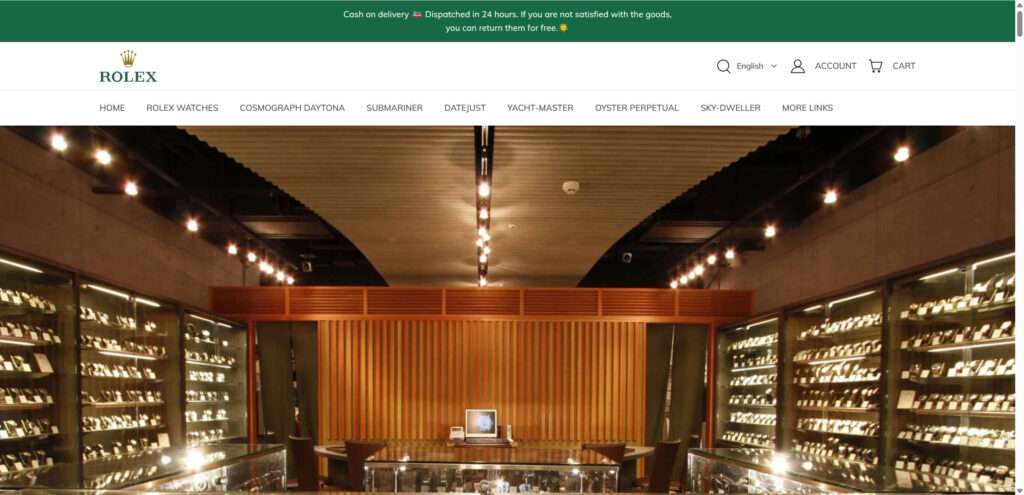
The Rolex 90% off Sale Scam is a large network of fraudulent sites masquerading as official Rolex retailers or authorized discount outlets. Examples include watchcod-en.shop, rolexwarehouse-outlet.shop, rolexclearance-sale.com, and similar domains that appear daily. These sites are hosted on disposable servers, often registered anonymously through offshore registrars, and are designed to look convincing enough to fool buyers who are browsing quickly or responding to social media ads.
The core tactic behind these scams is impersonation. Scammers copy the layout of official Rolex marketing, including the green color scheme, crown logo, product placement style, and showroom imagery. Some pages even display high-resolution photos taken directly from authorized Rolex dealers or watch blogs. The branding is familiar, the navigation bar is polished, and the entire store is structured to resemble a real luxury shopping experience. From a distance, the site appears legitimate.
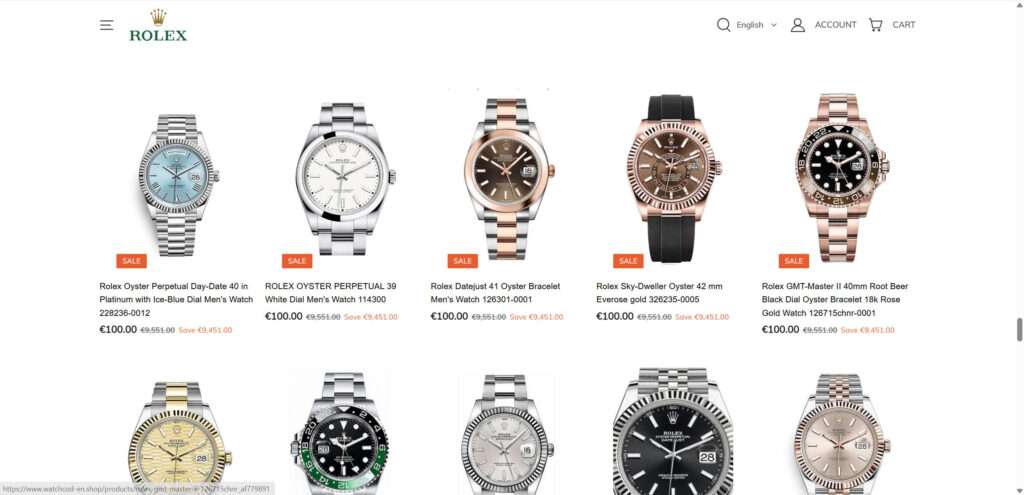
One defining characteristic of these scam sites is the pricing. Every watch is listed at exactly the same price, usually around 100 euros, even for high-end models that cost more than 40,000 euros. For instance, a Rolex Day-Date 40 in platinum, which retails for over 60,000 euros, may be listed for 100 euros on these sites. When every model mysteriously has the same discount and the same final price, this is a clear indicator of a fake storefront.
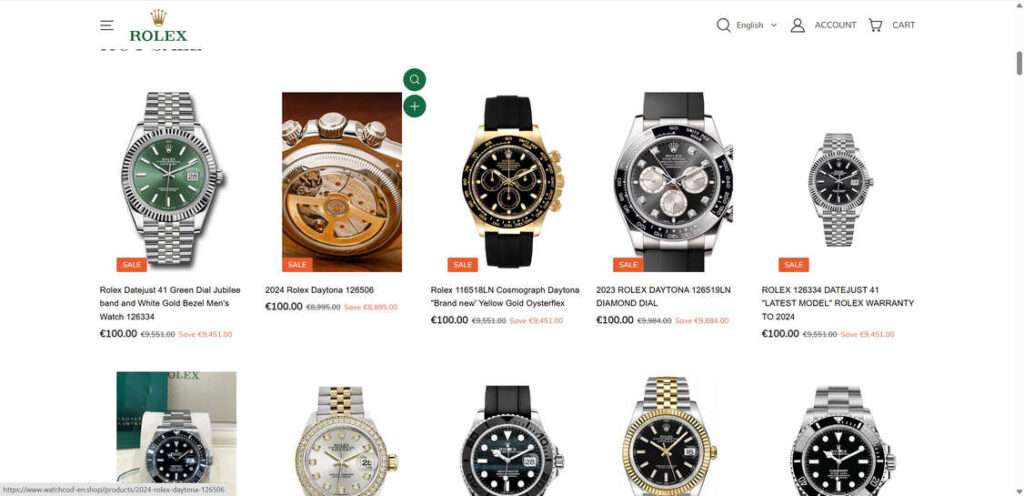
The product descriptions are usually copied from legitimate Rolex listings. However, there are often minor errors in grammar, punctuation, and model naming. The scammers rely on the brand reputation to make the offer seem irresistible. They also use countdown timers, low-stock warnings, and pop-ups showing fake purchases. Messages like “Only 17 left in stock” or “382 people purchased this in the last 7 days” are designed to create urgency.
The checkout process is the next component of the scam. Many of these sites accept credit cards directly, while others prefer methods that offer less buyer protection, such as bank transfers, cryptocurrency, or third-party gateways with minimal chargeback support. When a credit card is accepted, the payment is often processed through an unrelated merchant name. This is a significant red flag, as legitimate retailers always list their business name clearly on billing statements.
Some victims report receiving nothing at all. Others report receiving a cheap replica watch worth only a few dollars. These replicas may arrive in plain packaging, often without any branding, certification, or protective wrapping. They are made of low-quality materials and bear no resemblance to authentic Rolex craftsmanship. Scammers rely on the fact that international chargeback processes can be slow and complicated.
Another tactic used by these sites is the promise of free shipping and free returns. In reality, returns are impossible. When a buyer tries to contact customer service, they receive automated responses or no response at all. Some sites list addresses in Switzerland, Germany, or the United Kingdom, claiming to operate official distribution centers. When these addresses are checked, they often correspond to unrelated buildings, empty warehouses, or mail forwarding providers.
The lifespan of each scam domain is intentionally short. Once a domain becomes flagged or receives negative reviews, scammers quickly abandon it and launch variations with new names. That is why new sites such as rolex-discount-event.shop, rolex2024outlet.store, or warehouse-rolexcenter.shop appear daily. This rapid cycling makes it difficult for consumers to find accurate informatio
n before making a purchase.
Social media advertising plays a central role in spreading these scams. Platforms such as Facebook, Instagram, and TikTok have become flooded with sponsored ads showing beautiful Rolex displays, pictures of luxury watch boutiques, and limited-time discount banners. These ads often link directly to fraud sites that mimic the real Rolex homepage. The scammers rely on impulse buyers who believe they have found a rare deal.
Because Rolex never sells watches online, any website claiming to sell new Rolex models at a discount is fraudulent. Official Rolex retailers are authorized physical shops. The brand does not run outlet stores, clearance events, warehouse sales, or online flash promotions. Therefore, the existence of any online sale promising 90% off is a direct violation of Rolex distribution policies and a guaranteed scam.
This growing issue has already caused thousands of people to lose money. Some victims have unknowingly submitted their full identity information, including address, phone number, and payment details. This opens the door to additional problems such as identity theft or unauthorized transactions. The goal of the scam is not only to take money through fraudulent sales but also to harvest personal information for resale on underground markets.
How the Scam Works
Step 1: Creating a convincing storefront
The scammers begin by building a website that mimics the look of luxury brand dealerships. They use templates that closely resemble the official Rolex branding. This includes:
- Green and gold color schemes
- High-resolution showroom photos
- Professional watch images taken from real authorized dealers
- Polished navigation menus (Submariner, Datejust, Day-Date, Cosmograph Daytona, etc.)
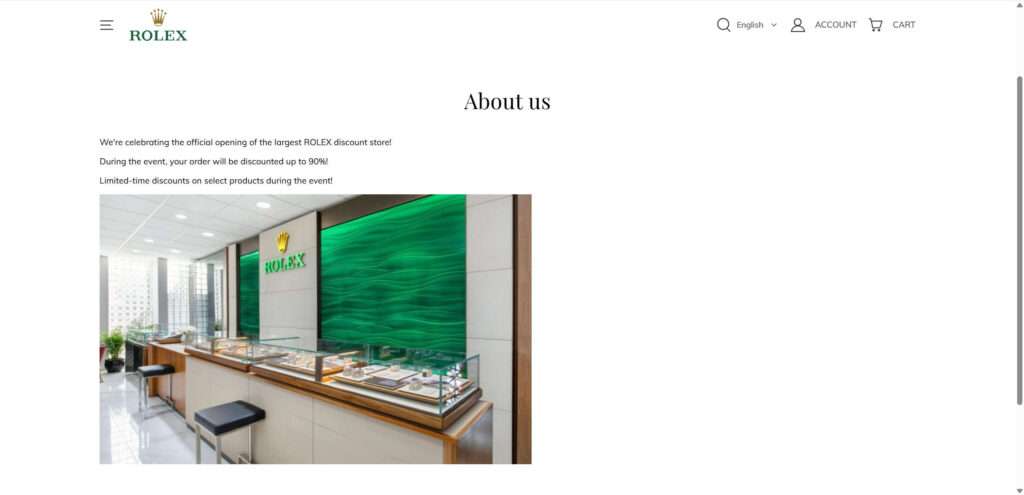
- Fake About Us pages showing images of legitimate retailers
Each page is designed to look premium at a glance. Visitors are not expected to inspect details closely. The scammers rely on emotional triggers such as the excitement of finding a luxury item for a fraction of the price.
Step 2: Running targeted ads on social media
The majority of traffic to scam sites comes from paid advertisements. Common strategies include:
- Flash sale banners
- 90% off promotions
- Limited-time offers with countdown timers
- Phrases like “Warehouse Clearance”, “Outlet Event”, “Global Sale”, or “Store Closing Sale”
Advertisements show watches rotating on display, luxury boutiques, or unboxing videos. These visuals are meant to evoke trust and excitement.
Step 3: Collecting customer data
Before payment is taken, the scammers collect:
- Full name
- Phone number
- Email address
- Home address
- Payment information
This personal information is extremely valuable. Even if the purchase is not completed, the data can be resold or used for future scams.
Step 4: Processing payments through unregulated gateways
Once the customer enters payment details, funds are processed through shady third-party processors. The billing name may be unrelated to the store, often raising questions only after the charge appears on the bank statement. Victims have reported charges appearing under Chinese import companies, random personal names, or foreign consulting firms.
Step 5: Sending a cheap counterfeit or nothing at all
If the scammers choose to send something, it is usually:
- A generic unbranded watch
- A poorly made stainless-steel replica
- An item worth less than three dollars
Some victims receive a parcel with unrelated items, such as a plastic bracelet or a toy. Others receive nothing. Tracking numbers, when provided, often link to unrelated shipments.
Step 6: Making refunds impossible
The refund process is deliberately structured to prevent success:
- Emails go unanswered
- Contact forms do not send
- Phone numbers are inactive
- Return addresses are nonexistent
- Policies require returns to an overseas address at the buyer’s expense
By the time victims realize what has happened, the scammers have moved on to new sites.
Step 7: Rebranding and launching new scam domains
Once complaints increase or a platform flags the site, scammers immediately create new ones. They use the same templates, product images, and text, only changing the domain name. This allows them to continue the cycle uninterrupted.
What to Do if You Have Fallen Victim to This Scam
- Contact your bank immediately
Initiate a chargeback for fraudulent transactions. Explain clearly that the site is a scam impersonating a luxury brand. - Freeze or replace your card
Your card information may have been stored or sold. Request a new card from your bank. - Monitor all transactions
Look for small unauthorized charges, which scammers use to test card validity. - Report the scam to your country’s consumer protection agency
This helps authorities track trends and shut down networks. - Document everything
Save screenshots of the website, your order confirmation, transaction details, and any communication. - Scan your devices for malware
Some scam sites contain scripts that attempt to steal browser data or install tracking code. - Report the site to hosting providers
Submitting a report can help shut the domain down faster. - Check if your personal information was leaked
If you entered a password or created an account, change that password everywhere you used it. - Warn others
Share your experience to prevent others from being targeted. - Do not ship anything back
Some scammers provide return addresses in China or Eastern Europe that are fake or lead nowhere. Shipping items back only wastes more money.
Spotting scam Rolex ads and fraudulent websites is critical because scammers rely on fast decision-making and emotional triggers. Most victims were targeted through paid ads on Facebook, Instagram, TikTok, and YouTube. These ads are polished and convincing, but they follow predictable patterns. By recognizing the red flags, you can avoid losing money or exposing personal information.
Recognizing the Scam Ads on Social Media
Scam advertisements promoting fake Rolex sales share unmistakable traits. Understanding them helps you avoid clicking on dangerous links.
- Unbelievable discounts such as “90% Off” or “Outlet Event”
Any Rolex promotion advertising 70–90 percent off is fake. Rolex does not run online discounts, clearance sales, or seasonal mega deals. - Advertisements with phrases like “Warehouse Sale” or “Going Out of Business”
Scammers use urgency messaging such as “Store Closing Sale”, “Outlet Sale”, “Warehouse Liquidation”, or “Limited Time Offer”. These slogans are common across all fake luxury discount scams. - Ads using real Rolex showroom images or luxury boutique videos
The visuals may look professional because scammers steal material from Rolex’s official marketing or authorized dealers. - Click-through ads leading to unknown domains
When you tap the ad, you are redirected to strange URLs like watchcod-en.shop or rolexwarehouse-outlet.store instead of rolex.com or an authorized dealer. - Ads from pages with generic names
The page name is often something like:- Luxury Watch Outlet
- Best Warehouse Shop
- Watch Clearance Europe
- Outlet Mega Sale
These pages have little or no posting history.
- Pages created recently with no legitimacy
Most scam ad accounts are only a few days or weeks old. You will see:- No real posts or engagement
- No verified checkmark
- No physical address or company details
- No customer reviews
- Suspicious comments and hidden feedback
Scammers delete negative comments. Often, comments are disabled entirely. When comments are allowed, they appear generic or bot-generated. - Repeated ads with identical designs under different page names
If the same design or video appears across multiple unrelated pages, it is a strong sign of an organized scam network.
These warning signs appear consistently across all platforms.
How to Identify a Fake Rolex Website
Even if the ad looks convincing, the website will reveal the scam through several key indicators. Fake Rolex sites follow identical patterns because they are built using the same templates.
- A domain that is not rolex.com or an official retailer
Rolex does not sell watches online through any website. Any domain offering online sales is fraudulent. Examples:- watchcod-en.shop
- rolex-outlet-discount.shop
- rolexclearance-event.store
- rolexflashsale.shop
All are scams.
- The entire site is built like an “outlet” or “warehouse” sale
Rolex does not run clearance stores, liquidation events, or discount outlets. Any site claiming this is immediately fake. - Uniform pricing on all watches
On scam sites, luxury models worth €20,000 to €60,000 are all listed for around €100. This is a universal scam marker. - Stolen images and descriptions
Photos and descriptions are copied from the official Rolex catalog. A fake site never has original photography. - Fake trust badges and banners
Scam sites display badges like:- Trusted Seller
- Secure Checkout
- Money Back Guarantee
- Verified Outlet
These badges are fake graphics and have no security function.
- Poor or inconsistent grammar
Scam sites often contain:- Misspelled words
- Unnatural phrases
- Broken English
Luxury retailers never publish unpolished text.
- Lack of company information
Fake stores do not provide:- A real business registration number
- A valid corporate address
- Terms and conditions linked to a legitimate company
The “About Us” page is often vague or fictitious.
- No PayPal or secure payment methods
Scam stores force buyers to use:- Credit cards
- Debit cards
- Questionable third-party processors
PayPal is never available because it protects buyers.
- No customer service
The contact information is either:- An unresponsive Gmail address
- A fake support email
- A dead phone number
In most cases, there is no customer service at all.
- Recently registered domain
Fake Rolex websites are almost always less than 30 days old. Domain age can be checked through WHOIS tools. - Returns and refunds are impossible
Fake sites list:
- Return addresses in China that do not exist
- Unusable return policies
- Refund procedures designed to fail
- The website disappears quickly
When complaints spread, scammers shut down the domain and relaunch the same site under a new name.
This pattern repeats endlessly across the entire scam network.
The Fast Checklist: Spotting Fake Rolex Ads and Websites
Consumers can avoid most scams by looking for these quick warning signs:
- Any discount above 20 percent is fake.
- Rolex never sells online.
- Rolex does not run warehouse or outlet sales.
- All watches priced the same means it is a scam.
- The domain is unfamiliar or newly registered.
- Social media page looks new or suspicious.
- No PayPal or official retailer verification.
- Customer service is missing or non-existent.
- Website design copies Rolex but lacks professionalism.
If even one of these red flags appears, the site is fraudulent.
Frequently Asked Questions About the Rolex 90% Off Sale Scam Sites
1. Are the Rolex 90% Off sale websites real?
No. Any website offering Rolex watches for 70% to 90% off is a scam. Rolex does not sell watches online, does not run outlet stores, does not offer clearance events, and never discounts their timepieces. All websites claiming huge discounts are operated by scammers who impersonate the brand to steal money and personal information.
2. What are some examples of these fake Rolex scam sites?
Scammers launch new domains daily, including examples such as:
- watchcod-en.shop
- rolexwarehouse-outlet.shop
- rolex-clearance-sale.store
- rolexflashoutlet.shop
- rolex90discount.shop
- rolex-outlet-online.store
These domains are newly registered, use hidden WHOIS information, and have no relationship with Rolex.
3. How do these scam websites make themselves look legitimate?
Fake Rolex sites copy the green-gold color palette, use stolen images of authentic watches, display professional layouts, and mimic luxury branding. They also include:
- Countdown timers
- Fake stock counters
- “Warehouse Sale” or “Outlet Sale” banners
- Fake reviews and purchase pop-ups
- Artificial trust badges
This design tricks shoppers into believing the website is an official Rolex discount outlet.
4. Why do the websites claim there is a “Warehouse Sale” or “Closing Store Sale”?
These phrases create urgency and make the scam seem plausible. Scammers use terms like “Warehouse Sale”, “Outlet Sale”, “Going Out of Business”, “Limited Time Offer”, and “Clearance Sale” to push victims into buying quickly. However, Rolex has no warehouse sales, no outlets, and no online flash sales.
5. Why does every Rolex model cost the same price on these websites?
This is one of the strongest signs of fraud. Luxury models that cost €8,000, €15,000, or even €40,000 are all listed for around €100. Scammers deliberately use a uniform price to simplify their payment system. Real retailers never do this, and Rolex pricing never fluctuates like that.
6. What happens if I buy from one of these scam sites?
There are four common outcomes:
- You receive nothing.
- You receive a cheap $3 replica watch that does not resemble a real Rolex.
- You receive a random item like a bracelet or a toy to fake a “delivery.”
- Your credit card is used for unauthorized transactions later.
In every case, victims lose money and do not receive an authentic product.
7. Do scammers steal more than just money?
Yes. These websites collect sensitive personal data, including:
- Full name
- Email address
- Home address
- Phone number
- Credit card number
- CVV code
This information can be resold or used for identity theft, phishing, account takeover attempts, and unauthorized charges.
8. Why don’t these scam sites accept PayPal?
Scammers avoid PayPal because it has strong buyer protection. PayPal makes refunds easy and fights fraudulent merchants. Instead, the scam stores accept:
- Credit cards
- Debit cards
- Prepaid cards
- Unregulated payment processors
These methods allow scammers to withdraw funds immediately and avoid disputes.
9. Why do scammers send a cheap fake watch instead of nothing?
Sending a $3 replica gives scammers a tracking number showing “delivered.” Many banks initially reject disputes if a delivery confirmation exists. This tactic is used to block chargebacks and delay detection.
10. Are the photos and descriptions on the scam websites real Rolex images?
The images are real, but stolen. Scammers scrape product photos, model descriptions, and marketing text from:
- Official Rolex websites
- Authorized Rolex dealer sites
- Watch review blogs
The watches displayed have no connection to the scammers’ inventory.
11. How can I quickly identify a fake Rolex sale website?
Look for these red flags:
- The URL includes terms like “sale”, “outlet”, “clearance”, “warehouse”, “discount”, or “90off”.
- All watches have identical pricing.
- Fashion-style banners with catchphrases instead of professional Rolex branding.
- No official retailer information or company name.
- Poor grammar or misspelled words.
- Payment only by credit card.
- No SSL certificate or one registered recently.
- The site appeared through a social media ad.
Any one of these is enough to classify the site as fraudulent.
12. Why are these scams spreading so quickly?
There are three main reasons:
- Scammers can cheaply create new domains in minutes.
- Social media platforms allow paid ads from newly-registered websites.
- Rolex demand is extremely high, and the idea of a luxury watch at 90% off triggers impulse purchases.
Scammers rely on the emotional reaction to luxury bargains.
13. Does Rolex ever sell watches online?
No. Rolex does not sell watches online. All new Rolex watches must be purchased in-store from authorized retailers. Therefore, any online shop claiming to sell new Rolex watches is fake.
14. Why do scam ads appear on Facebook, Instagram, and TikTok?
Scammers submit professionally designed ads featuring high-resolution Rolex imagery. These ads often bypass automated moderation. Social networks display the ads widely, especially to users who search for luxury brands or watch reviews. This gives the scam tremendous visibility.
15. What should I do if I entered my credit card into a scam Rolex site?
You should:
- Contact your bank immediately
- Request your card to be replaced
- Ask for a chargeback
- Monitor your statements for unusual activity
- Enable SMS notifications for transactions
Scammers may attempt additional charges days or weeks later.
The Bottom Line
Any website claiming to sell new Rolex watches at 90% off is fraudulent. Rolex does not offer online sales, outlet events, clearance deals, or warehouse liquidations. Scammers take advantage of brand trust, social media advertising, and convincing website templates to lure buyers into a trap. These fraudulent websites exist solely to steal money and personal information.








