

An email carrying the name of a major law firm says your website infringed a copyright, or that lawyers recovered money you lost to an earlier scam. Either story can sound serious enough to deserve an immediate reply.
The firm name is real. The sender, claim, deadline, and payment request may be entirely fabricated.
Overview
Criminals impersonate a genuine international law firm
Ropes & Gray LLP is a real law firm with official operations and an established domain. Scammers misuse that reputation in emails, lookalike websites, social-media advertisements, legal documents, and payment instructions.
The impersonation does not mean the genuine firm sent or approved the message. A logo, attorney name, office address, or regulatory number can be copied from public sources and placed in a fraudulent communication.
The message may threaten or promise
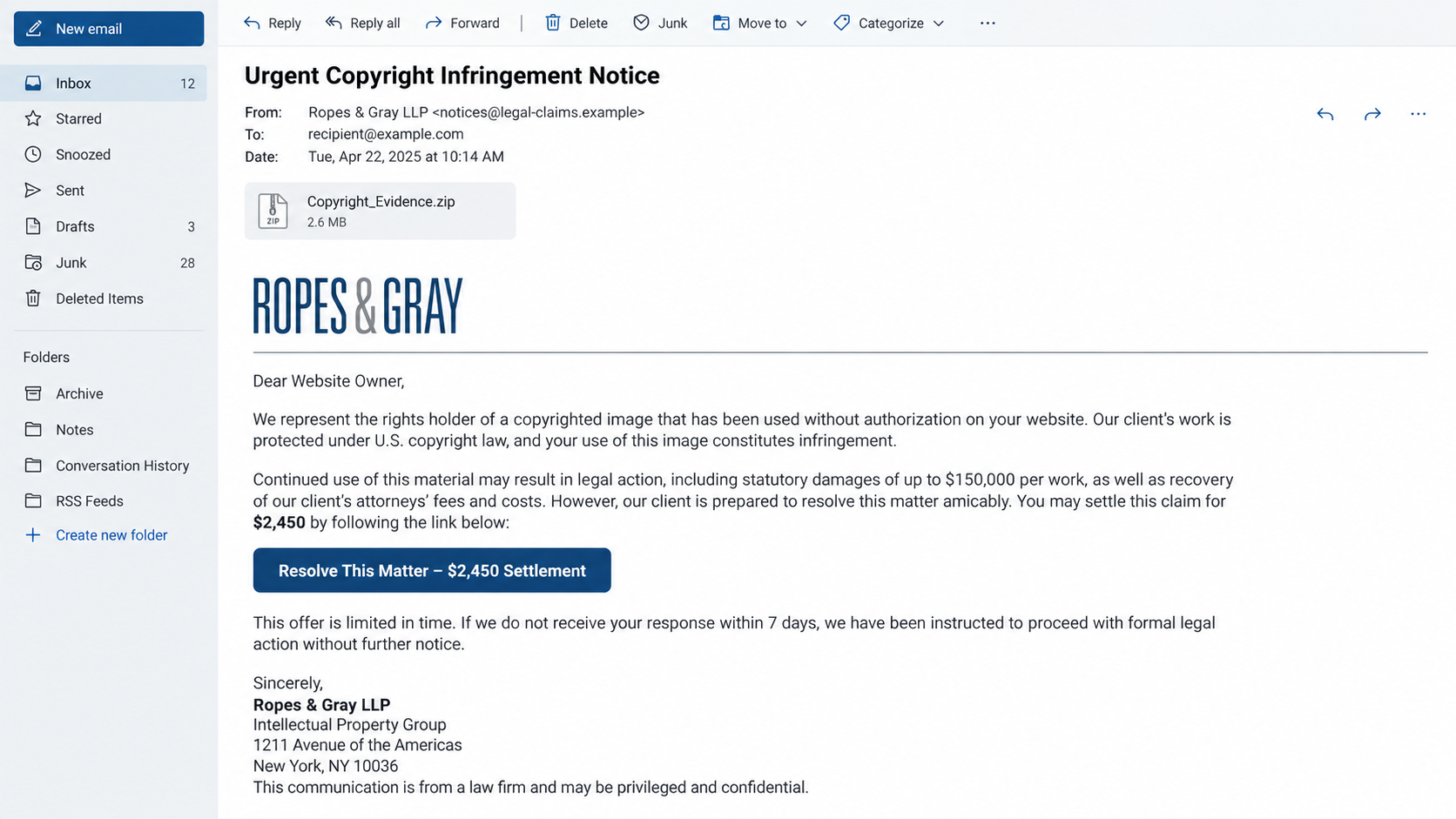
One version claims a business used copyrighted images, music, or other material without permission. It threatens a lawsuit while offering a settlement link, attachment, or payment deadline.
Another version targets people who already lost money. It claims lawyers located the missing funds and can release them after an identity check, legal fee, tax, insurance charge, or cryptocurrency payment.
Both paths collect money and sensitive information
A fake copyright portal may steal business credentials, card details, or banking information. A malicious attachment can install credential-stealing malware under the label of evidence or a formal complaint.
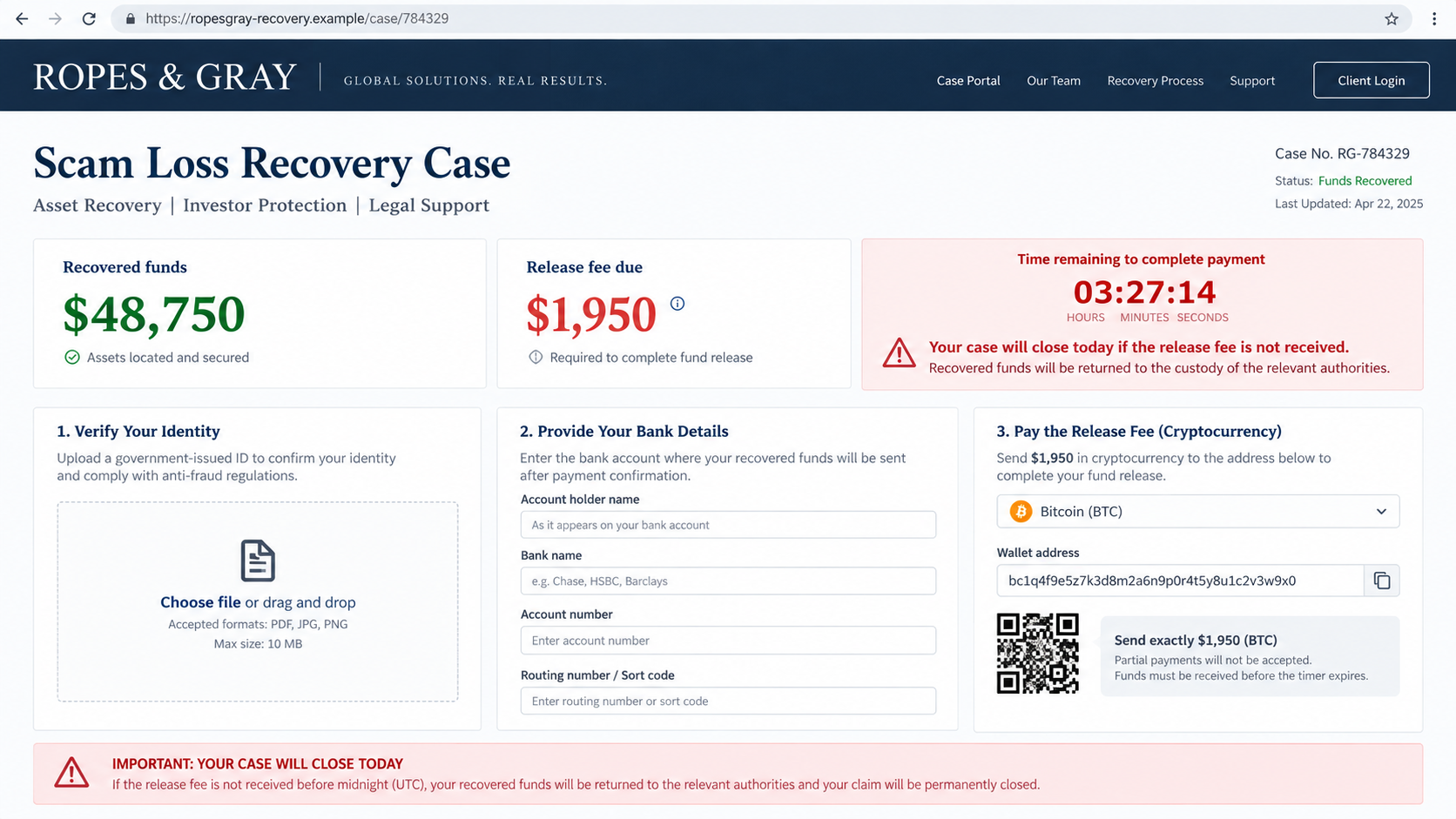
A recovery portal may request a government ID, bank account, routing number, and wallet transfer. The displayed recovered balance is fictional, so every release fee becomes another loss.
- An unexpected email uses the Ropes & Gray name or copied branding.
- The sender address differs from the firm’s official ropesgray.com domain.
- A copyright threat or recovery promise creates urgency.
- Links lead to lookalike legal or case-management portals.
- Attachments claim to contain evidence, contracts, or court documents.
- Payment or identity data is requested before the claim is verified.
Confirmed Warnings About Ropes & Gray Impersonation
The Solicitors Regulation Authority published a warning after emails and social-media advertising misused the name of Ropes & Gray International LLP in supposed recovery of scam losses. The warning identified lookalike domains and people falsely presented as connected to the firm.
The SRA said the genuine firm advised that it did not offer the recovery service promoted in those messages. Scammers also misused genuine professional details and an SRA identification number, demonstrating why accurate-looking facts are not enough.
A recovery scam often begins after a victim’s contact information and loss details have circulated. The new sender can describe the original scam convincingly because the same criminals, a data broker, or another fraud group obtained the case information.
Copyright demands are another common legal-impersonation lure. A recipient who manages a website or social account may believe an overlooked image license created genuine liability, making an attachment or settlement offer difficult to ignore.
A real copyright dispute deserves legal review, but urgency does not justify using the sender’s payment portal. Independent counsel can evaluate the work, claimed owner, license history, alleged use, damages theory, and authority of the person making the demand.
How the Ropes & Gray Scam Works
Step 1: Public information is turned into credibility
Fraudsters copy a real firm’s logo, office address, practice descriptions, attorney names, and registration details. They may also research the recipient’s business, website, or previous loss before making contact.
Each accurate detail reduces suspicion, but none proves control of an official mailbox or a real attorney-client matter. Public facts are the easiest parts of an impersonation to reproduce.
Step 2: A lookalike sender creates a false relationship
The email may use a free account or a domain containing words such as ropesgray, legal, international, claims, or recovery. On a small screen, the decisive domain ending can be easy to miss.
The display name may show an attorney or department while replies go elsewhere. A reply-to address different from the visible sender is an especially important warning.
Step 3: Fear or hope drives a quick response
Copyright versions threaten statutory damages, account removal, or a lawsuit unless a settlement is paid. Recovery versions promise that a large balance is already located and nearly ready for release.
Both stories make delay feel costly. The recipient is discouraged from calling the firm independently because verification would break the scammer’s control over the conversation.
Step 4: A portal or attachment captures the victim
The link opens a polished page showing a case number, recovered funds, settlement amount, countdown, or document upload. The interface looks orderly because professional design is inexpensive to imitate.
An attachment may contain a fake contract or complaint, but it can also include malicious code, a credential link, or instructions to bypass security warnings. Opening it is not necessary to verify the sender.
Step 5: Payment and identity requests escalate
A copyright settlement may request a card or wire transfer. Recovery fraud may demand a release fee, tax, anti-money-laundering deposit, insurance, or cryptocurrency before the displayed funds can move.
Government ID, bank records, and signatures are valuable beyond the first payment. Criminals can reuse them for identity fraud, account takeover, and more convincing legal impersonation.
Step 6: New legal obstacles keep the victim paying
After the first fee, another document supposedly requires notarization, a court adds a charge, or a bank places the transfer on hold. The recovered balance remains visible but never becomes withdrawable.
If the victim resists, a new “partner,” regulator, bank officer, or investigator may appear. Multiple professional titles can be controlled by the same group and do not independently confirm the case.
What a Genuine Legal Communication Should Allow You to Verify
A real firm should be reachable through contact information published on its own established website or an official professional register. The person contacting you should be verifiable through that independent route.
A copyright demand should identify the client, protected work, ownership or authority, specific alleged use, relevant dates, and requested remedy. Vague accusations paired with a payment button deserve immediate skepticism.
A filed case should exist in the named court’s official records. The court, parties, docket number, filing date, and counsel should align with documents obtained from the court, not merely with a PDF attached by the sender.
Recovery claims should explain the legal basis, custody of funds, responsible institution, fee agreement, and client relationship. Money supposedly held for a victim should not require cryptocurrency sent to an unrelated private wallet.
The genuine Ropes & Gray contact page also explains that sending an email does not itself create an attorney-client relationship. A stranger cannot establish representation simply by placing a firm logo and confidentiality footer in an unsolicited message.
Independent legal advice is especially important when a threat might be genuine. Ignoring a real claim can have consequences, but paying an unverified impersonator does not resolve the underlying issue.
Why Law Firm Impersonation Is So Persuasive
Legal communications are unfamiliar to many recipients, which gives scammers room to invent procedures. A target may not know how quickly a complaint is filed, how settlements are negotiated, or which documents a lawyer normally sends.
Confidentiality language can discourage outside help. A warning not to discuss the matter with employees, family, banks, or another attorney isolates the target from people most likely to recognize the fraud.
Copied signatures and biographies create social proof. The named professional may be completely genuine and unaware that criminals are using their identity, so finding the person on the real firm’s website confirms only that the impersonation was researched.
Scammers also exploit the cost of legitimate legal disputes. A $2,450 settlement can feel attractive beside a threat of much larger damages, even though the sender has never established ownership, infringement, or authority to settle.
Recovery fraud reverses the emotion but keeps the same structure. A victim who has waited months for help may accept a $1,950 release fee because the portal promises $48,750 is already secured.
Professional formatting is no longer difficult to produce. Templates, copied logos, generated text, and public case records let a criminal build a credible-looking package without access to any law firm system.
Business email controls should therefore evaluate behavior as well as appearance. Unexpected archives, new payment beneficiaries, secrecy requests, cryptocurrency instructions, and pressure to bypass review deserve escalation even when the writing is polished.
A short pause changes the balance of power. Once the recipient calls a verified number and checks the alleged matter with independent counsel, the impersonator loses control of both the evidence and the deadline.
Company, Address, and Fulfillment Checks
Inspect the complete email route
Expand the sender, reply-to, and return-path fields. Legitimate firm email should use the established official domain, while additional words or different endings can belong to a separate registrant.
Headers can reveal sending infrastructure and authentication results. Ask an email administrator or security professional to preserve and review them before forwarding the message normally.
Contact the firm independently
Manually type ropesgray.com and use contact information published there. Do not call a number in the disputed email, attached letter, advertisement, or lookalike portal.
Ask whether the named person works at the firm and whether the reference number and matter are genuine. Do not send confidential documents until the relationship is confirmed.
Verify courts, regulators, clients, and domains separately
Check court dockets and regulator warnings through their official sites. A genuine SRA number can be copied, so confirm that the email, telephone number, and domain match the regulated entity’s record.
Domain age and ownership are supporting clues, not final proof. A recently registered lookalike is suspicious, while an older compromised domain can still be abused.
Reject rushed or irreversible payment methods
Do not send cryptocurrency, gift cards, wires, or card details merely to stop a deadline. Have independent counsel review any settlement and confirm the receiving account belongs to the verified party.
A recovery service demanding money before funds are released has the structure of advance-fee fraud. A timer and guaranteed balance are marketing pressure, not evidence of recovered assets.
What to Do if You Have Fallen Victim to This Scam
- Stop communicating and paying. Do not send another fee for tax, release, insurance, court filing, notarization, or refund processing.
- Contact the payment provider immediately. Ask the bank, card issuer, exchange, or wire service about freezing, recalling, or disputing the transaction. Recovery is not guaranteed, but delay reduces options.
- Preserve the original evidence. Save the email with headers, attachments, URLs, wallet addresses, receipts, caller numbers, portal screenshots, and every identity document submitted.
- Notify the genuine firm. Use contact information from ropesgray.com so its security or legal team can confirm the impersonation and record the abused domains and names.
- Secure exposed accounts. Change passwords from a clean device, enable multi-factor authentication, review email forwarding rules, and remove unfamiliar sessions and recovery contacts.
- Protect identity documents. If an ID, tax record, or bank statement was uploaded, place suitable credit freezes or fraud alerts and monitor for new accounts.
- Check the device. If an attachment was opened or software installed, run a reputable scan such as Malwarebytes and follow professional incident-response advice for business systems.
- Block known malicious routes. AdGuard can reduce exposure to known phishing pages and deceptive ads, but it cannot recover money or make a submitted password safe.
- Report the fraud. File with the FTC, IC3, local police, and the relevant professional regulator. Businesses should also notify their internal security and finance teams.
Warn colleagues without forwarding a live link or harmful attachment. Share a screenshot with personal data hidden and let the security team handle the original evidence.
Frequently Asked Questions
Is Ropes & Gray a real law firm?
Yes. The scam consists of criminals impersonating a genuine firm. The existence and reputation of the real organization do not authenticate an unsolicited email.
Does a real attorney name prove the email is genuine?
No. Names, biographies, addresses, and registration details are public and can be copied. Confirm the person through the firm’s official contact route.
Should I ignore every copyright notice?
No. Preserve it and have independent counsel assess the claim, but do not open risky attachments or pay through an unverified sender’s link.
Can a law firm charge for recovering scam losses?
Legitimate legal services can involve agreed fees, but an unsolicited guaranteed recovery that demands advance cryptocurrency or release charges is a major fraud warning.
What if the email uses an official-looking SRA number?
Verify the number and every associated contact detail in the regulator’s own records. Scammers have copied genuine regulatory information into false documents.
Can I safely open the attachment to check the evidence?
Do not open an unexpected archive or document on a normal work device. Preserve it and let a qualified security professional examine it in an isolated environment.
The Bottom Line
Ropes & Gray scam emails borrow authority from a real law firm, then use either legal fear or recovery hope to push the recipient toward a controlled link, attachment, or payment.
Verify the sender through the firm’s official website, check any court or regulator independently, and let qualified counsel review a genuine dispute. A copied name can look official; only an independent route can confirm who is really contacting you.








