

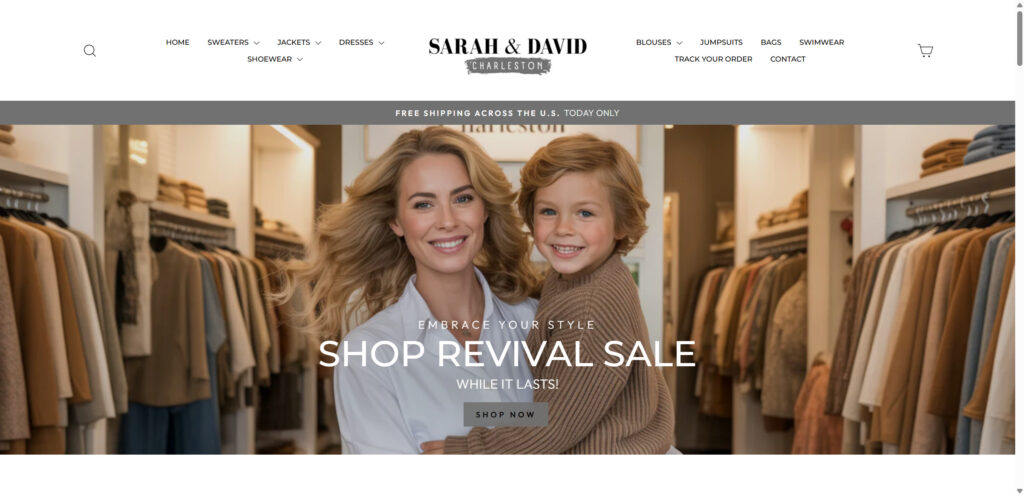
At first glance, Sarah & David Charleston looks like the kind of cozy coastal boutique many of us dream of supporting.
A smiling mother and child, soft sweaters on wooden hangers, a heartfelt revival sale that promises to keep a beloved family brand alive just a little longer.
But as more shoppers click, buy, and wait for their packages, a very different story begins to unfold. If you have ever paused on one of these ads and wondered whether it is really safe to order, this guide is for you.
Scam Overview
What is Sarah & David Charleston supposed to be?
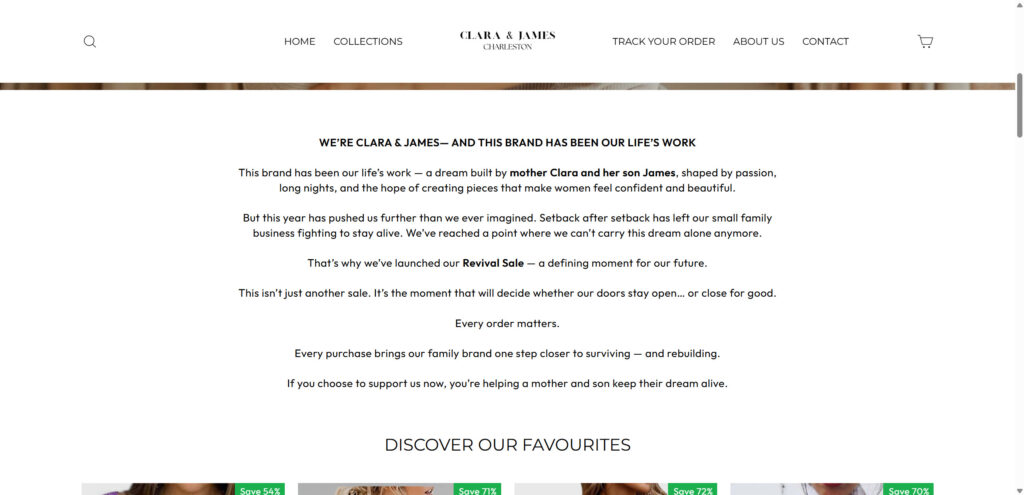
Sarah & David Charleston presents itself as a small, family run fashion label based around the charm of coastal life. The website tells a touching story about a mother, Sarah, and her son, David, who supposedly built the brand from scratch out of love for comfortable, effortless style.
The copy is warm and personal. It talks about long nights, sacrifices, and a dream of helping women feel confident and beautiful. Visitors are told that every order “keeps the dream alive” and helps this family business survive difficult times.
On top of that emotional story sits the main hook: a big “Revival Sale” that is framed as a make or break moment. If enough people shop the sale, the brand can stay open. If not, the doors may close for good.
To nudge shoppers over the line, the site usually advertises:
- “Today only” or “final chance” free shipping
- Deep discounts that claim you can “save 50%” or more
- Extra savings when you buy multiple items
- Soft urgency language like “while it lasts” and “every order matters”
Everything is carefully designed to make you feel that you are not just shopping. You are helping a struggling family survive.
Why so many people are calling it a scam
When you look past the pretty photography and emotional story, the problems start stacking up. Across similar “Charleston” themed boutiques, shoppers report nearly identical experiences:
- Orders take many weeks to arrive, if they arrive at all
- Items often ship from large Chinese warehouses, not a small studio in Charleston
- The actual products feel cheap, thin, and badly made compared to the cozy photos
- Sizes are wildly inconsistent and returns are extremely difficult or impossible
- Customer support either ignores emails or responds with scripted, unhelpful replies
- Refunds are refused, delayed, or replaced with tiny partial offers
In other words, what looks like a warm family shop behaves like a typical fast fashion dropshipping operation that hides behind a fake story.
The recycled story pattern
Sarah & David Charleston does not exist in a vacuum. The same kind of narrative appears again and again:
- A “heart for the coast” or a love of a picturesque town
- A founder who is a devoted mother, or a couple who started the brand out of love
- A big emotional sale that is framed as a closure, revival, or medical emergency fundraiser
- The promise that “every order matters” and “you are part of our journey”
The names, faces, and precise backstory might change. One site might be Mia & Sophia, another Clara & James, another Lily’s Boutique. Yet the structure of the story, the layout, and even some of the visuals are eerily similar.
This pattern is a huge red flag. Authentic small brands usually have:
- A traceable business registration and physical address
- Social media accounts with years of organic activity
- Real customer photos and reviews that exist outside the website itself
- A consistent story that matches local news, interviews, or community features
Scammy “sale boutiques” typically have none of those. Their domain names are very new, their social media pages (if they exist) have little genuine engagement, and there is no evidence that the founders are real people.
The lure of “orthopedic” shoes and miracle comfort
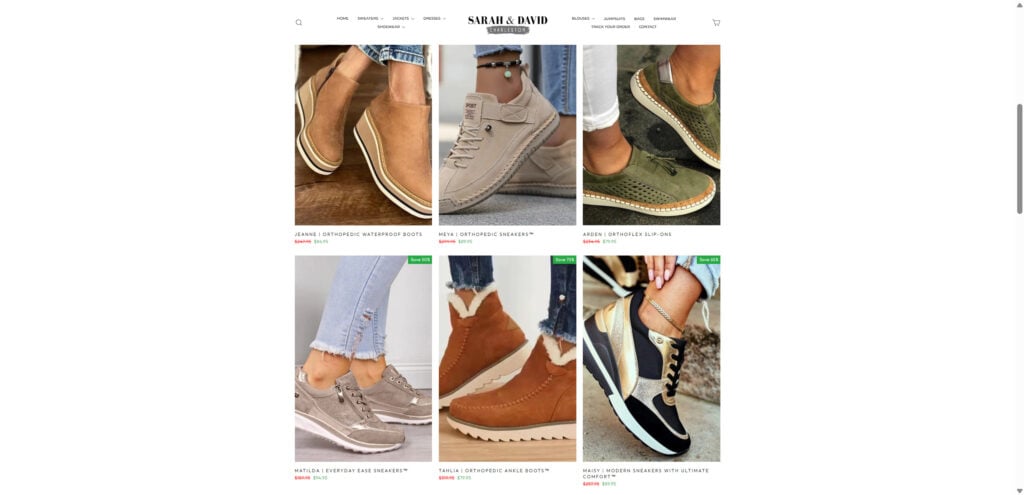
Sarah & David Charleston heavily pushes footwear marketed as “orthopedic,” “premium quality,” or “doctor recommended.” The product images show stylish boots and sandals on slim ankles, usually in well lit lifestyle photos.
The prices are often marked as dramatic markdowns, for example:
- “Was $219.95, now $84.95”
- “Save 60%” or similar slogans
In reality, shoppers frequently discover that:
- The shoes are basic mass produced imports, sold on large marketplaces for a fraction of the supposed original price
- Materials are synthetic and flimsy, not premium leather
- Insoles have no special support features, despite the medical language on the product page
Using words like “orthopedic” without clear medical backing is another red flag. Legitimate orthopedic brands are transparent about certifications, materials, and design, and they usually have a verifiable history in the industry.
The illusion of safety and trust
To calm any last doubts, the Sarah & David Charleston website leans heavily on trust badges and comforting promises:
- “Free shipping across the U.S. today only”
- “Thousands of satisfied customers”
- “30 day return policy”
- “Secure payment”
However, when customers try to use those policies, they often find that they are traps rather than protections.
Return policies may require you to ship items back at your own expense to an overseas address that is not clearly spelled out before purchase. Email replies may stall for weeks. In many reports, people are offered a small partial refund “for the inconvenience” if they agree to keep the product and stop asking for more.
The end result is that many buyers feel pressured to accept a tiny refund for items that are nothing like what they expected.
Why these “family revival” boutiques are so effective
The Sarah & David Charleston model works because it combines three powerful psychological levers:
- Emotion – You are not just buying shoes. You are keeping a mother and son’s dream alive.
- Urgency – The Revival Sale might determine whether the brand survives. You should buy now before it is too late.
- Bargain hunting – The discounts look incredible. It feels like you would be foolish not to grab them while they last.
Scammers know that if they can trigger even two of these feelings at the same time, many people will purchase without digging deeper. That is why these sites invest so much in storytelling and polished visuals, while quietly cutting corners on everything that actually matters after you pay.
How the Scam Works
In this section we will walk through a typical experience step by step. Details vary from shopper to shopper, but the underlying pattern is remarkably consistent for sites like Sarah & David Charleston.
To keep it clear, we will break it into six main stages.
1. You see a heartwarming ad
Most people first discover Sarah & David Charleston through social media ads. These often show:
- A warm, cozy boutique interior
- A smiling mother and child sharing a hug
- Short clips of women wearing colorful sweaters or comfortable shoes
- Text like “Final Revival Sale,” “Mother and son fighting to save their dream,” or “Shop now, every order matters”
The ads highlight:
- Big discounts
- Free shipping “today only”
- Limited stock warnings such as “Almost sold out in your size”
The vibe is intimate and emotional rather than corporate. It feels like you have stumbled on a hidden gem rather than a faceless fashion site.
Since modern ad platforms can target by age, interests, and location, these campaigns are often aimed at women who like handmade goods, coastal style, or independent boutiques. That targeting makes the story feel even more personal.
2. The website reinforces the story and lowers your guard
Clicking the ad brings you to a clean, attractive website. The home page often features:
- A banner photo of Sarah and her son, or a similar family portrait
- A text block about how the brand started in 2015 or another year, usually tied to a charming city like Charleston
- A heartfelt letter explaining why the Revival Sale matters so much
Every element is designed to build trust:
- The copy is written in first person, as if Sarah herself is talking to you
- There are references to “long nights,” “setbacks,” and “fighting to stay alive”
- The sale is framed as a last chance to help the brand survive and rebuild
By the time you scroll down to the product grid, you may already feel emotionally invested. You want the story to be true. You want to help.
This is exactly what the scammers are counting on.
3. You place an order during the “Revival Sale”
The products themselves look stylish and fairly priced once the sale discount is applied. You might see:
- Orthopedic sneakers supposedly reduced from around $200 to under $90
- Warm winter boots labeled as premium leather
- Lightweight cardigans with floral or geometric patterns
The product pages often contain:
- Dozens of 5 star reviews with generic praise
- Size charts that are copied from other sites and may not reflect reality
- Phrases such as “handcrafted,” “made with love,” or “tested by thousands of women”
At checkout, everything feels normal:
- You can pay with a credit or debit card and sometimes with PayPal
- Shipping appears to be free within the U.S.
- There is a promise that orders are processed quickly
You receive a confirmation email that repeats the emotional story and thanks you for supporting a family in need.
Up to this point, nothing looks obviously wrong, especially if you have not yet searched for reviews.
4. Shipping is slow, vague, and confusing
After a few days, you might receive a short email saying that your order has shipped and providing a tracking link. At this stage, several shady tactics often appear:
- Tracking numbers that do not work for many days
- Tracking pages that show only vague status updates like “in transit” with no clear location
- Sudden changes of carrier or tracking URL
Behind the scenes, items frequently ship from large warehouses in China using the cheapest postal options available, which can take several weeks or longer. The website, however, continues to speak as if everything is shipping from a small U.S. based boutique.
If you email customer service to ask where your order is, you may receive scripted replies such as:
- “Dear customer, your order is on its way, please be patient.”
- “Due to high demand from our Revival Sale, shipping times are longer than usual.”
The goal is to stretch your patience past the window where your bank or payment provider can easily reverse the charge.
5. The product that arrives is nothing like the photos
Many customers who do eventually receive something from sites like Sarah & David Charleston describe a nasty surprise when they open the package.
Common complaints include:
- Shoes that are made of thin plastic or vinyl instead of leather
- Soles that feel hard and flat, despite all the talk of orthopedic support
- Strong chemical odors from cheap glue or synthetic materials
- Sweaters that are thin, loosely knit, and already pilling right out of the bag
- Colors and patterns that look dull or different compared to the website photos
Sometimes the wrong size or even the wrong item is shipped. In other cases, key features from the listing simply do not exist on the product.
The packaging itself is often a simple plastic mailer with a Chinese shipping label, not a custom branded box from a boutique in Charleston.
At this point, most people realize that the story they were sold does not line up with reality.
6. Refunds and returns are made as hard as possible
Now the real frustration begins. When shoppers try to return their items or request a refund, the company may respond with a series of tactics designed to wear them down.
Typical responses include:
- Asking for multiple photos of the product from different angles
- Claiming that the item matches the description and therefore is not eligible for a full refund
- Offering a small partial refund if the customer agrees to keep the item
- Giving a return address that is overseas, with instructions that the customer must pay for shipping and provide a valid tracking number
Sending a package back to China with tracking can cost a significant portion of what you paid for the item. On top of that, there is no guarantee that the company will actually process the refund when they receive it.
By making the official return route expensive and inconvenient, the company nudges people toward accepting a tiny partial refund instead. Others simply give up, write it off as a bad experience, and move on.
Either way, the operators of the site keep most of the money, while the “family boutique trying to survive” story continues to pull in new shoppers.
What To Do If You Fell Victim
If you have already ordered from Sarah & David Charleston and now suspect that you have been scammed, you are not alone. Try to stay calm. There are practical steps you can take to limit the damage and increase your chances of getting your money back.
Below is a clear, step by step plan.
1. Gather all your evidence
Collect everything related to your order and save it in one place. This should include:
- Order confirmation emails
- Payment receipts or screenshots from your bank, card provider, or PayPal
- Any tracking information
- Screenshots of the product page, including the price, description, photos, and reviews
- Screenshots of the “Revival Sale” story or any promises of easy returns or guarantees
- All email exchanges with the company
Having this evidence ready will help you explain your case to your bank, PayPal, or any consumer protection agency you contact later.
2. Contact the seller once, politely and clearly
Before escalating, it is usually worth contacting the seller one time in a firm but polite way. State clearly:
- What you ordered
- What you received (or that you received nothing)
- Why you believe the product is not as described
- What resolution you want, for example a full refund
Give them a short deadline, such as 5 business days, to respond. Keep your message calm and factual. Do not threaten them. You want to show later that you tried to resolve the problem directly.
If their response is a stalling tactic, a tiny partial refund offer, or complete silence, move on to the next step.
3. Open a dispute with your bank or payment provider
For many victims, this is the most important step.
- If you paid by credit card, contact your card issuer and ask to file a chargeback for “goods not as described” or “goods not received,” whichever applies.
- If you used PayPal, open a dispute in the Resolution Center as soon as you realize there is a problem.
Explain that:
- The website presented itself as a small U.S. based boutique, but the items shipped from overseas, often from a mass warehouse.
- The quality of the goods is drastically worse than represented in the photos and descriptions.
- The seller is refusing to honor a fair return or refund.
Attach the evidence you gathered earlier. The more clearly you can show that the website made misleading claims, the stronger your case becomes.
There is usually a time limit for chargebacks and PayPal disputes, so do not wait.
4. Secure your devices and accounts
Most of these boutiques operate more like classic online ripoffs than technical hacks, but it is still wise to take some security precautions after shopping on a suspicious site.
- Scan your devices
- Install and run a full system scan with a reputable security tool such as Malwarebytes. It can help detect unwanted programs, browser hijackers, and other threats that may have slipped in through malicious ads or fake pop ups.
- Block shady ads and trackers
- Consider using a trusted ad blocking and filtering solution such as AdGuard. This can reduce your exposure to deceptive shopping ads, fake updates, and other malicious scripts as you browse.
- Change your passwords
- If you created an account on the boutique’s site, avoid reusing that password anywhere else. Update passwords on your main email and banking accounts, especially if you reuse credentials.
These steps help lower the risk of further problems, even if the original issue was primarily a bad purchase rather than malware.
5. Monitor your bank statements
Keep a close eye on the account you used to pay for your order for at least a few months.
Watch for:
- Duplicate charges from the same merchant
- Charges from unfamiliar companies that could be related
- Small “test” transactions that you did not authorize
If you see anything suspicious, report it to your bank immediately. In some cases, it may be wise to cancel that card and request a new one, especially if you suspect your details were stored insecurely.
6. Report the website to consumer protection organizations
The more reports a scammy boutique receives, the easier it becomes for authorities and other shoppers to spot the danger.
Consider filing complaints with:
- Your country’s consumer protection agency or equivalent
- The Better Business Bureau or similar organizations, if available
- Your local trading standards office, if you are in a region that uses that system
If the domain is very new, sometimes hosting providers or registrars will take action when they see a pattern of abuse. Include as much detail as you can about:
- The URL of the site
- How you found it (for example, Facebook ad, Instagram ad, or Google search)
- What went wrong with your order
7. Warn other shoppers
Finally, one of the most helpful things you can do is share your experience in places where other potential victims might look before they buy.
You can:
- Write an honest review on independent consumer review platforms
- Post a factual warning on social media groups where people discuss online shopping
- Share your story on forums that specialize in scam reporting and internet safety
Stick to facts. Avoid insults or threats. Explain clearly what you ordered, what went wrong, and how the company responded when you asked for help.
Your review might be the one that convinces someone to pause, search for more information, and avoid losing their money.
The Bottom Line
Sarah & David Charleston looks, at first glance, like a heartfelt coastal boutique run by a devoted mother and son who are fighting to keep their dream alive. The Revival Sale language, the emotional photos, and the deep discounts all work together to create a powerful sense of urgency and trust.
Once you look closer, however, the story begins to unravel. The recycled narrative, the heavy use of unrealistic orthopedic claims, the cheap imported products, and the obstructive refund practices all point toward a shop that behaves far more like a dropshipping scam than a genuine family brand.
If you are still deciding whether to buy, the safest move is simple: do not. Support verified local boutiques, established online stores, or brands with a proven track record instead.
If you have already ordered and feel misled, you are not powerless. Gather your evidence, push for a refund through your bank or PayPal, secure your devices with tools like Malwarebytes and AdGuard, and share your experience so others can learn from it.
The more we talk openly about operations like Sarah & David Charleston, the harder it becomes for this type of “sale scam” to quietly recycle itself under new names and new sentimental stories.

Join the discussion
0 commentsShare your experience or ask a question about this article.
Discussion
Start the conversation
Have a question or something useful to share? Add the first comment.