

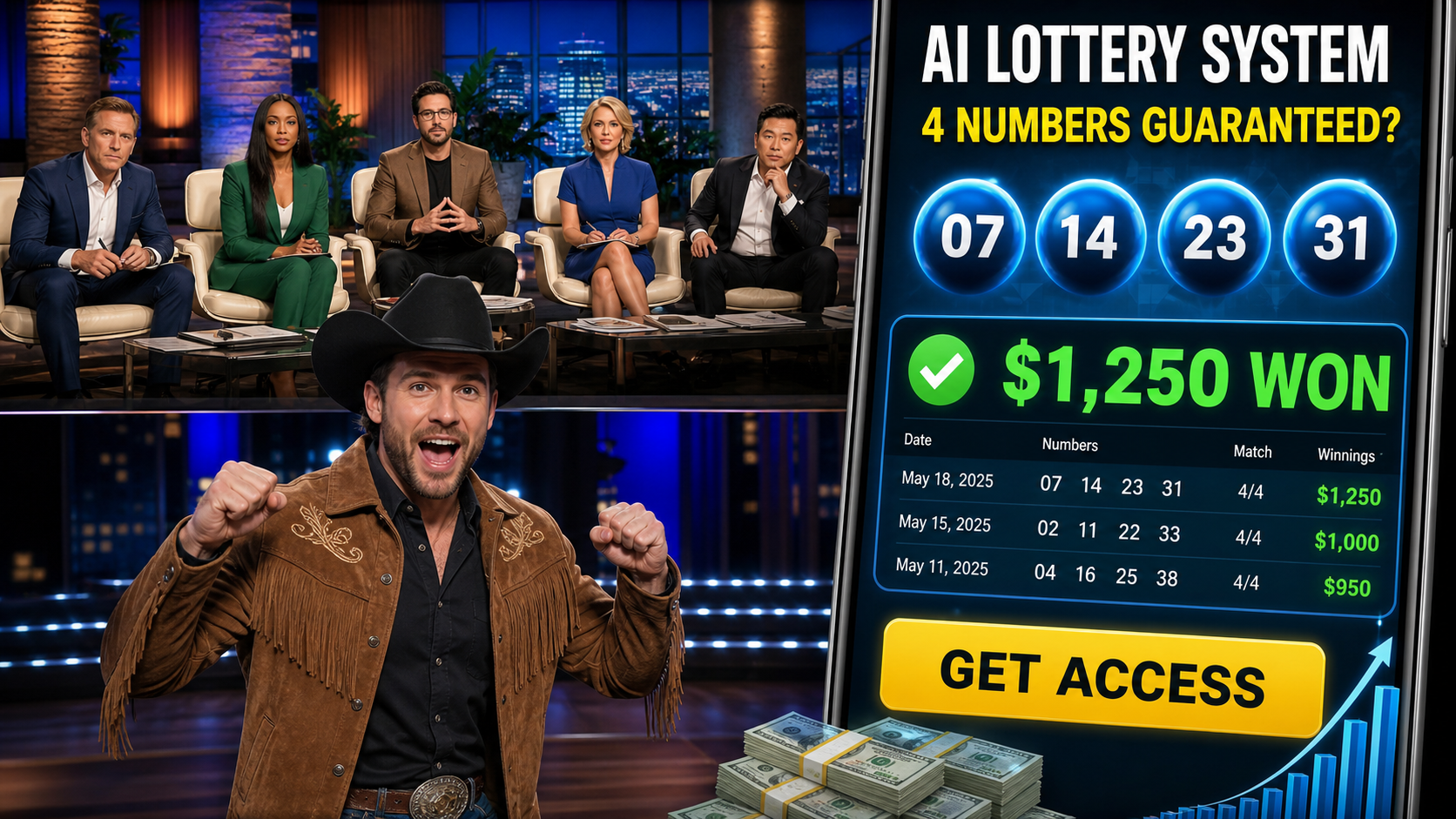
A familiar investor panel watches a cowboy entrepreneur reveal an AI that supposedly predicts winning lottery numbers. The clip says the system impressed the Sharks, produced repeated wins, and is now available to a small group of ordinary players.
The real television appearance had nothing to do with lottery software. The campaign splices authentic history into a fabricated AI-win story, then sells access to numbers no algorithm can guarantee.
Overview
What the “Shark Tank” AI Lottery Ad Claims
The ads promote names such as Apollo AI Lottery or Project Apollo. A video claims artificial intelligence can identify at least four Powerball numbers, repeat the result every week, or exploit a mathematical loophole hidden inside lottery drawings.
A cowboy-style entrepreneur appears with the “Shark Tank” cast, while other versions invoke Elon Musk or a former Tesla engineer. Screenshots show winning checks, matched numbers, and users celebrating repeated payouts.
What Really Happened on the Television Show
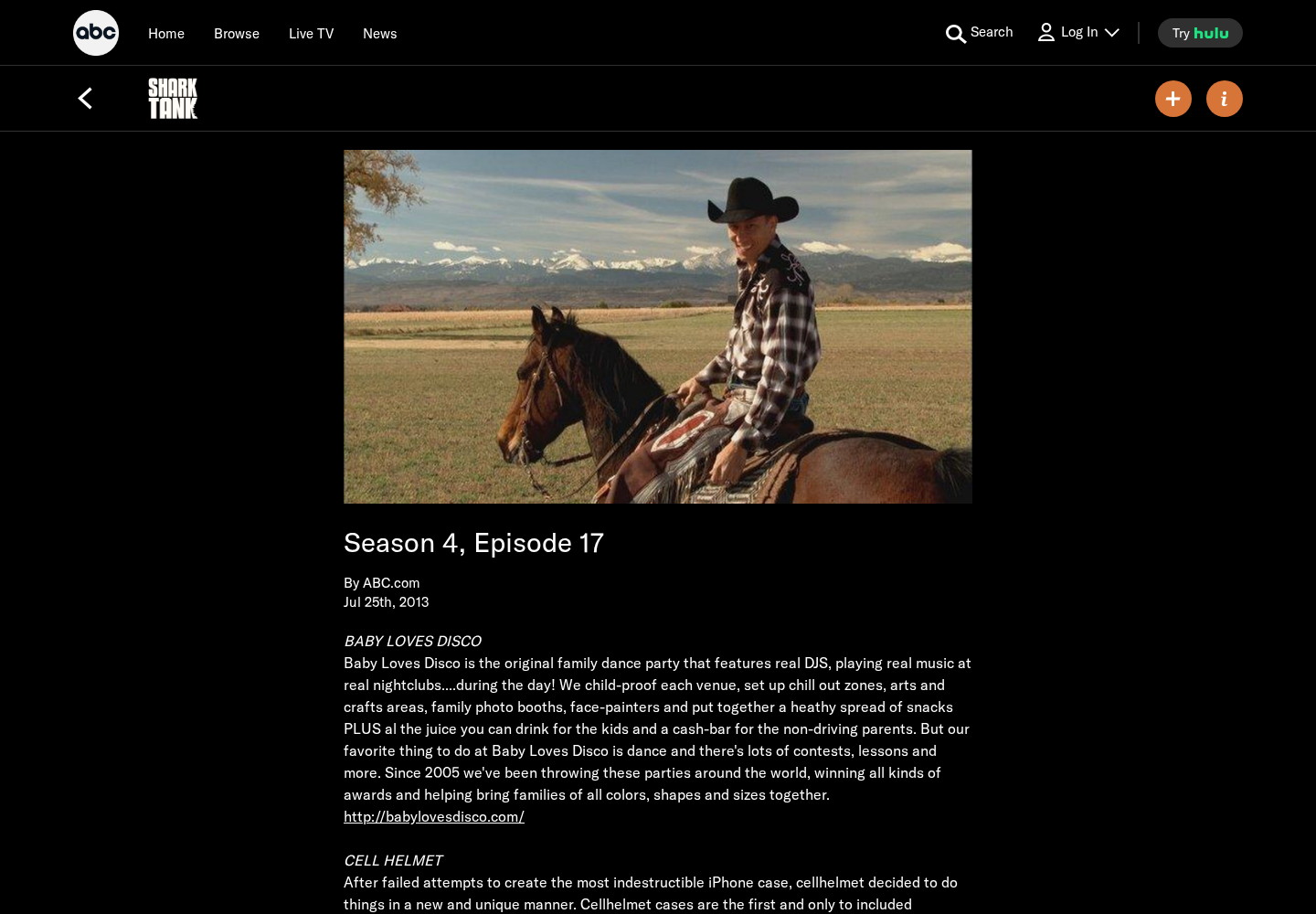
Ryan “Cowboy” Ehmann did appear on “Shark Tank.” ABC’s official episode page identifies his product as Lose 12 Inches, a fitness program built around heart-rate training. The real pitch did not involve Powerball, lottery prediction, Tesla, or an AI number generator.
That small kernel of truth is used to support a completely different story. Old show footage can be edited, dubbed, and combined with a fake dashboard so the viewer assumes the lottery product was broadcast and vetted.
- The real entrepreneur pitched fitness, not lottery software.
- The investor panel did not endorse Project Apollo lottery predictions.
- Powerball says every ticket has the same chance to win.
- The jackpot odds are about 1 in 292.2 million.
- Displayed checks and dashboard wins are not independently verified.
How This Differs From Other Project Apollo Scams
Project Apollo is a reusable name. MalwareTips has also documented a Project Apollo AI paycheck scheme that promises automated online income.
This article addresses the lottery version: fake “Shark Tank” history, repeated number-matching claims, and paid access to predictions. The stories share AI hype and false authority, but the promised mechanism and search intent are different.
Did “Shark Tank” Endorse an AI Lottery System?
No credible evidence supports that claim. A real show clip proves only that the people appeared on television in another context. It does not prove that the dialogue, product, or endorsement in the social ad is authentic.
ABC’s official page describes Ehmann’s fitness program and “Cowboy Fit Zone Software.” The software calculated a heart-rate exercise zone. Scammers can reuse the word “software,” a real cowboy persona, and a genuine appearance to make their invented lottery product sound like the next chapter.
The fake presentation may add the “Shark Tank” cast reacting with excitement. Those shots can be lifted from unrelated pitches. Audio can be cloned, captions can be rewritten, and product screens can be composited into the frame.
If a product supposedly appeared on the show, locate the exact episode through ABC or another official distributor. Confirm the entrepreneur, business name, product category, and deal. Do not rely on a clip uploaded by the seller.
Can AI Predict Winning Powerball Numbers?
No system can guarantee future numbers from a properly conducted random lottery drawing. Historical draws can be counted and visualized, but past frequency does not reveal the next independent combination.
Powerball states that every ticket has the same chance to win and lists jackpot odds of 1 in 292.2 million. A sequence that appeared recently is not “used up,” and a number that has not appeared for weeks is not “due.”
AI can generate number combinations, check tickets, organize a pool, or explain odds. Those are convenience functions. They do not create information about balls that have not yet been drawn.
A seller may highlight four matched numbers without disclosing how many combinations were purchased, how many failed predictions were omitted, whether the image was edited, or whether the ticket even belongs to the person shown.
Even a genuine small prize would not prove prediction. People win lower-tier lottery prizes every drawing because millions of combinations are sold. The relevant question is whether the system produced a statistically reliable profit after every ticket, fee, failed forecast, and refund was counted.
How the “Shark Tank” AI Lottery Scam Works
Step 1: A Deepfake Ad Combines Fame, AI, and a Jackpot
The campaign appears in Facebook, Instagram, YouTube, or TikTok feeds. A fast video says the Sharks discovered an algorithm ordinary players were never meant to see.
The three ingredients solve different trust problems. “Shark Tank” suggests business vetting, AI suggests advanced capability, and a national lottery provides an enormous emotional reward.
Step 2: A Fake News Page Tells a Plausible Origin Story
The click opens a television-style article or long video. It may claim a former Tesla developer, sometimes described as the entrepreneur’s brother, discovered a flaw in lottery mathematics.
The page uses logos, screenshots, bylines, and urgent headlines to look independent. In reality, prominent links lead toward the same order page.
Step 3: Real “Shark Tank” Footage Is Rewritten
Ryan Ehmann’s genuine fitness appearance gives the edit a searchable foundation. The scam changes what he supposedly pitched and places lottery claims over unrelated reactions from the panel.
A viewer who searches only the entrepreneur’s name confirms he was on the show, then may stop before checking the actual business. The deception lives in that missing second step.
Step 4: Fake Winning Proof Makes Chance Look Repeatable
The presentation displays checks, lottery tickets, number tables, or testimonials claiming 29 or 38 wins. A dashboard may show four-of-four matches and a growing balance.
None of those images explains total spending, failed tickets, dates, ticket validation, prize tiers, or independent ownership. A screenshot can be fabricated, selectively chosen, or unrelated.
Step 5: A Guarantee Redefines What “Prediction” Means
The strongest claim is often that the system identifies four winning numbers every week. Later language may soften the promise to “improve odds,” “analyze patterns,” or provide recommended combinations.
This shift lets the seller use a guarantee in the ad while delivering only a random-number tool or generic training after payment.
Step 6: The Checkout Sells Access, Not a Jackpot
The visitor is asked to buy software, a membership, number reports, or admission to a private group. The price may begin low enough to feel trivial compared with the advertised winnings.
Read whether billing repeats and whether recommended tickets require additional spending. The purchase price may be only the first cost if the strategy encourages many combinations for every drawing.
Step 7: Private Chats Create New Payment Pressure
Some funnels move buyers into Telegram, WhatsApp, Facebook groups, or private messaging. A coach may claim the next draw is unusually predictable and sell a premium package.
Private contact reduces public scrutiny and allows individualized pressure. Never send crypto, gift cards, wire transfers, or bank credentials to unlock lottery predictions or winnings.
Step 8: The Name Changes When Complaints Catch Up
Apollo AI, Project Apollo, Lotto AI, and other technology-themed names can be replaced without changing the script. The entrepreneur, celebrity, or show invoked by the ad can change too.
Remember the structure: stolen authority, impossible prediction, selective proof, paid access, then more pressure. That pattern survives every rebrand.
Why the “Four Numbers” Claim Is Misleading
Matching four numbers sounds close to the jackpot, but the details determine everything. Powerball requires five white balls plus the red Powerball for the jackpot. Different match combinations have very different prize values.
A seller can generate a huge list of combinations, find one that matched several numbers after the draw, and advertise only that line. Without the complete pre-draw prediction set, timestamp, ticket cost, and all failures, the result proves nothing.
The system may also count any four numbers that appeared somewhere in a large output, even if they were not on the same playable line. That is not equivalent to holding a winning ticket.
Ask for independently audited, pre-registered predictions across a long period, with every recommendation and cost included. A genuine predictive advantage would need repeatable statistical evidence, not a montage of winners.
Company, Address, and Fulfillment Checks
The Show Name Is Not the Merchant
“Shark Tank,” Apollo AI, and Project Apollo do not identify the legal company charging the card. Find the seller in the checkout terms and compare it with the receipt and statement descriptor.
If the company relies on ABC footage but provides no registration, management, or business history of its own, the authority is entirely borrowed.
The Address May Be a Virtual Mailbox or Absent
Digital lottery products do not need a warehouse, but the operator still needs an accountable service address. Search the location. A mailbox, residence, or unrelated company does not prove where the software was developed or who handles disputes.
Support Can Move Into Untraceable Private Chats
Test the official email and phone before purchasing. Ask for the legal merchant, complete price, recurring status, refund procedure, and typical user result. Refusal to answer while pushing Telegram or WhatsApp is a strong warning.
There Is No Physical Product to Anchor Accountability
Fulfillment may consist of a login, number generator, PDF, or group invitation. That can be delivered instantly and cheaply. It does not demonstrate a predictive algorithm or a relationship with the television show.
Save the product description before purchase. If the delivered material is only generic lottery advice, the original AI guarantee and fake endorsement remain relevant to a refund or dispute.
Red Flags in AI Lottery Promotions
- A “Shark Tank” clip exists only in a sponsored social ad.
- The real entrepreneur pitched an unrelated product.
- A former Tesla developer or celebrity is added without verification.
- The system guarantees four or more future numbers.
- Winning checks and dashboards cannot be independently authenticated.
- Only successful predictions appear, with no complete failure record.
- The total cost of recommended tickets is hidden.
- A low access fee leads to premium groups or prediction packages.
- The operator’s legal name, address, and refund process are unclear.
- Payment is requested by crypto, gift card, wire, or a private chat.
What to Do if You Have Fallen Victim to This Scam
- Stop buying predictions and tickets. Do not chase losses with a premium package or larger pool. A supposed “high-confidence draw” is another sales claim.
- Preserve the original promise. Save the ad, “Shark Tank” clip, fake news page, number guarantee, checkout, terms, dashboard, receipt, chats, and statement descriptor.
- Cancel memberships in writing. State that you cancel all software access, groups, recurring billing, and future services. Ask for confirmation and a refund under the advertised policy.
- Contact the payment provider. Explain the false television endorsement and impossible prediction claims. Ask about disputing charges and blocking future payments.
- Secure your accounts. Change reused passwords, enable two-factor authentication, and remove unknown sessions. Never send identity documents to a private lottery coach.
- Scan suspicious downloads. If you installed software or an extension, remove it and run Malwarebytes. Use AdGuard to reduce future scam-ad and redirect exposure.
- Report the campaign. Report the ad for impersonation and fraud. U.S. victims can use ReportFraud.ftc.gov and IC3.
- Get support if gambling is escalating. If the system encouraged unaffordable ticket buying or chasing losses, contact a trusted person and a licensed gambling-help service in your country.
Frequently Asked Questions
Was Apollo AI Lottery featured on “Shark Tank”?
No verified episode shows that product. Ryan Ehmann’s real appearance concerned a fitness program called Lose 12 Inches, not an AI Powerball predictor.
Can AI guarantee four Powerball numbers?
No credible system can guarantee future numbers from a properly random draw. AI can generate combinations or analyze history, but it cannot know the independent outcome in advance.
Did the Sharks invest in Project Apollo?
We found no official evidence that the “Shark Tank” investors backed the lottery system. Reaction shots and voices in a social ad can be taken from unrelated footage or synthetically altered.
Why does the ad use Ryan “Cowboy” Ehmann?
He is a real former contestant with a memorable persona, so a search confirms part of the story. The scam depends on viewers not checking that his actual pitch was a heart-rate fitness program.
Are screenshots of winning checks proof?
No. They can be edited, borrowed, selectively chosen, or shown without total ticket costs and failures. Credible evidence would require timestamped pre-draw predictions and independent auditing of every result.
Is this the same as the Project Apollo AI paycheck scam?
It is a related naming pattern but a different offer. The paycheck version promises automated online income. This version sells lottery predictions using fake “Shark Tank” authority and winning-number claims.
The Bottom Line
“Shark Tank” did not endorse an AI system that guarantees Powerball numbers. The campaign rewrites a real fitness pitch, adds artificial-intelligence hype, and uses selective or fabricated winning proof to sell digital access.
Every Powerball ticket has the same chance. Do not pay anyone who claims a television panel, celebrity, or secret algorithm can turn a random draw into guaranteed income.

Join the discussion
0 commentsShare your experience or ask a question about this article.
Discussion
Start the conversation
Have a question or something useful to share? Add the first comment.