


Steppa asks you to put real money on a simple promise: hit your step goal every day, and you split a prize pool with everyone else who does.
The pitch is cheerful and simple, but the rules that decide who gets paid sit in the terms, and they are stricter than the headline suggests.

Overview
What Steppa is and how it sells itself
Steppa, listed as Steppa – Step Challenges, is an iPhone app from Steppa LLC whose website promises that you can win real cash by walking.
You join a challenge, reach a daily step target and share the prize pool with everyone who finishes, with your steps read from Apple Health.
The App Store listing calls it free with in-app purchases, rates it 18+, and uses screenshot slogans such as Get Paid to Move and Walk and Earn Real Money.
The description says there are no penalties or charges for missing goals, a line the terms qualify in two ways that a casual reader will not expect.
What the terms say about your money
The entry fee is your stake plus a service fee and, on public challenges, a creator fee, and the app is supposed to show each before you enter.
The terms include a financial risk acknowledgment saying you may lose 100% of your entry fee, which is the plainest sentence in the document.
Entry fees are non-refundable, including for challenges you choose not to finish, although the company may refund at its discretion for documented medical emergencies or verified technical failures.
A forfeited stake stays in the prize pool, so the people who drop out are exactly who funds the people who finish.
What independent sources report
The Czech government office warned in May 2026, as reported by CNN Prima, that Steppa may trigger or deepen problem gambling in predisposed people.
The same report says paid step challenges are not available in Czechia, because local rules differ from those where the app operates.
A competing rewards app that discloses its interest describes Steppa as real, paying finishers, but built like a pool bet, with reviewers reporting $25 entries that returned about $23.
One reviewer paid $35 for a 15-day challenge at 7,500 steps a day, received $44, and reported that more than 600 other entrants failed.
Here is where the evidence stands after our checks:
- Verified in the terms: non-refundable entry fees, forfeited stakes, a payout minimum, arbitration and a 7-day dispute window.
- Reported by others: small net results, sync problems with step data and a government warning about gambling-like harm.
- Not found: a regulator action against Steppa itself, or a named founder in the terms.
Our advice is to treat Steppa as a bet with a walking requirement, not as income, and to read the response section below before staking anything.
Is Steppa a Game, a Contest or a Bet?
The terms describe Steppa as a skill-based fitness competition and say plainly that it is not a gambling service.
Walking is a skill of a kind, but the money loop will look familiar to anyone who has joined a pool: pay in, hit the target, split what remains.
Apple rates the app 18+, and the Czech warning shows that officials see the resemblance, even where the legal label is different.
Calling something a skill contest decides which rules apply to the company, but it does not change what a participant can lose, which is the whole entry fee.
A federal precedent shows why the format deserves care: in 2017 the FTC announced a settlement with Pact, an app that charged $5 to $50 for each missed activity.
The FTC alleged that Pact failed to pay promised rewards and kept charging users.
The settlement carried a judgment of $1,500,000, with more than $940,000 going back to consumers as rewards and refunds.
That case concerned a different company, and we found no regulator action against Steppa, but it shows how disputes over this kind of app tend to start.
How a Steppa Challenge Works
Step 1: You pay an entry fee that is more than the stake
The stake enters the prize pool, while the service fee and any creator fee are charged on top, so you risk more than the number shown.
The service fee is waived for accounts with an active Steppa Pro subscription, which also raises the limit on concurrent challenges from one to five.
The service fee is non-refundable, and the terms say the entry fee as a whole is non-refundable apart from the discretionary cases.
Step 2: Only measured steps count
Progress comes from Apple Health on iPhone or Health Connect on Android, and steps entered by hand are never counted.
By joining, you agree that the company’s record of your steps is authoritative for all challenge purposes, which leaves little room to argue about a missing sync.
The daily target ranges from 3,000 to 30,000 steps, so the difficulty depends on the challenge you pick.
Step 3: Missing the goal costs the stake
Leaving a challenge after joining forfeits the entry fee whether or not the challenge has started, and failing the daily goal has the same effect on your stake.
Fitcoin’s review warns that sync delays can mark real steps as missed and advises screenshotting your daily totals as proof.
That advice matters because the terms give you only seven days after a challenge ends to raise a dispute.
Step 4: Finishers share the pool
Challenges created on or after June 18, 2026 use an up-front-fee model, in which the pool is made of stakes and goes in full to winners.
The company earns its service fee instead of taking a cut of the pool.
Older challenges used a legacy model in which a platform fee and any creator cut came out of the pool at settlement.
If nobody qualifies as a winner, the terms say the company retains the prize pool.
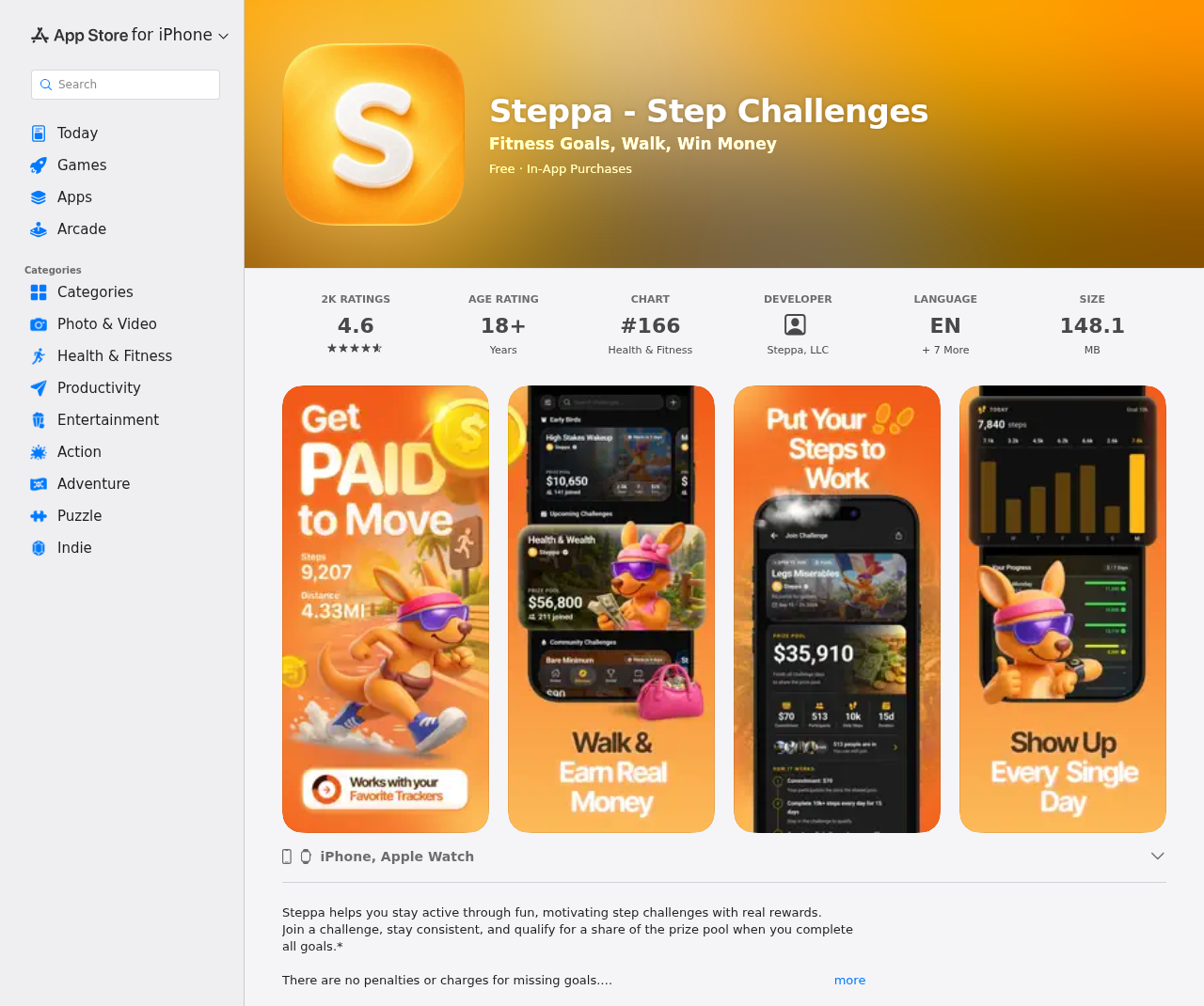
The listing above shows the app’s public face: five-figure prize pools, an 18+ rating and a line about no penalties for missing goals.
Step 5: Payouts have thresholds and limits
Prizes are credited to your cash balance within 24 hours of a challenge ending, and withdrawals need a $25 minimum.
Payouts are capped at $500 in any rolling 24 hours and $2,000 in any rolling 7 days, with no more than three requests a day.
The company may ask for extra proof, such as device data or screenshots, and failing to verify can mean losing pending balances.
Where the Winnings Come From
Under the up-front-fee model, the prize pool is made only of stakes, and the terms say the pool goes in full to the people who finish.
That means a finisher’s profit is money forfeited by entrants who dropped out or missed a day, unless a sponsor funds the pool, as the terms allow for sponsored challenges.
With equal stakes and no forfeits, a finisher would get back about the stake while the service fee stays with the company, so a challenge everyone completes pays no profit.
The reviewer’s net gain of $9 on a $35 entry is consistent with that picture, a modest return funded by the hundreds who reportedly failed.
The reverse also holds: the more people finish, the thinner each share becomes, which fits reviewers’ reports of $25 entries returning about $23.
Walking more therefore does not raise your payout, because only other people’s failures do, and the app rewards persistence rather than effort.
The terms add a safeguard for the company, saying that if nobody qualifies as a winner, no payout is made and the company retains the pool.
Who Runs Steppa, and Where Would a Dispute Go?
The company and its address
The terms name Steppa LLC at 131 Continental Dr, Suite 305, Newark, Delaware 19713, with an email address and a phone number for support.
We found no founder or officer named in them, so a buyer knows the company’s name and address but not the people behind it.
The terms were last updated on November 5, 2026, three days before we read them, which is a reminder to check the current version before paying.
Who processes the money
The terms name Whop as the processor for entry fees and Solo Goal payments, and Mercury as the banking platform for automated payouts.
That means the charge on your statement may carry a processor name rather than the app’s, so keep the receipt and the challenge details together.
Where disputes go
The terms require arbitration, waive class actions and send other claims to courts in Delaware.
You can opt out of arbitration by emailing the company within 30 days of first accepting the terms, with the subject line Arbitration Opt-Out and a clear statement.
The window runs from first acceptance of the terms, so it can close before you ever join a paid challenge.
What we could not verify
We did not join a paid challenge, so we cannot confirm payout timing, support responses or how the app displays fees at the moment of entry.
We also did not read the in-app screens where the app shows each fee, so the exact amounts at entry are unverified.
The reviewer figures above are one person’s results and one competitor’s description, not a measured sample of Steppa users.
Solo Goals: A Different Kind of Bet
Steppa also offers Solo Goals, which the terms call neither competitions nor games of chance.
You pick a missed-day amount between $0.99 and $10.00, and the company retains that amount for each day you miss your step target.
That is a charge for missing a goal, which sits awkwardly beside the App Store description saying there are no charges for missing goals.
The terms keep Solo Goals outside the challenge refund policy, so the non-refundable language for challenges is not the only thing to read.
Who Should Be Careful
The terms say step counts and other metrics are for information and entertainment only, and that the company is not a healthcare provider and has no knowledge of your health.
Daily targets can reach 30,000 steps, which is a heavy load for someone who is not already active, and a missed day can cost money.
That combination creates pressure to push through pain, bad weather or illness, which is the risk the Czech report calls problem exercise.
An addiction specialist quoted by CNN Prima called the app a motivating start but warned of a large risk of addictive behavior.
A trainer quoted in the same report supports any app that gets people moving but advises raising step counts gradually.
If you have a heart or joint condition, are pregnant or have struggled with gambling, talk with a doctor or counselor before putting money on a daily target.
Teenagers should not enter, since the app is rated 18+ and the terms bar anyone from misrepresenting their age.
What to Do Before and After Entering a Challenge
-
Read the fee breakdown in the app. Look for the stake, the service fee and any creator fee before paying, because the terms say each is disclosed before entry.
-
Treat the whole entry fee as spent. The terms say you may lose all of it, so stake only an amount you would lose without regret.
-
Keep your own proof. Screenshot your daily step totals and Apple Health data, because sync delays can mark real steps as missed.
-
Mind the clock. Contact the company within seven days of a challenge ending if you believe the result is wrong, and keep every message.
-
Check where you live. Paid challenges are void where the law prohibits them, and Czechia is one place where they are not offered.
-
Know the exits. If a dispute stalls, ask your card issuer or payment service about the charge, and report problems at ReportFraud.ftc.gov.
Frequently Asked Questions
Is Steppa a scam?
We found a real company that pays finishers, so we do not call it a scam, but we do call it a bet with real losses.
The risks are in the terms, not hidden behind them: non-refundable fees, forfeited stakes and arbitration.
Can you really win money by walking?
Yes, if you finish and enough others forfeit, but the reported results are small, such as a $9 net gain on $35 or $23 back on $25.
Does Steppa count as gambling?
The terms say no, calling it a skill competition, while Apple rates it 18+ and the Czech government office warns of gambling-like harm.
What happens if I miss a day?
In a paid challenge you forfeit your entry fee, and in a Solo Goal the company keeps the missed-day amount you chose for each day.
Can I get a refund?
Entry fees are non-refundable, with discretionary refunds for documented medical emergencies and verified technical failures, and disputes must be raised within seven days.
Is Steppa available outside the United States?
The terms void monetary challenges where the law prohibits them, and the Czech report says paid challenges are unavailable there, so check before you pay.
The Bottom Line
Do not treat Steppa as a way to earn money: it is a pool bet in which the entry fee is at risk and refunds are limited.
If you join anyway, stake only what you can lose, keep proof of your daily steps and act inside the seven-day dispute window.
If a charge looks wrong, contact the company first, then your card issuer, and report persistent problems to the FTC.

Join the discussion
0 commentsShare your experience or ask a question about this article.
Discussion
Start the conversation
Have a question or something useful to share? Add the first comment.