

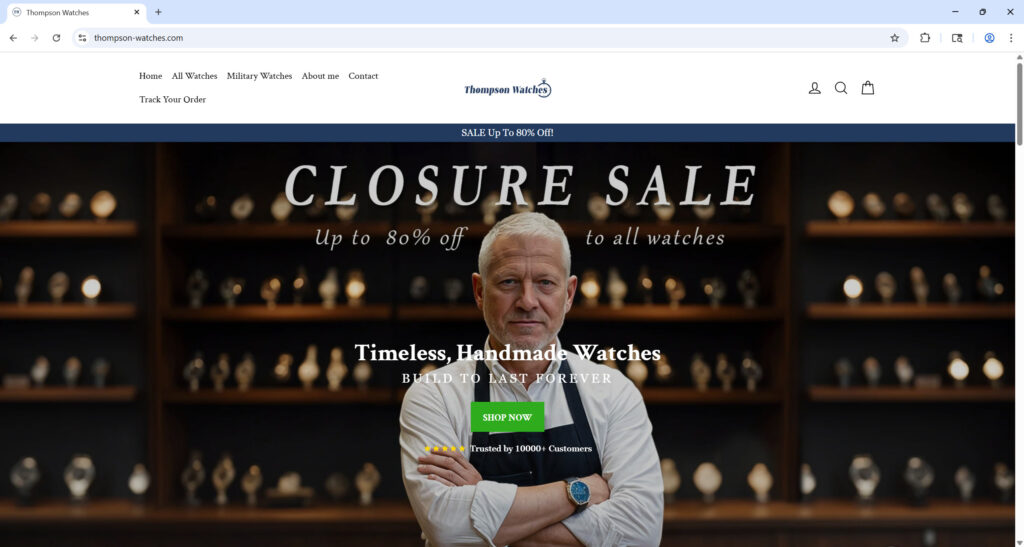
“Closure Sale – Up to 80% OFF!” These bold letters greet visitors of Thompson Watches, a seemingly professional online store claiming to sell “Timeless, Handmade Watches.” With slick visuals, glowing customer testimonials, and a founder’s emotional retirement story, it all feels convincing and authentic. But is it truly a genuine closing down sale, or is it all just a smart marketing ploy wrapped in a web of deception? This article takes a deep dive into the reality behind Thompson-Watches.com and uncovers whether it is a legitimate business or yet another AI-powered dropshipping scam designed to part you from your money.
We will walk through every red flag, show how the scam operates in detail, guide you through recovery steps if you’ve been scammed, and help you recognize the warning signs next time you come across a suspicious online deal.
Scam Overview: The Illusion of Luxury
Thompson Watches markets itself as a sophisticated, boutique-style brand. It uses emotionally appealing language and visuals to lure buyers, featuring slogans such as:
- “Built to last forever”
- “Handmade, Timeless Craftsmanship”
- “Over 40 years of watchmaking excellence”
At first glance, the website seems legitimate. It displays professional-looking photos of watches, images of men in suits proudly holding watch boxes, and written messages of gratitude from a founder supposedly retiring after decades in the industry. The urgency of a “Closure Sale” with discounts of up to 80% adds a psychological push to buy now or miss out.
But as soon as you begin analyzing the site closely, warning signs start to appear.
Red Flags:
- AI-generated founder image: The photo of “Mr. Thompson” on the homepage is likely created using AI or is a heavily edited stock image. Reverse image searches yield no real identity attached to the man featured.
- Fake customer photos: Multiple images of men holding boxes labeled “Thompson Watches” appear overly staged and almost identical in lighting, pose, and background. These images are often sourced from stock libraries or AI rendering tools.
- Products identical to AliExpress listings: Most watches shown on the site are available on platforms like AliExpress, Temu, and DHGate at a fraction of the price (as low as $10–$25). The scam lies in branding them as luxury pieces and inflating the price tag.
- Fabricated reviews: The store claims “1700+ 5-star reviews” but lacks review verification. Independent sources like Trustpilot either have no reviews at all or showcase a few genuine user complaints.
- Lack of transparency: No company address, no customer service number, and only a basic email contact form. This lack of traceability is typical in online scams.
- Misleading urgency triggers: Automated popups stating “Only 2 left in stock!” or “Karen from Texas just bought this!” are hard-coded scripts, not real-time purchase notifications.
The scam appears to be part of a larger network of fraudulent stores that share a common backend structure, reuse images, and cycle through new domain names after negative attention builds up. This makes it hard for consumers to track them down and report them before they vanish or rebrand.
How The Scam Works
Understanding how the Thompson Watches scam operates helps expose the inner workings of a deceptive e-commerce model that is growing rapidly due to AI tools, low-cost suppliers, and clever psychological manipulation. Here’s a detailed breakdown:
Step 1: Build a Professional-Looking Online Store
Using tools like Shopify or WooCommerce, scammers build clean, well-organized websites using pre-made themes. The focus is on luxury aesthetics: dark backgrounds, serif fonts, elegant product photos, and hero banners proclaiming massive sales. Key pages like “About Me” and “Contact” are added to build trust, though their content is thin or vague.
Step 2: Create a Backstory Using AI
A founder’s retirement message and emotional appeals are fabricated using ChatGPT-style AI. They may claim to have built watches for decades, lovingly assembled each piece by hand, and now wish to retire by offering a farewell sale. These false narratives are designed to build trust and urgency simultaneously.
Step 3: Import Cheap Products from China
The scam operators source watches for $10–$25 from suppliers like AliExpress or DHGate. They upload the product images, assign them fancy model names (e.g., “Sean,” “Stephen,” “Leo,” or “Troy”), and price them at $200–$300 with markdowns bringing them to $59.95–$79.95. The fake markdowns suggest extreme value.
Step 4: Add Trust-Building Elements
Trust badges such as “Trusted by 10,000+ Customers,” “SSL Secured Checkout,” and “Money Back Guarantee” are added to the site. These visuals appear professional but are meaningless since there’s no accountability. Fake reviews with 5 stars and short messages like “Great quality!” or “Fast shipping!” are sprinkled across the site to strengthen perceived legitimacy.
Step 5: Fake Testimonials and AI-Enhanced Images
Men holding watch boxes with forced smiles are shown across the store. Some images appear to be deepfakes or generated with Midjourney/DALL-E. Names and countries are sometimes attached, giving the illusion of international popularity.
Step 6: Urgency and Fear of Missing Out (FOMO)
Popups like “Only 3 left!” or “Hurry! 90% sold out!” manipulate buyer psychology. Even the product pages mention “Only 18 watches left before they’re gone forever!” — a phrase repeated across multiple scam sites. Countdown timers and bulk discounts (Buy 2 get 10% off, Buy 3 get 15% off) are used to pressure buyers.
Step 7: Take Payment and Minimize Liability
The scam store accepts payments via Shop Pay, PayPal, and credit cards. If buyers complain, they are often ghosted or sent generic replies. If any products are delivered, they are of extremely poor quality, non-functional, or completely different from what was shown online.
Step 8: Exit, Rename, or Rebrand
Once chargebacks and reports start to escalate, the operators shut down the domain, move to another one, and repeat the entire scheme under a new brand name. These scammers use throwaway domains and cloned site templates to keep cycling fresh operations without consequence.
What To Do If You Have Fallen Victim to This Scam
Don’t panic, but act fast. If you believe you’ve been duped by Thompson Watches or a similar site, here’s what you should do:
1. Prevent Further Charges
- Credit/Debit Card Users: Contact your bank immediately to request a chargeback and flag the transaction as fraudulent.
- PayPal Users: Go to your dashboard, select the transaction, and open a dispute. Escalate to a claim if no response comes within 48 hours.
2. Save All Communication and Proof
- Screenshots of your order
- Email correspondence or delivery delays
- Product images (if received)
- Evidence of missing tracking or fake tracking numbers
3. Report the Scam to Authorities
Use these official platforms to alert regulators and protect others:
- United States:
- FTC Complaint Assistant: https://reportfraud.ftc.gov/
- Better Business Bureau: https://www.bbb.org/
- United Kingdom:
- Action Fraud: https://www.actionfraud.police.uk/
- European Union:
- European Consumer Centre: https://www.eccnet.eu/
4. Leave Reviews and Warnings
Make sure others don’t fall for the same scheme:
- Leave a review on Trustpilot or SiteJabber
- Post on Reddit forums like r/scams or r/fraud
- Comment on social media ads where you saw the original promotion
5. Monitor and Freeze Accounts
- Check your bank account for any unusual or repeat transactions
- Consider changing your credit card if the scammer had full access
- Freeze your card if unsure and discuss next steps with your bank
6. Educate Others
Warn friends and family, especially those more vulnerable to online marketing tricks. The more we collectively expose these scams, the harder it becomes for them to thrive.
Here is a detailed, SEO-optimized FAQ section for the Thompson Watches scam, written for improved readability and Google Search performance:
Frequently Asked Questions (FAQ) About the Thompson Watches Scam
Is Thompson Watches a legitimate brand?
No, Thompson Watches is not a legitimate watch brand. Despite its professional-looking website and emotionally driven marketing, the store is part of a deceptive dropshipping scheme that sells cheaply made watches at inflated prices.
Are the Thompson Watches really handmade or luxury items?
No. The watches sold by Thompson Watches are not handmade or luxurious. The same models can be found on websites like AliExpress and DHGate for a fraction of the price, often under $20. Claims about craftsmanship, durability, and decades of experience are fabricated.
Who is the founder of Thompson Watches?
There is no verifiable individual behind the brand. The supposed founder and watchmaker, often shown as a white-haired man on the homepage, is an AI-generated or stock photo. There is no credible information or public record confirming this person’s existence.
Why do the reviews on the site look so positive?
The reviews on Thompson-Watches.com are fake or unverified. They are generated to build trust and create the illusion of customer satisfaction. Many images used for testimonials are stock photos or AI-created, and there’s no option to leave or verify real reviews on the site.
How does the Thompson Watches scam work?
The scam operates by creating a fake brand with a compelling backstory and urgency-driven discounts. It lures buyers with the promise of 80% off luxury watches and uses AI-generated images and testimonials to build credibility. The products are then drop-shipped from overseas suppliers or not delivered at all.
Can I get a refund from Thompson Watches?
In most cases, no. The company provides no phone number or return address, and customer support is either unresponsive or automated. If you purchased using PayPal or a credit card, your best option is to dispute the charge as soon as possible.
What should I do if I bought a watch from Thompson-Watches.com?
Act quickly:
- Contact your bank or PayPal to initiate a chargeback.
- Save all documentation, including receipts and correspondence.
- Report the scam to agencies like the FTC or Action Fraud (UK).
- Warn others by posting reviews and sharing your experience.
How can I check if an online store is a scam?
Look for the following signs:
- No verifiable contact details (phone number, address, live support)
- Unrealistic discounts (70%–90% off)
- Pressure tactics (low stock alerts, countdown timers)
- Overly positive or fake-looking reviews
- Stock photos or AI-generated images
- Domain age less than a year (check via WHOIS)
Is Thompson Watches connected to other scam websites?
Yes. It appears to be part of a broader network of scam sites using identical templates, fake founder stories, and the same product catalog under different brand names. These sites often disappear and rebrand under new domain names once exposed.
Can I report Thompson Watches to authorities?
Yes. Reporting helps others avoid the same trap. Use the following resources:
- U.S.: FTC at reportfraud.ftc.gov
- UK: Action Fraud at actionfraud.police.uk
- EU: ECC Net at eccnet.eu
The Bottom Line
Thompson Watches is not a trusted luxury brand, nor is it a real closing store sale. It is a carefully crafted illusion exploiting AI tools, psychology, and the dropshipping model to deceive consumers. What looks like a farewell discount on a handmade product is, in reality, a bait-and-switch for poor-quality watches mass-produced and sold under a false identity.
Always be skeptical of:
- Massive discounts over 70%
- Emotionally charged founder stories
- Urgency-driven popups and low stock alerts
- Sites lacking customer service numbers, addresses, or verified third-party reviews
When shopping online:
- Do a background check
- Search for “[Store Name] + scam”
- Use secure payment methods with buyer protection
By remaining informed, alert, and cautious, you can avoid these traps and help others stay safe from falling into the same scams. In the case of Thompson Watches, the glossy presentation hides a rotten core. Don’t be fooled — think before you click.
Stay aware. Shop smart. Protect your money.








