

The Trump Tariff Refunds scam is built around one powerful idea: free money tied to a hot political and economic headline.
Scammers know that when people hear words like “refund,” “rebate,” “stimulus,” or “government payment,” they pay attention. So they package those words into text messages, emails, and social media ads that look urgent, official, and easy to believe.
The promise sounds simple. You are told you qualify for a Trump tariff refund, tariff rebate, or tariff relief payment. To receive it, you just need to click a link, verify your identity, or pay a small processing fee.
But the offer is fake.
The real goal is to steal personal information, banking details, login credentials, and in some cases credit card data. In other cases, the scammers are simply trying to push people into lead generation funnels, bogus call centers, or other shady schemes that make money off their information.
This article explains how the Trump Tariff Refunds scam works, why it feels convincing, what warning signs matter most, and what to do if you already interacted with one of these messages.
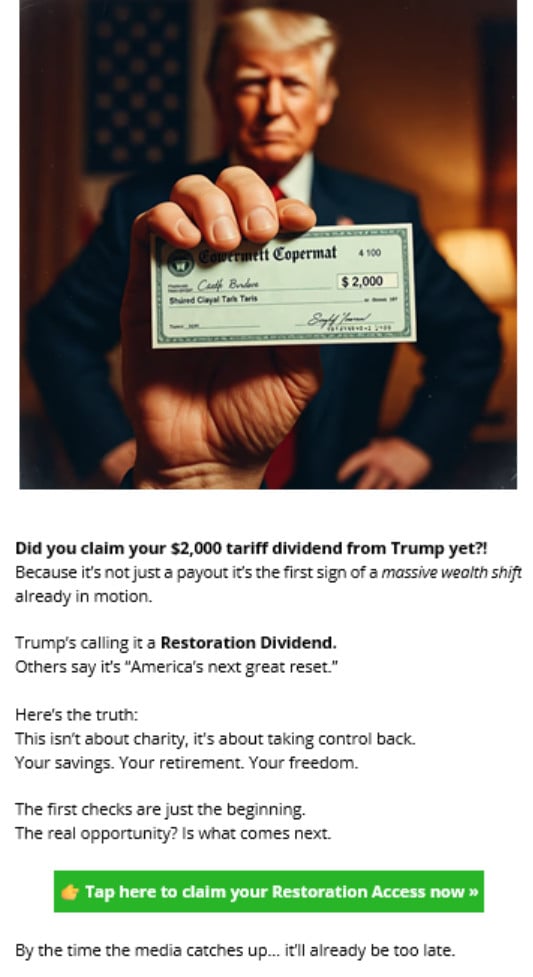
Scam Overview
Why this scam exists in the first place
This scam did not appear out of nowhere. It grew out of real headlines.
In November 2025, Reuters reported that the White House said Trump was committed to exploring a $2,000 dividend to Americans using tariff income. Then in March 2026, Reuters reported that a federal judge ordered the government to begin paying refunds related to unlawful emergency tariffs, with estimates ranging from about $168 billion to $182 billion, while Customs and Border Protection worked on a refund mechanism for importers. That combination of political talk, tariff confusion, and refund headlines gave scammers exactly what they needed: a believable story they could twist into fake consumer offers.
That is what makes the Trump Tariff Refunds scam so effective.
It does not rely on a completely invented subject. It borrows pieces of real news, strips away the context, and then repackages everything into a fake message aimed at ordinary people.
For many people, that distinction is easy to miss.
Someone sees a text saying they are eligible for a “tariff refund.” They remember hearing something about tariffs on the news. They may even recall talk about rebate checks or tariff dividends. That small amount of familiarity lowers their guard.
The scam works because it feels close enough to something real.
The basic pitch
The pitch usually comes in one of three ways:
- A text message claiming your tariff refund is ready
- An email saying you must verify your information to receive payment
- A social media ad promising tariff relief, tariff credits, or Trump tariff rebate benefits
The message often says your payment is pending, approved, delayed, or at risk of cancellation unless you act now.
That urgency is intentional.
Scammers do not want people to stop and think. They want them moving quickly, before they verify anything with an official source.
The fake offer may promise:
- A $2,000 refund
- A tariff rebate check
- A tariff relief voucher
- A Trump stimulus-style payment
- A refund tied to higher prices caused by tariffs
- A “consumer relief” payment that allegedly offsets import taxes
These offers vary, but the psychological trigger is the same. The victim is made to feel that money is available right now and will disappear unless they respond immediately.
What officials have already warned about
This pattern is not hypothetical. Officials have already warned about tariff rebate scam texts.
The Idaho Attorney General issued a warning about fraudulent texts claiming recipients had to act urgently to receive $2,000 tariff rebate checks. The office said the messages were not from any government agency and stressed that no government payment would require a text response to qualify for it.
That warning matters because it confirms the core structure of the scam: fake urgency, fake government authority, and a link or response request designed to pull the victim into the trap.
At the same time, broader federal warnings about refund scams line up almost perfectly with what these tariff messages are doing. The FTC warned in January 2026 that texts and emails about “tax refunds” can be phishing scams used to steal personal information and refunds, and it said real tax agencies do not contact people by text, email, or social media to request information that way. The IRS also warns that scammers mislead people about refunds, credits, and payments, often using pressure, suspicious links, and promises that sound too good to be true.
So even when the wording changes from “tax refund” to “tariff refund,” the fraud pattern remains very familiar.
Why ordinary consumers are especially vulnerable
One reason this scam spreads so fast is that tariffs are confusing to many people.
Most consumers do not spend their time reading customs law, trade policy, or court rulings. They only hear the broad public version: tariffs are in the news, politicians are talking about refunds, and prices are going up.
That confusion creates room for scammers.
People may not know:
- Who would actually receive any real tariff-related refund
- Whether the payment would come from the IRS, Treasury, Customs, or another agency
- Whether a text message could ever be a legitimate notice
- Whether a small “processing fee” is normal
- Whether social media ads can be trusted
When people are unsure, they are more likely to follow instructions just to be safe.
Scammers exploit uncertainty better than almost anyone.
The real-world context scammers are abusing
One of the most important facts readers need to understand is this: the real tariff refund process reported by Reuters involved importers and customs collections, not random consumers being contacted out of the blue with a text link. Reuters reported that Customs and Border Protection was building a system tied to refunds of unlawful tariff collections, and that the money at issue concerned importers.
That is a major clue.
A consumer who gets a random text saying, “Claim your Trump tariff refund now,” is not being approached through a normal refund mechanism. The scammer is taking a real policy story and converting it into a fake direct-to-consumer payout.
That is the heart of the deception.
How the scam appears across platforms
This scam is not limited to text messages.
The Washington Post reported that deceptive Facebook and Instagram ads were promoting fake “tariff relief” payments and bogus “tariff relief” vouchers, sometimes using figures such as $750 or $5,600. According to the report, these ads appeared designed either to collect personal information or funnel users into marketing or call-center schemes.
That matters because many victims still assume that if an ad appears on a major platform, it must have passed some kind of legitimacy check.
Unfortunately, that assumption can be expensive.
Scammers know how to dress fake offers in clean branding, patriotic language, and slick ad copy. They may use American flags, government-like seals, references to Trump, references to tariffs, or phrases such as:
- “New consumer tariff relief program”
- “Claim your Trump refund”
- “Approved tariff rebate”
- “National tariff reimbursement”
- “Consumer import tax recovery”
- “Price inflation relief credit”
None of that makes the offer real.
It just makes the scam look more polished.
Why the “small fee” trick is so dangerous
Some versions of this scam do not stop at identity theft.
Instead of just asking for personal information, they ask the victim to pay a small fee. That fee may be described as:
- A processing fee
- A release fee
- A verification fee
- A delivery fee
- A tax clearance fee
- A card validation charge
This is one of the oldest scam tactics in the book.
The amount is kept low on purpose. It may be $1, $2.99, $4.95, or some similarly small number. The scammer wants the victim to think, “That is not much. I will just pay it and get my refund.”
But the small fee is often just the first theft.
Once the victim enters card details, several things can happen:
- The card is charged multiple times
- The card data is stored and reused
- The victim is enrolled in a hidden subscription
- The victim’s billing information is sold or passed to other fraudsters
- The site collects enough data to support larger fraud later
A tiny charge can turn into a much bigger problem fast.
The emotional hooks behind the scam
The Trump Tariff Refunds scam is not only about fake policy. It is about emotional timing.
Scammers aim this offer at people who are already worried about money. Higher prices, economic stress, political uncertainty, and talk of government relief all create the perfect environment for false hope.
The message often hits several emotional buttons at once:
- Relief: “You are owed money”
- Urgency: “Act now before it expires”
- Authority: “This is a government-related benefit”
- Fairness: “This refund helps offset tariff costs”
- Scarcity: “Limited time verification”
- Fear: “Your payment may be canceled”
That combination is powerful.
A person who would normally ignore a random link may click when the message seems to offer money they believe they deserve.
The branding tricks scammers use
Scammers rarely send messages that say, “Hello, I am a criminal.”
Instead, they imitate the tone and look of official communication.
Some messages use vague agency names that sound serious but do not make much sense, such as “Department of Legal Compliance,” “Administration Registry,” “Consumer Payout Office,” or similarly generic labels. Others borrow the names of real agencies while directing people to fake sites with odd web addresses.
The IRS warns people to watch for odd or misspelled links, pressure tactics, and impersonators who make urgent demands. The FTC likewise warns that real agencies do not use random texts, emails, or social media messages to collect your sensitive information for a refund.
That is why the scam often succeeds more with tone than with detail.
The wording sounds official enough for a quick glance. And that is often all scammers need.
Who is most at risk
Anyone can fall for this scam.
But some groups are targeted more aggressively:
- Older adults who are less comfortable verifying digital links
- People who are under financial pressure
- Social media users who frequently click sponsored posts
- People who follow political content and are used to hearing about stimulus-style payments
- Consumers who already expect some kind of refund or rebate during tax season
- People who have recently dealt with government forms, benefits, or claims
This does not mean the victims are careless.
It means the scam is engineered to meet people where they are already vulnerable.
That is an important distinction.
Why this scam will likely keep evolving
Even after one version gets reported, the fraud does not end.
Scammers simply rename it.
Tomorrow it may be called:
- Trump Tariff Refund
- Tariff Dividend Claim
- Tariff Relief Credit
- Consumer Tariff Reimbursement
- Import Price Relief Program
- Economic Recovery Rebate
The specific wording changes, but the structure stays almost identical.
That is why readers should not focus only on one exact phrase. They should learn the underlying pattern. Once you understand the pattern, the next version becomes easier to spot before any damage is done.
How The Scam Works
Step 1: The scammer piggybacks on a real headline
The first step is always credibility.
Scammers look for subjects already circulating in public conversation. Tariffs, rebates, consumer price relief, Trump statements, court rulings, and “refund” headlines all create a believable background story.
Instead of inventing a claim from scratch, scammers borrow from real events and turn them into a fake personal opportunity.
That is what makes this scam more dangerous than a random nonsense message. It sounds anchored to something you may have actually heard discussed on TV, in a Facebook post, or in a political clip.
And when a scam sounds familiar, people hesitate less.
Step 2: The bait arrives through text, email, or social media
Next comes delivery.
The victim receives a message such as:
- “Your Trump Tariff Refund is waiting”
- “Your tariff rebate has been approved”
- “Final notice to claim your tariff relief payment”
- “Navigate to the administration registry to clear your auto alert”
- “Act now to release your approved tariff refund”
The language may be clumsy. It may also be polished.
Some versions are obviously suspicious. Others look clean enough to pass a quick inspection.
On social media, the hook is often even more refined. The ad may use an image of cash, a government-style seal, or a patriotic design. It may promise a fixed amount like $750 or $2,000 and frame the offer as consumer relief. Reporting from the Washington Post showed how fake tariff-relief ads on Meta platforms directed people toward lead-generation or information-harvesting schemes.
This wide distribution matters because the scam meets people in the exact places they already spend time.
Step 3: The message creates urgency
A good scam does not just make an offer. It creates pressure.
The victim is told the refund is pending, but action is required right away. Common phrases include:
- “Respond immediately”
- “Your payment will be canceled”
- “Final verification needed”
- “Claim expires today”
- “Failure to act may delay release”
Urgency reduces scrutiny.
Once the victim feels rushed, they are less likely to pause and ask simple questions such as:
- Why would a real government payment depend on a text reply?
- Why is there a deadline measured in hours?
- Why is the link not a clearly recognizable official domain?
- Why do I need to pay money to receive money?
The Idaho Attorney General specifically warned that tariff rebate scam texts used urgent language and fake deadlines, which is a classic pressure tactic in this kind of fraud. (Idaho Office of Attorney General)
Step 4: The victim is pushed to click a link
The link is where the scam really begins.
The text or ad directs the victim to a website that may look surprisingly polished. Sometimes it includes:
- Official-looking logos
- Red, white, and blue color schemes
- References to “refund status” or “claim portal”
- A countdown timer
- A form asking for identity details
- Fake testimonials
- Fine print that is vague, hidden, or misleading
In some cases, the URL itself gives away the fraud. It may be a strange domain, a shortened link, or a misspelled imitation of a government-style address.
The IRS warns people to watch for odd or misspelled web links because they can lead to harmful sites instead of real government pages.
But scammers know many people do not study web addresses carefully, especially on a phone screen.
That is why the site only has to look legitimate for a few seconds.
Step 5: The scammer harvests personal information
Once the victim lands on the fake page, the next request is usually framed as “verification.”
The site may ask for:
- Full name
- Address
- Date of birth
- Social Security number
- Driver’s license number
- Phone number
- Email address
- Bank account information
- Debit or credit card details
This is the moment where the scam becomes especially dangerous.
People often assume they are just filling out a normal claim form. In reality, they are handing over exactly the information scammers need for identity theft, account takeover, payment fraud, or future phishing campaigns.
The FTC warned that refund-themed phishing messages may ask for personal and bank details under the excuse of verifying your identity and sending money. (Consumer Advice)
That is almost exactly what these fake tariff refund pages are doing.
Step 6: The “small fee” is introduced
Some victims never reach a payment page. Others do.
When the small fee appears, it is usually explained as harmless and routine. The site may say it is needed to:
- Confirm your card
- Release the refund
- Verify your identity
- Activate direct deposit
- Cover a processing charge
This is meant to feel normal.
The amount is often small because small charges lower resistance. A victim who would refuse a $99 fee may accept a $1.95 charge, especially if the promised refund is much larger.
But once the victim enters card details, the scammer gains something extremely valuable.
Even when the immediate charge is tiny, the card number, expiration date, billing address, and sometimes CVV are enough to facilitate additional fraud.
The fee is not a harmless admin cost. It is part of the theft.
Step 7: The victim is sometimes pushed into a deeper funnel
Not every scam site steals money directly on the first page.
Some sites collect data and then redirect the victim into a second-stage funnel. That can include:
- A call center pitch
- A fake benefit enrollment page
- A debt relief offer
- An insurance lead form
- A subscription trap
- Another scam entirely
The Washington Post described fake tariff-relief ads that appeared to funnel people toward marketing call centers or information-collection schemes rather than a real payment process. (The Washington Post)
This matters because victims may think, “Nothing happened, so maybe it was not a scam.”
But if you shared your details, something did happen.
Your information may now be circulating in marketing, scam, or lead-broker ecosystems that create problems for months.
Step 8: The scammers keep the victim engaged
Some scams end after one form submission.
Others continue through follow-up texts, emails, and calls.
Once a victim has clicked or shared information, scammers may label them as responsive. That makes them more valuable.
They may receive:
- More messages about the same refund
- Fake calls from “agents” helping finalize the payment
- Requests for additional documents
- More fees
- Pressure to provide banking or tax details
- New scam offers that build on the original story
This is why one click can create a long tail of fraud risk.
The initial tariff refund claim may just be the opening move.
Step 9: The money never arrives
At the center of the scam is a basic truth: there is no consumer payout waiting on that fake page.
Victims may see any of these excuses after submitting information:
- “Your claim is under review”
- “Verification incomplete”
- “Payment delayed”
- “Temporary processing issue”
- “More information required”
Or the site may simply vanish.
The phone number stops working. The email bounces. The ad disappears. The page goes offline.
That disappearance is not accidental. Scam operators frequently rotate domains, ads, and phone numbers to stay ahead of complaints and platform enforcement.
Step 10: The real damage appears later
The most frustrating part for many victims is that the damage is not always immediate.
A person may enter their details today and only discover the consequences days or weeks later.
Those consequences can include:
- Unauthorized card charges
- New phishing emails
- More scam texts
- Bank account issues
- Attempts to open accounts in their name
- Suspicious logins
- Fake customer service calls
- Identity theft-related notices
Because the harm is delayed, some victims never connect it back to the original tariff refund form.
That delay works in the scammer’s favor.
Why the scam feels so believable in the moment
It is easy to look at a scam afterward and wonder how anyone could click.
But that view misses how the experience feels in real time.
The victim may be:
- Busy
- On a phone
- Distracted
- Financially stressed
- Already expecting a refund of some kind
- Exposed to constant news about tariffs and political payments
- Reassured by the fact that the message mentions a real public figure or real policy topic
That is why shame has no useful place here.
People do not fall for scams because they are foolish. They fall for scams because the scammer created a convincing shortcut between a real headline and a fake personal benefit.
The biggest red flags to watch for
Before moving to next steps, it helps to summarize the clearest warning signs.
A Trump Tariff Refund message is likely fraudulent if it does any of the following:
- Arrives by unsolicited text or random email
- Uses urgent language or threats
- Claims your payment is about to expire
- Tells you to click a link to verify your eligibility
- Asks for your Social Security number or banking information
- Requires a small fee to release money
- Comes from a suspicious domain
- Uses a vague agency name
- Appears in a sponsored social media post promising “easy” money
- Mentions tariff relief for ordinary consumers without directing you to a clearly official source
The FTC says real tax agencies do not reach out by text, email, or social media to collect information for a refund, and the Idaho Attorney General said no government payment would require a text response to qualify. Those two principles alone can help many people avoid this trap.
What To Do If You Have Fallen Victim to This Scam
- Stop all contact immediately
Do not reply to more texts, emails, or calls from the sender.
Do not click anything else. Do not argue. Do not try to “fix” the claim by giving additional information. The moment you suspect fraud, the goal is to cut off the scammer’s access.
- If you entered card details, contact your bank or card issuer right away
Tell them you believe your card information was submitted to a fraudulent tariff refund or tariff rebate website.
Ask them to:
- Review recent charges
- Block or reverse unauthorized transactions where possible
- Replace the card
- Monitor the account for fraud
- Disable recurring charges if any were created
This step matters even if the only charge was small. Small test charges often come before larger ones.
- If you shared bank account information, contact your bank immediately
Tell the bank the details were shared with a scam site.
Ask what protective measures are available, including heightened monitoring, account changes, or other fraud safeguards. The sooner you flag the risk, the better.
- If you entered personal identity information, act as though identity theft is now possible
That includes your Social Security number, date of birth, address, or driver’s license number.
You should consider taking identity-theft precautions, such as reviewing your credit reports, placing a fraud alert or security freeze where appropriate, and watching for suspicious notices, applications, or account activity.
The FTC specifically warns that refund phishing can be used to steal your identity, not just your immediate payment details.
- Change passwords if you reused any login information
Some scam pages ask victims to create an account, sign in, or reuse email credentials.
If you entered a password anywhere on the fake site, change it immediately. Start with your email account, then move to banking, shopping, and any other important accounts that used the same or a similar password.
- Report the text message as junk
The FTC advises using your phone’s report-junk option or forwarding unwanted texts to 7726, which spells SPAM. This helps carriers detect and block similar campaigns.
This will not reverse the scam by itself, but it does create a record and may help reduce further targeting.
- Report the email as phishing or spam
Mark the email as spam or phishing in your email service.
Do not just delete it without reporting it first. Reporting helps train filtering systems and may protect other users from the same campaign.
- Document everything
Take screenshots of:
- The text message or email
- The website
- The URL
- Any payment confirmation page
- Charges on your card
- Any follow-up messages or calls
This evidence can help when dealing with your bank, card issuer, law enforcement, or fraud-reporting systems.
- Report the scam to the appropriate authorities
Depending on where you are and what happened, that may include consumer protection agencies, financial institutions, or online fraud reporting systems.
The IRS has fraud reporting guidance for tax-related scams, and the FTC provides channels for reporting fraud. The exact category may vary, but the key point is to report it instead of silently moving on.
- Watch for secondary scams
This is a critical step that many victims overlook.
After one scam, new messages may arrive claiming to help recover your lost money or complete your tariff refund. These recovery scams are common. The new scammer may even appear to know details from the first interaction.
Do not trust anyone who contacts you out of the blue promising to recover funds, unlock your payment, or clean up the case for a fee.
- Keep monitoring for several months
Not all fraud appears immediately.
Review card statements, bank activity, credit reports, and email alerts carefully. Watch for new account openings, password reset attempts, or unfamiliar transactions.
A scam involving personal data can have consequences that appear long after the fake tariff refund page is gone.
- Do not blame yourself
This matters more than people realize.
Scammers build these campaigns to feel timely, official, and emotionally persuasive. They use real headlines, real political themes, and platform ads that look far more legitimate than old-fashioned spam.
The right mindset is not shame. It is fast, practical damage control.
The Bottom Line
The Trump Tariff Refunds scam is a classic phishing and payment trap wrapped in a timely political headline.
It works because it borrows the language of real tariff news, real refund talk, and real economic anxiety, then turns all of that into a fake personal offer delivered by text, email, or social media ad.
The message may promise a tariff rebate, tariff relief payment, or Trump refund check. But the real objective is far less generous. Scammers want your personal information, your banking details, your credit card data, or a quick fee they have no intention of returning.
Official warnings already show the pattern clearly. Idaho’s Attorney General warned about fake $2,000 tariff rebate texts, while the FTC and IRS continue warning that scammers use refund-themed messages, suspicious links, and pressure tactics to steal money and identities. Reuters has also reported that real tariff-related refunds being built out by the government concern importers and customs collections, not random consumers receiving unsolicited claim links.
That is the key takeaway.
A real government payment does not need a random text response. A real refund does not require a mystery fee on a suspicious website. And a real claim process should never depend on panic, secrecy, or rushed clicks.
When a message says money is waiting and all you need to do is act fast, assume the opposite.
Slow down, verify independently, and do not hand over information just because the words “tariff,” “Trump,” or “refund” are in the same sentence.
FAQ
What is the Trump Tariff Refunds scam?
The Trump Tariff Refunds scam is a fake offer that claims you can collect a tariff refund, rebate, or relief payment.
Scammers spread it through text messages, emails, and social media ads. The real goal is usually to steal personal information, banking details, or credit card data.
Are Trump tariff refund text messages legitimate?
In general, no.
A random text telling you to click a link, verify your identity, or pay a small fee to receive a government-related refund is a major red flag. That is a common scam pattern.
Why are scammers using the words “tariff refund”?
Because it sounds believable.
Many people have seen headlines about tariffs, court cases, economic relief, or rebate-style payments. Scammers use that public confusion to make a fake offer sound official.
How does the scam usually start?
It often starts with an unsolicited message that says you qualify for money.
The message may claim your refund is approved, pending, or about to expire. It then pushes you to click a link, fill out a form, or respond immediately.
What information are scammers trying to steal?
They may try to collect:
- Your full name
- Home address
- Phone number
- Email address
- Date of birth
- Social Security number
- Bank account details
- Debit or credit card information
Some fake sites also try to steal login details or get you to sign up for unwanted subscriptions.
Why do they ask for a small fee?
Because it lowers your guard.
A victim may be told to pay a small processing, release, or verification fee to unlock the refund. But that fee is fake. In many cases, the card details are the real target.
Can they steal my identity from this scam?
Yes, they can.
If you gave them enough personal information, they may try to use it for identity theft, phishing, fraudulent account openings, or other scams later.
What should I do if I clicked the link but did not enter anything?
You should still be careful.
Close the page immediately. Do not return to it. If the site downloaded anything or asked you to install something, scan your device with trusted security software and watch for unusual behavior.
What should I do if I entered my credit card information?
Contact your bank or card issuer right away.
Tell them your card information may have been submitted to a scam website. Ask them to review transactions, block suspicious charges, and replace the card if needed.
What should I do if I gave out personal information?
Treat it seriously.
Monitor your accounts, watch for suspicious messages, and consider identity-theft protections such as fraud alerts or credit freezes if the exposed information was sensitive enough.
Are social media ads for tariff relief safe?
Not automatically.
Just because an ad appears on Facebook, Instagram, or another platform does not mean it is legitimate. Scammers often use polished ads to make fake offers look trustworthy.
How can I tell a tariff refund message is fake?
Watch for these warning signs:
- It arrives out of the blue
- It creates urgency
- It says your payment will expire
- It asks you to click a link
- It asks for personal or financial information
- It requires a small fee to release money
- It comes from a strange website or vague “agency”
Will a real government refund require a fee first?
No legitimate refund process should require you to pay a random fee through a suspicious link just to receive money.
That is one of the clearest scam signals.
Can scammers contact me again after I fall for it?
Yes.
People who respond once are often targeted again. You may receive follow-up texts, emails, or calls claiming to help complete the refund or recover lost money. Those can be scams too.
How do I stay safe from these scams in the future?
Use a simple rule: never trust unsolicited messages about money.
If a message claims you qualify for a refund, rebate, or relief payment, do not click the link. Verify independently through official channels you look up yourself.








