

A Walmart employee, an unexpected fortune, and an arrest that supposedly leaves police speechless. It sounds like the beginning of a story worth opening.
If that headline brought you to Tyler’s Telegram Channel, pause before following the next link. There is more to this invitation than the headline suggests.
Overview
The Walmart employee story is the hook
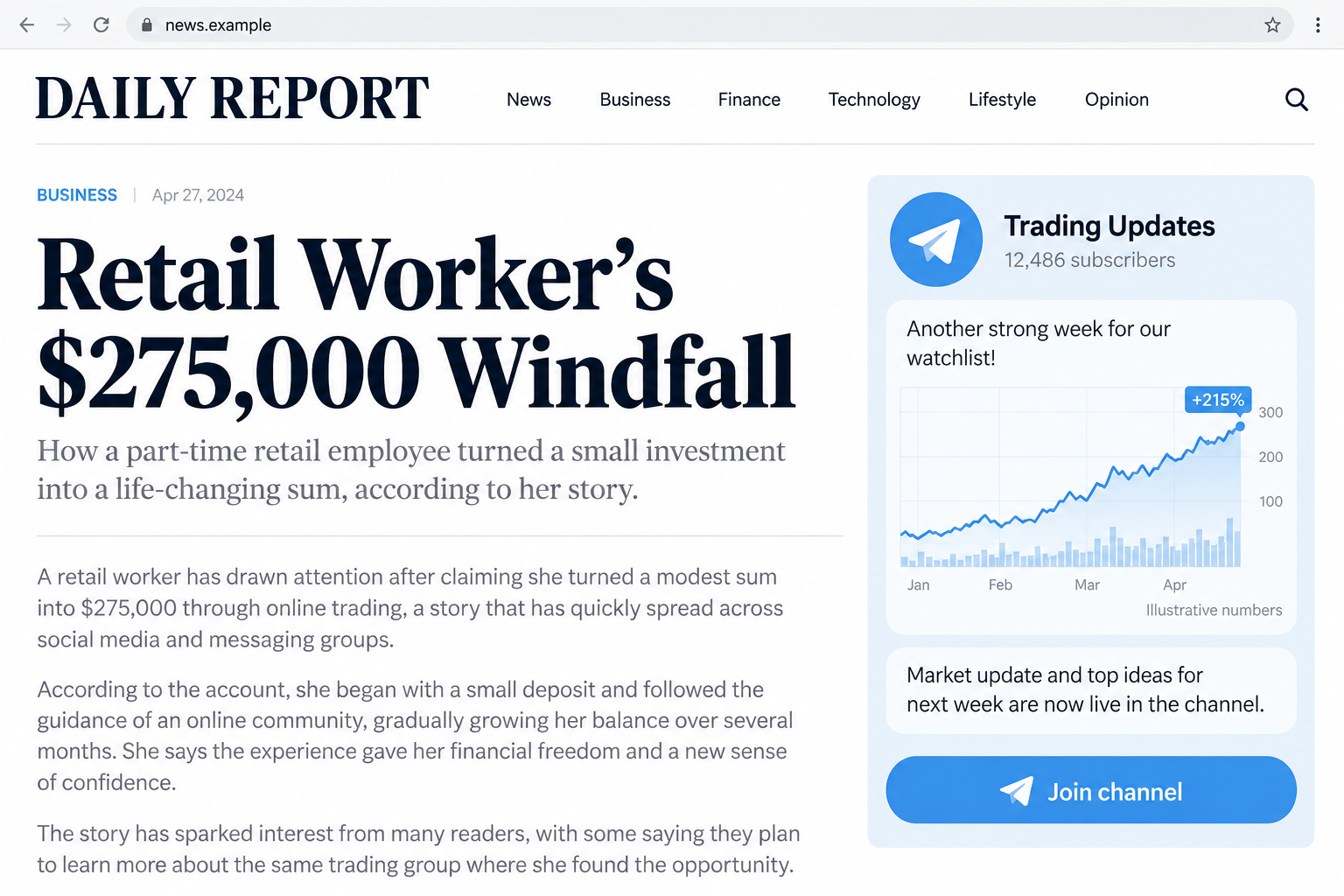
The Tyler’s Telegram Channel scam uses a supposed news report about a Walmart worker named Kevin to introduce a trading opportunity.
One promotion claims $275,000 appeared in his account. The associated article changes the amount to $300,000 and wraps the story in TMZ-style branding.
Those figures are advertising claims, not verified earnings. Neither an arrest-style headline nor a picture of an account balance establishes that someone made that money.
The article’s real purpose becomes clearer as it moves away from the alleged arrest and toward a channel offering trading signals.
A familiar outlet becomes a borrowed credential
The campaign route identified as tmz.one is not TMZ’s normal news domain, tmz.com. The extra branding is meant to make the sales story feel reported.
That distinction matters more than whether the page looks polished. Anyone can imitate a masthead, invent an interview, and place a messaging link beneath it.
The opening illustration uses fictional page details to show this news-to-channel handoff. It is not an original screenshot or a record of someone’s trades.
What this warning does and does not cover
The established problem is the impersonating promotion. Do not treat it as an independently verified TMZ report or evidence that a trading channel delivers dependable income.
- The worker’s windfall is part of the pitch, not a financial record.
- A Telegram invitation is not a license to provide investment services.
- Names such as Tyler Live Trading and TradingWithTyler need exact account checks.
- Similar names do not establish that unrelated people or businesses are involved.
No payment or withdrawal was tested for this investigation. Particular withdrawal blocks, account losses, and fee demands should be documented individually rather than assumed.
Why the Arrest Story Makes the Offer Feel Urgent
The headline does two jobs at once. It promises a surprising event and suggests that an ordinary worker discovered something powerful enough to attract official attention.
That setup can pull readers past their normal skepticism. Instead of asking who is selling trading access, they start wondering how Kevin supposedly made his money.
The story then supplies familiar pressures: long shifts, household bills, and a family needing more time and security. These details make the character easy to identify with.
There is nothing suspicious about wanting a better income. The manipulation lies in using an unverified personal success story as proof of a financial opportunity.
The alleged arrest also supplies a convenient explanation for why the method is not widely known. The story implies that widespread success would threaten ordinary employment.
That is a promotional narrative, not a reason to trust the method. A useful financial service should withstand ordinary questions without invoking suppression or secret access.
Pay particular attention when a supposed news report answers every concern with another success anecdote. Readers need identifiable businesses, clear risks, and verifiable terms instead.
How the Tyler’s Telegram Channel Scam Works
Step 1: A sponsored headline catches people looking for extra income
The first contact is presented as a dramatic news item rather than a straightforward advertisement for trading signals.
Walmart provides the familiar setting. The large transfer provides the surprise. The police angle gives the reader a reason to click before asking who sponsored it.
A recognizable employer is not endorsing a trading offer simply because its name appears in a headline. The same applies to a news outlet’s copied logo.
Before opening an invitation, separate the account paying for the ad from the organization pictured inside it. Those identities may be entirely different.
Step 2: The click opens a news-looking page outside the real outlet
The imitation page extends the story with article formatting, interview-style dialogue, and apparent reader reactions. These features make the commercial message resemble editorial coverage.
The address is the decisive checkpoint. A TMZ-like page on another domain does not become TMZ journalism because its headline, colors, or navigation look familiar.
Open the real outlet separately and search its own archive. A link supplied by the promotion cannot authenticate the promotion itself.
Even an HTTPS padlock only concerns the connection. It does not verify the author, the interview, the trading results, or the advertised channel.
Step 3: Kevin’s supposed results introduce the trading signals
The article credits the worker’s improved finances to following a channel’s signals. The story presents the channel as the explanation the reader came to discover.
Debt repayment, a better home, and luxury imagery do not disclose how trades were executed or how much capital was risked.
Missing losses matter. A selected winning balance says little about earlier deposits, failed trades, fees, or whether the money could actually be withdrawn.
The question is not whether a profitable trade can exist. It is whether this particular promotion provides reliable evidence for the income it encourages readers to expect.
Step 4: The reader is moved from a public page into a messaging channel
The channel invitation turns a passive reader into a reachable prospect. Messages can then arrive directly, away from the supposed news page.
Inside a group, frequent posts and enthusiastic reactions may create an impression of established success. They do not independently verify the people posting them.
Telegram itself is a real messaging service. Its availability does not authenticate a channel administrator or make a financial offer safe.
Save the exact handle and invitation address if you need to report the promotion. Display names and profile pictures can change or be copied.
Step 5: Trading access becomes a decision about real money
The dangerous point comes when a viewer is asked to fund an account, purchase access, follow signals, or send money to another person.
At that point, a friendly channel name is insufficient. You need the legal counterparty, the payment recipient, the service being purchased, and the applicable risk disclosures.
The campaign material mentions Pocket Option. That mention alone does not establish who operated the ad or implicate every service using similar branding.
Do not make a small deposit merely to test whether the story is real. A transaction can expose funds and personal documents without answering the original credibility problem.
What Would Actually Count as Trading Evidence?
A dramatic screenshot usually leaves out the information a reader most needs. It can show a number without showing where that number came from.
An account balance is not necessarily profit. Deposits, promotional credits, unrealized positions, and demonstration accounts can all produce figures that resemble earnings.
A meaningful performance claim needs a defined period, starting capital, complete results, fees, and a clear explanation of risk. Selected wins cannot substitute for that record.
Even authentic historical results do not guarantee future performance. A strategy can lose money after an impressive period, especially when leverage or short-term speculation is involved.
The SEC warns against making investment decisions solely from social-media recommendations. Independently verify anyone offering financial advice.
Use official registration resources for the relevant service and jurisdiction. A copied registration number or an administrator’s screenshot is not the same as a matching official record.
Check the legal name, website, contact details, and permitted activities together. Impersonators can borrow the identity of a real registered professional.
If the administrator refuses ordinary verification and returns to pictures of cars or winning trades, the conversation has not addressed the problem.
Also distinguish trading education from control of your funds. Paying for general lessons, copying a signal, and handing money to an administrator are different arrangements.
Ask which arrangement is proposed before discussing returns. A service that changes its explanation between the public page and private messages needs to account for that difference.
A free channel is not necessarily an independent channel. An administrator may benefit when followers register or trade through a referral link.
That potential incentive should be disclosed and understood. It gives the promoter a reason to encourage activity even when a follower should stop risking money.
Do not confuse popularity with suitability. A large audience cannot tell you whether a proposed trade fits your finances or whether you can afford the loss.
Money reserved for rent, debt payments, or emergencies should not become an experiment based on a sensational worker story. The headline offers no protection if the trade fails.
Finally, keep the original promise in view. Evidence that someone can open an account does not verify the windfall, the interview, or the claimed steady income.
Check the Invitation, the Payee, and the Permission Being Requested
This case does not call for a generic warehouse or product-manufacturer investigation. The relevant trail is digital: the ad, the imitation article, the channel, and the payment destination.
Write those stages down separately. A person answering in Telegram may not be the account that placed the advertisement or the entity receiving a deposit.
Never give a channel administrator your exchange password, email password, recovery phrase, or one-time security code. Those details are not necessary to explain a trading strategy.
If an offer involves connecting software, examine its permissions before granting access. The ability to withdraw funds is very different from read-only account access.
Do not install a remote-control application to let a stranger complete a deposit. An investment conversation should not require someone else to operate your banking session.
These are additional warning signs to watch for, not claims that every one occurred in the documented Tyler promotion. Respond to the requests you actually received.
A channel that demands more money to release an existing balance presents a separate, serious red flag. Preserve that demand before breaking contact.
What to Do If You Responded or Sent Money
-
Stop adding funds and pause the conversation. Do not chase a promised result with another deposit, access upgrade, or payment supposedly needed to correct an account problem.
You do not need to win an argument with the administrator. Concentrate on preserving access to your own accounts and preventing another transfer.
-
Keep the full trail. Save the ad, imitation news address, channel handle, invitation link, conversation, receipts, transaction identifiers, and any withdrawal request.
Include dates and amounts. Keep original messages where possible, because a cropped balance screenshot alone may not show who requested or received your money.
-
Contact the actual payment provider promptly. Tell your bank, card issuer, or transfer service what happened and ask which dispute or recall options apply.
For cryptocurrency, provide the transaction hash and destination address to the sending service. Recovery is uncertain, and an irreversible transfer cannot simply be canceled.
-
Secure any exposed accounts. Change reused passwords through the genuine service, revoke unfamiliar sessions, and enable strong multifactor authentication where available.
If you shared identification documents, use IdentityTheft.gov for a recovery plan appropriate to the information exposed.
-
Report the impersonation with precise identifiers. Report the Facebook ad and Telegram channel through their official reporting tools, keeping copies before the material disappears.
Submit the financial details to IC3 when applicable. Explain that the entry point was a news impersonation, not simply a disappointing trade.
-
Refuse paid recovery promises. People claiming they can retrieve your balance may use information from the original incident to sound convincing.
The CFTC warns about recovery fraud. Do not pay an unsolicited contact a fee to unlock, trace, insure, or reimburse the money.
If you only read the article, you have not automatically lost money or compromised a device. Close it, avoid the invitation, and report the deceptive advertisement.
A family member may still believe the story because they saw it under a familiar logo. Show them the domain mismatch rather than criticizing their judgment.
Frequently Asked Questions
Is Tyler’s Telegram Channel a genuine TMZ recommendation?
The promotion uses a TMZ-looking page outside the outlet’s normal domain. Do not regard the worker story or channel invitation as a verified recommendation from TMZ.
Did a Walmart employee really receive $275,000 or $300,000?
Those amounts belong to the promotional story. The material does not provide independently verified financial records establishing the employee’s claimed windfall.
Does the warning mean every Telegram trading group is fraudulent?
No. The warning concerns this impersonating funnel. A messaging platform or a common first name cannot establish the identity or conduct of unrelated groups.
Can a trading screenshot prove that the channel works?
Not by itself. It may omit deposits, losses, account type, fees, and withdrawal restrictions. Even genuine past gains cannot promise your future returns.
Should I pay a withdrawal fee to get my money back?
Do not send another payment solely on an administrator’s promise to release funds. Preserve the request and consult your payment provider about the transaction.
What if the advertisement now uses a different channel name?
Look at the method, not just the label. A copied news outlet, an extraordinary windfall, and a private trading invitation remain reasons to stop.
The Bottom Line
Do not fund a trading account through the Tyler’s Telegram Channel promotion. Its news impersonation and unverified Walmart windfall are not a trustworthy basis for risking money.
If you already paid, stop further transfers, preserve the exact channel and payment records, and contact your provider promptly. Do not pay someone else to recover the balance.

Join the discussion
0 commentsShare your experience or ask a question about this article.
Discussion
Start the conversation
Have a question or something useful to share? Add the first comment.