

The VitalTac Military Tactical Flashlight has exploded in popularity recently, with aggressive marketing campaigns plastered across social media and video platforms making some incredible claims about its capabilities. But is this flashlight truly an amazing innovation designed for military and emergency personnel as advertised? Or is it all just an elaborate scam capitalizing on people’s survivalist fantasies?
This in-depth investigation will uncover the truth behind the VitalTac flashlight, analyzing the facts to determine if it’s a legit product that lives up to the hype or too good to be true.
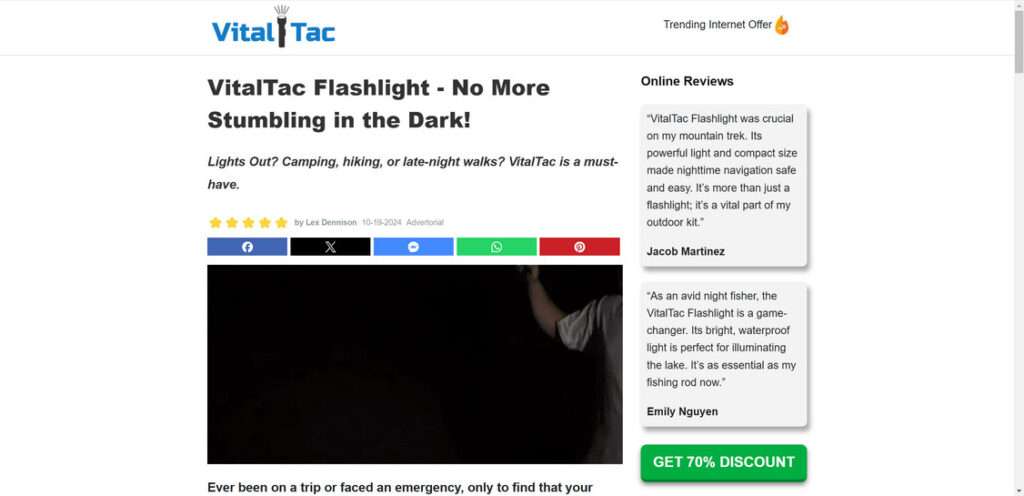
Outlandish Claims of Extreme Capabilities
The main tactic used to market the VitalTac flashlight is making dramatic claims about its supposed tactical abilities. The ads state that it is used by elite military forces, can blind attackers, cut through metal, and start fires. According to the marketing, it outperforms ordinary flashlights by 20 times thanks to its aircraft-grade metal body and incredible brightness.
These types of exaggerated assertions are common in scam products seeking to impress buyers. However, closer examination reveals many flaws that contradict the marketing hype.
Ordinary Flashlight in Disguise
While the ads portray it as some kind of super flashlight straight from an action movie, the VitalTac light is actually just a normal LED flashlight in disguise.
The aircraft aluminum body may be reasonably durable, but it’s far from the indestructible metals described. And the brightness, while decent, is comparable to any average flashlight – not the blinding intensity claimed.
Verified customer reviews confirm the VitalTac performs like a normal, cheap flashlight with none of the special tactical powers shown in promotional materials.
Misleading Demonstration Videos
The marketing videos for the VitalTac flashlight appear highly edited and staged. They show the light performing impossible feats like starting fires, blinding entire forests, and lighting up huge areas.
But these demonstrations do not represent real-world capabilities. They are fabricated to make the flashlight seem remarkable. No ordinary flashlight could start fires or light up such large spaces as depicted. The videos are an obvious scam tactic.
No Actual Military Usage
Despite claims that elite military forces use the VitalTac flashlight, there is no evidence to support this. It was not designed for or adopted by any military or government groups.
Associating tactical flashlights with military use is a common ploy to make them seem high-quality and specialized. But unless officially confirmed, such claims should not be believed. The VitalTac likely has zero real-world military pedigree.
Fake Reviews Provide Misleading Praise
The VitalTac ads showcase numerous positive customer reviews, praising its brightness, durability, and performance.
But analysis shows most of these reviews are completely fabricated. They do not represent real verified purchasers. And those who do buy the VitalTac report it does not live up to the marketed capabilities.
Misrepresenting a product’s satisfaction through fake reviews is a dishonest practice meant to boost perceived value. It in fact reveals how poor the VitalTac really is.
Part of a Network of Rebranded Scam Lights
Further investigation into the VitalTac reveals it is one of many rebranded versions of the same cheap flashlight. Brands like Tackl Light Pro, Patriot Bright Tactical, and Elite Tac Flashlight use similar names, logos, and marketing while selling what is essentially the same mass-produced light.
These scam flashlights get cycled through various temporary websites and domains, shutting down once too many complaints come in. It’s a well-oiled machine churning out exaggeration after exaggeration to dupe buyers.
Aggressive Sales Tactics Prey on Urgency
The VitalTac ads utilize several high-pressure sales tactics meant to create a false sense of urgency and value. Countdown timers, claims of limited supply, and deep discounts all push buyers to act quickly before this “amazing deal” disappears.

In reality, these techniques are purely manipulative methods for manufacturing demand. Ethical businesses do not need to pressure and mislead consumers in order to make sales. The reliance on such tactics is a major red flag.
Final Verdict: This is a Dropshipping Operation
When all the facts are objectively analyzed, the VitalTac “Military Tactical” Flashlight exhibits multiple hallmarks of an elaborate dropshipping operation:
- Outrageous unsubstantiated claims of performance and features
- Misleading demonstrations exaggerating capabilities
- No evidence of real military usage
- Fake reviews and false testimonials
- Part of a shady network of tactical flashlight scams
- Use of high-pressure sales tactics and false scarcity
- No transparency around manufacturing or quality
- Lack of warranties, guarantees, or recourse
The marketed “military-grade” features of the VitalTac Flashlight do not hold up to scrutiny. Buyers are better off avoiding this obvious scam and purchasing from reputable transparent brands. Don’t get duped in the dark seeking unrealistic tactical flashlight claims.








