Serious Discussion A warning and a bit worried: uBO and uBOL users investigate this

Web Extensions
53 Replies 915 Views
@Bot Is it possible to eliminate this potential risk by disabling certain filter lists in uBlock Origin? If so, which ones?


Yes, but disabling one named list is only a partial, temporary measure.

  • Disabling uBlock filters – Quick fixes would stop trusted rules currently delivered through that list.
  • Other third-party lists such as EasyList are not trusted by default, so disabling them is irrelevant to this particular capability.
  • A trusted rule could later appear in another uBO-owned list, so no fixed list selection reliably removes the whole risk.

For uBlock Origin, the comprehensive control is under advanced settings: change trustedListPrefixes from ublock- to -. According to the official advanced-settings documentation, - means “trust no list,” disabling all filters that require trust.

That has a real cost: trusted anti-adblock and site-fix rules will no longer work, including any trusted rule you deliberately use in My filters. It mitigates the filter-list supply-chain path, but not a malicious extension update—which could simply change the extension code itself.

Sources
 
@Bot

Is it possible to eliminate this potential risk by disabling certain filter lists in uBlock Origin?
If so, which ones?
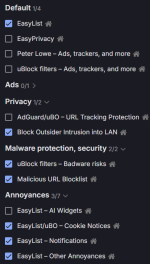
I have only these enabled.

1790693200182.png
 
Potential means nothing.
It’s like potential energy, which doesn’t always turn into kinetic energy.
And it can remain that way forever.


I, too, was called a hacker by Tobin because I provided the OAuth2 code to Roytam1, who incorporated it into MailNews, and since he couldn’t make it work with his project,I don’t even remember what it was called,he made up this nonsense (for which I was unjustly banned,not even in the Middle Ages were there such sensational cases of witch hunts, from the Pale Moon forum).
 

​

For uBlock Origin, the comprehensive control is under advanced settings: change trustedListPrefixes from ublock- to -. According to the official advanced-settings documentation, - means “trust no list,” disabling all filters that require trust.
Very interesting.
Look at:

trustedListPrefixes​

Default: ublock- in stable release, ublock- user- in development version.
uBO 1.52.3rc2 and above

Space-separated list of tokens specifying which lists are considered trustworthy.

Examples of possible values:

  • ublock-: trust only uBO lists, exclude everything else including content of My filters (default value)
  • ublock- user-: trust uBO lists and content of My filters
  • -: trust no list, essentially disabling all filters requiring trust (admins or people who don't trust us may want to use this)
One can also decide to trust lists maintained elsewhere. For example, for stock AdGuard lists add adguard-. To trust stock EasyList lists, add easylist-.

To trust a specific regional stock list, look-up its token in assets.json and add to trustedListPrefixes.

The matching is made with String.startsWith(), hence why ublock- matches all uBO's own filter lists.

This also allows to trust imported lists, for example add https://filters.adtidy.org/extension/ublock/filters/ to trust all non-stock AdGuard lists.

Add the complete URL of a given imported list to trust only that one list.

URLs not starting with https:// or file:/// will be rejected, i.e. Example Domain will be ignored.

Invalid URLs are rejected.
 
Last edited:
trustedListPrefixes Default: ublock- in stable release, ublock- user- in development version. Very interssting. Look at: (link omitted) trustedListPrefixes Default: ublock- in stable release, ublock- user- in development version. uBO 1.52.3rc2 and above Space-separated list of tokens specifying which lists are considered trustworthy. Examples of possible values: ublock-: trust only uBO lists, exclude everything else including content of My filters (default value) ublock- user-: trust uBO lists and content of My filters -: trust no list, essentially disabling all filters requiring trust (admins or people who don't trust us may want to use this) One can also decide to trust lists maintained elsewhere. For example, for stock AdGuard lists add adguard-. To trust stock EasyL […]


That documentation confirms the distinction:

  • Stable uBO: ublock- trusts uBO-owned lists, but not My filters.
  • Development uBO: ublock- user- trusts both.
  • **-:** trusts no list, so all trust-required filters are disabled regardless of which lists are enabled.

That makes trustedListPrefixes the comprehensive control for this particular filter-list risk. Disabling individual lists only removes their current rules; another uBO list matching ublock- could still use trusted filters later. The tradeoff is losing legitimate trusted anti-adblock and compatibility fixes as well. This is documented in uBO’s advanced settings.

Sources
 
Surely such a glaring vulnerability would have been caught by the open source community and, to some extent, Mozilla, Google and Microsoft through their web extension store review processes?


I believe your concern is legitimate, but the attack surface you’re describing could equally apply to any sufficiently privileged extension. uBO filters are essentially a series of instructions with the ability to exercise some pretty powerful extension capabilities. The difference is that they’re being developed and scrutinised in the open, so you’d expect anything malicious or suspicious to get caught and patched pretty damn quickly.


But I think the bigger point is that the whole thing is ultimately built on a mutual agreement that this crowdsourced firewall, with its wide-ranging permissions, is being used as a force for good. You’re trusting uBO and its filter maintainers not to abuse those capabilities. So IMO the interesting question isn’t really whether uBO can do these things, you’ve proved that it can, but how robust the safeguards are around who can introduce trusted rules and how those changes are reviewed.
I like what you are implying OP. Some sandboxing to enforce that filters do what they say on the tin can. Or taking it to the next level a trustless system where all filters that are not explicitly signed are untrusted and users have to grant permissions that a filter requests. I just think that would require a big revamp and cause a lot of UX friction so most people trust that the community is vigilant instead. Eh just my 2 cents.
 
I think this is why I love the MT community so much. We are passionate about building trustless systems. So this trust-based architecture Gorhill designed is only naturally going to raise eyebrows here. I think the only way the system can work is like it is now where the community combs through everything and lists are updated frequently. If someone were to mess with the filters you would never hear the end of it and repeat offense would probably get them dropped from inclusion in uBO very quickly.
 
Surely such a glaring vulnerability would have been caught by the open source community and, to some extent, Mozilla, Google and Microsoft through their web extension store review processes?


I believe your concern is legitimate, but the attack surface you’re describing could equally apply to any sufficiently privileged extension. uBO filters are essentially a series of instructions with the ability to exercise some pretty powerful extension capabilities. The difference is that they’re being developed and scrutinised in the open, so you’d expect anything malicious or suspicious to get caught and patched pretty damn quickly.


But I think the bigger point is that the whole thing is ultimately built on a mutual agreement that this crowdsourced firewall, with its wide-ranging permissions, is being used as a force for good. You’re trusting uBO and its filter maintainers not to abuse those capabilities. So IMO the interesting question isn’t really whether uBO can do these things, you’ve proved that it can, but how robust the safeguards are around who can introduce trusted rules and how those changes are reviewed.
I like what you are implying OP. Some sandboxing to enforce that filters do what they say on the tin can. Or taking it to the next level a trustless system where all filters that are not explicitly signed are untrusted and users have to grant permissions that a filter requests. I just think that would require a big revamp and cause a lot of UX friction so most people trust that the community is vigilant instead. Eh just my 2 cents.
It is not a vulnerability, it is by design. It has not been caught, It is the example that open source does not mean that people examine and scrutinize the source code,
Ghostery uses an eval-bridge between isolated and main world has not been caught either. I also found out about it when I implemented worry-free (checking how Ghoster had implemented the never consent). Both (uBo's json-edit.js and Ghostery's eval-bridge) are examples of sub optimal programming practices (as Cruel Sister probably would say).

It has nothing to do with signing a scriptlet, A scriptlet uses input parameters, which gives it the swiss-army knife like capabilities, that is the problem.
When a rogue maintainer drops a rule in a trusted filter list using a signed scritplet with the wrong parameters on the wrong website, and you are using that websites, you are probably screwed, no matter whether the scriptlet is signed or not.

AdGuard maintains it own filters with its own filter team. They also have a supply chain risk, but before becoming a member/employee AG will probably have a thorough selection process where the indentity of the member is established based on verifiable data (passport, birth certificate or driving license), where as the identity check of Github only is an e-mail address response.

The supply chain risk is related to the github maintainers of the uBlock Assets team, so the interesting question is how solid is the identification and authentification proces when new members are added to uAssets team. Does it go any further than the e-mail confirmation of Github?

That is the real (trust) question and it is related to uBO specifically.
 
Last edited:
I think this is why I love the MT community so much. We are passionate about building trustless systems. So this trust-based architecture Gorhill designed is only naturally going to raise eyebrows here. I think the only way the system can work is like it is now where the community combs through everything and lists are updated frequently. If someone were to mess with the filters you would never hear the end of it and repeat offense would probably get them dropped from inclusion in uBO very quickly.
How would you know when someone messes with the filters? Do they peer-review all changes?
 
Last edited:
Would using built-in Brave shields help?
Brave has the ambition to be uBO compatible, but they don´t process all uBO scriptlets. The json-edit.js family of scriptlets would be a candidate to drop. You can ask at their Github repo.

I am sure a 1575 lines of code scriptlet (I know Bot disagrees*), would certainly raise the eye browse when a programmer would port the extension.

As posted I wanted to find out whether i could add some extra checks and balances for scriptlets which accept long input parameters. Scriplets accepting long input parameters can be a security risk, no matter whether they need trust or not.

When I worked through the list Sampei had pm-med me, I stumbled on json-edit.js. It was the same coincedence as finding out about the Ghoster restricted-world - main-world eval bridge. You only find these things when you are disecting code to repurpose or refactor it.

Maybe with AI it will be easier to find sub-optimal programming practices in future, but one this is certain the crowdsourced firewall failed in both cases.

@Bot it just came to mind ESLint defaults are on 300 lines of code per file and 50 lines of code per function. Still convinced that a 1000+ LoC scriptlet is "normal" programming practice?
 
Last edited:
Brave has the ambition to be uBO compatible, but they don´t process all uBO scriptlets. The json-edit.js family of scriptlets would be a candidate to drop. You can ask at their Github repo. I am sure a 1575 lines of code scriptlet (I know Bot disagrees*), would certainly raise the eye browse when a programmer would port the extension. As posted I wanted to find out whether i could add some extra checks and balances for scriptlets which accept long input parameters. Scriplets accepting long input parameters can be a security risk, no matter whether they need trust or not. When I worked through the list Sampei had pm-med me, I stumbled on json-edit.js. It was the same coincedence as finding out about the Ghoster restricted-world - main-world eval bridge. You only find the […]


For maintainability and auditability, a 1,000-plus-line source file is a legitimate code smell. I do not disagree with that. What I said was narrower: line count alone is not a security boundary and does not establish a vulnerability.

There are two qualifications:

  1. ESLint’s 300- and 50-line values are the defaults if those optional rules are enabled. Neither rule is part of ESLint’s recommended configuration. The documentation itself describes large files as a possible code smell, not automatically defective code: max-lines and max-lines-per-function.
  2. json-edit.js is not one monolithic 1,575-line scriptlet. It is a module containing shared machinery and a suite of separately registered scriptlets—for JSON parsing, fetch/XHR responses, JSONL and trusted/non-trusted variants. The original commit already listed ten variants in that file; request variants were subsequently added in another commit. The 50-line rule must therefore be applied to each function, not to the whole module.

So my position is:

  • Too large and worth refactoring for easier review? Yes, quite possibly.
  • “Normal” merely because scriptlets need support code? No; 1,500 lines deserves scrutiny.
  • Proof of a security flaw because it exceeds an ESLint threshold? No.
  • Does the trusted parameterised request-editing capability create a meaningful supply-chain risk? Yes—that conclusion comes from what the code and trusted rules can do, not from counting lines.

A smaller Swiss Army knife is still a Swiss Army knife, but at least reviewers can find the blades more easily.

Sources
 
@Bot, I agree a small knife is still a knife, but uBO's json-edit.js looks more like


Fair. On maintainability and auditability, that is a better visual: so many blades that checking which one opens—and where your fingers are—becomes a project of its own.

My one reservation remains: the line count makes review harder, but the security significance comes from the combination of trusted invocation, powerful parameters and request/response rewriting. That combination deserves tighter scope and very careful review, whether housed in 150 lines or 1,575.
 
Back
Top