
New Update Adguard v8 released

Dreams&Visions

Level 2
Thread author
Nov 16, 2024
92
537
65
38
Germany
It comes with Dark Mode, either by manual setting or detecting the system wide setting.
Installed version 21/08/2026 is v8.0.5560.0


A brand-new version, a new major number, a fresh design — and, most importantly, truly system-wide protection. AdGuard for Windows v8.0 doesn’t just look different: it gives you clearer control over the traffic on your computer and makes the most important settings easier to reach.

Truly system-wide protection​

Alongside the DNS filtering you already had, AdGuard offers full-fledged network-level filtering. This means stronger protection and more control: you can filter all Internet traffic on your device, so your protection is system-wide.

AdGuard uses a special network driver that handles the actual sending and receiving of data, allowing us to filter traffic from every app on your device.
While DNS filtering is still there, it is less flexible, and some tracking requests can still get through. This is where HTTPS filtering becomes essential. With it enabled, AdGuard can inspect traffic within Windows apps. This allows us to distinguish between legitimate content and tracking requests, even when they come from the same domain. By decrypting the traffic, AdGuard can identify the full URL and block only the tracking requests while leaving the rest of the app working just fine.

While HTTPS filtering is enabled for browsers by default, it is disabled for most other apps to ensure better compatibility. You can always enable it for extra protection: just select the application you want to filter in App management and toggle on Filter HTTPS traffic.

Filter HTTPS traffic

See what your apps are doing and take control​

To make managing traffic easier and give you a clear picture of what’s happening on your device, we’ve added two new sections: App management and Statistics.

App management​

App management lets you control how each app accesses the Internet. By default, AdGuard filters everything. As soon as an app goes online, it appears in App management, and its traffic is routed through AdGuard. From there, you can configure what to do with the app and how to filter it:

  • Decide which apps have their traffic routed through AdGuard
  • Choose to block ads and trackers in specific apps
  • Enable HTTPS filtering in apps of your choice
App management

We’ve also introduced Filter unknown apps, a new setting for handling apps that are not yet in the compatibility or exclusion lists. It’s on by default — new apps get regular filtering, while HTTPS interception stays off to avoid affecting app behavior.

Statistics​

Statistics show detailed network activity. The Companies section provides a perspective on all the companies that your device has sent requests to, while in Apps and Domains you see the stats specific traffic data for every app routed through AdGuard. You can quickly identify and block anything suspicious.

Statistics

Not only inside updates: A complete redesign​

AdGuard for Windows has been completely redesigned. Our focus was on simplicity and ease of use. The most important tools are now front and center, while advanced settings are still available — just tucked away so they don’t overwhelm new users.

Key settings in plain sight​

The app is designed to let you enable everything you need straight from the first screen. Just click the symbols you see — they stand for blocking ads and trackers, handling cookie notices and similar annoyances, and DNS protection.

Fine-tune your protection: Head to the Protection section, where settings are clearly categorized, explained in simple terms, and enabled by one toggle.

Main screen

Tracking protection: Choose a level of protection — from a simple, comfortable experience to a more advanced one, which includes deleting cookies for enhanced privacy. There is also a custom level where you can freely fine-tune everything to suit your preferences: like blocking notifications from websites or enabling anti-DPI protection.

Tracking protection

Advanced approach to filtering: You can find low-level and network settings in Settings → App settings.
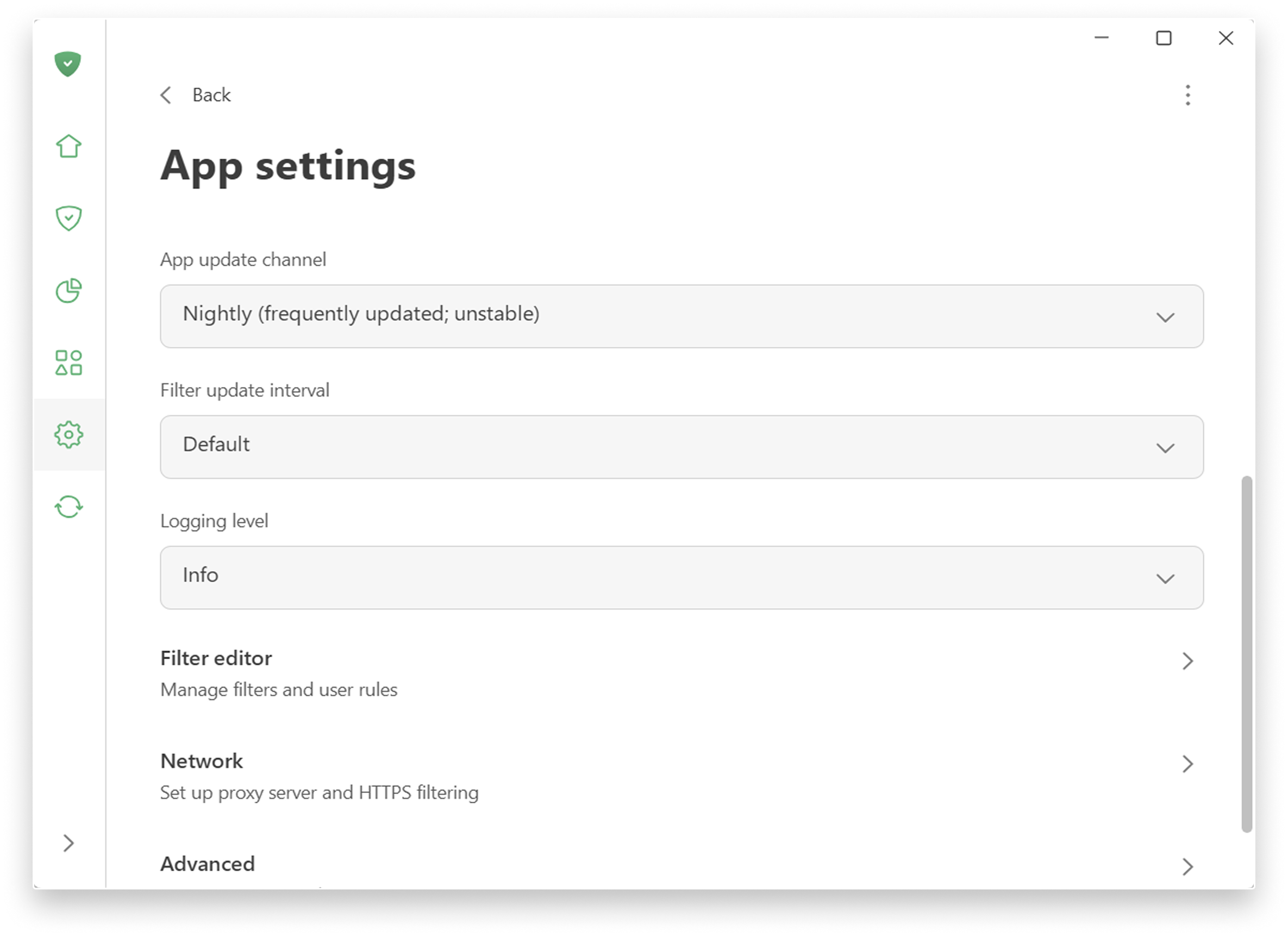
App settings

For more details on new features, check the Knowledge Base.
 
It comes with Dark Mode, either by manual setting or detecting the system wide setting.
Installed version 21/08/2026 is v8.0.5560.0


A brand-new version, a new major number, a fresh design — and, most importantly, truly system-wide protection. AdGuard for Windows v8.0 doesn’t just look different: it gives you clearer control over the traffic on your computer and makes the most important settings easier to reach.

Truly system-wide protection​

Alongside the DNS filtering you already had, AdGuard offers full-fledged network-level filtering. This means stronger protection and more control: you can filter all Internet traffic on your device, so your protection is system-wide.


While DNS filtering is still there, it is less flexible, and some tracking requests can still get through. This is where HTTPS filtering becomes essential. With it enabled, AdGuard can inspect traffic within Windows apps. This allows us to distinguish between legitimate content and tracking requests, even when they come from the same domain. By decrypting the traffic, AdGuard can identify the full URL and block only the tracking requests while leaving the rest of the app working just fine.

While HTTPS filtering is enabled for browsers by default, it is disabled for most other apps to ensure better compatibility. You can always enable it for extra protection: just select the application you want to filter in App management and toggle on Filter HTTPS traffic.

Filter HTTPS traffic

See what your apps are doing and take control​

To make managing traffic easier and give you a clear picture of what’s happening on your device, we’ve added two new sections: App management and Statistics.

App management​

App management lets you control how each app accesses the Internet. By default, AdGuard filters everything. As soon as an app goes online, it appears in App management, and its traffic is routed through AdGuard. From there, you can configure what to do with the app and how to filter it:

  • Decide which apps have their traffic routed through AdGuard
  • Choose to block ads and trackers in specific apps
  • Enable HTTPS filtering in apps of your choice
App management

We’ve also introduced Filter unknown apps, a new setting for handling apps that are not yet in the compatibility or exclusion lists. It’s on by default — new apps get regular filtering, while HTTPS interception stays off to avoid affecting app behavior.

Statistics​

Statistics show detailed network activity. The Companies section provides a perspective on all the companies that your device has sent requests to, while in Apps and Domains you see the stats specific traffic data for every app routed through AdGuard. You can quickly identify and block anything suspicious.

Statistics

Not only inside updates: A complete redesign​

AdGuard for Windows has been completely redesigned. Our focus was on simplicity and ease of use. The most important tools are now front and center, while advanced settings are still available — just tucked away so they don’t overwhelm new users.

Key settings in plain sight​

The app is designed to let you enable everything you need straight from the first screen. Just click the symbols you see — they stand for blocking ads and trackers, handling cookie notices and similar annoyances, and DNS protection.

Fine-tune your protection: Head to the Protection section, where settings are clearly categorized, explained in simple terms, and enabled by one toggle.

Main screen

Tracking protection: Choose a level of protection — from a simple, comfortable experience to a more advanced one, which includes deleting cookies for enhanced privacy. There is also a custom level where you can freely fine-tune everything to suit your preferences: like blocking notifications from websites or enabling anti-DPI protection.

Tracking protection

Advanced approach to filtering: You can find low-level and network settings in Settings → App settings.

App settings
Important considerations with the new system-wide filtering

The expanded network-level filtering should provide broader coverage than DNS filtering alone, especially for applications that use multiple domains or serve tracking content from the same domain as legitimate content.

However, HTTPS filtering involves local TLS interception. AdGuard must install and use a trusted local certificate to decrypt and re-encrypt inspected traffic. This can cause compatibility issues with:

  • Banking and payment applications
  • Applications using certificate pinning
  • VPN, security, and privacy software
  • Apps with their own certificate stores
  • Some games and launchers

Leaving HTTPS filtering disabled for unknown applications by default is therefore a sensible compatibility precaution. Users should enable it selectively and exclude any application that stops connecting or reports certificate errors.

The new App management and Statistics sections should also make troubleshooting easier, although a domain appearing in the statistics does not by itself indicate malicious activity. Blocking unfamiliar domains should be based on reliable information and observed behavior rather than the domain name alone.

The official release notes and Knowledge Base should be used for version details, supported Windows versions, known issues, and upgrade guidance.