AV-Comparatives Consumer Summary Report 2025

Disclaimer
  1. This test shows how an antivirus behaves with certain threats, in a specific environment and under certain conditions.
    We encourage you to compare these results with others and take informed decisions on what security products to use.
    Before buying an antivirus you should consider factors such as price, ease of use, compatibility, and support. Installing a free trial version allows an antivirus to be tested in everyday use before purchase.

because they do not issue their own certificates, the method applied by K and B?
Yeah, I think this is the reason. Avast uses SSLKEYLOGFILE which seems to cause extra disk writes compared to the other method. Avast can also use the other method; they use it in any other browser outside of Chrome, Edge and Firefox; for example, Brave.
 
Avast uses SSLKEYLOGFILE which seems to cause extra disk writes compared to the other method
I admired its method for not breaking the original certificate, but looks everything comes at a cost.
Let K & B break as much certificates as they need.
Tear Paper Tearing GIF by moodman
 
Yeah, I think this is the reason. Avast uses SSLKEYLOGFILE which seems to cause extra disk writes compared to the other method. Avast can also use the other method; they use it in any other browser outside of Chrome, Edge and Firefox; for example, Brave.
I assume McAfee does not perform HTTPS scanning either?
In the case of Eset, I noticed that the HTTPS check remains active on YouTube. I assume this is intentional?
 
Sad news about the cost of Avast's unique MITM implementation. They still excel in other areas for efficiency.

I assume McAfee does not perform HTTPS scanning either?
In the case of Eset, I noticed that the HTTPS check remains active on YouTube. I assume this is intentional?
McAfee does not use an MITM proxy to decrypt HTTPS. So, like Microsoft Defender, it will scan your downloads once they're completed.

WebAdvisor is a highly effective browser gatekeeper in other ways: you get reliable domain/IP reputation checks and safe browsing signals.
 
Sad news about the cost of Avast's unique MITM implementation. They still excel in other areas for efficiency.


McAfee does not use an MITM proxy to decrypt HTTPS. So, like Microsoft Defender, it will scan your downloads once they're completed.

WebAdvisor is a highly effective browser gatekeeper in other ways: you get reliable domain/IP reputation checks and safe browsing signals.
Thank you for your reply. That makes sense. And I like it, because I don't like it when a third-party AV slows down the browsing process. Kaspersky is my favorite product, but I don't like it for this reason, and I have other reasons too. It integrates too deeply into Windows. And I think the https scanning is noticeable while browsing.
 
In the case of Eset, I noticed that the HTTPS check remains active on YouTube. I assume this is intentional?
Do you mean ESET is doing HTTPS on YouTube for you? If yes then that's odd as it doesn't do on mine. If it's also not doing it for you then yeah it's intentional from ESET to whitelist YouTube.
WebAdvisor is a highly effective browser gatekeeper in other ways: you get reliable domain/IP reputation checks and safe browsing signals.
I really like the WebAdvisor extension. I usually use it even if I have a different third-party AV installed.
Thank you for your reply. That makes sense. And I like it, because I don't like it when a third-party AV slows down the browsing process. Kaspersky is my favorite product, but I don't like it for this reason, and I have other reasons too. It integrates too deeply into Windows. And I think the https scanning is noticeable while browsing.
Yeah, I like Kaspersky but I always felt and also proven by fact that on average Kaspersky has the most impact on web browsing speed among Avast, ESET, Bitdefender and Kaspersky. Usually, I disabled Kaspersky's HTTPS scanning when I used it.
 
Do you mean ESET is doing HTTPS on YouTube for you? If yes then that's odd as it doesn't do on mine. If it's also not doing it for you then yeah it's intentional from ESET to whitelist YouTube.

I really like the WebAdvisor extension. I usually use it even if I have a different third-party AV installed.

Yeah, I like Kaspersky but I always felt and also proven by fact that on average Kaspersky has the most impact on web browsing speed among Avast, ESET, Bitdefender and Kaspersky. Usually, I disabled Kaspersky's HTTPS scanning when I used it.
Ohhh...sorry, I wrote it down wrong. You're right that when using Eset, there is no HTTPS scanning for YouTube videos. I wrote it down wrong. And I've noticed this many times. This way, videos load faster in full resolution and there are no problems. The same is true for McAfee, because there is no HTTPS scanning there either. I don't know about you, but for me, the most important thing about third-party AV software is that I feel its presence on my computer as little as possible. It should protect me, but have a minimal impact on my computer experience.
 
Do you mean ESET is doing HTTPS on YouTube for you? If yes then that's odd as it doesn't do on mine. If it's also not doing it for you then yeah it's intentional from ESET to whitelist YouTube.
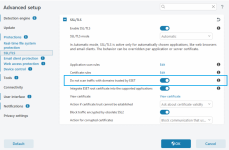
ESET uses their internal witelist for HTTPS scanning. You can also disable it if you wish to scan all traffic:

1771645890282.png
 
Ohhh...sorry, I wrote it down wrong. You're right that when using Eset, there is no HTTPS scanning for YouTube videos. I wrote it down wrong. And I've noticed this many times. This way, videos load faster in full resolution and there are no problems. The same is true for McAfee, because there is no HTTPS scanning there either. I don't know about you, but for me, the most important thing about third-party AV software is that I feel its presence on my computer as little as possible. It should protect me, but have a minimal impact on my computer experience.
Yeah, lightness is important. McAfee is probably the lightest AV at the moment. It only scans on execution, which also helps with performance.
ESET uses their internal witelist for HTTPS scanning. You can also disable it if you wish to scan all traffic:

View attachment 295817
Yeah, I'm aware of this. I even manually put some sites on the ignore list from the option above your marked one to disable HTTPS on some specific sites. But that option doesn't work as reliably anymore for me.
 
Yeah, lightness is important. McAfee is probably the lightest AV at the moment. It only scans on execution, which also helps with performance.

Yeah, I'm aware of this. I even manually put some sites on the ignore list from the option above your marked one to disable HTTPS on some specific sites. But that option doesn't work as reliably anymore for me.
The truth is that the situation is more nuanced for me. Let me give you an example: I run Kerish Doctor to clean up the system, and it runs very slowly alongside McAfee and Kaspersky. I guess it's because the two AV engines are monitoring its activity! With ESET, this happens lightning fast. And the cleanup itself is not just a check. So Kerish Doctor runs faster under ESET.
 
The truth is that the situation is more nuanced for me. Let me give you an example: I run Kerish Doctor to clean up the system, and it runs very slowly alongside McAfee and Kaspersky. I guess it's because the two AV engines are monitoring its activity! With ESET, this happens lightning fast. And the cleanup itself is not just a check. So Kerish Doctor runs faster under ESET.
Everything works faster with ESET.
 
The truth is that the situation is more nuanced for me. Let me give you an example: I run Kerish Doctor to clean up the system, and it runs very slowly alongside McAfee and Kaspersky. I guess it's because the two AV engines are monitoring its activity! With ESET, this happens lightning fast. And the cleanup itself is not just a check. So Kerish Doctor runs faster under ESET.
I see. So you found an area where McAfee is slow for you.
ESET is usually the speed champ as well as uses the lowest amount of CPU among the popular AV products, while Microsoft Defender is the highest (I haven't checked the latest McAfee on my PC yet).
ESET doesn't have a typical behavior blocker, which helps, but also the performance-critical component of the ESET engine is written in highly optimized assembly language, which also helps with speed and low CPU usage.