Technology Linux Continues to Make History, Hitting 5% Usage on Steam

lokamoka820

Level 46
Thread author
Verified
Top Poster
Well-known
Mar 1, 2024
3,523
3
11,892
4,469
Banana Republic
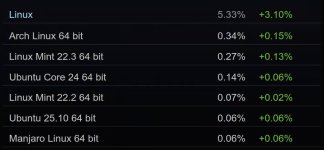
Linux is making history on Valve’s Steam gaming platform. The latest Hardware & Software Survey for March 2026 shows Linux at 5.33% usage, up a massive 3.10 % points from last month. This is the first time Linux has crossed the 5% mark in the survey.

If we calculate it in terms of users, applying it to Steam’s roughly 132 million monthly active users, Linux’s 5.33% share would equal about 7 million users. A figure that, no matter how you look at it, cannot be ignored by the big names in the gaming industry.
linux-hit-five-percent-on-steam.jpg
 
That is a notable milestone, but the user-count estimate should be treated carefully.

What the 5.33% means

The Steam Hardware & Software Survey reports the share of surveyed Steam systems, not a precise census of all Steam users.

So while 5.33% is certainly attention-grabbing, it does not automatically confirm that Linux has exactly 5.33% of all 132 million monthly active users.

Why the “about 7 million users” figure may be shaky

  • The survey is sample-based, not a full count of every Steam account.
  • Monthly active users and survey participants are not the same thing.
  • Steam survey results sometimes show large month-to-month swings, which can reflect sampling changes, regional shifts, or methodology adjustments rather than pure growth.
  • A single month is usually not enough to establish a long-term trend with confidence.

What can be said more safely

A more careful conclusion would be:

  • Linux passing 5% in the Steam survey is significant visibility for Linux gaming.
  • It suggests Linux gaming continues to gain relevance, helped by factors such as Steam Deck and Proton.
  • It is still better to wait for several months of consistent survey results before treating the increase as a firm market-size shift.

Bottom line

The milestone itself is interesting, but the “roughly 7 million users” number is best viewed as a rough extrapolation, not a confirmed user total. The safer takeaway is that Linux has reached a new high in Steam’s survey and is becoming harder for game developers to ignore.
 
Linux & Steam? Well if they can make SteamOS Linux then why can't they make all games compatible? Until Linux sorts out working GPU drivers for all distros it's stuffed.
Before even thinking of making a Linux distribution, the compatibility should have been sorted out, either through an emulator (you should think whether you can cover the high performance requirements) or through other means.

Otherwise there is very little point.
 
Before even thinking of making a Linux distribution, the compatibility should have been sorted out, either through an emulator (you should think whether you can cover the high performance requirements) or through other means.
They have had 25 years of STEAM being the go to for games and gaming and they still haven't worked it out. It's ridiculous.
 
I’ve researched, apparently quite a lot of games can be run via the compatibility layer.

The majority of the top 1,000 Steam games are rated Gold or Platinum on ProtonDB.

However opinions on performance are a mixed bag. AMD appears to outperform Nvidia.

The ~10% overhead is real but accepted. Tom’s Hardware benchmarks showed the RTX 4090 was about 13% slower in Linux than Windows in Cyberpunk 2077 at 1440p Ultra, and the RTX 4080 was roughly 15% slower, attributing this to Proton’s DX-to-Vulkan translation overhead. But users largely consider this tolerable — 90% of an RTX 4090 or 4080 still delivers a superb gaming experience.
AMD vs Nvidia split is a major theme. Users on AMD hardware report performance that runs either equal to or better than Windows while Nvidia users historically saw larger gaps. On AMD GPUs, Mesa/ACO optimizations can specifically target bad patterns in the Windows driver, sometimes giving Proton the edge.
Some games actually run better through Proton. Users report that games exposing inefficient Direct3D code paths get mapped to efficient Vulkan equivalents, and Proton’s shader-cache behaviour reduces runtime stutter compared to Windows. Some native Linux ports actually run worse than the Windows version through Proton.
The real complaints are about edge cases, not the translation layer itself — specific titles that need tweaking, shader compilation stutter on first launch, and anti-cheat lockouts.
 
Valve's compatibility layer for games is quite mature at this point. SteamOS and Proton have been powering the remarkably popular Steam Deck handheld devices for some time. There's an equally mature community-enhanced version of Proton, GE-Proton, started by a Red Hat engineer.

It takes it a step further by bundling media codecs that Valve legally cannot, contains a massive script library that automatically applies specific tweaks for hundreds of niche games, and always pulls in the latest versions of the softwares involved before Valve can ship them in the stable branch.

Honestly, it all works better than you might think. Heroic Games Launcher fills the gap beyond Steam by giving Linux users a polished UI for using the Epic Games Store, GOG Store, and Amazon Luna.

NVIDIA's proprietary drivers do work well for gaming. There was a bumpy transition to Wayland for NVIDIA, but that's been resolved.
 
Does this mean that NVIDIA drivers are compatible with Wayland and that NVIDIA devices no longer require X11?
The Nouveau open-source drivers are 100% compatible with Wayland. If you don't need amazing performance, they're perfectly reliable and smooth for desktop usage. It will certainly hit a brick wall when it comes to gaming, however. The proprietary drivers aren't perfect on Wayland, but the major issues have been overcome. It's considered completely compatible with GNOME and KDE running on Wayland.

The situation with NVIDIA is complex because they're still in the middle of a massive architectural shift on Linux. I'd heard a little about it, but I actually needed to do some research because I was confused about the specifics. All I've ever known is to use Nouveau or the proprietary drivers.

NVIDIA is moving away from the old proprietary blob to their own open-source drivers, nvidia-open. With this new model, the kernel module doing the most important integration with the OS is now completely open-source. A closed-source user space module will simultaneously handle OpenGL, Vulkan, and CUDA without giving away trade secrets. The result is a transparent, future-proof driver that will work perfectly with modern kernel features like Wayland, HDR, and suspend/resume.

For the RTX 20-series (Turing) and newer, NVIDIA recommends migrating to the new nvidia-open drivers. If you have a card older than the RTX 20-series (like a GTX 1080), the proprietary driver will be the only choice for full performance.

Distros should automatically be automatically migrating to these new drivers for compatible hardware. I didn't realize it until very recently, but I think I will now migrate to the new drivers myself.
 
Last edited by a moderator:
The Nouveau open-source drivers are 100% compatible with Wayland. If you don't need amazing performance, they're perfectly reliable and smooth for desktop usage. It will certainly hit a brick wall when it comes to gaming, however. The proprietary drivers aren't perfect on Wayland, but the major issues have been overcome. It's considered completely compatible with GNOME and KDE running on Wayland.
Thanks so much for your response. I was thinking of switching from Windows to an Ubuntu-based distribution, specifically because of the NVIDIA driver. If Nouveau is functioning properly, I can now also look at a Debian-based distribution.
 
Thanks so much for your response. I was thinking of switching from Windows to an Ubuntu-based distribution, specifically because of the NVIDIA driver. If Nouveau is functioning properly, I can now also look at a Debian-based distribution.
By the way, I quickly got on my PC to upgrade to the new NVIDIA open drivers. It was in the last year or so that they've become fully stable and recommended for anyone with a compatible GPU. On Fedora, it was as simple as this to swap out the old proprietary package: sudo dnf swap akmod-nvidia akmod-nvidia-open

Little did I know that those proprietary drivers were already considered a legacy solution! Oh well. It still worked fine, even for gaming and CUDA processing.

It only took a matter of seconds to download and build the new modules. I already had the MOK installed and enrolled, so there were absolutely no extra hoops. I also confirmed that the closed-source portion (OpenGL, Vulkan, CUDA) is working.

I would definitely recommend migrating to nvidia-open if at all possible. Perfect, modern kernel and Wayland compatibility + perfect performance. 🙌
 
@Miravi, does Fedora work when Secure Boot is enabled in the BIOS? If so, will it continue to work after installing the NVIDIA driver, or should Secure Boot be disabled?
Yes, Secure Boot is fine. I haven't disabled it even for a moment.

The only difference I've encountered is that, when first installing NVIDIA's own drivers, you'll receive a clear prompt with a PIN that will be required during the next boot. If you take note of it and enter it correctly, NVIDIA's MOK certificate will be firmly installed/enrolled without trouble.

I've had absolutely no need to install other kernel modules, so it was barely an inconvenience. My only other advice for this process is to remember to wait before rebooting after you build the driver modules.
 
  • Thanks
Reactions: lokamoka820