Hardware New smartphone labels for battery life and repairability are coming to the EU

Gandalf_The_Grey

Level 85
Thread author
Verified
Honorary Member
Top Poster
Content Creator
Well-known
Forum Veteran
Apr 24, 2016
7,757
6
82,472
8,389
54
The Netherlands
The European Union has announced details of new mandatory labels for smartphones and tablets sold in the bloc, which include ratings for energy efficiency, durability, and repairability. Hardware will also have to meet new “ecodesign requirements” to be sold in the EU, including a requirement to make spare parts available for repair.

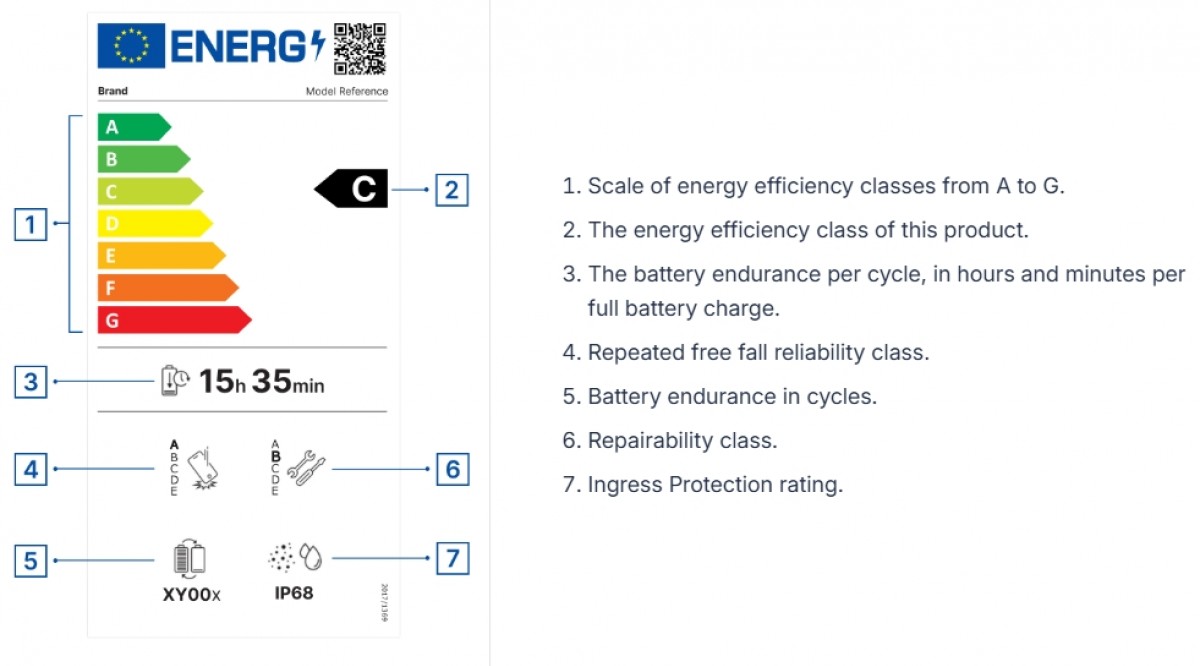
The labels, which will be required for any devices that go on sale from June 20th onwards, are similar to existing ones for home appliances and TVs. They display the product’s energy efficiency rating, on a scale from A to G, along with battery life, the number of charge cycles the battery is rated for, letter grades for durability and repairability, and any applicable IP rating for protection from dust and water.

Alongside the labels the EU is introducing “ecodesign requirements” imposing minimum standards on the same products. Those include protection from splashes of water (and dust particles larger than 1mm for phones), scratch and drop protection, batteries that retain at least 80 percent of their capacity after 800 charging cycles, and making “critical spare parts” available within 5-10 working days. Manufacturers are also required to provide operating system updates within six months of the source code becoming available — a bar that Samsung would have failed to meet with its recent One UI 7 rollout.
 
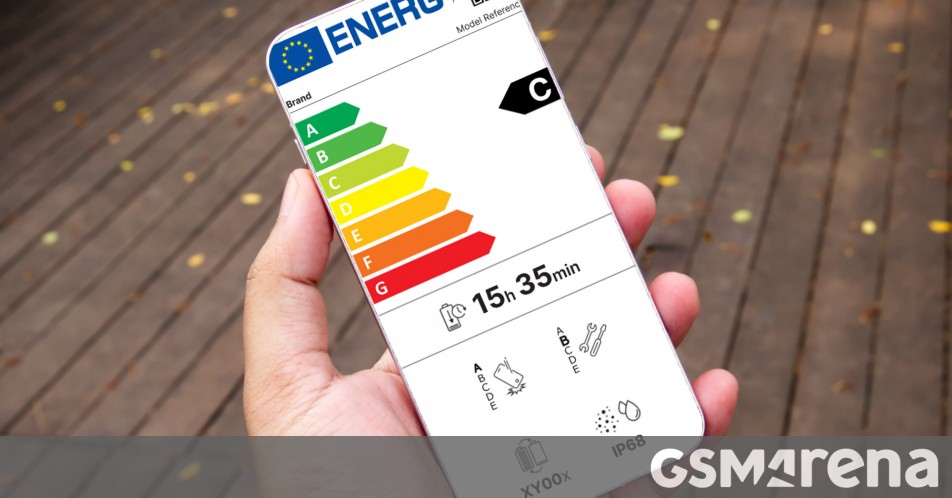
Starting today, all new smartphones and tablets sold in the EU are required to provide an energy efficiency label inside their packaging. The in-box sticker is similar to the ones shown on other consumer electronic devices sold in the EU/EEA market. The new regulation's main goal is to help EU consumers make informed buying choices and help reduce CO₂ emissions.
The regulation applies to all cordless phones (landlines), smartphones used on cellular or satellite networks, feature phones without internet connection or third-party apps, and tablets with screens between 7 and 17.4 inches.

1750437074013.jpeg


The ENERGY sticker, as it is commonly known, features a rating on a scale from A to G, with A being the most efficient and G the least efficient. It displays seven pieces of information:
  • The overall energy efficiency class rating (from A to G).
  • Battery endurance per cycle (in hours and minutes) per full battery charge
  • Repeated free fall reliability class (from A to E).
  • Battery endurance in cycles.
  • Repairability class (from A to E).
  • Ingress protection rating.

Smartphones and tablets to get a new label in June, indicating battery life and efficiency


Manufacturers will need to register their products with the European Product Registry for Energy Labelling (EPREL) which is managed by the European Commission.

In addition, all new devices sold in the EU will have to meet five eco-design criteria:
  • Durability: Devices should be resistant to accidental drops and protected against dust and water.
  • Battery longevity: Batteries must endure at least 800 full charge and discharge cycles while retaining at least 80% of their original capacity.
  • Repairability: Manufacturers must make critical spare parts available within 5 to 10 working days, and continue offering them for 7 years after the product is no longer sold in the EU.
  • Software support: Devices must receive operating system upgrades for at least 5 years from the end-of-sale date.
  • Repair access: Professional repairers must have non-discriminatory access to any required software or firmware.
Devices launched before June 20 are exempt from the new labels, and they also do not apply to devices with rollable displays, smartphones designed for high-security communications and tablet computers with full-featured operating systems.

We’d like to point out that the new battery endurance rating aspect is actually closely tied to our very own battery life test and uses software from French automation company SmartViser, which now offers the same testing solutions to device manufacturers.
 
Last edited by a moderator: