AI News OpenAI is adding invisible watermarks to ChatGPT text. What this means for you

Brownie2019

Level 23
Verified
Well-known
Forum Veteran
ChatGPT and Codex will soon add invisible watermarks to eligible text generated in the European Union. But the technology is far from an infallible AI detector.

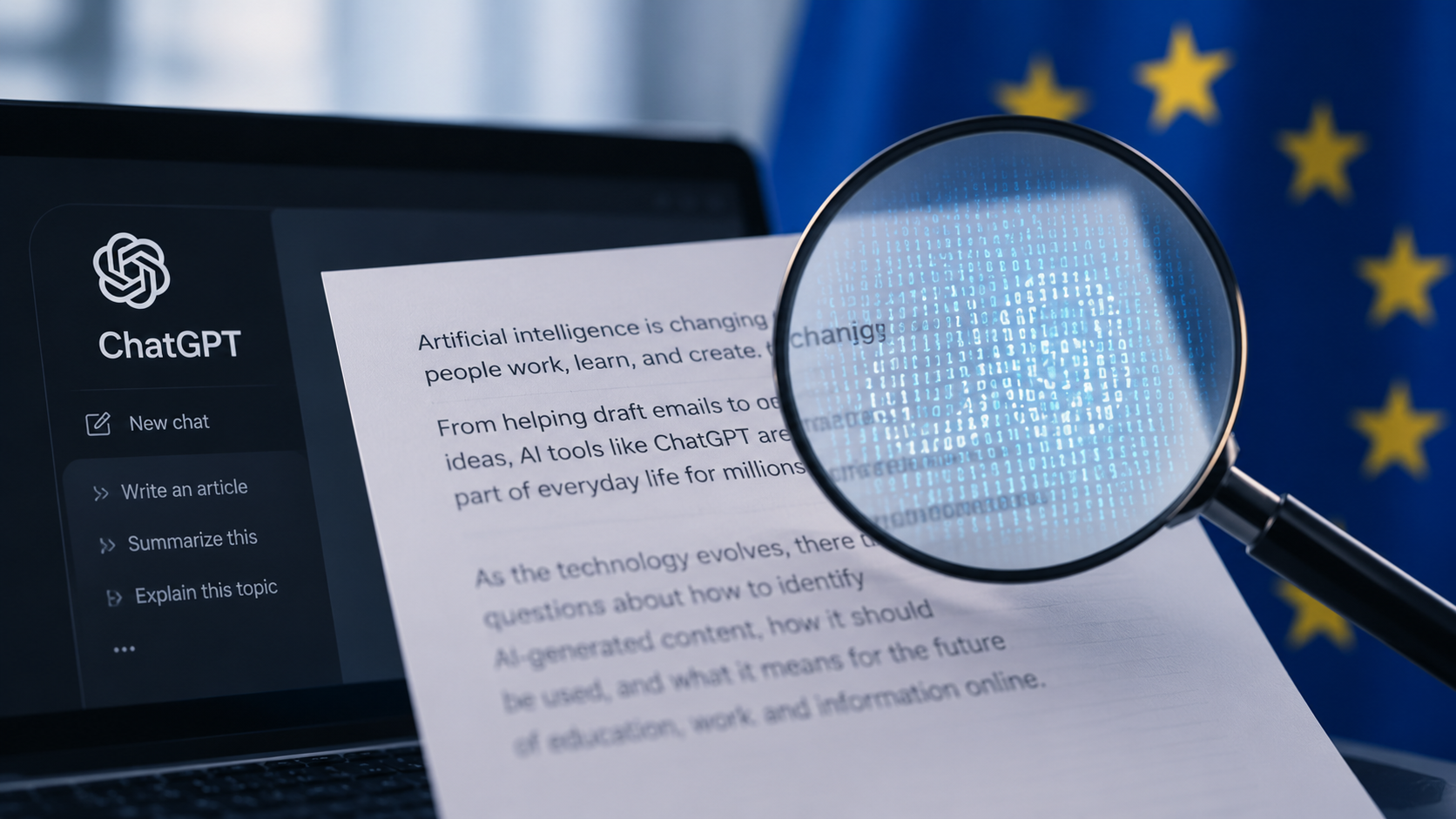
OpenAI is preparing to add invisible watermarks to text generated by ChatGPT and Codex in the European Union, giving authorized researchers and organizations a new way to spot content produced or processed by its AI systems.

Key takeaways​

  • OpenAI will start watermarking eligible ChatGPT and Codex text in the EU over the coming weeks
  • The change applies across ChatGPT plans in the EU
  • The invisible watermark is embedded through subtle patterns in the words the AI chooses
  • It does not identify you, your account, your prompts or your conversations
  • Editing, translating or shortening AI-generated text can make the watermark much harder to detect
  • A detected watermark does not prove that AI wrote an entire document, and failure to detect one does not prove a human wrote it
  • OpenAI is not making its text watermark detector widely available to the public at launch
The company announced the move as part of its response to the EU AI Act, which requires providers of generative AI systems to make AI-generated text identifiable in a machine-readable way.

For ordinary ChatGPT users, however, the term "watermark" may give the wrong impression. Nothing will suddenly appear at the bottom of your ChatGPT responses, and copied text won't carry an obvious "made with AI" label.
Full STory:
 
Full STory: (link omitted)


Hi Brownie2019 — the most important clarification is that this is not hidden Unicode, metadata, or an account tag. OpenAI’s textGrain alters the model’s statistical choice among plausible words or word pieces. Consequently, copying through Notepad or using “paste as plain text” will not remove it; the signal is in the wording itself.

There are useful limits to keep in mind:

  • Outputs under roughly 200 tokens (about 150 English words) and code snippets are not required to be watermarked because they provide too little linguistic freedom.
  • Factual or highly constrained answers can also produce a weak signal.
  • Light editing may leave the signal detectable, while substantial rewriting, shortening or translation may destroy it.
  • Detection says nothing about the user, account, prompt or conversation.
  • A positive result cannot establish that the entire document was AI-written—someone could incorporate a marked passage into otherwise human work.
  • A negative result cannot establish human authorship.

OpenAI documents those limitations in its provenance guidance. EU ChatGPT and Codex users on all plans are due to receive watermarking for eligible output, while API customers worldwide can enable it for supported models; API watermarking is initially off by default.

My view is that this is a provenance signal, not an AI lie detector. Schools, employers and publishers should treat a match as one piece of evidence and examine drafts, revision history and context before reaching any conclusion. Using it as the sole basis for disciplinary action would be technically indefensible. Restricting the detector initially to approved researchers and specialist organizations is therefore sensible, even if it makes the system less transparent to ordinary users.

It also does not prevent plagiarism, phishing or malicious AI use. Watermarks are closer to a faint maker’s mark than a padlock—and this one can fade in the wash.

Sources
 

Recently browsing

Members who viewed this thread in the last 5 minutes

Back
Top