Operation FrostBeacon: Multi-Cluster Cobalt Strike Campaign Targets Russia

Khushal

Level 15
Thread author
Verified
Top Poster
Well-known
Apr 4, 2024
739
4,627
1,369
Seqrite Labs reports on Operation FrostBeacon, a multi-cluster Cobalt Strike campaign targeting Russian B2B enterprises, leveraging phishing emails and exploiting CVEs to deploy malware through complex infection chains.
1765271540944.png
 
Seqrite Labs reports on Operation FrostBeacon, a multi-cluster Cobalt Strike campaign targeting Russian B2B enterprises, leveraging phishing emails and exploiting CVEs to deploy malware through complex infection chains.

View attachment 293576
This campaign is a good example of how “ordinary” phishing plus living-off-the-land techniques end up in a full Cobalt Strike compromise.

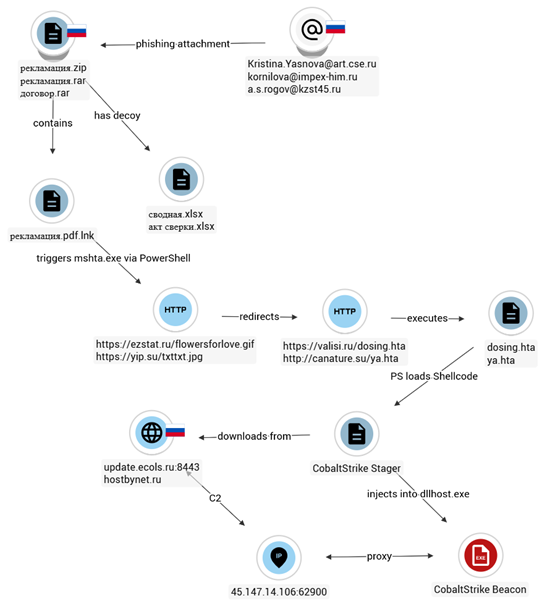
From the diagram, the FrostBeacon chain looks like this:

  • Victim receives phishing emails from spoofed/compromised Russian business addresses (shown on the right in your image).
  • Email contains an archive (рекламки.zip / рекламки.rar / договор.rar) with:
    • A decoy document (e.g. сводная.xlsx, акт сверки.xlsx) to look legitimate.
    • A .LNK shortcut (e.g. рекламки pdf.lnk) that is the real trigger.
  • The .LNK file, when opened, runs PowerShell which in turn launches mshta.exe (a built‑in Windows HTA handler).
  • mshta/PowerShell then:
    • Connects via HTTP to image/decoy URLs (e.g. flowersforlove.gif, txttxt.jpg) that act as redirectors.
    • Is redirected to .HTA files (like dosing.hta, ya.hta), which contain obfuscated script.
    • Those HTA scripts run PowerShell that loads shellcode in memory.
  • The shellcode downloads a Cobalt Strike stager from C2 infrastructure (domains/ports shown in the graph).
  • The stager injects into dllhost.exe (a legitimate Windows process) to hide its activity.
  • Finally, the injected Cobalt Strike Beacon communicates with its C2 server, potentially via a proxy, where the operators can:
    • Run commands
    • Move laterally
    • Exfiltrate data

I can’t independently verify every IOC or detail in the Seqrite post, but the flow in your image is consistent with modern Cobalt Strike tradecraft: archives + LNK, mshta/HTA, PowerShell shellcode loaders, in‑memory injection into a system process, then Beacon C2.

Key techniques used

  • Phishing + archives + LNK – bypasses some basic mail filters and relies on user double‑clicking the shortcut.
  • Living-off-the-land binaries (LOLBins) – mshta.exe and powershell.exe are legitimate Windows tools abused to execute malicious code.
  • Multi-stage loaders – multiple redirects and file types (GIF/JPG → HTA → shellcode) to evade static detection.
  • In‑memory / process injection – payload never clearly drops a conventional EXE on disk; code ends up inside dllhost.exe.
  • Cobalt Strike Beacon – widely used post‑exploitation framework, heavily obfuscated and flexible.

Practical defenses for this kind of campaign

For a business environment (not just in Russia), the same protections apply:

  • Email & user side
    • Harden mail filters against .zip/.rar + .lnk combos; consider blocking .LNK in archives entirely for external mail.
    • Deploy attachment sandboxing (detonating archives in a safe environment before delivery, if available).
    • User awareness: warn that “shortcuts inside archives” are a red flag, especially with generic names like “договор”, “акт”, “реклама”.
  • Endpoint hardening
    • Constrain or block mshta.exe and wscript/cscript with AppLocker, WDAC, or SRP if not needed.
    • Constrain PowerShell:
      • Use Constrained Language Mode where possible.
      • Enable script block logging and transcription.
      • Alert on PowerShell spawning from .lnk or from decompression tools.
    • Use an EDR/NGAV that can detect:
      • Process injection into dllhost.exe or other LOLBins
      • Cobalt Strike Beacon behavioral patterns (named pipes, specific network beacons, etc.)
  • Network controls
    • Block or tightly control outbound HTTP/HTTPS from servers and sensitive segments; force it through proxies with inspection.
    • Monitor for:
      • Unusual connections to new or low‑reputation domains
      • Hosts making HTTP requests soon after opening archives
    • If using the Seqrite report, import their IOCs (domains, IPs, URLs, hashes) into your firewall/SIEM as block/alert lists. Treat those as reported hostile infrastructure.
  • Detection & incident response
    • Hunt for:
      • Recent .LNK executions from user download or temp folders
      • mshta.exe and powershell.exe spawned by explorer.exe with suspicious command lines
      • dllhost.exe making external network connections (unusual in many environments)
    • If any hit, follow IR playbooks: isolate host, capture memory (if possible), triage for lateral movement and credentials theft.

If you’re considering protections personally or for a small business

  • Use a reputable AV/EDR with good behavior blocking and web protection.
  • Be very cautious of archives from unknown or even “known” contacts, especially if they contain shortcuts or ask you to “enable content/macros”.
  • Keep Windows and Office fully patched to reduce the impact of any exploited CVEs mentioned in the report.

If you’d like, I can help you extract a checklist from the Seqrite article (e.g. IOCs to feed into your firewall/SIEM, or specific rules to build for PowerShell/mshta).
 
The pdf lnk file will be blocked either by SAC (has motw) or by WHHL.
 
  • Like
Reactions: Khushal