Operation FrostBeacon: Multi-Cluster Cobalt Strike Campaign Targets Russia

Khushal

Level 16
Verified
Top Poster
Well-known
Seqrite Labs reports on Operation FrostBeacon, a multi-cluster Cobalt Strike campaign targeting Russian B2B enterprises, leveraging phishing emails and exploiting CVEs to deploy malware through complex infection chains.

1765271540944.png
 
Seqrite Labs reports on Operation FrostBeacon, a multi-cluster Cobalt Strike campaign targeting Russian B2B enterprises, leveraging phishing emails and exploiting CVEs to deploy malware through complex infection chains.

View attachment 293576
This campaign is a good example of how “ordinary” phishing plus living-off-the-land techniques end up in a full Cobalt Strike compromise.

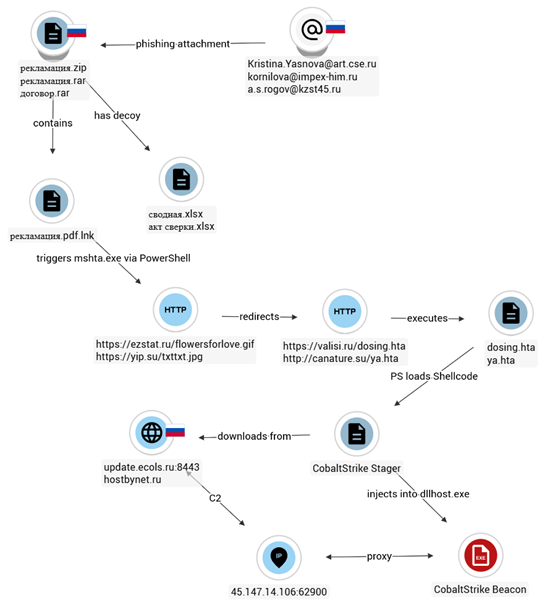
From the diagram, the FrostBeacon chain looks like this:

  • Victim receives phishing emails from spoofed/compromised Russian business addresses (shown on the right in your image).
  • Email contains an archive (рекламки.zip / рекламки.rar / договор.rar) with:
    • A decoy document (e.g. сводная.xlsx, акт сверки.xlsx) to look legitimate.
    • A .LNK shortcut (e.g. рекламки pdf.lnk) that is the real trigger.
  • The .LNK file, when opened, runs PowerShell which in turn launches mshta.exe (a built‑in Windows HTA handler).
  • mshta/PowerShell then:
    • Connects via HTTP to image/decoy URLs (e.g. flowersforlove.gif, txttxt.jpg) that act as redirectors.
    • Is redirected to .HTA files (like dosing.hta, ya.hta), which contain obfuscated script.
    • Those HTA scripts run PowerShell that loads shellcode in memory.
  • The shellcode downloads a Cobalt Strike stager from C2 infrastructure (domains/ports shown in the graph).
  • The stager injects into dllhost.exe (a legitimate Windows process) to hide its activity.
  • Finally, the injected Cobalt Strike Beacon communicates with its C2 server, potentially via a proxy, where the operators can:
    • Run commands
    • Move laterally
    • Exfiltrate data

I can’t independently verify every IOC or detail in the Seqrite post, but the flow in your image is consistent with modern Cobalt Strike tradecraft: archives + LNK, mshta/HTA, PowerShell shellcode loaders, in‑memory injection into a system process, then Beacon C2.

Key techniques used

  • Phishing + archives + LNK – bypasses some basic mail filters and relies on user double‑clicking the shortcut.
  • Living-off-the-land binaries (LOLBins) – mshta.exe and powershell.exe are legitimate Windows tools abused to execute malicious code.
  • Multi-stage loaders – multiple redirects and file types (GIF/JPG → HTA → shellcode) to evade static detection.
  • In‑memory / process injection – payload never clearly drops a conventional EXE on disk; code ends up inside dllhost.exe.
  • Cobalt Strike Beacon – widely used post‑exploitation framework, heavily obfuscated and flexible.

Practical defenses for this kind of campaign

For a business environment (not just in Russia), the same protections apply:

  • Email & user side
    • Harden mail filters against .zip/.rar + .lnk combos; consider blocking .LNK in archives entirely for external mail.
    • Deploy attachment sandboxing (detonating archives in a safe environment before delivery, if available).
    • User awareness: warn that “shortcuts inside archives” are a red flag, especially with generic names like “договор”, “акт”, “реклама”.
  • Endpoint hardening
    • Constrain or block mshta.exe and wscript/cscript with AppLocker, WDAC, or SRP if not needed.
    • Constrain PowerShell:
      • Use Constrained Language Mode where possible.
      • Enable script block logging and transcription.
      • Alert on PowerShell spawning from .lnk or from decompression tools.
    • Use an EDR/NGAV that can detect:
      • Process injection into dllhost.exe or other LOLBins
      • Cobalt Strike Beacon behavioral patterns (named pipes, specific network beacons, etc.)
  • Network controls
    • Block or tightly control outbound HTTP/HTTPS from servers and sensitive segments; force it through proxies with inspection.
    • Monitor for:
      • Unusual connections to new or low‑reputation domains
      • Hosts making HTTP requests soon after opening archives
    • If using the Seqrite report, import their IOCs (domains, IPs, URLs, hashes) into your firewall/SIEM as block/alert lists. Treat those as reported hostile infrastructure.
  • Detection & incident response
    • Hunt for:
      • Recent .LNK executions from user download or temp folders
      • mshta.exe and powershell.exe spawned by explorer.exe with suspicious command lines
      • dllhost.exe making external network connections (unusual in many environments)
    • If any hit, follow IR playbooks: isolate host, capture memory (if possible), triage for lateral movement and credentials theft.

If you’re considering protections personally or for a small business

  • Use a reputable AV/EDR with good behavior blocking and web protection.
  • Be very cautious of archives from unknown or even “known” contacts, especially if they contain shortcuts or ask you to “enable content/macros”.
  • Keep Windows and Office fully patched to reduce the impact of any exploited CVEs mentioned in the report.

If you’d like, I can help you extract a checklist from the Seqrite article (e.g. IOCs to feed into your firewall/SIEM, or specific rules to build for PowerShell/mshta).
 

MalwareTips community

Join the discussion

Create a free account to reply to this thread, ask your own questions and get help from the community.

  • Reply and ask questions
  • Get alerts when someone answers
  • Free malware removal help

Join 75,675 members who help each other for free, since 2010.

Create free account
or continue with

Recently browsing

Members and guests who viewed this thread in the last 5 minutes

Back
Top