Direct answer
Based on what you described alone, this can plausibly be treated as a security weakness, but I cannot safely confirm it as a vendor-acknowledged vulnerability without official documentation, a CVE, or a clear vendor statement.
Why it may be considered a vulnerability
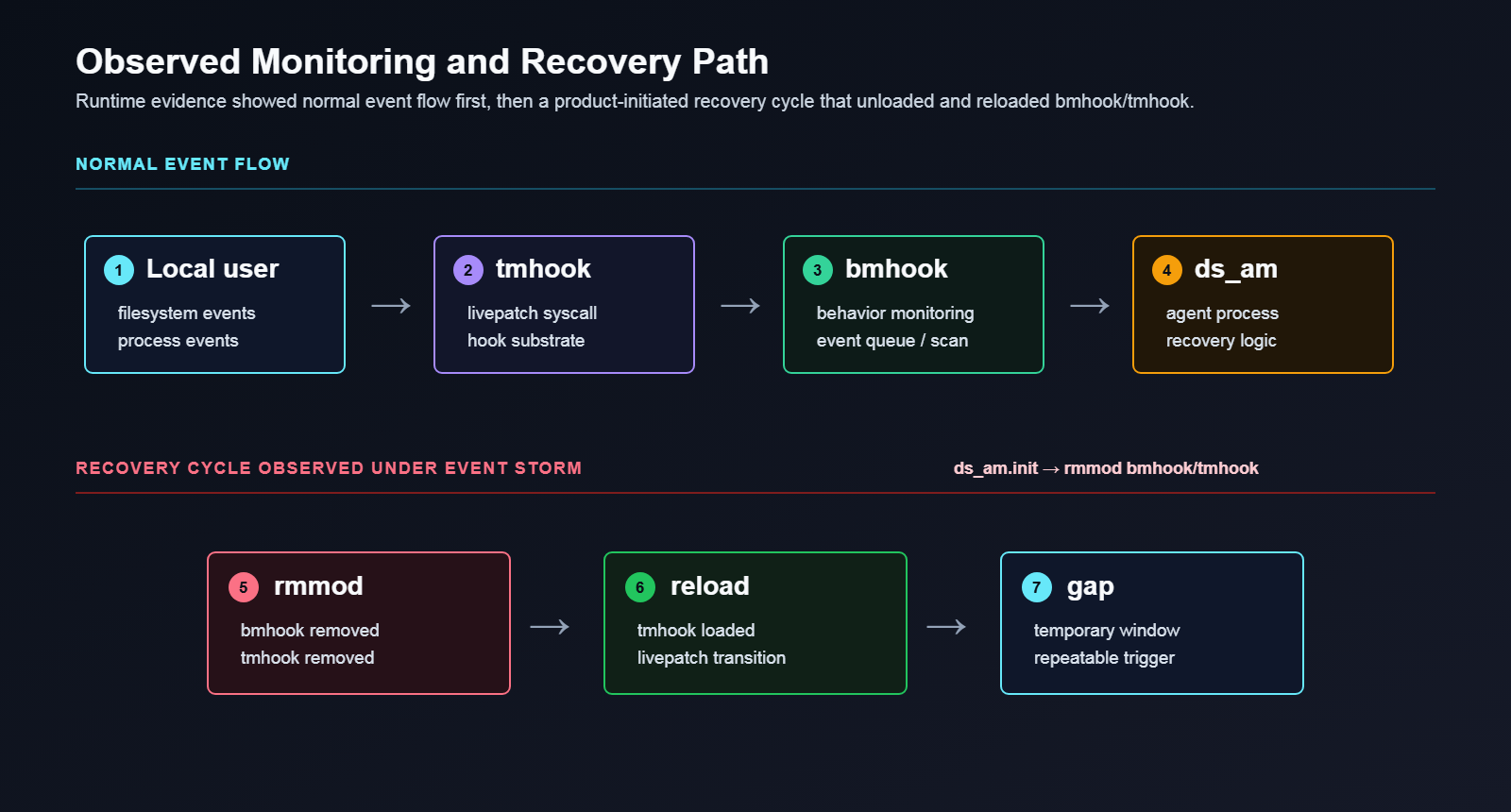
If the behavior is reproducible as described, the main security concern is not the recovery logic itself, but the fact that:
- a local unprivileged user can intentionally trigger it,
- that trigger causes security components to unload and reload,
- there is a measurable protection gap during that transition, and
- an action that is normally blocked can succeed during that gap.
From a security design perspective, that is more than a harmless stability event. It is effectively a bypass of a protection mechanism under attacker-controlled conditions, even if it is temporary and even if it does not give code execution by itself.
Important nuance
That said, severity depends heavily on context:
- If an attacker already has local unprivileged code execution, the impact is narrower than a remote pre-auth issue.
- If the bypass is very brief, timing-sensitive, or unreliable, that may reduce practical severity.
- If the affected module is only one layer of protection and other controls still detect or block the payload, the real-world risk may be limited.
- If the vendor explicitly documents this as intentional self-protection or loop prevention, that explains the behavior, but it does not automatically eliminate the security impact.
“Expected behavior” and “security-relevant weakness” are not mutually exclusive. A mechanism can be intentional yet still be abuseable.
How this is usually framed
A careful way to describe it would be:
- local attacker-triggerable denial or disruption of a security control,
- resulting in a temporary monitoring or enforcement gap,
- which can permit otherwise blocked file activity during the reload window.
That framing is generally stronger and more precise than calling it “remote code execution” or a “persistent kill switch,” which you already ruled out.
What would strengthen the claim
To assess it more confidently, the most important points would be:
- clear reproduction steps,
- proof that an unprivileged user can trigger it consistently,
- timing or frequency data for the protection gap,
- evidence that the blocked artifact succeeds only during the unload/reload window,
- confirmation of which protections remain active and which do not,
- testing across agent versions and kernel versions,
- any vendor response clarifying whether this is intended, accepted risk, or a fix candidate.
Bottom line
If an unprivileged local user can reliably force Trend Micro Deep Security Agent to temporarily disable or reduce behavior-monitoring enforcement and use that window to write something normally blocked, that is reasonably described as a security vulnerability or at minimum a security-control bypass. The exact classification and severity still depend on reproducibility, scope, and vendor confirmation.




matheuzsecurity.github.io


 ? You've got more problems than you think.


