
Privacy News What Your IP Address Reveals Every Time You Visit a Website

Brownie2019

Level 23
Verified
Well-known
Forum Veteran
Your IP address can reveal your location, ISP, connection type, and VPN use to websites, ad networks, and trackers before a page even loads.
Every site, ad network and tracker you load gets your IP address before anything else. Here is what they can work out from it, what they cannot, and what changes when you hide it.

Before a web page shows a single word, your device has already handed the server one piece of information: its IP address. There is no opting out of that step. The server needs a return address for the page, in the same way a letter needs one to get a reply.

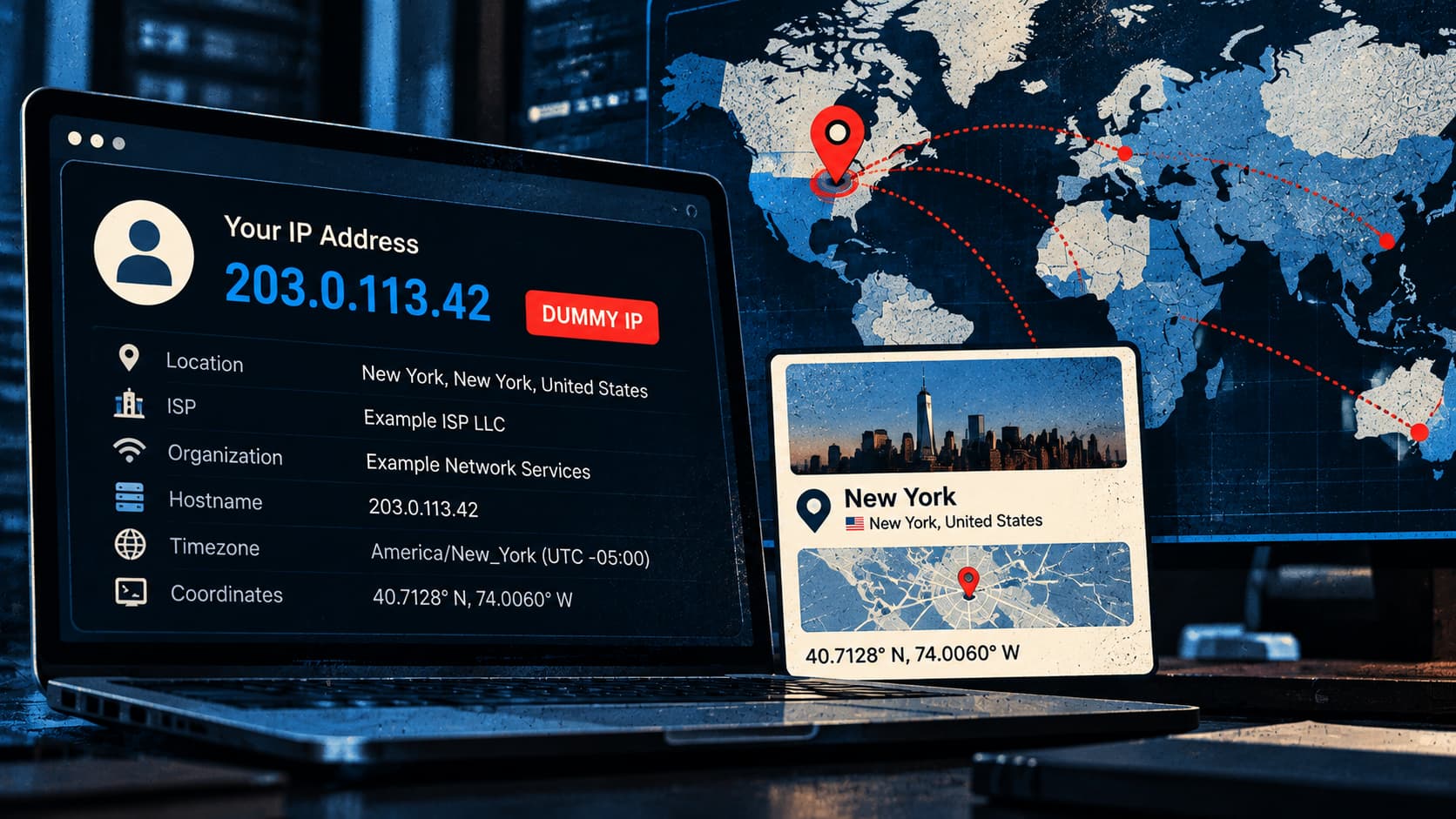
From that address alone, a website learns roughly where you are, which company sells you internet access, whether you are on a home line, an office network or a phone, and whether you are trying to hide. It learns all of that without a cookie, a login or your consent. It does not learn your name or where you live.

What a Website Reads From Your Address
A website does not work any of this out by itself. It looks the address up in an IP intelligence database, a commercial product that returns a profile in a few milliseconds.

Location comes first. MaxMind, one of the most widely used suppliers, estimates that its data places a visitor in the right country 99.8% of the time. For US addresses, it puts accuracy at about 80% for the state and 66% for the city, counted as anywhere within 50 km.
Full Story:
 
What I find interesting about this topic isn't so much that a website can determine our approximate location or ISP, but rather what happens when that information is combined with all the other data collected on a daily basis. Individually, each piece of data may seem harmless, but over months or years, the accumulation of information can build fairly detailed profiles of people.

It's not about being paranoid, since much of this data collection serves legitimate purposes, but about being aware of how much information we leave behind, the value it can have to third parties, and why it's worth being mindful of what we share. 🧩📊
 
For a VPN, Firefox VPN (a proxy through Fastly, reportedly with no logs but no audit) is free for 50 GB per month. Cloudflare One (24-hour logs, no audit) is free, although it doesn’t hide your general geographic location. It does at least hide your IP address. With both, the IP addresses seem to change with each connection throughout the day.

With ISP CGNAT, the IP addresses aren’t fixed if rebooting the router daily. Windows IPv6 addresses change every seven days, and Android’s change daily. Mine only reveal a general geographic location, just like Cloudflare One.
 
Public ips are not the same as private ips. These are assigned via your home Internet or cellular providers. While they give a approximate location, it is not an exact location such as a home address or gps coordinates. Websites can only approximate your general location. Not something one should be concerned about.
 
Public ips are not the same as private ips. These are assigned via your home Internet or cellular providers. While they give a approximate location, it is not an exact location such as a home address or gps coordinates. Websites can only approximate your general location. Not something one should be concerned about.
What you said is mostly true for now. However, give it a few months to test the waters, followed by rapid, convenience-driven adoption. Suddenly, a brand-new market opens up for junk you never asked for—devices now running LLMs, dynamically aware of your presence and everything around them down to centimeter-level accuracy using nothing more than standard Wi-Fi.

All of this is courtesy of 802.11az throwing open the floodgates, fueled by the vectorized propagation of carrier-grade municipal hotspots like Xfinity Wi-Fi, Spectrum WiFi, and Cox Wi-Fi—swallowed whole by the masses in the name of convenience.

(And yes, I know I sound like a total tinfoil-hat lunatic.)

Still, what you said is largely true—for the moment.
Does not sound like a tin foil hat to me but maybe over reaching as web servers can not read local ToF ranging data without hardware access or OS permissions. These coupled with Mac randomization keep that info from being widely broadcasted. Not to mention that the rolling out of 802.11az requires a lot of upgrades and adjustments leading one to believe that this may take much longer than a few months. As for how AI will be able to position you this is not wrong but again a website has several barriers from browser to system in the way.
 
Does not sound like a tin foil hat to me but maybe over reaching as web servers can not read local ToF ranging data without hardware access or OS permissions. These coupled with Mac randomization keep that info from being widely broadcasted. Not to mention that the rolling out of 802.11az requires a lot of upgrades and adjustments leading one to believe that this may take much longer than a few months. As for how AI will be able to position you this is not wrong but again a website has several barriers from browser to system in the way.


I fully understand that perspective, but we shouldn't underestimate the corporate marketing drive to implement micro-tracking if it becomes profitable—or beneficial to the broader government apparatus. If these capabilities aren't fully realized in Wi-Fi 8, they almost certainly will be in Wi-Fi 9 and beyond.

After all, department stores already track your physical location if you have their app installed, even analyzing which merchandise you pause to look at. This technology was piloted years ago and is now paving the way for fully autonomous grocery stores. By combining weight sensors, smart carts, and continuous spatial tracking, these systems monitor exactly what you take, completely eliminating the need for a checkout line or any human interaction.
 

Join the discussion

Write your reply below. You'll create a free account or log in before it's posted.

Recently browsing

Members who viewed this thread in the last 5 minutes

Back
Top