
I agree with you on this. which is why I consider Windows Defender as only a secondary line of defense against malware.Windows Defender protection against scripts is poor by default, so is not stopping anything unless it's flagged as known malware.


Open MalwareTips from your Home Screen or desktop. Follow discussions, find answers and pick up where you left off.
If you cannot find an install option, update your browser or use its bookmark option to keep MalwareTips close.
After installation, open the app and sign in. Enable push notifications in Preferences if you want alerts. On iPhone and iPad, push requires a Home Screen web app and iOS or iPadOS 16.4 or later.
Sign in to manage notificationsInstallation is optional. Your notification settings stay under your control.
 Thread starter
Templarware
Thread starter
Templarware
I agree with you on this. which is why I consider Windows Defender as only a secondary line of defense against malware.Windows Defender protection against scripts is poor by default, so is not stopping anything unless it's flagged as known malware.

I found this thread on Reddit, where a user is claiming that Windows Defender can be easily disabled by malware and even trusted applications.
Thoughts?

 malwaretips.com

Seems you misunderstand how this has been abused in the past, which forced Microsoft hand with Anti-Tamper (which is still useless to an extent), Windows Defender can indeed be easily disabled.
Is pretty obvious the payload is only downloaded after disabling WD, the script that disables WD itself is not supposed to be detected, nor it is the real malware.

You should not say this. It is clear that your knowledge about the current Defender's anti-script protection requires the update.Windows Defender protection against scripts is poor by default, so is not stopping anything unless it's flagged as known malware.

Microsoft knows better if it is useless or not on the basis of successful attacks in the wild. It can be probably sufficient for now, but far from being a comprehensive solution - still, the attack surface is too big. Some other AVs (like Kaspersky) have stronger anti-tampering (the AV services cannot be disabled even with TrustedInstaller privileges).Tamper Protection is useless cause you can still disable WD in the current session (it won't turn back on, already tested), only after a restart that WD is back on (and only if not corrupted by malware already), and by then is too late.
You are right that the method of the attack from the OP is clearly a kind of vulnerability. It could be used in the wild as a primary infection vector (sometimes even successfully). Fortunately, it has also many drawbacks as the primary infection vector so it is very unpopular despite the fact that it is known for many years.Microsoft had to go as far as removing regedit entries for WD, cause it was that easy to bypass Tamper Protection, and it still is unfortunately.

Hi Andy,It is clear that your knowledge about the current Defender's anti-script protection requires the update.
Anyway, it is true that any popular Home AV on default settings has only mediocre anti-script protection.
Script protection via ASR rules and AMSI behavior-based detections (also post-execution detections) are available in all Windows editions.Hi Andy,
isn't Defender's script protection only available to Enterprises via the Attack Surface Reduction (ASR) component? Also if I'm not mistaken, many threats will obfuscate the script sent in a .zip file that often evades AV. Sodinokibi Ransomeware, for example, does this.

You can take a look here and here if you are wanting to use powershell to enable ASR rules for Windows 10 Home instead of Andy's tool. He just makes it a lot easier.Hi Andy,
isn't Defender's script protection only available to Enterprises via the Attack Surface Reduction (ASR) component? Also if I'm not mistaken, many threats will obfuscate the script sent in a .zip file that often evades AV. Sodinokibi Ransomeware, for example, does this.
I do not require any update on Windows Defender script protection, if you relying on AMSI you already lost.You should not say this. It is clear that your knowledge about the current Defender's anti-script protection requires the update.
Anyway, it is true that any popular Home AV on default settings has only mediocre anti-script protection.
Microsoft knows better if it is useless or not on the basis of successful attacks in the wild. It can be probably sufficient for now, but far from being a comprehensive solution - still, the attack surface is too big. Some other AVs (like Kaspersky) have stronger anti-tampering (the AV services cannot be disabled even with TrustedInstaller privileges).
You are right that the method of the attack from the OP is clearly a kind of vulnerability. It could be used in the wild as a primary infection vector (sometimes even successfully). Fortunately, it has also many drawbacks as the primary infection vector so it is very unpopular despite the fact that it is known for many years.
Do you know any example of such an attack in the wild? I know only the examples where this method was used by the malware as one of many post-infection actions (not primary infection vector).
Furthermore, this method can be easily detected by behavior-based modules. If it is not for now (I do not know) then this would strongly suggest that it is not used in the wild as a primary infection vector (or used very rarely).
Most malware targeted at Home Users is not hidden, nor it needs to, they simply wanna do as much damage as possible.Let's look at two methods of theft:
The first method is very noisy, unpredictable, and very unpopular among professional thieves. The same is true for the method from the OP (as the primary infection vector). Although the first method is possible, most people do not use additional protection to prevent it.
- Sneak into the house with weapons, kill the host, and steal what you want.
- Sneak into the house, avoid the family members, and steal what you want.
One example of such prevention would be installing the weapon detector and do not allow entering people with weapons. This would be analogous to use script blocking, SmartScreen, etc.
The situation is different when professional criminals want to attack the house with strong protection to get something very precious (worth killing). They can use another strategy:
Sneak into the neighbor's house which is not protected so well, and kill the host. Observe the target house, gather information, concentrate more people and more weapons. Use the weak point in the security to attack the target house at a suitable moment.
This method is analogous to the lateral movement in Enterprises.

Which better anti-script solution is applied in popular Home AVs?I do not require any update on Windows Defender script protection, if you relying on AMSI you already lost.
Yes, I hope that Microsoft remembers about it. But for now, it is doing pretty well:The way I see it, Windows Defender is the most popular/used in the world, due to being built in, so not only is more susceptible AV crippling attacks but Windows crippling attacks as well. Having the best prevention and tempering protection is really a must.
malwaretips.com
The AV testing Labs do not support your claims.Crippling Windows Defender is pretty much a basic feature most malware has nowadays, considering it comes pre-installed with Windows 10, so it is more popular than you believe.
malwaretips.com

I can already hear people complaining: I am installing 3rd party AV and MS does not want to let me, arghhh! Majority of users do not care about security, extra popup = bloatware.Don't understand why they not adding something like this.

 mspoweruser.com
Thanks Andy,Script protection via ASR rules and AMSI behavior-based detections (also post-execution detections) are available in all Windows editions.
I actually have those rules enabled in Group Policy, done a long time ago I guess. Still I think for some reason I had some doubt that they were fully effective for non-enterprise users, but I take your word for it that they are.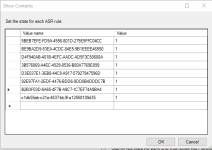
In Home AVs, you better off relying on Behaviour Blockers like System Watcher.Which better anti-script solution is applied in popular Home AVs?
Members who viewed this thread in the last 5 minutes


