

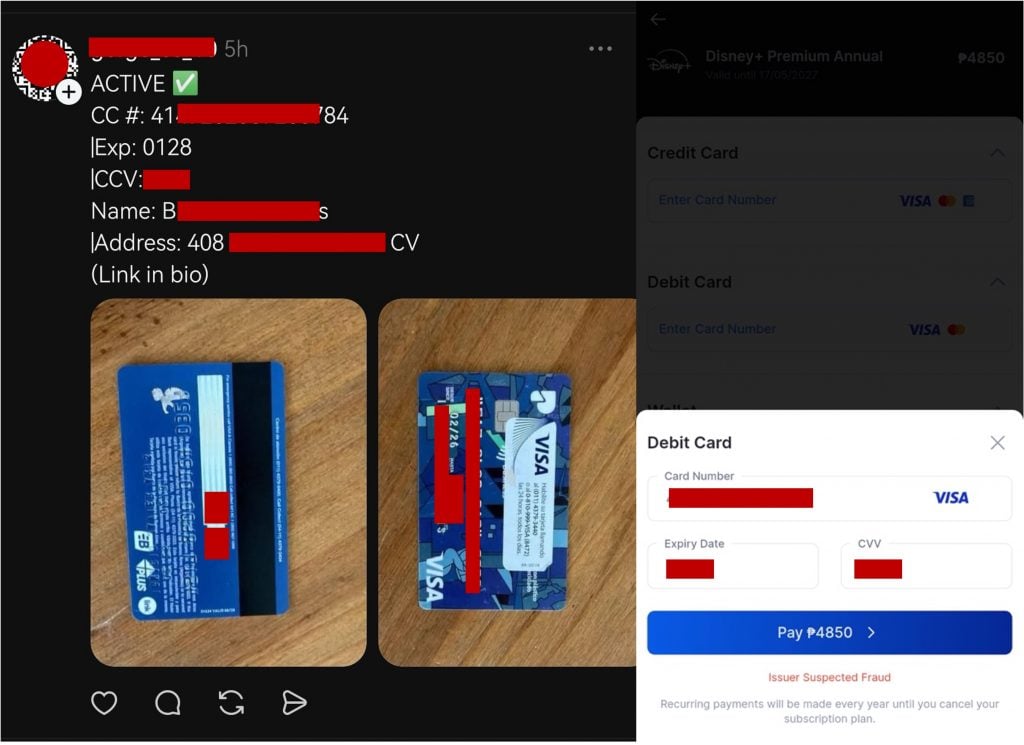
A Threads post appears to give away complete credit card details. The card is described as active, the comments point toward easy money, and a Telegram link promises access to a private group where people supposedly repeat the trick every day.
The card is not the prize. It is the entrance to a controlled funnel that ends with a $200 Bitcoin payment, a useless PDF, and repeated demands for more cryptocurrency.
Overview
Declined card details are used as social-media bait
The Threads credit card giveaway scam begins with posts displaying photos of cards and redacted personal details. The account claims the information is active and invites viewers to use it or follow a link for more “drops.”
In the campaign examined, the publicly posted card was already unusable. A declined transaction is not an accidental flaw in the offer. It pushes the viewer toward the profile and its Telegram link, where the real sales pitch begins.
Telegram creates a private room full of manufactured success
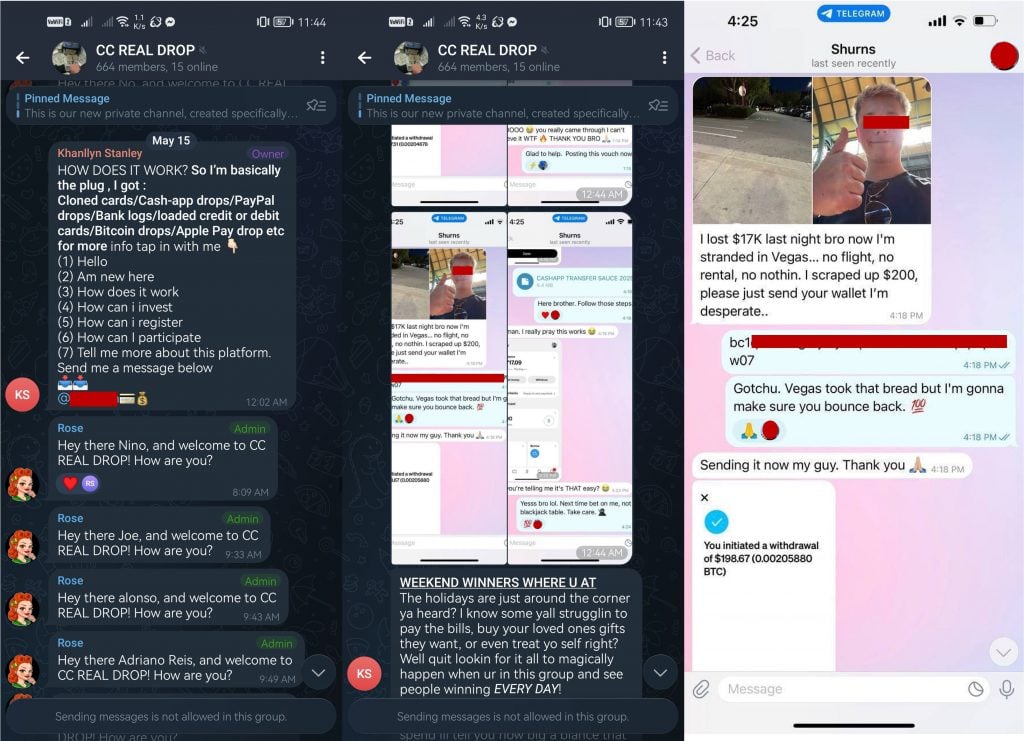
The linked Telegram channel presents itself as a community for cloned cards, Cash App transfers, PayPal “flips,” bank logs, and Bitcoin drops. Regular members may be unable to post, allowing the administrator to control every visible message.
Apparent testimonials show large balances, Bitcoin receipts, grateful buyers, and emotional stories. A busy feed can look like independent proof, but a broadcast-only channel can be written entirely by one operator and a collection of automated accounts.
A $200 Bitcoin fee opens an escalating payment trap
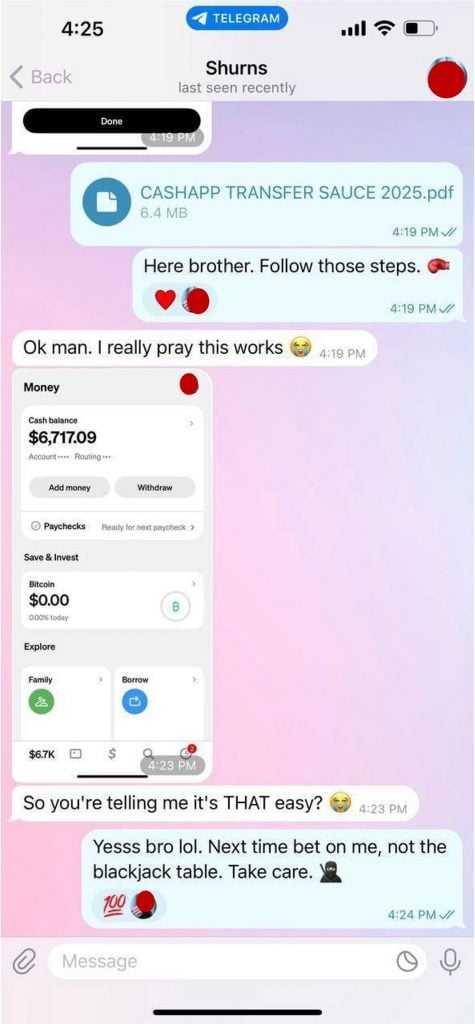
The administrator eventually asks for about $200 in Bitcoin to unlock a guide described as “Cash App Transfer Sauce.” The file does not create legitimate income and reportedly directs recipients toward unauthorized access to other people’s accounts.
After the first payment, the operator may demand another $100 for a supposed one-time-password bot or $300 to perform the process. The promised money never arrives, while each irreversible payment creates another opportunity to extract funds.
- The public card details are bait, not a genuine giveaway.
- The Threads profile directs viewers to a Telegram channel.
- Only administrators may be able to publish success stories.
- Receipts, balances, and transaction identifiers can be fabricated.
- The first demand is about $200 in Bitcoin.
- A paid PDF replaces the promised access to money.
- Additional $100 and $300 upsells may follow.
- Attempting to use another person’s card or account is illegal.
The “Free Card” Is Designed to Fail
A stranger has no sensible reason to post a working payment card publicly. If the information were usable, automated fraud systems, other viewers, the cardholder, and the issuing bank could detect or exhaust it within minutes.
Scammers can recycle canceled, blocked, expired, invented, or previously exposed card details. The failed payment then becomes a qualification test. Anyone who continues looking for a working card has shown both interest and willingness to cross a legal boundary.
That makes the viewer easier to manipulate. The operator can claim the public post was only a sample and that the private Telegram group contains fresh material available to paying members.
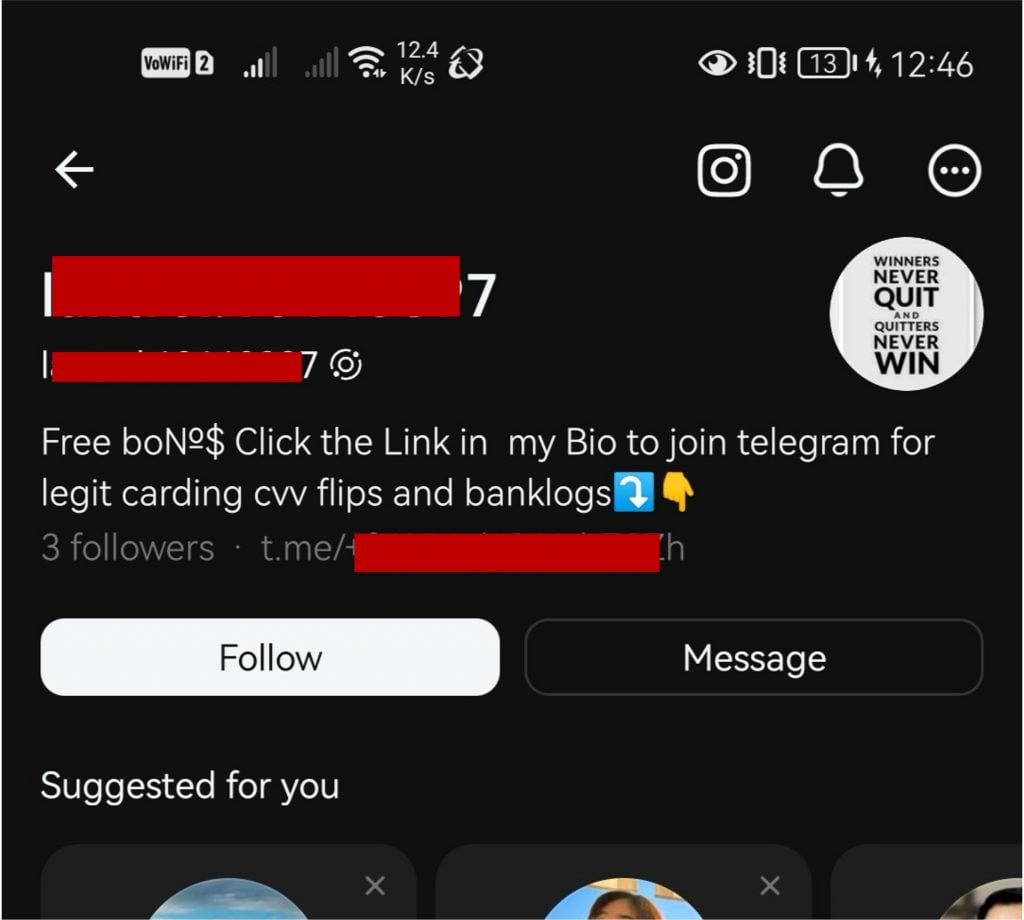
The profile language may include phrases such as “carding,” “CVV flips,” “banklogs,” and “free bonus.” These are not ordinary giveaway terms. They describe access to stolen financial information or schemes built around unauthorized accounts.
Do not test the number, add it to a wallet, or make a small purchase to see whether it works. Even an unsuccessful attempt can expose a device, IP address, merchant account, delivery address, and identity to fraud monitoring or law enforcement.
The safe action is to preserve a redacted screenshot if needed, report the post, and stop. Curiosity is exactly what moves people from a public post into the private payment funnel.
Why the Telegram Channel Looks Busy and Convincing
A channel with hundreds of subscribers can create social proof at a glance. Subscriber counts do not show how many people are genuine, active, paid, automated, or controlled by the administrator.
Broadcast-only settings are especially useful to scammers. Real buyers cannot warn newcomers, challenge a failed claim, or ask why a transaction identifier does not appear on a blockchain explorer.
The administrator can publish a steady sequence of welcome messages, screenshots, payment instructions, and success stories. A bot can greet new names, making the group appear active without any independent conversation.
Emotional stories replace verifiable evidence
The observed channel paired payment screenshots with stories about gambling losses, being stranded, family hardship, or urgently needing rent. The details are crafted to sound spontaneous and human.
A genuine financial transaction does not become authentic because a dramatic story appears beside it. The wallet address, transaction identifier, amount, time, and blockchain record must agree independently.
Invalid Bitcoin data exposes staged screenshots
Some displayed addresses and transaction references reportedly failed basic validation. A screenshot can contain a string shaped like a wallet address without corresponding to a valid address or a confirmed transaction.
Scammers can edit images, reuse another person’s transaction, change displayed balances, or assemble a conversation between accounts they control. The pixels show what the operator wants the viewer to see, not what the blockchain recorded.
Before trusting any crypto receipt, search the full transaction identifier through a reputable block explorer for the correct network. Confirm the sending address, destination, amount, timestamp, confirmations, and status.
A missing or invalid record means the receipt is not proof. A real record only proves that a transaction occurred between two addresses. It does not prove the storyteller owns either wallet or that a promised service is legitimate.
The simplest conclusion remains the strongest: a stranger promising stolen money in exchange for Bitcoin is not offering a safe business opportunity.
How the Threads Credit Card Giveaway Scam Works
Step 1: A Threads post offers supposedly active card details
The operator posts a physical card photo, a partial number, an expiration date, a security code, or a cardholder identity. Redactions may protect the campaign screenshot later, but the original post is framed as a usable free gift.
The post attracts people searching for free money, payment tricks, or proof that online carding works. It may also reach ordinary users through recommendations, reposts, replies, or curiosity-driven engagement.
Step 2: The profile sends interested viewers to Telegram
A link in the Threads bio points to a Telegram account or group. Moving platforms separates the scam from the original post, reduces public criticism, and gives the operator more control over the conversation.
The Telegram destination may rotate when an account is reported. The Threads profile can also change its username while continuing to push followers toward a replacement channel.
Step 3: A broadcast channel manufactures social proof
The channel displays hundreds of members and a stream of apparent wins. Newcomers see Cash App balances near $6,000, Bitcoin withdrawal notices, card claims, and friendly conversations praising the administrator.
If members cannot post, there is no independent community. The operator decides which messages exist, can stage replies between controlled accounts, and can delete every complaint before a new visitor sees it.
Step 4: Fake receipts make the promised system look measurable
Transaction screenshots add numbers, timestamps, and technical strings to the story. Those details feel harder to fake than a simple testimonial, but image editing and fabricated interfaces make them inexpensive to produce.
The campaign depends on viewers treating a screenshot as final proof. An actual Bitcoin transaction should exist on the public blockchain, while an actual Cash App balance must be verified inside the account that owns it.
Step 5: The administrator requests about $200 in Bitcoin
Once the viewer asks how to participate, the operator introduces an entry price. Bitcoin is presented as the payment for private instructions, access to a “drop,” or a proven method for generating a Cash App balance.
The FTC warns that unexpected social-media contacts demanding cryptocurrency are a major scam signal. Crypto transfers generally lack the card-dispute process victims expect from traditional purchases.
Step 6: A PDF replaces the promised money
After paying, the buyer receives a document instead of working card access or a legitimate income service. The observed file used the name “Cash App Transfer Sauce” and was presented as a secret guide.
The material reportedly encourages unauthorized access to other people’s accounts. It does not provide lawful earnings, and following it can expose the buyer to account closure, financial loss, identity theft, and criminal investigation.
Step 7: New tools and fees keep the victim paying
When the guide fails, the operator can blame a missing bot, verification tool, one-time password, or execution service. Another $100 or $300 is offered as the final piece needed to make the process work.
Each payment becomes a sunk cost. The victim may send more because walking away would mean accepting that the first $200 is gone.
Step 8: Fear and shame reduce complaints
The funnel deliberately recruits people through the attempted use of someone else’s financial data. Victims may hesitate to report their loss because they would have to explain why they entered the group.
The scammer uses that silence as protection. Reporting the fraud honestly is still the right move. Do not repeat the illegal attempt or destroy evidence to hide what happened.
The Paid Cash App Guide Is Not a Harmless Shortcut
A PDF can make the transaction look as though a digital product was delivered. Delivery of a file does not make its claims legitimate, useful, or legal.
Instructions that depend on another person’s card, password, one-time code, account, identity, or balance are instructions for unauthorized access. There is no safe testing environment inside a stranger’s real financial account.
Cash App says it uses fraud monitoring, alerts, and account controls, and it tells users never to give sign-in codes or PINs to someone claiming to represent the service. Its official support and reporting paths are inside the app and on cash.app.
Do not install an application, browser extension, configuration profile, or remote-access tool supplied with such a guide. A file sold as a payment bot may instead steal passwords, session cookies, wallet keys, or files.
If the document contains links, QR codes, macros, scripts, or executable downloads, preserve it without opening those components. A security professional can examine a copy in an isolated environment when necessary.
The legal and financial risk belongs to the buyer, while the anonymous operator keeps the Bitcoin. That is why the supposed shortcut always favors the person selling it.
Company, Address, and Fulfillment Checks
The social profile is not a legal business
A username, follower count, Telegram administrator badge, and motivational profile picture do not identify a registered merchant. The campaign provides no verified company responsible for the cards, guide, refund promise, or payment request.
Ask who legally accepts the order, which jurisdiction applies, and what name appears on a receipt. An anonymous account selling access to stolen data cannot provide a credible answer.
A Telegram handle is not an address
The seller offers no verifiable office, owner, registration, or service address. A profile can be renamed, deleted, transferred, or replaced within minutes.
There is nowhere to send a legal cancellation or return request. The lack of a traceable address is central to the model, not a minor customer-service omission.
Support disappears after the Bitcoin arrives
Before payment, the administrator may answer quickly and promise a replacement or refund. After payment, support can become a new sales script that blames the customer and demands another fee.
No neutral dispute service controls the transaction. A promise made in Telegram does not give the victim the protections attached to a credit card purchase.
The wallet and files are the real evidence trail
Save the destination wallet address, transaction hash, Telegram username, channel link, Threads profile, file hash, payment time, and every message. Those identifiers may connect the campaign to other reports even after the display names change.
Do not publish unredacted cardholder data while warning others. Give sensitive evidence only to the relevant platform, financial institution, or law-enforcement channel.
What to Do if You Have Fallen Victim to This Scam
- Stop immediately. Do not test another card, open another account, send another Bitcoin payment, or follow more instructions. Continuing increases both the financial and legal risk.
- Preserve the evidence. Save redacted screenshots, profile and channel links, usernames, wallet addresses, transaction hashes, messages, invoices, and the PDF filename. Keep the original file closed if it may contain active content.
- Report the Threads profile. Use the in-app reporting option for scams, fraud, and exposed financial information. Do not repost the full card data when warning other users.
- Report the Telegram channel and administrator. Use Telegram’s reporting controls on the channel, messages, and account. Include the Bitcoin demand and the sale of unauthorized financial access.
- Contact the crypto service immediately. Tell the exchange or wallet provider that the destination was involved in fraud. A confirmed transfer may not be reversible, but the provider can record the address and preserve account evidence.
- Secure Cash App and related accounts. Change reused passwords, enable Security Lock and two-factor protection, review connected devices, and report suspicious activity through the official Cash App application.
- Protect exposed identity and payment data. If you shared a card, bank account, ID, email password, or Social Security number, contact the institution, replace affected cards, review credit reports, and use IdentityTheft.gov for a recovery plan.
- Scan every device involved. Use Malwarebytes to look for malicious downloads, credential stealers, and unwanted remote-access tools. Use AdGuard to reduce malicious ads, tracking, and redirects that can lead back into similar funnels.
- Report the fraud honestly. File with the FTC and FBI’s IC3. Explain the complete sequence, including the original post, attempted card use, Telegram contact, Bitcoin transfer, and later demands.
- Ignore recovery agents. Anyone who guarantees that Bitcoin can be recovered for an upfront fee may be running a second scam. Work with the payment provider and law enforcement, not an unsolicited social-media account.
Frequently Asked Questions
Are the free credit cards posted on Threads real?
The observed details were already unusable and served as bait. No legitimate person gives strangers working credit cards, security codes, and cardholder identities through a public post.
Why does the scam move from Threads to Telegram?
Platform hopping gives the operator a more controlled environment. A broadcast channel can hide criticism, stage testimonials, automate greetings, and move followers when an account is reported.
Can a Bitcoin receipt screenshot be verified?
Search the complete transaction identifier on a reputable explorer for the correct blockchain. Confirm every field. A real transaction still does not prove the seller owns the wallets or offers a legitimate service.
What is the $200 Cash App PDF?
It is the digital file delivered after the initial Bitcoin payment. It does not create legitimate earnings and reportedly promotes unauthorized account access rather than a lawful Cash App method.
Can Bitcoin sent to the administrator be reversed?
A confirmed Bitcoin transfer usually cannot be canceled like a card payment. Report it immediately to the exchange or wallet provider and preserve the transaction hash for investigators.
Can I report the scam if I tried to use the posted card?
Yes. Stop, preserve the evidence, and report the full facts honestly. Do not keep testing cards or hide evidence. Consider obtaining legal advice if you are concerned about your own actions.
The Bottom Line
The Threads credit card giveaway scam uses declined card data to identify interested viewers, moves them into a controlled Telegram channel, and surrounds them with staged proof before demanding about $200 in Bitcoin.
The PDF, bots, testimonials, and later fees do not unlock free money. Report the accounts, protect any information you exposed, and never pay a stranger for access to someone else’s card, account, or balance.








