


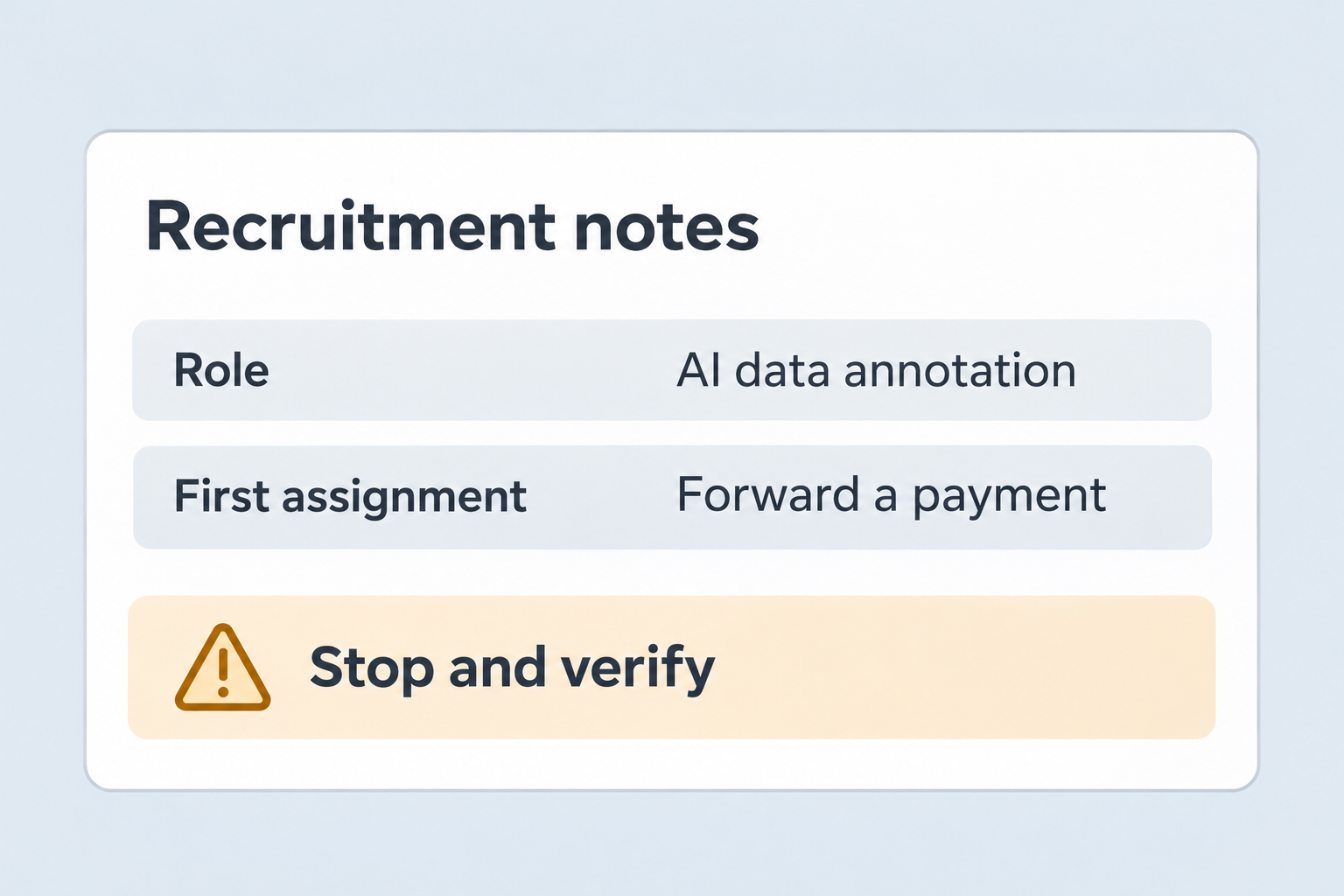
An AI data annotator job scam can look like ordinary remote work until the first assignment turns out to be moving somebody else’s money through your account.
You may be asked to deposit a check, send part of an incoming payment onward, or pay to release supposed earnings. Each situation calls for a different response.
Overview
The advertised work isn’t the same as the first assignment
Legitimate annotation work can involve labeling records, assessing responses, or comparing examples. It doesn’t require you to receive and forward a stranger’s money through your personal bank account.
What matters is the instruction you received, not the research jargon used to describe it. A contract or sample annotation task doesn’t make the payment request legitimate.
Determine what actually arrived
Money shown on a website, provisional bank credit from a check, and a real incoming transfer all look different once you check the statement in your own financial app.
- A balance on the recruitment site isn’t evidence that you were paid.
- A check may show as available before the bank discovers it’s bogus.
- A real transfer can still involve someone else’s stolen funds or a disputed transaction.
Use your bank, not the recruiter’s explanation
Don’t spend, forward, or return unexpected funds on instructions from the person who recruited you. Ask your bank or payment provider how to handle the original transaction safely.
In the United States, the FBI warns about job offers that turn recruits into money mules. That warning describes the mechanism, not a determination about every online annotation company.
What to Do if a Recruiter Asks You to Move Money
- Stop the transaction before sending or spending any of the funds. Do not accept an alternate account, wallet, or payment app proposed by the recruiter.
- Open your own bank or payment app directly. Record what actually appeared, including the amount, status, date, and transaction reference, without posting private details.
- If money arrived or left, contact the institution’s fraud team through a known number and tell it the transaction followed a suspicious job offer.
- Save the job listing, messages, and instructions, then independently check whether the company advertised the role. Do not use links or reference contacts provided by the recruiter.
- If you want to report the offer, use the platform’s reporting tools or the FTC’s US fraud reporting site. Report the payment separately to the financial provider involved.
Do not wait for another assignment to see whether the work becomes legitimate. Contact your own provider first if a transfer is pending or you have already received a check.
What a Real Annotation Role Should Be Asking You to Do
An annotator helps produce or evaluate labeled data. An assignment might ask whether two responses meet the same criteria, or which of several categories describes an example.
A recruiter can copy that language and provide a believable test. Verify the ongoing duties, written pay terms, company identity, and applicant portal through a channel you found independently.
A skills test and a payment to start are different requests.
If a recruiter says testing an account requires personal funds or a pass-through payment, stop before completing that part.
When you find the employer’s real website, go to its careers area yourself. Compare the job title, how applicants apply, and the type of contact the company says it uses.
If the listing came from a job board and the company doesn’t confirm it, use the job board’s reporting process. Don’t treat a copy of the posting as independent corroboration.
Sometimes employers hire through an outside recruiting firm. Ask the verified employer whether the firm handles the role and where you should submit an application, without sending money.
Recognize a real company without trusting the message
DataAnnotation’s trust and safety guidance says people have misused its name and that applicants should apply through its official site. It says it won’t ask applicants for payment.
That tells you how to check that brand, not that every suspicious annotation offer uses it. The DataAnnotation impersonation report covers that particular name and recruitment pitch.
A legitimate contractor onboarding process may eventually require tax information or payout details. Verify the company, role, and authenticated onboarding channel before sharing sensitive documents.
Your employer needs a way to pay you. It doesn’t need your bank password, a one-time financial login code, or the ability to transfer funds out of your account.
Check the FTC’s side-hustle scam alert for the difference between finding paid work and paying someone who says they can get you started.
Read the First Payment Request Before Calling It a Paycheck
The recruiter sends a check and asks you to forward some of it
A stranger may tell you to deposit a check and send part of the money to an equipment vendor, trainer, or project coordinator.
The check is not proof of a job.
The FTC’s fake-check guidance explains why the bank making funds available does not prove the check is genuine. A bad deposit can be reversed later.
If you’ve already deposited it, call your bank and leave the funds alone. Tell the bank if you were told to send money elsewhere before the check could be verified.
Do not handle a supposed overpayment by sending your own money back. The institution needs to identify the original deposit and tell you how to manage it.
Money really appears in your bank or payment app
An incoming transfer can be real without being legitimate pay. The requester may be using your account to pass along money that someone else sent or had stolen.
Tell the fraud team how the funds arrived, what the recruiter asked you to do, and whether you know the payer. Ask it to identify any reversals, holds, or restrictions.
Do not try to trace or negotiate with the apparent sender. Leave the provider to manage the disputed credit through the normal transaction and reporting process.
If you already sent money on, report both directions of the transfer.
A bank or payment provider needs different identifiers for each movement, especially when another service received the outgoing funds.
The MalwareTips money mule job guide covers the broader job pattern. Here, the useful clue is the gap between the annotation role and the instruction to move money.
The earnings exist only in an online task balance
Someone might claim your pay is locked behind a deposit, an account upgrade, or an unusually large task. A figure shown on the site isn’t a settled payment.
The FTC’s task-scam guidance documents a version in which people see apparent earnings and are told to put their own money in to withdraw them.
Don’t combine that with the check scenario. In a task scam you may never receive real funds, while in a pass-through offer they can appear in your financial account.
If an initial small payment did arrive, it doesn’t establish that the apparent balance is withdrawable.
Ignore a demand to pay more and discuss any money already sent with your provider.
If You Already Took Part, Preserve the Record
Start a private timeline with the name the recruiter used, where you found the offer, what you were asked to do, and the date each instruction arrived.
Save the original messages and genuine payment confirmations. For any encrypted or disappearing conversation, retain what you can access without contacting the recruiter again or opening another link.
A useful bank report separates what the recruiter said from what your own account shows. Identify the amount that posted, the amount that left, and what is still pending.
If you paid by a wallet or other service, use that service’s legitimate fraud contact as well. An open case with one institution doesn’t alert a second company automatically.
If you’re concerned that strangers used your account for criminal activity, consider obtaining independent legal advice. Avoid relying on the person who signed you up to tell you your responsibilities.
If you sent personal details but no money
Identify whether you gave out a government ID, financial login, or personal contact details. Give the relevant institution the specifics so it can distinguish identity exposure from attempted access.
For a password or sign-in code, act through the actual service and ask it to review access. Replace any reused passwords on the accounts that shared them.
If you shared a US Social Security number or similar identity data, IdentityTheft.gov can help you identify appropriate next steps.
Avoid posting the documents as part of a public warning.
If you installed software or granted remote access at the recruiter’s request, contact workplace IT or a trusted technician as appropriate. Use another device for banking while access is investigated.
A Practical Test Before Accepting a Remote Role
Ask what a completed assignment looks like and how payment travels from the company to you. The answers should describe two separate activities: work delivered and compensation received.
Request the pay schedule and the actual employer or contracting party in writing. Compare those terms with what the independently verified company says about the role.
If a job depends on collecting money from strangers, don’t perform the transfer. Ask why the company wouldn’t handle its payments through its own business account.
If you are offered a separate role in purchasing or payments, check it independently too. Changing the title doesn’t make using your personal account for business transfers an acceptable audition.
Keep copies of the official intake and your agreed duties. If the next message introduces a duty you never agreed to, you have something concrete to check with the company.
Compare a fictional test assignment with a real payment
Imagine that you complete a short writing review and the recruiter says your next step is to receive payment for a reviewer. There is no new annotation task attached.
The test may have been technically plausible. The proposed transfer is still unrelated to the work you were asked to do and shouldn’t be performed.
If the money only appears on a portal, record that as a displayed number, not a deposit. If your bank shows a credit, report the bank transaction itself.
A notice saying a refund is due doesn’t change the decision. A request to pay back a different account creates a separate transaction, with no guarantee the credit will stay.
Check the role without sending your identity paperwork first
Ask the verified company whether it runs the recruitment process and what its application stages are. You can describe where you saw the listing without sending the recruiter your ID.
Look for the company named in the contract, not only the brand in the profile picture. Verify who will pay you and which independently confirmed portal hosts the onboarding requirements.
A person pretending to be a subcontractor may mention a real AI platform as a customer. Verify the hiring contractor on its own merits rather than relying on that relationship.
If you don’t know who is responsible for handling your proposed payment, closing the conversation is reasonable. Don’t open a new account to learn whether the offer is real.
If you must explain the payment to your bank
Use a clear description: an online job instructed you to move an unexpected payment. Mention whether you know the person who sent it and whether you followed the instruction.
Ask the fraud team what to do with money remaining in the account and whether it needs evidence before you close anything. Keep the response and case number.
If the bank says the matter is still being reviewed, do not withdraw the rest while waiting. Direct any fresh request from the recruiter to the provider’s documented process.
If a separate account or app received the money, check that provider’s case process too. Your employment records and the receiving provider’s transaction records may answer different questions.
Frequently Asked Questions
Is AI data annotation itself a scam?
No, because people are legitimately paid to label or evaluate data. The concern here is a job offer that substitutes transfers or deposits for the work it advertised.
What if my bank already made the recruitment check available?
Available funds don’t confirm a check is genuine. Contact your bank and avoid spending, withdrawing, or forwarding the money while the institution investigates the deposit.
Can I refund a transfer the recruiter says was sent in error?
Don’t send a separate transfer to correct it yourself. Give the original reference to the bank or payment service and follow its instructions about the disputed credit.
Is a skills assessment the same as paying to start?
An assessment can test how you classify or review material. It should not require you to send money, accept deposits, or forward funds to anyone.
How can I verify the employer behind the listing?
Find the company and its hiring process outside the message. Check the role and the communication channel with the official employer before providing identity or payout information.
What if I already forwarded some of the money?
Stop further payments and contact the provider you used. Give it the original inbound record and every outbound reference, then preserve the messages for your report.
The Bottom Line
Judge an annotation job by the actual assignment and the source of its pay. A plausible work sample doesn’t justify using your personal account to move other people’s money.
If money arrived, leave it in place and let your own institution handle it. If a portal only shows earnings, don’t buy access to a withdrawal.

Join the discussion
0 commentsShare your experience or ask a question about this article.
Community experiences
Did this happen to you?
Your experience could help someone recognize the same scam. Submit a private report for our team to review.
I experienced this tooReports are reviewed before publication. Sharing publicly is always your choice.
Discussion
Start the conversation
Have a question or something useful to share? Add the first comment.