

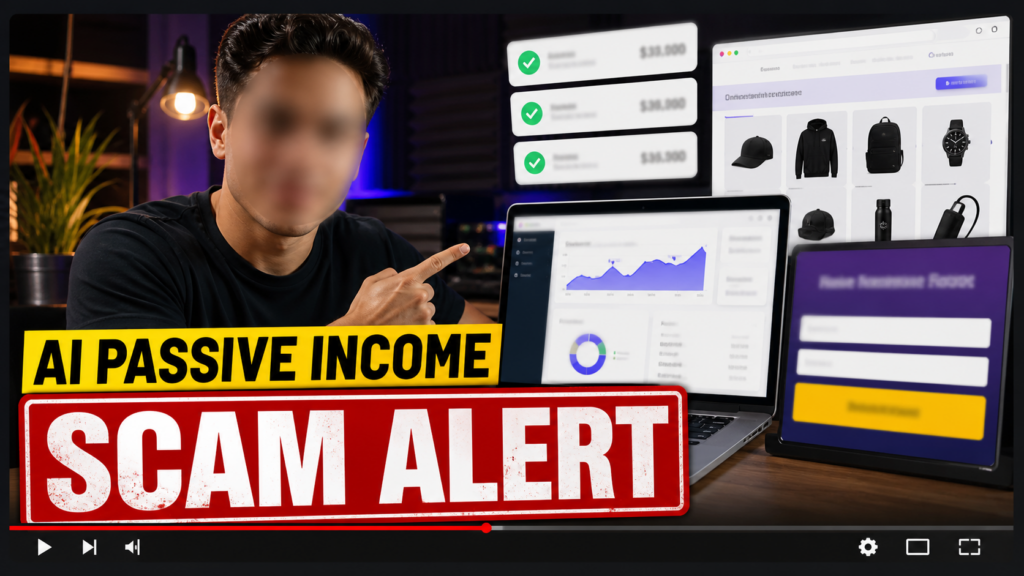
The pitch arrives as a professionally produced video about artificial intelligence doing the hard work for you. A small payment supposedly unlocks a ready-made online business, and the income examples make the decision feel almost risk-free.
What happens after that first payment is the part the advertisement does not explain clearly enough.
Overview
What the AI passive-income offer promises
The offer claims ordinary people can use an automated AI system to create a store, attract customers, or generate income with little experience and very little daily work. The initial price may be presented as a one-time $67 activation or access fee.
Names such as AI Systems, AI Wealth Machine, and AI Profit Systems can appear around versions of the funnel. The branding sounds technical, but the sales presentation often gives few concrete details about the actual software, work, operating costs, or realistic path to profit.
The cheap entry can lead to a more expensive sales process
A low opening price lowers resistance. After payment, the buyer may be told to finish a store setup, create a Shopify account, pay another small verification charge, or speak with an onboarding specialist.
That conversation can become a qualification call. Instead of technical support, the caller asks about age, income, credit, savings, and financial goals, then argues that more commitment is needed to succeed.
Why the offer raises serious concerns
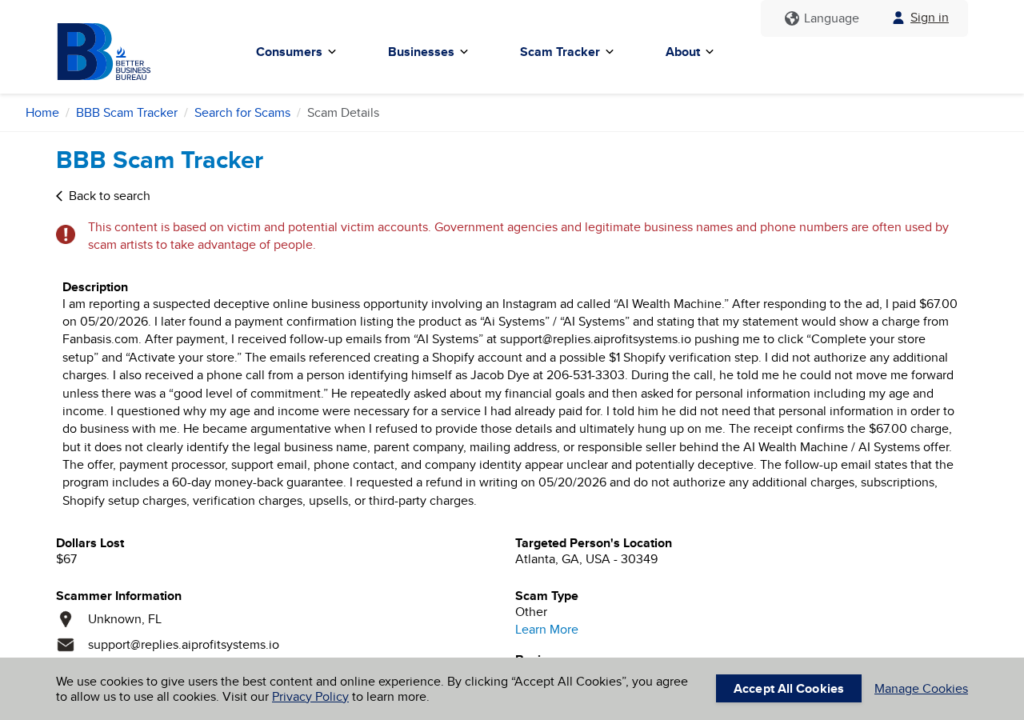
A complaint filed with BBB Scam Tracker in May 2026 described a $67 purchase connected with AI Systems and a Fanbasis card descriptor. The complainant said follow-up messages pushed store activation and a Shopify step, while a caller requested personal financial information.
- The seller’s legal identity was unclear to the complainant.
- Several domains and offer names appeared around one purchase.
- The initial payment did not clearly explain the full business model.
- Follow-up contact focused on financial capacity and commitment.
- The buyer feared additional charges and requested a refund.
A consumer complaint is not a court finding, and one report cannot describe every buyer’s experience. It is still valuable evidence of the exact confusion these offers can create when the company, product, processor, and next steps are not clearly presented before payment.
What Is Actually Being Sold?
A legitimate business opportunity should explain what the customer will do, what is delivered, how revenue is generated, what expenses continue after purchase, and what skills or time are required.
Vague phrases such as “AI-powered store,” “automated income,” or “done-for-you system” do not answer those questions. AI can help with product descriptions, customer support, research, and other tasks, but it cannot guarantee that strangers will visit a new store and buy from it.
An online store still needs products, suppliers, positioning, traffic, payment processing, customer service, tax and legal compliance, returns handling, and advertising. If the pitch skips those realities, the buyer is not seeing a complete business plan.
The FTC warns that offers promising guaranteed income, large returns, or a proven system are likely scams. It also warns that a low-cost starting system can turn into a costly series of mentoring or service upsells.
The right way to evaluate AI Systems is not by asking whether AI is popular. It is by asking what specific asset or service the buyer receives for $67, who provides it, and why it should produce revenue after every additional expense.
How the Scam Works
Step 1: A social-media ad promises effortless AI income
The funnel begins with a short video or advertorial claiming that a new AI method is paying ordinary users daily. It may show dashboard balances, payment notifications, luxury imagery, or testimonials from people who say they started with no technical experience.
These visuals create possibility without proving profit. A balance shown in a marketing video does not reveal expenses, refunds, advertising costs, or whether the account belongs to a real customer.
Step 2: A long presentation makes the system feel exclusive
The viewer is told that access is limited, enrollment may close, or major companies do not want the method widely known. The video delays the practical explanation while repeating how easy and transformative the opportunity could be.
This structure builds emotional commitment before the viewer sees the seller’s identity or full terms. By the time the price appears, $67 feels small compared with the income examples.
Step 3: The first payment buys access, not a proven business
The order may be processed through a platform such as Fanbasis, so the card descriptor can differ from the sales-page brand. The buyer receives login details, onboarding messages, or a prompt to continue setting up a store.
At this point, the critical question is what the original fee actually covered. If the customer cannot use the system without buying more services, the opening price did not communicate the real cost.
Step 4: Setup tasks create another commitment
Follow-up emails may tell the buyer to activate a store, create a Shopify account, or pay a small verification amount. Each step seems minor, but it moves the buyer deeper into an ecosystem with recurring platform, domain, app, advertising, or service costs.
A $1 verification is not necessarily fraudulent. The problem is when it is presented without a clear explanation of what account is being opened, who controls it, and which ongoing charges can follow.
Step 5: A sales caller measures the buyer’s ability to pay
The “onboarding” call may ask about income, available credit, savings, age, and financial goals. Those questions help a closer estimate how much the person might spend on coaching or a higher-tier package.
A real support agent can explain the product without pressuring a customer to reveal unnecessary financial details. Refusing to answer should not prevent someone from using a service they already purchased.
Step 6: The upsell is framed as the missing commitment
If the buyer hesitates, the salesperson may say success requires investment, serious students act quickly, or the customer will fail by choosing the basic option. This shifts responsibility away from the incomplete original offer.
Never borrow money or increase a card limit during a high-pressure call. Ask for the full proposal, company name, refund terms, and earnings evidence in writing, then end the call and review it independently.
Step 7: Refund deadlines and scattered identities create friction
The buyer may have a 60-day guarantee but be unsure whether to contact the sales-page brand, email sender, payment platform, or caller. Different domains such as aiprofitsystems.io, replies.aiprofitsystems.io, dexentraq.com, or aisystemsforge.com can make the trail harder to follow.
That is why documentation must begin before purchase. If the merchant identity is already unclear at checkout, assume a dispute will require extra evidence.
How to Evaluate an AI Business Offer Before Paying
Ask for a plain-language description of the work. Who finds the products? Who owns the store? Who pays for advertising? Who answers customer complaints? What are the monthly costs after the first fee?
Then ask for earnings information that includes typical results, not the best screenshot. Revenue is not profit. A store that sells $5,000 of goods can still lose money after inventory, refunds, advertising, apps, taxes, and processing fees.
Finally, confirm whether the seller complies with business-opportunity rules that apply to its offer. Honest sellers should not resist a request for legal identity, address, material terms, cancellation rights, and substantiated earnings claims.
Red Flags Hidden Behind the “Done for You” Language
“Done for you” sounds as though the difficult work has already been completed. In practice, the phrase can mean almost anything, from a basic website template to a collection of prerecorded lessons. The seller should define every deliverable before checkout.
Ask who selects products, writes listings, purchases ads, responds to customers, pays refunds, and handles chargebacks. If those jobs still belong to the buyer, the opportunity is not passive and the advertising should not imply otherwise.
Also ask who owns the assets. A store created inside someone else’s account can disappear if the service relationship ends. The customer should control the domain, store login, advertising account, payment account, customer data, and any original content purchased.
Watch for earnings examples that show revenue without costs. A dashboard may display sales while hiding advertising spend, product costs, platform fees, app subscriptions, refunds, and taxes. Profit is what remains after every expense, not the largest number on the screen.
Finally, separate training from investment management. A course seller should never need remote access to online banking, a cryptocurrency wallet, or a card account. No coach needs a one-time password to help someone create a store.
Company, Address, and Fulfillment Checks
No clear legal seller means no clear accountability
The BBB complainant said the receipt did not clearly identify a responsible legal business, parent company, or mailing address behind the AI Systems or AI Wealth Machine offer. That is not a small omission.
Before paying, find the legal entity in the terms and confirm that the same entity appears at checkout and on the receipt. A collection of product names and domains is not a substitute.
Domains and processors should form one understandable chain
Write down the ad domain, landing-page domain, checkout domain, processor, email-sending domain, and card descriptor. Different services can legitimately be involved, but their roles should be disclosed.
If the seller cannot explain why several unrelated names surround one purchase, stop. Confusion gives a dishonest operator room to deny responsibility later.
Phone calls should provide support, not financial interrogation
Search the number and caller’s name. Call the company through contact information in its formal terms, not through a number given only in a high-pressure message.
Do not disclose income, available credit, bank balances, Social Security number, or online-banking credentials to qualify for software or coaching. End the call if the representative becomes argumentative or says immediate payment proves commitment.
Digital fulfillment can hide the real upsell path
There may be no warehouse, but “fulfillment” still matters. Identify every account created in your name, who controls the domain and store, which subscriptions are active, and whether canceling the course also cancels third-party services.
A login page and a few training videos technically deliver something. They do not prove that the advertised income system exists or that the remaining costs were disclosed honestly.
What to Do if You Have Fallen Victim to This Scam
- Stop additional payments. Decline coaching, financing, advertising packages, and remote-access requests while you review the transaction.
- Save every record. Keep the ad, sales video, checkout, receipt, guarantee, emails, text messages, call logs, domains, phone numbers, and screenshots of the member area.
- Request the refund in writing. Send a dated message to every documented support channel. State the purchase amount, order number, guarantee, and that you do not authorize future charges.
- Contact the card issuer or payment provider. Explain what was promised, what was delivered, and any additional charge you did not approve. Ask whether the merchant can be blocked.
- Cancel connected subscriptions separately. Review Shopify, domain registration, email, advertising, app, and payment accounts. Cancel through each provider and preserve confirmation numbers.
- Protect your identity. If you disclosed sensitive financial data, monitor accounts and credit reports. Consider a fraud alert or credit freeze if enough information was exposed.
- Secure your devices. Remove remote-control tools the caller installed, change reused passwords from a clean device, enable multifactor authentication, and run Malwarebytes if suspicious software or downloads were involved.
- Reduce malicious advertising. AdGuard can block many deceptive ad and tracking domains. It will not make an income offer legitimate, so still research the seller before paying.
- Report the offer. File a report with the FTC at ReportFraud.ftc.gov, the payment platform, BBB Scam Tracker, and the social network that carried the advertisement.
Frequently Asked Questions
Is AI Systems a guaranteed way to make money?
No legitimate business can guarantee profit from a vague automated system. Income depends on a real product, customers, expenses, execution, and market conditions.
What does the $67 payment buy?
The offer should state that clearly before payment. Reports indicate it may provide access to an onboarding or store-setup process, but buyers should not assume it includes every tool or cost needed to operate a business.
Why does Fanbasis appear on the statement?
Fanbasis can act as a commerce platform or processor for digital offers. A processor descriptor does not verify the seller’s claims, and it may differ from the brand shown in the advertisement.
Should I answer questions about my income and credit?
Not during an unsolicited or high-pressure onboarding call. Those details are not necessary for ordinary software support and can be used to size an upsell.
Is a Shopify verification charge proof of a scam?
No. Shopify may use legitimate trial or billing steps. The concern is whether the account, ongoing fees, ownership, and purpose were clearly disclosed before you were pushed to continue.
Can I recover the payment?
Act quickly. Request the promised refund in writing, contact the payment platform and card issuer, keep proof of what was advertised, and do not let the stated guarantee period expire while waiting on phone calls.
The Bottom Line
The AI passive-income system pitch sells certainty before it explains the business. A small opening fee can become a store setup, a financial qualification call, and a ladder of additional services.
AI is a useful tool, not an automatic customer machine. If the seller cannot plainly identify the company, deliverable, total cost, work required, and typical results before charging $67, do not pay to discover those details afterward.








