

If you’ve seen a video claiming that Donald Trump, Barack Obama, or Oprah Winfrey are urging you to withdraw thousands of dollars from a hidden government fund tied to your Social Security Number—stop. You’re not watching a legitimate news story. You’re being targeted by one of the most sophisticated scams online today.
This scam, known as the American Refunds Recovery Money Program, is an elaborate fraud that uses deepfake videos, fake news site templates, AI-generated speech, and social engineering to steal money from unsuspecting victims. If you’re here, you’re probably wondering whether the offer is real, how it works, and what to do if you’ve fallen for it.
Let’s break it down piece by piece, with a thorough investigation into the scam, how it functions step-by-step, and how to protect yourself and others.
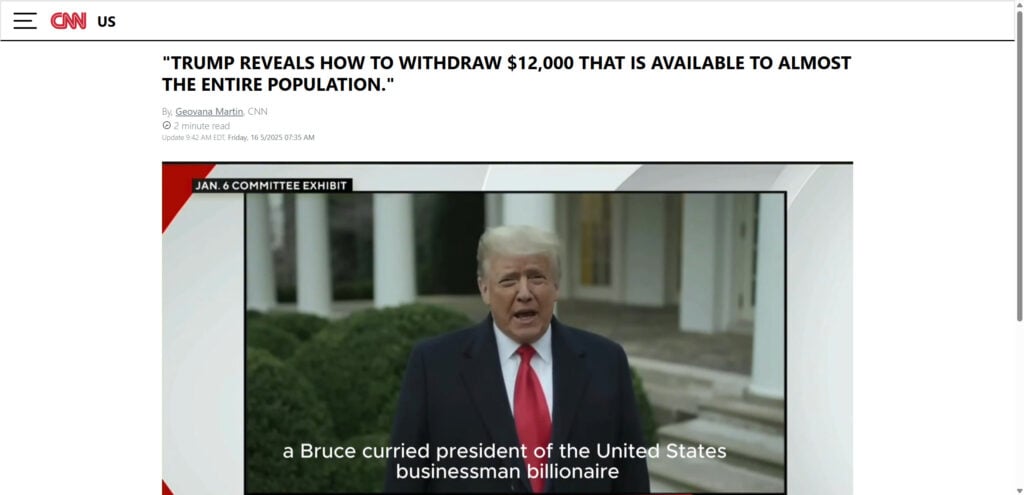
Scam Overview: What Is the American Refunds Recovery Money Scam?
The American Refunds Recovery Money scam (sometimes called “American Funds Recovery Money”) is a digital fraud operation designed to exploit financial desperation and misinformation by promising fake government refunds. It claims that average Americans can unlock between $2,000 and $15,000 using a so-called legal loophole in the U.S. banking system.
What makes this scam especially dangerous is its combination of AI deepfakes, fake media websites, and emotional manipulation tactics.
Fake News Site Pages and Viral Videos
This scam typically appears in the form of:
- A fake CNN, FOX News, or CNBC article
- A deepfake video of a U.S. President (usually Trump or Obama)
- A false claim that banks are “hiding your money”
- Promises that you can “withdraw up to $15,000 today”
Fake media headlines often read:
“Trump Reveals How to Withdraw $12,000 That Is Available to Almost the Entire Population”
This type of headline is designed to look official and urgent. Once clicked, users are taken to a website that mimics a legitimate news outlet — often hosted on suspicious domains like .xyz, .shop, or .pro. These sites include videos, social proof, and even fake comment sections to add credibility.
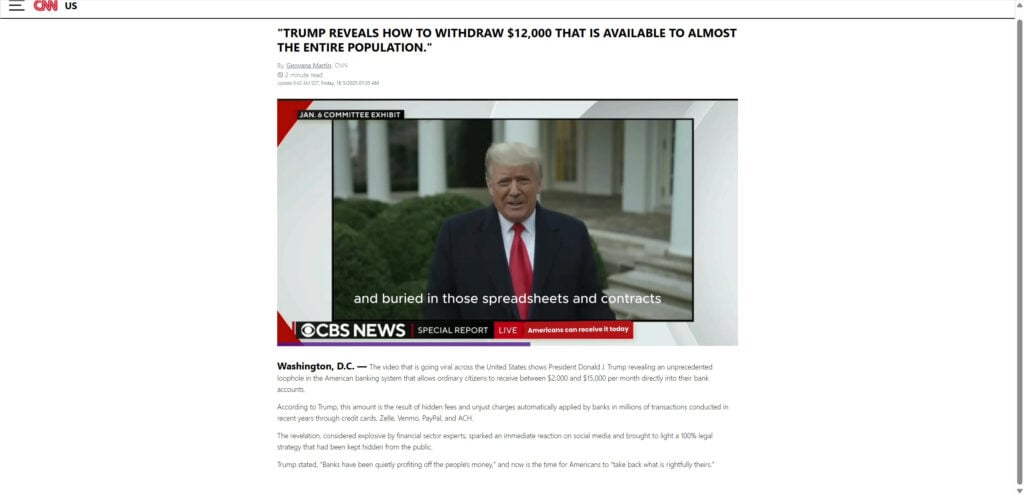
How the Scam Hooks Victims
At the center of the scam is a $97 “processing fee” that users must pay to “unlock” their funds. The scammers claim this fee is necessary to gain access to a downloadable guide or secret method tied to government refund programs.
Victims are led to believe:
- There’s money legally owed to them by the Federal Reserve
- They must act immediately or lose access
- Public figures like Trump and Obama are backing the program
The reality: There is no government refund. There is no hidden account. The entire operation is a scam.
No Official Program Exists
There is no federal program offering blanket cash refunds to people who have used Zelle, Venmo, PayPal, or credit cards. These are fabricated claims, and no legitimate U.S. government website promotes or acknowledges anything resembling this program.
Why This Scam Works
This scam preys on:
- Financial vulnerability – especially during inflation or economic downturns
- Trust in authority figures – like U.S. Presidents and well-known TV personalities
- Lack of tech literacy – many victims don’t recognize deepfake technology
- Urgency and scarcity – “Offer ends tonight,” “You may lose your refund forever”
It’s one of the most dangerous financial scams because it looks legitimate, sounds convincing, and costs real money.
How the Scam Works
This scam unfolds in a carefully scripted series of steps designed to disarm suspicion and extract payment. Here’s how it typically progresses.
Step 1: Fake News Article or Video Ad
You might first see the scam on:
- YouTube pre-roll ads
- Spam emails
It often shows a headline such as:
“Donald Trump: How to Withdraw $15,000 in Secret Refunds Owed to Every American”
You’ll then click through to what appears to be a CNN or FOX News article—but the domain is clearly off (e.g., cnn-reports.xyz or foxnews-now.shop).
Step 2: Deepfake Video
Once on the page, a deepfake video auto-plays. Depending on the version, you might see:
- Trump claiming he discovered this loophole before leaving office
- Obama stating “most Americans don’t know they qualify for a refund”
- Oprah endorsing a “refund revolution for Americans”
These videos are created using AI tools that mimic speech and facial expressions. While not perfect, they’re realistic enough to fool casual viewers.
Step 3: The Refund Calculator
Next, the website displays a tool that says:
“Enter the last 4 digits of your SSN to calculate your refund amount.”
After entering information (even if it’s fake), a loading bar appears with messaging like:
“Verifying your entitlement… Success! You qualify for a $9,742 refund.”
This is pure theater. The site returns a random number and confirms eligibility to lure you further in.
Step 4: The Payment Wall
Once “approved,” you’re asked to pay $97 to “access the refund system.” You’ll see language like:
- “100% refundable processing fee”
- “Government compliance access charge”
- “Unlock your personal claim code now”
The payment is processed through a third-party platform like Digistore24, which is often used in affiliate marketing schemes — and sometimes by scam operators.
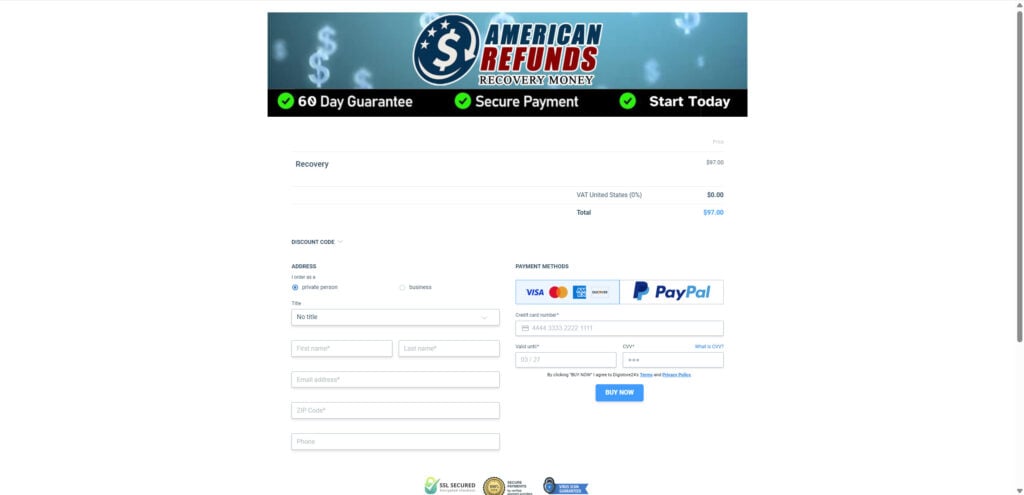
Step 5: The Download and Silence
After paying, users are given access to a PDF guide that contains vague, useless information — such as links to real government sites or general advice on financial literacy. It does not provide access to any real refund.
Some victims are even re-targeted by “recovery agents” claiming to help them get their money back — for another fee.
What to Do If You’ve Been Scammed
If you’ve already fallen victim to the American Refunds Recovery Money scam, take the following steps immediately:
1. Stop All Further Communication
- Do not reply to follow-up emails or messages.
- Block any phone numbers or senders that contacted you.
2. Request a Chargeback
- Contact your bank or credit card company immediately.
- Report the transaction as fraudulent.
- Request a chargeback or refund through your payment provider (especially if it was PayPal, Visa, or MasterCard).
3. Report the Scam
File reports with the following official bodies:
- FTC (Federal Trade Commission): reportfraud.ftc.gov
- IC3 (FBI’s Internet Crime Complaint Center): www.ic3.gov
- Better Business Bureau (BBB): www.bbb.org/scamtracker
- Your state’s Attorney General’s office
4. Monitor Your Identity
If you entered personal data (SSN, address, etc.):
- Freeze your credit with Equifax, Experian, and TransUnion
- Consider an identity theft protection service
- Watch for new credit inquiries or bank activity
5. Warn Others
Share your experience online to prevent others from falling victim. If you saw the ad on Facebook, report the page or profile spreading it.
Certainly. Here’s a comprehensive, SEO-optimized FAQ section tailored specifically for the American Refunds Recovery Money Scam, designed to improve user experience, bolster search relevance, and address common concerns.
Frequently Asked Questions (FAQ) About the American Refunds Recovery Money Scam
1. What is the American Refunds Recovery Money scam?
The American Refunds Recovery Money scam is a fraudulent online scheme that falsely claims Americans can withdraw between $2,000 and $15,000 from a secret government or Federal Reserve account tied to their Social Security Number (SSN). Victims are lured in through fake news articles, AI-generated videos, and celebrity deepfakes, then asked to pay a “processing fee” to unlock their supposed funds. The entire setup is a scam — there is no such government program.
2. Is there really a way to get thousands of dollars from the Federal Reserve using my SSN?
No. This is entirely false. There is no legal or government-backed method that allows U.S. citizens to withdraw money from any Federal Reserve account based on SSN activity or credit card usage. The claims made by the scam are fabricated to deceive and defraud.
3. Why does the website look like CNN or Fox News?
Scammers often clone the design and layout of legitimate news websites to build trust quickly. While the site may appear to be CNN, Fox, or CBS at a glance, the URL will usually be something suspicious like cnnnews-us.xyz or fox-report.shop. These are fake domains meant to mislead users into thinking the scam is endorsed by reputable news outlets.
4. Are the videos of Trump and Obama real?
No. The videos are deepfakes, created using AI-generated visuals and synthetic voice technology. Scammers use these fake videos to make it appear that well-known public figures are endorsing the refund program. None of the people shown in these videos are involved in any real refund initiative, and their likenesses are being used fraudulently.
5. What happens after I pay the $97 fee?
Once the fee is paid:
- You typically receive a generic PDF file with no real value or actionable content.
- You may be contacted again by scammers posing as “account recovery agents” offering help — for another fee.
- In some cases, no product is delivered at all.
You will not receive any real money or government refund.
6. Can I get my money back if I already paid?
Possibly. Here’s what you should do:
- Immediately contact your bank or credit card provider and request a chargeback.
- If you paid via PayPal, open a dispute within the Resolution Center.
- Inform your financial institution that you were the victim of an online scam.
The sooner you act, the higher the chances of recovering your money.
7. I entered the last 4 digits of my SSN. Should I be worried?
While the last 4 digits of your SSN aren’t enough on their own to steal your identity, it’s still important to remain cautious. If you provided additional sensitive details (like your full name, address, or date of birth), you should:
- Monitor your credit report for unusual activity.
- Place a fraud alert or credit freeze with Equifax, Experian, and TransUnion.
- Consider signing up for an identity protection service.
8. How can I verify if a government program is legitimate?
Always use official government websites for verification:
- Unclaimed property: https://www.usa.gov/unclaimed-money
- IRS Refunds: https://www.irs.gov/refunds
- FTC Scams: https://reportfraud.ftc.gov
Never trust programs that require upfront fees, ask for personal data without verification, or are advertised through unfamiliar domains.
9. How do I report the American Refunds scam?
To report the scam, use these official channels:
- FTC (Federal Trade Commission): https://reportfraud.ftc.gov
- FBI Internet Crime Center (IC3): https://www.ic3.gov
- BBB Scam Tracker: https://www.bbb.org/scamtracker
- Your State Attorney General’s Office
Make sure to include screenshots, URLs, and any payment confirmation when filing your report.
The Bottom Line
The American Refunds Recovery Money scam is a highly manipulative and dangerous fraud that uses modern tools — including AI deepfakes and fake news websites — to trick people into handing over money under false pretenses.
There is no refund. No legal loophole. No government account linked to your SSN filled with thousands of dollars.
What you’re seeing is part of a global network of fraudsters profiting from financial hardship and online misinformation. If something feels too good to be true — especially involving money and urgency — it probably is.
Stay skeptical. Stay informed. And help others by sharing what you’ve learned.

Join the discussion
0 commentsShare your experience or ask a question about this article.
Discussion
Start the conversation
Have a question or something useful to share? Add the first comment.