

A message from the Aquesst hiring team arrives while you’re looking for work. The timing feels right, and the sender sounds ready to help.
Before you send your résumé or answer the next question, take a moment to check the person behind that promising introduction.
Overview
A real recruiting company is being impersonated
The Aquesst hiring team scam involves people borrowing the name of a legitimate recruiting business to approach job seekers with opportunities that aren’t genuine.
Aquesst recruits for technology and engineering roles. Its existence is not in doubt. The problem is someone claiming to represent it without authorization.
On its official LinkedIn page, Aquesst says an individual has contacted candidates about illegitimate opportunities while falsely presenting themselves as a recruiter.
A separate company warning identifies a recruitment text as fraudulent and cautions against sending sensitive information in response to unsolicited messages.
The company’s payment and information rules are clear
Aquesst says candidates should not pay application, interview, or placement fees. Its warning also rejects requests to send money or purchase equipment during recruitment.
It directs people to verify suspicious contacts through its own team. That check belongs outside the conversation with the person whose identity is uncertain.
- Do not pay someone who says payment will secure an Aquesst position.
- Do not send Social Security numbers or banking details in an unexpected recruiting text.
- Confirm the recruiter’s identity and the vacancy independently before continuing.
What this warning does and doesn’t establish
The company has confirmed impersonation. That does not establish a single salary, job title, phone number, payment method, or script used in every approach.
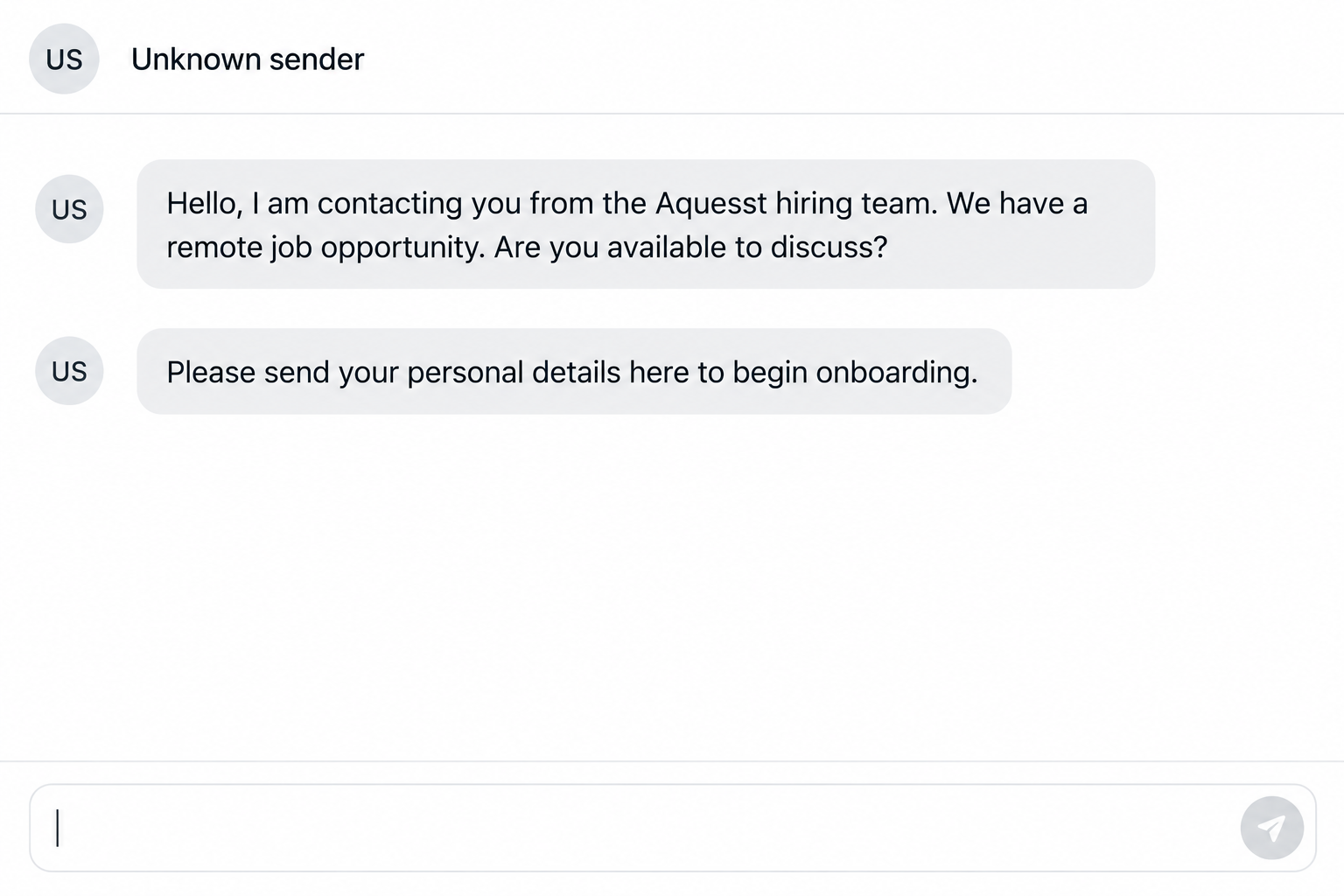
The message image above is an illustration, not an original conversation. Its wording shows the risk without presenting invented messages as captured evidence.
The sequence below explains how recruiter impersonation develops. Payment and fake-check examples are broader job-scam variations, not confirmed outcomes for every Aquesst-themed message.
Why This Message Can Feel Like a Genuine Opportunity
Job seekers are used to hearing from strangers
When you’ve uploaded a résumé, applied through several platforms, and answered recruiter messages, another introduction doesn’t necessarily feel unusual.
You may reasonably assume the sender found your professional profile. The scammer benefits when you fill in that missing explanation yourself.
A recognizable company name helps. You search for Aquesst, find a real business, and feel reassured. But that search answers the wrong question.
The important question isn’t whether Aquesst exists. It’s whether this particular person is authorized to recruit for the specific role they mentioned.
Ordinary hiring details make useful camouflage
An interview time, department name, or description of remote work can make a conversation sound routine. Those details can be copied from legitimate vacancies.
Even a real employee’s name is not enough. Someone can lift that name from a public profile and use it in an unrelated messaging account.
A genuine employee may have no idea their name is being used. Ask the company whether the communication actually came from that person.
How the Aquesst Hiring Team Scam Works
Step 1: The sender borrows a recruiter’s identity
The approach begins with a claim of affiliation. The sender introduces themselves as part of Aquesst, sometimes using general language about its hiring team.
That introduction does much of the work. Instead of starting with a financial request, the person offers something you want: progress toward employment.
A company name in a display name is only text. It does not authenticate a telephone number, email account, social profile, or conversation.
The exact route can vary. An unexpected text deserves scrutiny, but an email or professional-network message still needs the same identity check.
A useful first response is not to send documents. Pause and find the recruiting company’s contact details through a route you choose yourself.
Step 2: A plausible opportunity encourages a conversation
The sender describes a position or asks whether you’re interested. At this stage, the conversation may contain nothing obviously alarming.
A short answer makes it easier for the person to keep you engaged. They can adjust the pitch to your availability, experience, or urgency.
That doesn’t mean replying automatically compromises your accounts. It means the conversation can move toward information you wouldn’t normally give a stranger.
Ask for a clear job description and a reference the real recruiting team can verify. Don’t let a confident answer replace that independent check.
A copied vacancy may be genuine while the person offering it is not. Matching the job title alone leaves that gap unresolved.
Step 3: Familiar hiring language is used to request sensitive details
The risky turn comes when the sender asks for information under a hiring explanation, such as onboarding, identity verification, or setting up payroll.
Those processes exist in real employment. The deception is using them before you have established who is receiving your information.
A résumé and a Social Security number are not interchangeable. Your work history may help an application; a full identity document creates a different exposure.
Aquesst specifically warns against sharing sensitive personal or financial information in unsolicited messages. Treat that boundary as more important than the sender’s reassurance.
If the person moves the conversation to another app, verification becomes no less necessary. A private chat is not an employer’s identity check.
Changing platforms may be convenient in legitimate business. In a suspicious approach, it can also separate you from the original platform’s reporting tools.
Step 4: A supposed hiring requirement may become a payment trap
The company’s warning gives a particularly useful stopping point: candidates should not send money, buy equipment, or pay recruiting fees.
If a purported Aquesst recruiter demands payment to apply, interview, or secure the job, do not pay. Verify the request directly with Aquesst.
In broader employment scams, the excuse may be training, a background check, a workstation, or a vendor selected by the supposed employer.
The FTC’s job-scam guidance describes bogus work offers that extract money or personal information instead of providing employment.
Another variation involves a check for equipment, followed by instructions to send part of the money elsewhere. That is a general warning, not a documented Aquesst transaction.
The FTC explains why an available balance does not prove a check is genuine.
If the check is later rejected, money you already forwarded can still be gone. Don’t treat a visible deposit as permission to pay a supposed supplier.
Step 5: The sender tries to keep control of the decision
Once you’ve invested time or shared documents, stopping can feel harder. You may worry that questioning the process will cost you the opportunity.
A deadline or promise of immediate placement can intensify that feeling. You don’t have to keep answering while you check the story.
A supposed recruiter might insist that only they can resolve the concern. That is precisely when an outside contact becomes most useful.
End the exchange if money or sensitive information is requested through an unverified contact. Save the conversation before blocking the account.
You are not rejecting every opportunity from the real company. You are refusing to let an unknown person decide how their own identity gets checked.
How to Verify an Aquesst Recruiter Without Exposing More Information
Use the company’s published contact route
Aquesst’s official contact page lists contact@aquesst.com and (678) 242-1350. Reach that page independently rather than through the suspicious sender.
Ask whether the person works with the company, whether the named vacancy exists, and whether the contact method belongs to its recruiting process.
You can describe the request without attaching your identity documents. A recruiter verification inquiry doesn’t need your bank account or Social Security number.
Keep your first message focused: the name used, the contact address or number, the vacancy, and what the person asked you to do.
Read the address, not just the display name
On email, expand the sender details. A friendly name can conceal an unrelated mailbox, and a familiar-looking address can contain a small spelling change.
Compare the domain with the company’s published address. Don’t assume that a logo in the signature, copied office details, or an attached PDF proves ownership.
Even a convincing address does not replace confirmation when the request is unusual. Accounts can be misused, and screenshots of emails can be fabricated.
For a messaging profile, inspect the actual handle and contact details. A professional photograph or lengthy biography is not a substitute for company confirmation.
Keep verification separate from onboarding
Real employers may eventually need tax, identity, and payment information. The issue is the timing, recipient, and secure process, not a blanket ban on hiring paperwork.
Ask the verified company how and when those documents should be submitted. Don’t use a form just because an unverified sender calls it secure.
Never send a one-time account code to prove you’re a serious candidate. A code may authorize access or an action unrelated to employment.
If the person tells you to ignore a warning in the code message, stop. The warning matters more than the explanation offered in the chat.
What to Do if You Have Fallen Victim to This Scam
Start with what you actually shared or paid. A reply, an exposed identity document, and a bank transfer require different responses.
-
Stop the exchange and preserve the evidence. Save messages, email headers, profile links, phone numbers, documents, and payment instructions before reporting or blocking.
Keep original files where possible. Record when contact began and which information you provided, so you can explain the exposure accurately.
-
Tell Aquesst about the impersonation through its real contact page. Include enough information to identify the approach, without sending additional sensitive documents.
Ask whether the vacancy or recruiter was genuine. If you also have an authentic application with Aquesst, explain that separately to avoid confusion.
-
Contact the payment provider immediately if you sent money. Tell your bank, card issuer, payment app, or transfer service that a fake recruiter deceived you.
Ask what can be stopped, recalled, or disputed. Preserve transaction references and recipient details. Recovery is not guaranteed, but waiting gives you fewer options.
The FTC’s recovery guidance separates the steps by payment method and by the information exposed.
-
Alert your bank if you deposited a suspicious employment check. Ask for its fraud team and explain the recruiting story before moving any funds.
Do not return an alleged overpayment or buy equipment with the deposit. Keep the check and instructions for the bank’s investigation.
-
Protect the specific accounts you exposed. Change any password entered into an unverified recruiting form, including other accounts where you reused it.
Use the real service’s app or website. Review recovery details and active sessions, and enable multifactor authentication where available.
If you shared a bank login or security code, tell the bank exactly what happened. Changing a password may not reverse an authorized transfer.
-
Take identity-document exposure seriously. If you sent a Social Security number or identity document, use IdentityTheft.gov for a recovery plan suited to the situation.
In the U.S., consider a free credit freeze with Equifax, Experian, and TransUnion. A freeze helps restrict new credit, not every possible misuse.
The FTC distinguishes credit freezes from fraud alerts. Choose the protection that fits your exposure and keep the confirmation details.
-
Report the account on the platform where contact occurred. Identify it as recruiter impersonation and include the messages requesting payment or sensitive information.
Report financial fraud through ReportFraud.ftc.gov. Keep report numbers with your bank correspondence rather than expecting a report alone to return money.
-
Be wary of anyone offering guaranteed recovery for an upfront fee. An approach using information from this incident can feel convincing without being legitimate.
Do not send another payment to release a refund or complete a supposedly unfinished hiring process. Continue recovery through your verified providers.
Frequently Asked Questions
Is Aquesst itself a scam recruiting company?
No. This warning concerns impersonators using a real company’s name. Aquesst has publicly warned candidates about someone falsely representing its recruiting team.
Does an unexpected Aquesst text automatically prove fraud?
No. Verify the sender and role independently. Requests for sensitive information in unsolicited texts or payment to secure a position conflict with the company’s warnings.
Can I verify the recruiter by replying to their message?
Not reliably. The person whose identity is uncertain controls that reply. Use Aquesst’s published contact route and ask its team to confirm the approach.
Should I pay for equipment if the recruiter promises reimbursement?
Do not send that payment through an unverified recruiter. Aquesst says its recruiting process does not require candidates to buy equipment or pay fees.
Am I compromised if I only replied that I was interested?
A reply alone doesn’t establish account compromise. Stop sharing information, report the approach, and watch for follow-up requests tailored to what you already discussed.
What if I already sent my résumé but nothing else?
Save the conversation and verify the contact. Watch for targeted messages using your work history, address, or references. Don’t send identity documents to finish the exchange.
The Bottom Line
Don’t send money or sensitive documents to an unverified Aquesst hiring contact. The real company has confirmed impersonation and offers an independent way to check recruiters.
If you already responded, act on the actual exposure: contact your payment provider for money sent, secure affected accounts, and protect identity details you shared.

Join the discussion
0 commentsShare your experience or ask a question about this article.
Discussion
Start the conversation
Have a question or something useful to share? Add the first comment.