

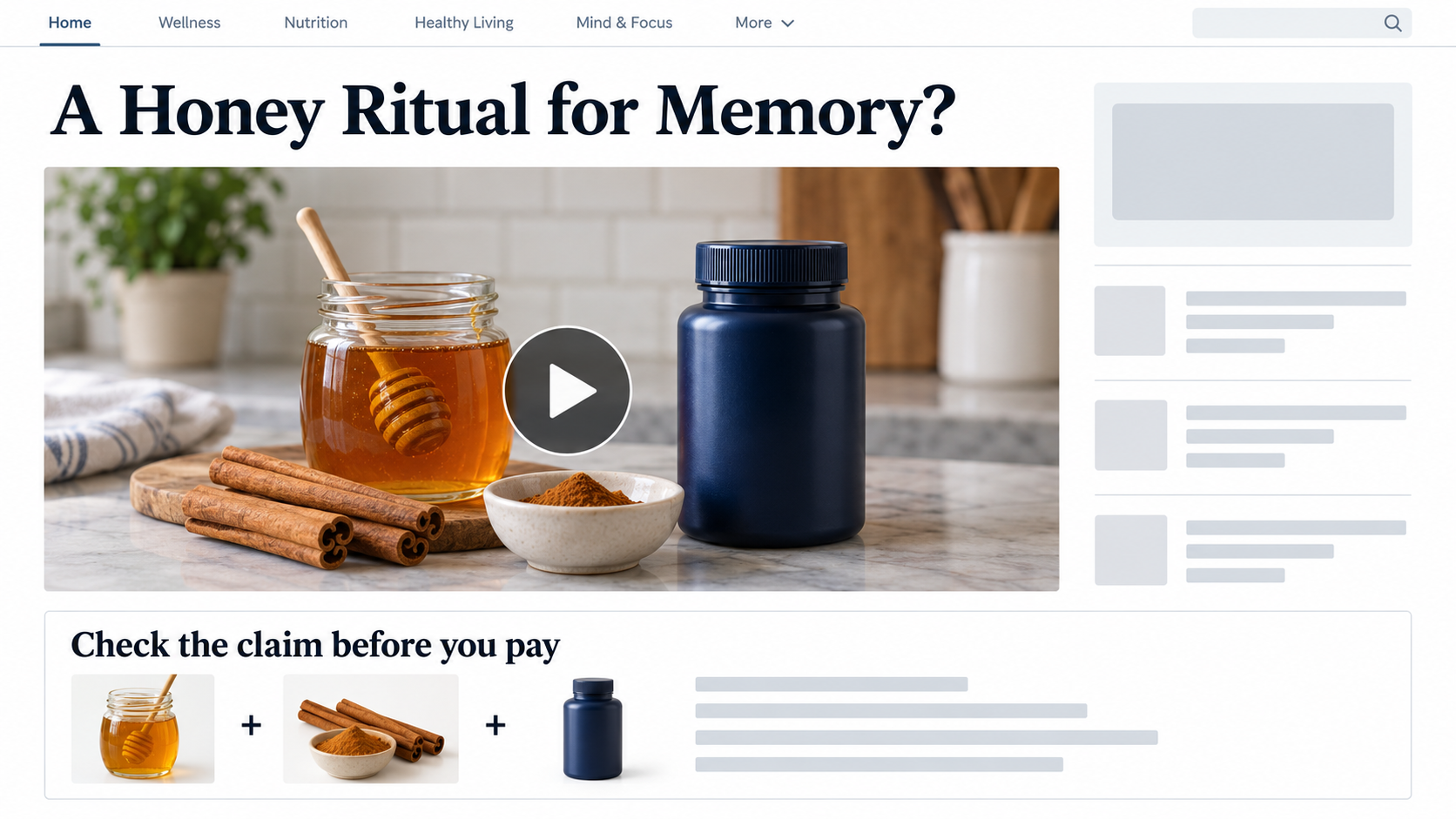
A honey ritual, a familiar face, and an extraordinary promise about memory. The Brain Recall promotion brings all three together in a presentation aimed at worried families.
If you stayed to hear the recipe or started looking for the bottle, there are several things you should know before going further.
Overview
Brain Recall is the supplement revealed behind the memory story
The promotion introduces Brain Recall after a lengthy story about cinnamon, honey, and reversing memory loss. A blue bottle appears as the proposed answer.
That is a commercial offer, not a demonstrated recipe for treating Alzheimer’s disease. A product name and persuasive video do not establish a clinically effective formula.
This investigation concerns the Brain Recall label in that campaign. It does not accuse unrelated products simply because their names contain brain, recall, or memory.
The advertisement borrows authority from television and celebrities
The presentation invokes Bill Gates, uses a 60 Minutes-style format, and includes purported celebrity accounts of overcoming serious memory problems.
It goes much further than ordinary focus support. Its claims include reversing Alzheimer’s, restoring lost memories, and replacing prescription medicines such as Aricept and Namenda.
The promotional footage is not an authenticated endorsement or a clinical record. Familiar faces and broadcast graphics cannot supply the evidence those claims require.
The cure claim is the reason to reject the offer
The FDA warns against unproven Alzheimer’s products sold with treatment claims. Such offers can waste money and delay appropriate care.
Several essential purchasing facts also remain unestablished for this campaign:
- A verified manufacturer and complete label for the advertised bottle.
- A clinical trial testing that exact formula for the promised outcome.
- The actual checkout total, billing frequency, and enforceable return instructions.
Do not buy Brain Recall through this Alzheimer’s-reversal promotion. The medical promise fails long before you need to resolve every question about its checkout.
What Is Actually Being Promised?
The story begins with an accessible household routine. Honey and cinnamon suggest something inexpensive that a family could prepare without becoming experts in brain disease.
Then the claims expand. The narration talks about removing a memory-related toxin and presents the method as more powerful than established prescription treatments.
Those statements are not simply colorful descriptions of feeling more alert. They imply treatment of a progressive neurological condition and replacement of medical care.
A claim of superiority requires a suitable comparison. The presentation does not identify a finished-product trial establishing that Brain Recall outperforms the medicines it names.
Nor does a story about remembering keys demonstrate recovery from Alzheimer’s. Everyday forgetfulness, diagnosed dementia, and a measured change in a clinical trial are different things.
The campaign blurs those distinctions. It takes recognizable frustrations and uses them to make an extraordinary disease claim feel personal and plausible.
A relative may watch because they want to preserve an ordinary conversation, a familiar name, or a parent’s independence. That hope deserves evidence, not a sales script.
How the Brain Recall Honey Cure Promotion Works
Step 1: The recipe attracts people who were not shopping for pills
A honey ritual sounds like practical information. Someone might click intending to learn what to mix, rather than to evaluate an unfamiliar supplement.
The initial commitment is small: watch long enough to hear the method. The important commercial question, what is being sold, comes later.
By delaying the bottle, the presentation gives its story time to establish trust before the viewer can compare price, ingredients, and accountability.
If an advertisement promises a recipe, notice whether it actually gives clear instructions or repeatedly postpones them while building anticipation.
Step 2: Television styling makes a sales pitch resemble reporting
The promotion uses a recognizable news-magazine style and a chain of apparent interviews. That format suggests someone has already investigated the discovery for viewers.
But a logo within a video is not a link to an authentic broadcast. Nor does a television personality’s face identify who published the page.
The distinction is between a program reporting a story and an advertiser making a story resemble a program. Only the first offers the claimed editorial provenance.
Look for the original report on the broadcaster’s own channels. A clip supplied only by the seller cannot authenticate its own news credentials.
Step 3: Celebrity stories substitute for a patient study
Purported endorsements make the formula seem both important and familiar. The viewer is encouraged to treat apparent personal experiences as proof of recovery.
Even a genuine endorsement would not demonstrate a medical outcome. An altered or unverified one adds another reason not to trust the presentation.
A clinical comparison would identify participants, diagnosis, treatment, dose, duration, outcome measures, and adverse effects. A montage of recognizable faces supplies none of that.
You also cannot infer a person’s private diagnosis or prescription history from words placed into a promotional video. Those are claims made by the advertiser.
Step 4: The simple food routine becomes a proprietary formula
Brain Recall is introduced as the finished solution after the honey story has done its work. The viewer has moved from kitchen advice to a bottle.
The narration mentions ingredients such as icariin, anthocyanins, and lithium orotate. Spoken ingredient names are not a verified Supplement Facts panel.
Amounts, other ingredients, warnings, serving instructions, and the actual manufacturer still matter. You cannot safely reconstruct a supplement from a persuasive voiceover.
Do not attempt to imitate the formula or add ingredients independently. A sales presentation is not a prescription, a safe compounding guide, or an individualized treatment plan.
Step 5: The purchase must be judged separately from the story
The exact checkout associated with this promotion was not established. Its current price, bottle quantity, renewal terms, and refund window therefore cannot be stated reliably.
Some supplement funnels use large bundles or recurring shipments. That pattern is a reason to inspect an order, not evidence that this particular transaction contains them.
If you reach a payment page, compare the product name there with Brain Recall. Do not assume a different bottle has the same formula or seller.
A new name cannot validate the memory-cure story. Equally, an unfamiliar merchant descriptor should be investigated rather than automatically described as an unauthorized charge.
Why the Alzheimer’s Claims Do Not Hold Up
A dramatic reversal is not a demonstrated treatment outcome
Alzheimer’s care involves diagnosis, assessment, and treatment decisions suited to the individual. There is no established honey-and-cinnamon recipe that reverses the disease as advertised here.
That does not mean medicine offers no help. Treatments and supportive care can have important roles, even when they cannot deliver the cure promised by an advertisement.
A supplement pitch should not exploit the difference between helping with symptoms and eliminating a disease. Those outcomes require different evidence.
The useful question is not whether honey is familiar or whether an ingredient has appeared in research. It is whether this finished product demonstrated this claimed result.
Prescription names are being used as a comparison, not a safety plan
Aricept and Namenda are named to make the advertised routine appear superior to conventional care. That is not evidence that a particular patient should stop either medicine.
Only the treating clinician can evaluate why a medicine was prescribed, what benefit is expected, and whether changing it is appropriate.
Do not assume a natural-sounding product can be added without review either. The full formulation and existing medicines need to be considered together.
If the advertisement persuaded you to change a treatment, tell the prescriber promptly. Describing what happened honestly is more helpful than trying to defend the purchase.
Personal improvement cannot confirm the campaign’s explanation
Someone may feel more focused after changing sleep, routine, nutrition, medication, or expectations. That experience does not establish that a promoted toxin has been removed.
Likewise, remembering an appointment or performing well on an informal test cannot demonstrate reversal of a diagnosed neurodegenerative disease.
Who Is Behind the Brain Recall Offer?
A bottle name is not a manufacturer
A bottle shown in a video identifies a marketed name. It does not establish the legal company that manufactures, distributes, or accepts responsibility for the formula.
The campaign material does not resolve that accountability question. A buyer should not treat a famous person’s apparent participation as the missing company information.
A refund promise needs the merchant’s actual return route
No verified return address, deadline, or refund procedure was established for the exact Brain Recall offer. Do not assume another supplement’s guarantee applies.
If you already ordered, the confirmation and package can help identify the relevant merchant. Keep both, including any insert that describes how to request a return.
Obtain the return instructions before mailing anything. A sender’s address on the parcel may be a dispatch depot, not the merchant’s authorized refund destination.
Support must come from the sale, not an unsolicited follow-up
Use contacts found in the order confirmation or payment service. A stranger claiming to be the celebrity’s assistant is not an authenticated refund department.
Do not provide passwords, verification codes, or remote access to obtain a supplement refund. None is necessary to establish a bottle count or return destination.
Be especially wary of requests for an additional payment to unlock reimbursement. Check such a demand with the payment provider before doing anything.
The delivered label matters more than the promotional rendering
Retain the manufacturer’s name, lot number, expiry date, ingredient amounts, and warnings if a parcel arrives. Photograph the packaging before opening it.
Do not assume the contents match a video illustration or another similarly named supplement. Ingredient safety cannot be assessed from the front label alone.
Without those details, you cannot reliably match the advertised formula to the delivered bottle. A pharmacist needs actual quantities and warnings, not a celebrity story.
What to Do if You Have Fallen Victim to This Scam
- Protect the medical care the advertisement called into question.
Contact the clinician responsible for the memory condition if you stopped, reduced, or added anything because of the promotion.
Explain which product you took and when. Keep the bottle available so a pharmacist can examine the formulation rather than guessing from the advertised name.
- Find the actual charge and seller.
Locate confirmation emails, order numbers, payment records, and parcel labels. Note the merchant descriptor exactly as it appears in your account.
Search your inbox for both the product and processor names. The receipt may use a different trading name from the one spoken in the video.
- Request an order cancellation or refund with a clear reason.
Describe the Alzheimer’s-reversal claims and apparent celebrity or broadcast endorsement that influenced the purchase. Include the relevant screenshots or saved advertising text.
Ask for written return instructions and confirmation of whether future shipments exist. Do not send a parcel to an address copied from an unrelated review.
- Ask the payment provider about unresolved or unauthorized charges.
Provide the receipt, amount, transaction date, merchant responses, and the misleading promise. Explain whether you authorized the initial payment but dispute how it was obtained.
If later charges appear, ask what cancellation or recurring-payment controls apply. A refund request and stopping future billing may require separate steps.
- Save the campaign before following more links.
Keep the landing-page address, advertiser name, video claim, bottle image, and any promised guarantee. A renamed product can make the original order harder to trace.
Share only redacted copies when reporting publicly. Keep your full financial records for the bank or payment service, not social-media comments.
- Help a relative without making them feel foolish.
Ask what the video promised and which part felt convincing. Then compare that exact claim with reliable medical information and the treating clinician’s advice.
Offer to organize the receipt and refund request together. Shame can make someone hide further purchases, while practical help makes stopping easier.
- Report the health claim and reject recovery fees.
The FDA’s health-fraud information explains why unsubstantiated disease-treatment offers are dangerous. Report the advertisement through the platform’s own reporting tools as well.
If someone later promises guaranteed recovery for an upfront fee, decline. A second payment to a stranger is not a safe way to recover the first.
Frequently Asked Questions
What is Brain Recall in the honey ritual promotion?
It is the supplement name introduced after a memory-reversal story. The promotional bottle does not establish a verified formula, manufacturer, or clinically proven Alzheimer’s treatment.
Did Bill Gates or 60 Minutes authenticate this product?
The campaign’s use of familiar faces and television styling is not an authenticated endorsement or original broadcast record. Do not treat the promotional footage as medical verification.
Can cinnamon and honey replace Alzheimer’s medication?
No established evidence supports that substitution. Discuss treatment with the prescribing clinician, especially if the video persuaded you to stop or alter a medicine.
Does Brain Recall definitely enroll buyers in monthly refills?
The specific checkout and recurring-payment consent were not verified. Inspect your actual receipt and challenge any unwanted renewal without assuming a subscription exists in every offer.
Does the FDA warning specifically name Brain Recall?
The linked FDA guidance concerns unproven Alzheimer’s products generally. It is not presented here as a recall, laboratory result, or enforcement action naming Brain Recall.
What should I do if the parcel has a different product name?
Retain the parcel, label, and receipt. Ask the merchant to explain the mismatch before using anything, and involve the payment provider if the order remains unresolved.
The Bottom Line
Do not purchase Brain Recall through the honey-cure campaign. Celebrity-style footage and an unsupported promise to reverse Alzheimer’s are not a sound basis for medical spending.
If you paid, protect prescribed care first, preserve the exact offer, and pursue the actual merchant or payment provider. Do not buy another bottle to rescue the promise.

Join the discussion
0 commentsShare your experience or ask a question about this article.
Discussion
Start the conversation
Have a question or something useful to share? Add the first comment.