


An unfamiliar company appears on your card statement, but you can’t connect it with anything you bought. Searching the name brings more confusion than answers.
Sometimes the statement name is only one layer of the problem. A federal payment-processing case shows how that layer could hide the merchant behind it.
Overview
CB Surety helped merchants keep access to card payments
The CB Surety mystery card charges case concerns Thomas Emil Eide, who pleaded guilty to bank fraud conspiracy after helping merchants process payments through sham companies.
The DOJ’s case page identifies transaction laundering and manipulation of chargeback rates, alongside a list of company names relevant to potential victims.
Some merchant clients charged people without authorization or failed to provide what people paid for. A working card-payment system therefore didn’t authenticate the underlying transaction.
Fake activity helped conceal genuine customer disputes
The guilty-plea announcement explains how numerous small, sham transactions made disputed payments look like a smaller share of overall activity.
The reported processing volume exceeded $111 million. The case page separately identifies at least $3.35 million in transactions resulting in refunds and chargebacks.
Those figures have different meanings: total processing volume isn’t automatically a loss total, and refunded transactions aren’t necessarily money still missing.
The company list is a starting point for checking records
- Compare the exact statement name with the DOJ’s current list.
- Identify whether the payment was unauthorized or the purchase wasn’t supplied.
- Keep the statement alongside your receipt and attempted cancellation records.
- Contact your card issuer promptly rather than waiting for the criminal case.
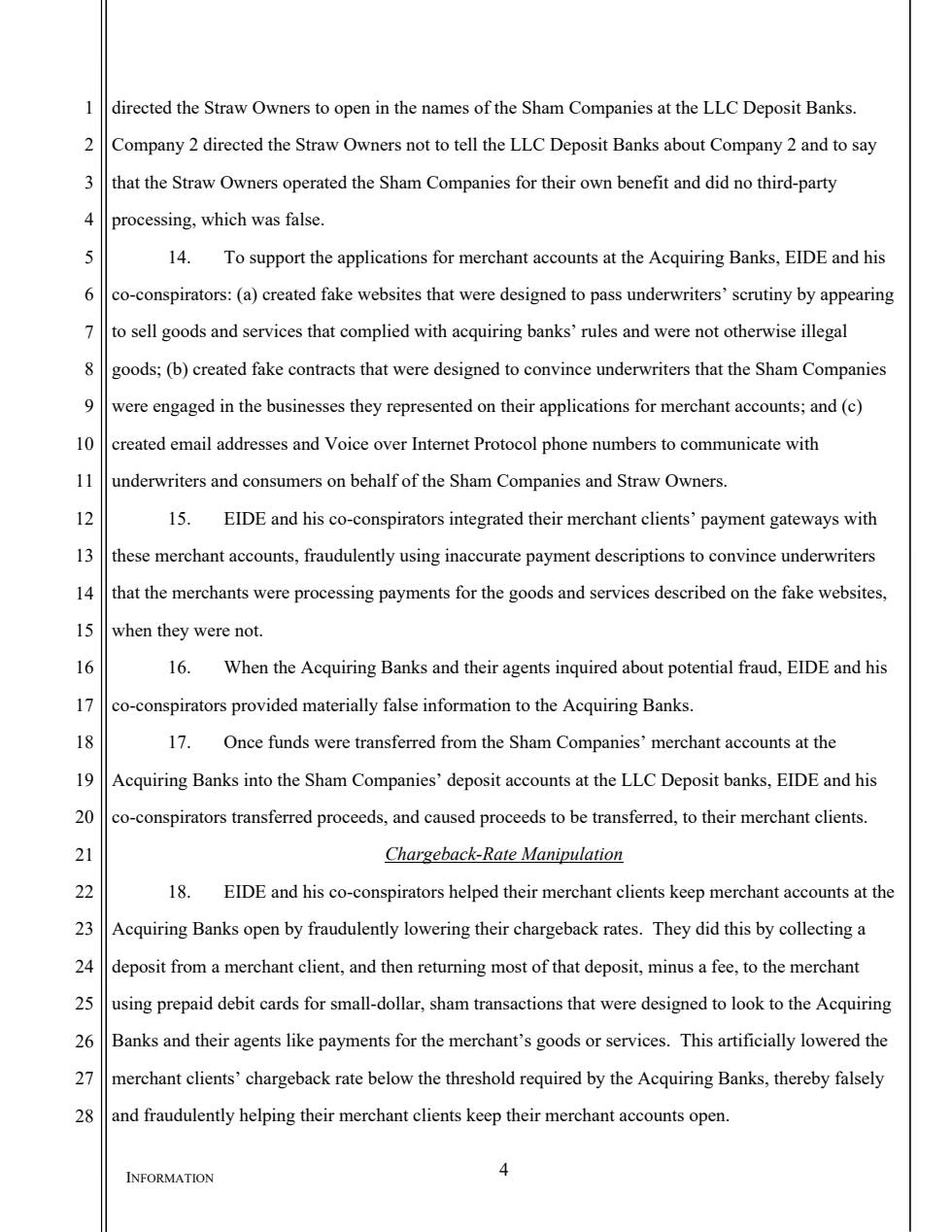
The lead image reproduces a page from the original federal charging document. Eide’s later guilty plea is confirmed separately by the DOJ’s case update.
Why a Statement Name Can Make a Dispute Harder
A confusing descriptor can send you searching for the wrong business. You may know what you ordered while remaining unable to recognize the company receiving the charge.
That uncertainty doesn’t require you to accept the payment as legitimate. Start with your own records and ask the card issuer for additional merchant information.
The difference between a brand and a billing name can sometimes have an ordinary explanation. This case involves deliberate concealment established through a criminal proceeding.
Look for a connection between your payment and the published case details. Compare the descriptor, amount, date, and goods or services you expected to receive.
Keep the date and amount visible while checking the name. A familiar-looking spelling without a matching payment isn’t enough to identify your loss.
If several charges appear, assess them individually. One authorized purchase shouldn’t automatically authenticate a later charge, and one unexplained item shouldn’t erase your recollection of another transaction.
The same care helps with reporting. Authorities specifically ask people to distinguish authorized and unauthorized charges when submitting supporting documents in this case.
You don’t need to solve the entire processing network first. A precise statement, receipt, and account of what happened can provide a useful starting point.
How the CB Surety Payment Scheme Worked
Step 1: Problem merchants sought another route into card processing
The federal account describes clients unable to obtain or keep merchant accounts through legitimate means. Those accounts allow businesses to accept card payments.
The reasons varied, including prohibited practices, high dispute levels, and previous account termination. Those are different concerns, rather than one finding about every merchant.
CB Surety offered fraudulent ways around the restrictions. That made the operation important beyond the individual business a customer thought they were paying.
For a shopper, the visible checkout may therefore reveal little about the companies operating behind the charge. Payment acceptance alone doesn’t establish satisfactory merchant screening.
The response remains attached to your actual transaction: what you authorized, what was promised, what arrived, and which institution processed the payment.
Step 2: Sham companies and straw owners obscured the real business
The original charging document describes accounts obtained through sham companies and people presented as their owners.
It also describes fake websites, contracts, email addresses, and telephone arrangements used to make those companies appear suitable to banks reviewing their applications.
These weren’t simply poorly written storefronts aimed at customers. Some fabricated material was designed to influence the financial institutions deciding whether to provide processing access.
A website matching the statement name could therefore reinforce the false identity. In this operation, fabricated websites helped the sham companies pass themselves off as ordinary merchants.
Preserve the address if you find one, but avoid entering personal details to investigate. Your bank can pursue transaction information without you testing the website.
Step 3: Payment descriptions concealed what merchants were actually selling
The court document describes merchant payment gateways connected with the sham accounts and inaccurate descriptions used to misrepresent the underlying goods or services.
A consumer could therefore encounter one offer while the processing records suggested another business. The mismatch could complicate recognition and the bank’s view of the merchant.
This doesn’t mean you should invent the missing connection yourself. Tell the issuer the offer you remember and provide the descriptor exactly as shown.
Save screenshots or emails already associated with your purchase. They can connect an advertised product with an otherwise unfamiliar name on the card statement.
If the seller supplies another company name during a dispute, preserve that explanation too. Changing labels shouldn’t replace the original transaction record.
Step 4: Sham microtransactions diluted the apparent chargeback rate
A chargeback rate compares disputed transactions with the wider transaction activity. Adding artificial activity can make the disputes appear proportionately smaller without resolving them.
The DOJ describes high-volume, low-value transactions used for this purpose. The charging document explains that client deposits were returned through sham payments, minus a fee.
The important point for consumers is that the genuine complaints hadn’t disappeared. The surrounding numbers were manipulated to make those complaints less conspicuous.
You don’t need to calculate a merchant’s overall dispute rate to challenge your payment. Keep your report focused on the charge and its actual basis.
Nor should a seller’s claim of having many satisfied customers settle your case. Other activity doesn’t establish that you authorized this payment or received this purchase.
Step 5: Funds moved through accounts serving the concealed merchants
The prosecution describes money passing through sham-company accounts before reaching merchant clients. The receiving name could therefore identify an intermediary rather than the offer you recognized.
Give the issuer the transaction reference alongside the name you recognize. Its records may connect that payment with a processing account you couldn’t identify from the advertisement.
Eide’s guilty plea establishes his criminal participation. It doesn’t mean every bank providing an account knowingly endorsed the deception or that every processed transaction was fraudulent.
Your purchase records still need to explain the harm. Tell the issuer whether you never authorized the charge or paid for something the merchant didn’t supply.
CB Surety and the Companies Behind the Statement Names
The processor’s identity differs from the retail offer
CB Surety was Eide’s company, while merchant clients and sham companies had their own roles. These names shouldn’t be treated as interchangeable participants in every sale.
A cardholder might recognize the product advertisement but never have encountered CB Surety. That doesn’t make the processor’s documented role irrelevant to the payment trail.
Record each name where it appeared: advertisement, receipt, card statement, customer-service reply, or government case page. Keep those records together without silently substituting one name for another.
The DOJ publishes names for potential victims to compare
The case page lists companies including Akhmas Micah Venturing LLC, Aalyn Jolly Group LLC, and Loti Online LLC, among many others.
Use the original list for your comparison rather than relying on a partial list copied into a warning. Similar names can lead to mistaken matches.
On a computer, use the browser’s Find command to search the exact statement name. Check the spelling and keep the matching entry with your transaction record.
Supporting documents need a clear explanation
The agency asks for bank or card statements showing relevant charges. It specifically distinguishes unauthorized payments from purchases where goods or services weren’t received.
Those are separate descriptions of harm, and your submission should say which applies. A purchase you authorized isn’t automatically an unauthorized charge because the seller later failed.
Explain the promised product, expected delivery, actual result, and attempts to resolve the problem. Keep speculation about other customers outside your own loss calculation.
The case update and a refund are different events
The current case page records Eide’s guilty plea and an April 29, 2027 status conference regarding sentencing. That isn’t a completed refund program.
A request for victim information also doesn’t guarantee that every submission qualifies for restitution. Authorities need records connecting the person, transaction, and claimed harm.
Keep pursuing available issuer remedies while preserving your case submission. Waiting for sentencing can waste time relevant to a separate billing dispute.
What to Do if You Have Fallen Victim to This Scam
-
Open your actual card or bank statement and identify the disputed transactions. Record the complete descriptor, date, amount, and payment reference.
Compare receipts and order emails before deciding what you recognize. Separate an unauthorized payment from an authorized purchase that wasn’t delivered.
If more than one charge is involved, create a separate entry for each. This prevents a later refund from obscuring the status of another transaction.
-
Contact your card issuer through its established app or the number printed on the card. Explain the transaction problem and the relevant CB Surety case information.
Ask about the applicable dispute process, deadlines, and protection against further unwanted charges. Supply your purchase and cancellation records where relevant.
For a consumer credit-card billing error, CFPB guidance also calls for written notice within sixty calendar days after the charge appeared on the statement.
-
Ask the issuer where to send that written notice and retain a copy. Include the account identification needed, disputed transaction, and reason for the claimed error.
Follow the issuer’s instructions for undisputed payments while the matter is examined. Debit cards, business accounts, and other payment types may involve different procedures.
Keep correspondence and follow-up dates together. A telephone conversation alone shouldn’t become the only record that you raised the issue promptly.
-
Open the official Eide case page independently and compare its company list with your records. Review Information for Potential Victims before preparing a submission.
The page directs supporting documents to Victimassistance.fraud@usdoj.gov. Clearly identify authorized versus unauthorized charges and explain any goods or services that weren’t supplied.
If the listed victim form isn’t available to open, ask that published unit for the current copy and secure submission instructions. Don’t trust an unsolicited replacement form or attachment.
-
Preserve statements, receipts, relevant messages, and your chronology privately. Provide necessary documents through the verified official route rather than uploading them to a public comment thread.
Keep any government acknowledgment separate from the issuer’s dispute confirmation. They concern different processes and may have different next steps.
Never pay a fee to someone claiming they can guarantee acceptance or accelerate restitution. Verify case-related contacts through the official page before sending additional records.
-
Review subsequent statements for further charges or credits. Confirm that a promised refund actually posted instead of relying only on a seller’s email.
If another unfamiliar descriptor appears, investigate that transaction separately through your issuer. Don’t assume a different name makes it unrelated or automatically proves another scam.
Maintain one clear record of charges, returns, reversals, and unresolved amounts. Accurate accounting helps both your financial institution and the agency examining potential victim losses.
Frequently Asked Questions
Was Eide convicted or only accused of processing problems?
The DOJ records an August 20, 2026 guilty plea to bank fraud conspiracy. The case concerns deliberate sham-company and payment manipulation practices.
The earlier charging document explains the alleged mechanism, while the later plea announcement confirms the criminal outcome described here.
Does every company name on my statement mean fraud?
An unfamiliar descriptor can have a legitimate explanation. Check the transaction against your receipts and the DOJ list before deciding it matches this case.
Give your issuer the exact name and circumstances. A spelling resemblance alone doesn’t establish the source of a payment.
Was all $111 million stolen from consumers?
The reported figure describes processing volume. The case separately identifies transactions resulting in refunds and chargebacks, which shouldn’t be presented as the same total.
Your own claimed loss should reflect the charges and credits in your records, rather than a share of the case-wide processing amount.
Why did small transactions matter to the scheme?
Sham activity made disputed transactions appear proportionately smaller within the overall payment volume. It concealed the dispute rate rather than resolving genuine customer complaints.
That statistical manipulation doesn’t remove your ability to report the particular payment that affected you.
Should I wait for restitution before disputing a charge?
Contact the issuer promptly rather than waiting. A criminal case and a card billing dispute are separate routes with different requirements.
Keep records for both processes and avoid assuming that a victim-information submission guarantees repayment.
What if the DOJ victim form doesn’t open?
Use the published victim-assistance contact on the official case page to request the current form and instructions. Preserve the statement evidence while awaiting guidance.
Don’t enter financial details into a form supplied by an unsolicited recovery agent claiming to handle the case.
The Bottom Line
Don’t dismiss an unexplained charge because the payment went through successfully. The CB Surety case shows that merchant identities and dispute statistics can both be manipulated.
Check the actual transaction, contact your issuer promptly, and compare the descriptor with the official case list. Preserve the records needed for any separate victim submission.

Join the discussion
0 commentsShare your experience or ask a question about this article.
Community experiences
Did this happen to you?
Your experience could help someone recognize the same scam. Submit a private report for our team to review.
I experienced this tooReports are reviewed before publication. Sharing publicly is always your choice.
Discussion
Start the conversation
Have a question or something useful to share? Add the first comment.