


An online offer promises that your money will work inside an affiliate program. You provide the investment, and the promised returns are supposed to follow.
That sounds different from building a website or earning a sales commission yourself. Before paying, find out what the offer actually expects your money to do.
Overview
An affiliate label concealed a fraudulent investment offer
The Wilson online affiliate investment scam involved money solicited for purported sales affiliate programs. People paid between $3,000 and $21,000 expecting significant returns.
According to the DOJ’s sentencing announcement, Sidney Marc Wilson Jr. kept the money or passed some to coconspirators instead of delivering the promised investment result.
The scheme operated online between 2018 and 2022 and fraudulently obtained millions. Victims who asked about their missing returns didn’t receive a response.
A prison sentence confirms more than a disappointing business outcome
The announcement records a six-year federal prison sentence for fraud, laundering, and tax offenses. Wilson was also ordered to pay victim restitution and owed taxes.
This was a confirmed criminal scheme, rather than a complaint that an ordinary affiliate business failed to earn enough. The money wasn’t used as represented.
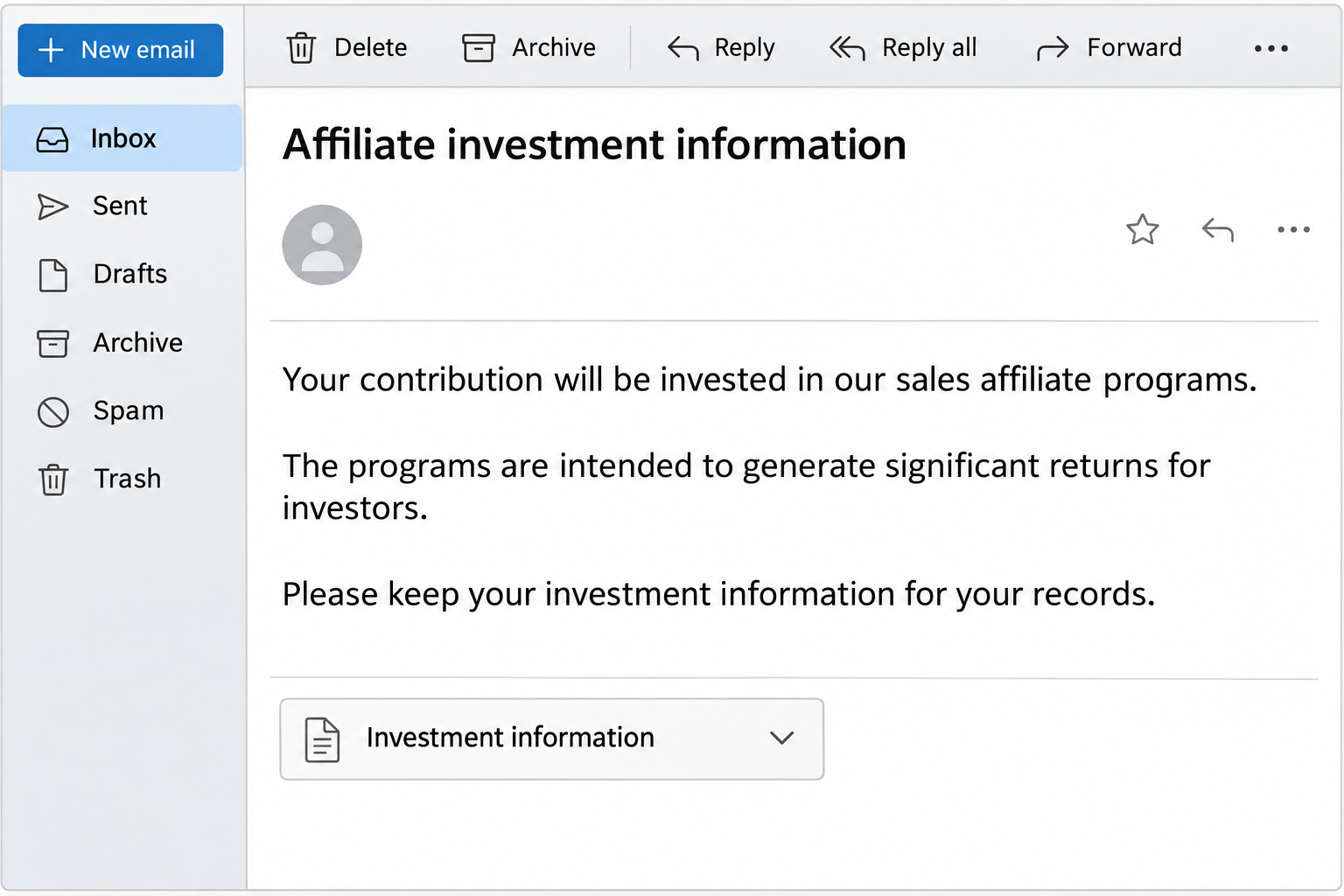
The lead illustration reconstructs an investment email. It doesn’t reproduce an actual Wilson message or identify an authenticated program website.
Understand what you’re funding before agreeing to pay
- An investment contribution isn’t the same as earning commission on your own sales.
- A business description doesn’t demonstrate how returns will be generated.
- Sending money successfully doesn’t establish that it reached a real revenue-producing activity.
- A criminal sentence doesn’t mean every victim has already been reimbursed.
The public announcement doesn’t identify every program name or reproduce its original advertising. The warning concerns Wilson’s documented conduct, rather than unrelated businesses using affiliate terminology.
The Question Hidden Inside an Affiliate Investment Pitch
Affiliate marketing is often described through sales activity: someone directs a customer to an offer and may receive a commission when a qualifying transaction occurs.
An investment pitch introduces a different arrangement. You’re asked to contribute capital because someone else says they will use it to produce a financial return.
Those descriptions can overlap in promotional language, but they create different questions. What exactly are you paying for, and what activity is supposed to generate your money?
If you’re buying a service, identify its deliverables and price. If you’re investing, identify the operator, use of funds, records, and conditions for receiving your money back.
Don’t allow a familiar business term to bridge the gap without explanation. Saying that a program involves affiliates doesn’t identify customers, completed sales, expenses, or actual revenue.
You should be able to describe the arrangement without repeating a promotional slogan. If you can’t explain it to someone else, pause before transferring funds.
Wilson’s customers were funding someone else’s promised activity, rather than earning commissions from their own completed sales. Their contributions instead reached Wilson and his coconspirators.
Ask where a contribution goes before considering projected earnings. In Wilson’s operation, the affiliate description distracted from the more basic question of what happened to investors’ money.
How the Wilson Online Affiliate Investment Scam Worked
Step 1: An online business story offered significant returns
Wilson presented investments into purported sales affiliate programs as a way to make substantial money. The invitation made a business label carry the promise of a financial outcome.
The critical question was whether there was a genuine activity capable of producing the represented returns. The label itself couldn’t establish that connection.
For a new offer, ask what part of the activity you can verify independently. A promoter’s own explanation isn’t another source merely because it arrives as a brochure.
Look at the arrangement before focusing on the payment deadline. You can decline to fund something that remains unexplained, even when the description sounds familiar.
Avoid borrowing money or exhausting savings to overcome uncertainty. A bigger commitment doesn’t make the underlying business activity easier to verify.
Step 2: Victims sent substantial investment payments
The documented contributions ranged from $3,000 to $21,000. Victims mailed or wired their money in expectation of returns from the supposed programs.
Those payments created real financial exposure immediately. The promised income remained dependent on what Wilson and the people receiving funds actually did afterward.
Before paying anyone, preserve the agreement and identify the beneficiary. If the recipient differs from the promoter or business name, obtain a clear explanation through independent records.
Don’t treat a transfer confirmation as an investment statement. It establishes the movement of money, rather than the business purpose or future result.
For someone already affected, the original receipt can be more useful than a polished presentation. It identifies the transaction a financial institution can examine.
Step 3: The funds didn’t produce the promised investment result
The sentencing account says Wilson kept the money or gave some to coconspirators. Victims didn’t receive returns on their purported investments.
The important distinction is what happened to the contributed funds. A business can experience losses honestly, but that doesn’t describe the conduct established here.
If another promoter invokes ordinary business risk to explain missing money, ask for the records behind that explanation. Losses should still correspond with actual activity.
Don’t substitute another deposit for the missing explanation. Additional funds can increase your exposure without clarifying how the original payment was used.
Keep any later offers to change the arrangement alongside the original agreement. A revised story shouldn’t quietly replace the promise that induced your investment.
Step 4: Questions about returns went unanswered
Victims tried to contact Wilson when the promised returns didn’t arrive. The DOJ says they didn’t hear back, leaving the investment story without the expected follow-through.
The unanswered requests left victims without the returns they had paid to obtain. Meanwhile, Wilson’s handling of the funds remained hidden behind the original affiliate-program story.
For an affected investor, the practical issue is when to stop waiting. A missed response doesn’t have to become another reason to delay contacting the payment provider.
Preserve your attempts to obtain an explanation or repayment. Dates and actual messages are more useful than a general statement that support was unhelpful.
If another person starts answering on the operator’s behalf, record their identity and instructions. Don’t assume a replacement contact has authority to recover the funds.
Step 5: Proceeds were moved through other assets
The prosecution describes some proceeds being laundered through real property and cryptocurrency transactions. That concerns the handling of stolen funds after victims paid.
It doesn’t mean every victim invested directly in cryptocurrency or property. The promised affiliate activity and the later movement of proceeds are different parts of the case.
Tell investigators how you actually paid, rather than rewriting the transaction around where the operator later put money. Your original route remains the starting point.
You don’t need to trace the laundering yourself before reporting. Provide the known recipient, transaction details, and the communications connecting your payment with the offer.
What a Real Explanation of the Offer Should Contain
A clear description begins with what you’re purchasing or funding. It should identify whether you’re buying work, acquiring an asset, or contributing money to someone else’s operation.
For a service purchase, ask what will be delivered and when. A promise of future earnings shouldn’t substitute for the actual service you’re paying to receive.
For an investment, ask what activity creates the return and what records demonstrate it. Understand the risks and conditions instead of treating a projected amount as guaranteed income.
Separate sales revenue from profits available for distribution. Even genuine sales don’t establish what remains after costs or what any particular investor is entitled to receive.
Ask which legal person owes the obligation and which account receives the funds. A promotional name alone may leave those practical responsibilities unclear.
Check whether the agreement matches the spoken pitch. If a written document removes the central promise, don’t assume the more reassuring conversation will control the outcome.
Keep answers in writing before transferring money. A promoter’s refusal to explain material terms is a reason to decline, rather than an invitation to trust more deeply.
Put those answers beside the payment instructions before making a decision. A proposal that explains potential earnings but won’t explain the contribution deserves to be declined.
Why a Sentence Doesn’t Complete the Recovery Process
A prison sentence addresses criminal responsibility. Recovering a payment depends on financial records, remaining assets, legal processes, and the circumstances of the individual loss.
The Wilson announcement includes restitution and tax obligations, but it doesn’t provide a universal refund amount or an automatic repayment schedule for every affected person.
Keep your actual loss calculation separate from case-wide figures. Contributions, genuine repayments, and any displayed or projected gains belong in different columns.
Don’t count a promise to repay as money returned. Confirm an actual credit or transfer in an account you control before updating your records.
A person claiming to distribute recovered funds should identify the official process they represent. Verify that through an independently obtained agency channel before supplying sensitive information.
Never send an upfront fee because someone says a criminal conviction has unlocked your investment. Knowledge of the case can be copied from public reporting.
If an old promoter contacts you with a new business proposal, consider it separately from the loss. Funding another opportunity isn’t a reliable way to recover the first payment.
What to Do if You Have Fallen Victim to This Scam
-
Stop contributions and preserve the offer as you received it. Keep emails, advertisements, agreements, messages, recipient details, and payment confirmations.
Write down what you understood the money would fund and what returns were promised. Distinguish those claims from any activity you personally verified.
If several people were involved, record each person’s role without assuming they all knew about the fraud. Keep referrals and payment instructions in their original context.
-
Contact the institution or service used to send the payment through its established support route. Explain that the money was solicited through a fraudulent online investment.
Provide dates, amounts, recipients, and transaction references. Ask what recall, investigation, or recovery options are available for that payment type.
If a mailed payment remains in transit, contact the delivery service promptly about available interception options. Don’t assume it can be recovered after delivery.
-
Create a chronological record of contributions, expected returns, attempted contacts, and any actual repayments. Keep copies of unanswered requests rather than repeatedly sending new information.
Calculate the money contributed and the amount truly received back. Show projected earnings separately so they don’t become confused with the principal you paid.
For older transactions, request records from your financial institution where necessary. Preserve what is available rather than filling gaps with estimates presented as exact figures.
-
Visit IC3.gov and choose File A Complaint. Read the terms and select Accept when ready, then enter your contact information and the investment details.
Include Wilson’s name only if your records establish that connection. Save the confirmation and any related payment-provider case numbers.
You can also report the deceptive offer through ReportFraud.ftc.gov. A report helps document the conduct without guaranteeing an individual response or reimbursement.
-
If you need case-related victim assistance, locate the relevant U.S. Attorney’s Office through the official DOJ announcement. Use contact information published independently by that agency.
Ask how to provide loss documentation for the named case and whether any current instructions apply. Don’t assume an old advertisement contains a valid claims route.
Keep official responses with your transaction records. No general article or unsolicited caller can determine whether a particular submission qualifies for restitution.
-
Tell anyone you personally introduced to the offer about the confirmed case and your actual experience. Avoid sharing their private financial documents with others.
Reject recovery pitches asking for an advance payment, another investment, or access to your financial accounts. Verify the person’s claimed official role through independent channels.
If the process feels overwhelming, ask a trusted person to help organize records and follow-up dates. Practical support can help you act without making another rushed decision.
Frequently Asked Questions
Was this an ordinary affiliate program that performed poorly?
The DOJ describes a confirmed fraud in which investment funds were retained or passed to coconspirators instead of producing the promised result. Wilson received a federal prison sentence.
That finding concerns his conduct, rather than the earning potential of every business using affiliate marketing.
How much did people contribute to Wilson’s offer?
The sentencing announcement describes contributions between $3,000 and $21,000. Those were investment payments made in expectation of significant returns.
Your own report should use the amount shown in your payment records, rather than assuming every participant paid the same sum.
Did victims necessarily buy cryptocurrency?
The prosecution describes cryptocurrency as one way Wilson laundered some proceeds. That doesn’t establish that every victim originally made a cryptocurrency investment.
Preserve the actual payment method you used and give that information to the relevant institution or investigator.
Can legitimate affiliate marketing exist alongside this fraud?
A legitimate sales commission arrangement isn’t automatically fraudulent because Wilson used affiliate terminology. The specific problem was his deceptive solicitation and handling of investment funds.
Identify what an offer actually requires you to pay for and how any return is supposed to arise.
Should I pay more if the promoter promises to fix the delay?
Don’t send further money merely to obtain an explanation or recover the original investment. Ask your payment provider about available assistance instead.
Save the new request with the earlier communications. Another contribution shouldn’t replace accounting for the money already received.
Does the conviction guarantee that my investment will be returned?
A criminal sentence doesn’t establish that your individual payment has been recovered or scheduled for reimbursement. Restitution involves a separate process and supporting records.
Verify any claimed recovery contact through official channels and don’t pay someone to guarantee acceptance or release funds.
The Bottom Line
Don’t fund the documented Wilson affiliate investment offer or send more money to repair its broken promises. The supposed returns concealed a confirmed criminal scheme.
If you paid, preserve the agreement and transaction trail, contact the relevant payment service, and report the actual loss. Treat recovery claims as something to verify independently.

Reviews & discussion
0 commentsShare a firsthand experience, or ask a question.
Community reviews
Online Affiliate
Moderated reader experiences, not an editorial verdict.
Start the conversation
Have a question or something useful to share? Add the first comment.