

You see it in your feed and it looks oddly convincing.
A “microneedle patch” that claims to activate brown fat, melt stubborn weight, control appetite, improve blood sugar, and somehow do it all without injections, side effects, or effort.
The CleraLuxe Brown Fat Microneedle Patch pitch is built to hit the exact moment when someone feels tired of dieting, tired of gimmicks, and ready for a simple solution that finally works.
And that’s the problem.
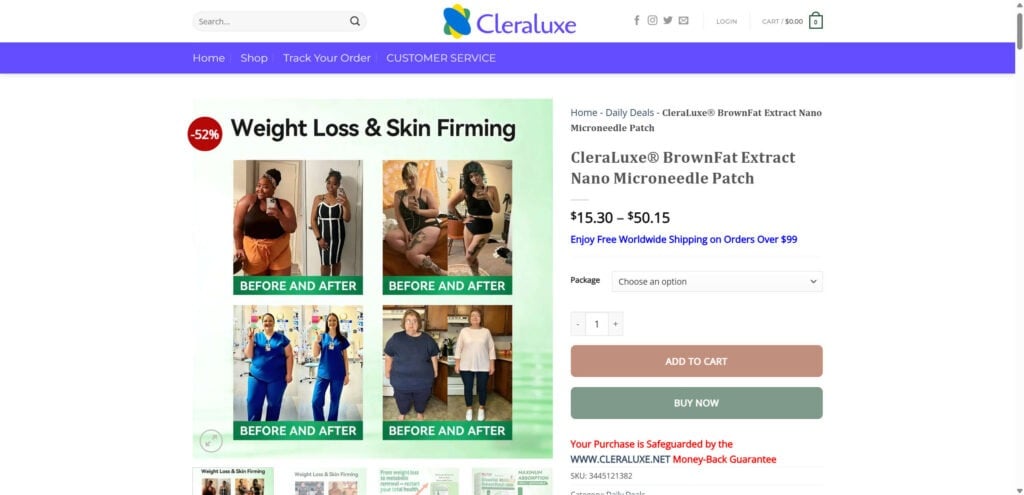
Because when you slow down and look closely, the CleraLuxe Brown Fat Patch offer has the familiar fingerprints of a modern online scam: over-the-top medical claims, credibility props that do not hold up, recycled “before and after” stories, a suspiciously polished sales page, and a checkout flow designed to push you into buying more than you intended.
If you came here wondering “Is CleraLuxe legit or a scam?”, this guide walks you through what’s really happening, how the operation works, and what to do if you already placed an order.
Scam Overview
The CleraLuxe Brown Fat Microneedle Patch is marketed as a breakthrough weight-loss technology. The ads and sales pages often present it as a “nano microneedle” patch that delivers active ingredients through the skin, allegedly triggering brown fat activation and rapid fat burning.
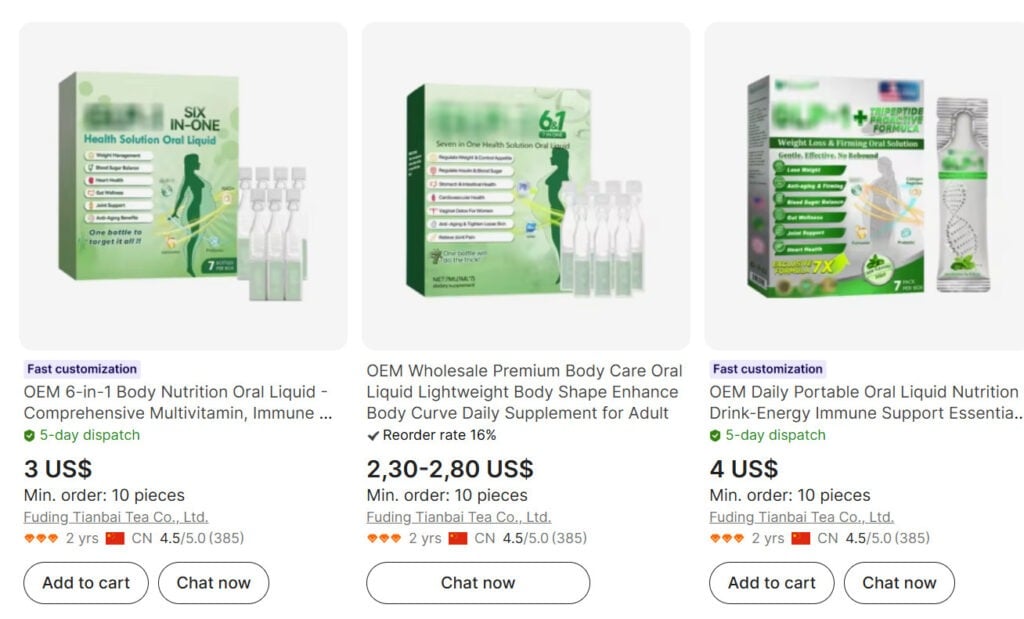
In practice, the CleraLuxe Brown Fat Patch promotion shows many of the same patterns seen in dropshipping-driven supplement scams and “miracle device” funnels.
Let’s unpack what that means, in plain language.
What the CleraLuxe Brown Fat Patch claims to do
The marketing usually centers on a few big promises:
- “Activates brown fat” to burn calories faster
- “Targets stubborn fat” in the belly, waist, hips, and thighs
- “Suppresses appetite” and reduces cravings
- “Balances blood sugar” and supports metabolism
- “Works fast,” often implying visible changes in days or a week
- “No injections, no pills,” and minimal effort
Some versions go further and imply it can help with multiple obesity-related conditions, or that it produces results comparable to prescription medications, without the downsides.
These are very serious claims.
If any company is promising medication-like outcomes from a patch sold through a social media ad and a generic storefront, the burden of proof should be extremely high.
Why the offer looks convincing at first
A well-built scam does not look like a scam at first glance.
Many CleraLuxe-style pages use credibility cues that make readers drop their guard:
- A clean logo and “brand” identity
- A long sales page with technical wording about metabolism and fat activation
- Scientific-sounding explanations, charts, and “clinical” language
- Badges like “FDA” or “GMP” presented in a way that suggests approval
- Claims like “doctor recommended” or “research team validated”
- “Over 100,000 reviews” or “over 2 million satisfied customers” style social proof
- Before-and-after images that look dramatic and emotionally persuasive
- A money-back guarantee, often 180 days, presented as risk-free protection
The problem is that these elements are easy to manufacture.
Badges can be decorative. Review counts can be invented. “Clinical” language can be copywritten without any underlying trials. Before-and-after images can be scraped, edited, or repurposed from unrelated products.
The key red flags that show up repeatedly
When you examine these campaigns across multiple “brands” and domains, the same red flags appear again and again.
1) Unrealistic medical claims paired with vague evidence
The claims tend to be sweeping and confident, but the evidence is thin.
A common trick is to reference “clinical studies” without naming them clearly, linking to them, or explaining how they relate to the exact product being sold. Sometimes the page cites studies about individual ingredients, then implies the patch produces the same effect, even though delivery method, dosage, and formulation are completely different.
That is not the same as proving the product works.
2) “FDA” language used in a misleading way
A lot of these pages flash “FDA” in a way that suggests the product itself is approved.
In reality, the FDA does not approve most dietary supplements the way it approves prescription drugs, and “FDA registered facility” is not the same as “FDA approved product.” Scammers rely on the fact that most shoppers do not know the difference.
If the page is using FDA language as a sales weapon, rather than providing clear compliance details, you should be cautious.
3) Aggressive discounting and urgency that never ends
You’ll often see something like:
- “80% OFF today only”
- “First 100 orders get a free order”
- “Limited stock due to high demand”
- A countdown timer that resets if you refresh
- “Special deal ends in 10 minutes” even when you revisit days later
This is a classic conversion tactic.
It creates panic, pushes people into fast decisions, and reduces the chance they will research.
4) Multi-bottle or multi-box pressure baked into the checkout
Even though the product is a patch, the funnel works like a supplement funnel.
The page nudges you to buy multiple boxes, bundles, or long packages, often with language like:
- “Most customers order 6 boxes”
- “Recommended for best results”
- “Save $X when you buy 3”
- “Buy 2 get 1 free” style offers
This is designed to maximize the charge amount per customer, because refund rates and chargebacks are expected in the business model.
5) A confusing or weak company identity
Look for the basics that real brands usually have:
- A verifiable business name
- A real address that matches corporate records
- A phone number that works
- A clear refund policy with practical steps
- Transparent shipping timelines and carrier details
- A support system that responds like a real company
With CleraLuxe-style stores, what you often find is the opposite:
- Minimal company information
- Generic “Contact Us” forms
- Support emails that lead to slow or scripted replies
- Policies written to protect the seller, not the buyer
- Vague shipping estimates and long fulfillment windows
What’s actually being sold
Even if a product shows up in the mail, that does not automatically mean it is legitimate.
In many dropshipping scams, the product is real in the sense that something is shipped. But the marketing claims are exaggerated, the branding is repackaged, and the customer experience is designed to make refunds difficult.
So the real question becomes:
Are you buying a proven product from a trustworthy business, or are you entering a funnel designed to charge you as much as possible while delivering as little accountability as possible?
With CleraLuxe Brown Fat Patch promotions, the patterns lean strongly toward the second.
Why “microneedle patch” is the perfect buzzword for scammers
“Microneedle” sounds like real medical technology, because microneedle systems are a legitimate area of research and development in healthcare.
That is exactly why scammers love the term.
It gives them permission to write “science” copy, show diagrams, and imply clinical credibility, even when the product is just a consumer good sold through a generic storefront.
And because most shoppers cannot verify whether a patch truly contains a meaningful microneedle delivery system, it becomes a convenient black box.
The marketing becomes the product.
How these scams spread so quickly
The CleraLuxe Brown Fat Patch campaign is not unique. It appears as part of a wider trend:
- New domain
- New brand name
- Same patch concept
- Same sales page structure
- Same claims, just rewritten slightly
- Same urgency tactics
- Same bundle pushes
- Same “guarantee”
- Same type of support issues
When one domain gets flagged, the operation can move to another name quickly.
That is why you will see multiple “different” brands selling what looks like the exact same patch, with the same images, the same claims, and the same layout.
How The Scam Works
This is the part most people never get to see clearly, because the funnel is designed to keep you focused on the promise, not the process.
Below is a step-by-step breakdown of how the CleraLuxe Brown Fat Microneedle Patch scam typically operates, from the moment you see the ad to the moment you try to get your money back.
Step 1: The ad targets emotions first, not facts
The first contact is usually a Facebook or Instagram style ad, sometimes TikTok, sometimes a “recommended” post.
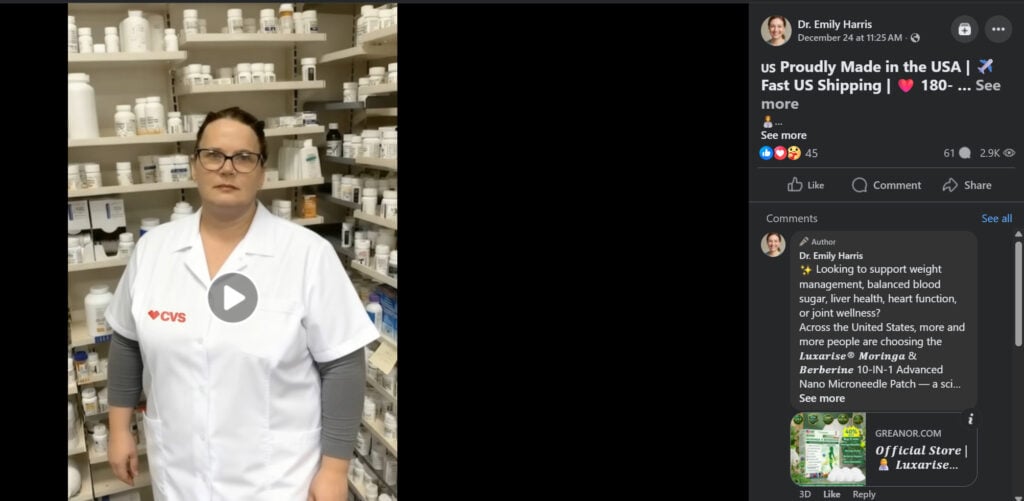
The ad often uses:
- A dramatic hook about stubborn belly fat
- A “breakthrough” claim that sounds new and exclusive
- A story format: “I tried everything, then this changed my life”
- A fake sense of authority: doctor, pharmacist, researcher, nurse
- Bold text overlays with health promises
- Before-and-after photos
The goal is not to educate you.
The goal is to trigger hope and urgency.
Step 2: You land on a highly optimized sales page
Next, you click and land on a long-form page built for conversion.
It’s structured to keep you scrolling:
- A headline that promises fast results
- A “why this works” section with scientific-sounding language
- A list of benefits that covers weight loss, energy, cravings, metabolism, and more
- “As seen in” style credibility cues
- Testimonials and transformation images
- Badges, seals, and icons meant to mimic trust signals
- A guarantee that reduces perceived risk
- A product selection area that nudges you to choose bundles
A lot of these pages are templates.
They are reused across multiple scam products because they work.
Step 3: The page uses “borrowed credibility” to lower skepticism
This is where the operation gets clever.
Instead of proving anything directly, the page borrows credibility from things that sound legitimate:
- The concept of brown fat (a real biological topic)
- The concept of metabolism regulation (real, but complex)
- The concept of microneedles (real in medical tech)
- The concept of GMP manufacturing (real, but often misused)
- The idea of “FDA registered facility” (real phrase, often misleadingly applied)
- Ingredient names like green tea, curcumin, berberine, resveratrol, collagen, hyaluronic acid, and more
Here’s the trick:
Even if ingredients exist, the marketing rarely proves:
- The exact dose
- The absorption rate through skin
- The patch design quality
- Whether the product has been tested as sold
- Whether the results are consistent and safe
So the reader is left with impressions instead of proof.
Step 4: The “results” story is engineered to feel inevitable
A common psychological pattern in these funnels is the “inevitable outcome” story.
It makes you feel like:
- Results are fast
- Results are common
- Results are almost guaranteed
- You are the only one not benefiting yet
This is done using:
- Large review counts (“100,000+ reviews”)
- Claims like “over 2 million satisfied customers”
- Repeated phrases like “clinically supported”
- Before-and-after images designed to shock
- Testimonials that read like short scripts
In scam funnels, testimonials are not evidence. They are a sales device.
Step 5: The pricing is designed to maximize your total spend
Here’s how the pricing psychology usually works:
- You see a low entry price to reduce resistance.
- You are offered bundles with “best value” highlighting.
- The page strongly implies that buying one is pointless, because “most customers” buy multiple boxes.
- The discount is framed as temporary, so you feel pressure to buy more now.
This is why people often end up spending far more than they intended.
They came for a $15 to $30 test.
They leave with a $70 to $200 bundle.
Step 6: After checkout, upsells may appear
Some versions of these funnels include upsells:
- Add more boxes for a “special” price
- Add expedited shipping
- Add a second product for “metabolism support”
- Add a subscription-like option
Even if the site does not label it as a subscription, some customers later report recurring charges, especially in related supplement funnels.
That is why it is important to check your statements carefully after ordering from any suspicious health product site.
Step 7: Fulfillment is slow and vague
Dropshipping operations frequently do not ship from a local warehouse, even if the ad implies “Made in the USA” or “Fast US shipping.”
Instead, the order may be routed through:
- A fulfillment partner
- A third-party shipping broker
- An overseas supplier
That leads to:
- Tracking numbers that take days to activate
- Packages that move slowly
- Delivery windows that stretch into weeks
- Confusing carrier handoffs
- Customer support that blames “high demand” or “processing delays”
When customers get anxious, they are often pushed to wait longer rather than cancel.
Step 8: Customer support becomes a wall, not a solution
This is where the scam experience becomes obvious for many buyers.
Real businesses treat customer support as a function of trust.
Scam funnels treat support as damage control.
Common patterns include:
- Long delays between replies
- Scripted responses that ignore your questions
- Requests for “more time”
- Offers of partial refunds instead of full refunds
- Pressure to keep the product and accept store credit
- “Return address” complications that make returning unrealistic
If you have to fight for a refund from day one, that tells you a lot.
Step 9: The refund policy is designed to look generous but function poorly
A “180-day money-back guarantee” sounds comforting.
But the reality often depends on fine print such as:
- You must return unopened items
- You must pay return shipping
- You must use a specific address
- You must provide multiple forms of proof
- Returns may only be accepted within a narrow window
- Customer support may require approval before you return
- Refunds may be delayed after receipt
In other words, the guarantee helps the conversion rate even if it rarely helps the customer.
Step 10: When the brand name gets heat, it changes
Finally, many of these patch scams are not built for long-term brand growth.
They are built for short-term ad profit.
When complaints rise, chargebacks increase, or ad accounts get restricted, the operation can:
- Change the domain
- Change the brand name
- Reuse the same sales page
- Reuse the same images and claims
- Start again with a fresh campaign
That is why you will see the “same patch” sold under different names, with slightly different stories, but the same structure.
What To Do If You Have Fallen Victim to This Scam
If you already ordered the CleraLuxe Brown Fat Patch and you’re worried, you still have options.
The key is to act calmly and methodically. Don’t assume you’re stuck.
Here’s a practical step-by-step plan.
- Collect and save your evidence
- Screenshot the product page, especially claims, pricing, and the guarantee.
- Save your order confirmation email and receipt.
- Screenshot the checkout page if it shows bundles, shipping fees, or extra charges.
- Save any tracking information.
- Check your payment method immediately
- Review your card or PayPal activity for unexpected charges.
- Look for multiple transactions close together.
- Keep checking for the next few weeks in case a second charge appears later.
- Contact the seller in writing
- Use the official support email or contact form.
- Keep your message short, clear, and firm.
- Ask for cancellation if it has not shipped, or a refund and return instructions if it has.
- Do not rely on verbal promises
- If they promise a refund “soon,” ask for confirmation in writing.
- If they offer partial refunds, reply that you want a full refund.
- If they stall, move to the next step.
- Set a short deadline
- Give them a clear window to respond, such as 48 hours.
- Scammers often delay because delay reduces chargeback success.
- Escalate through your payment provider
- If you paid by card, contact your bank and ask about disputing the charge.
- If you used PayPal, open a dispute through the Resolution Center.
- If you used a virtual card service, freeze or cancel the card.
- If a package arrives, document it
- Take photos of the packaging, shipping label, and product.
- Save the inserts, instructions, and any manufacturer details.
- If the return becomes necessary, this documentation helps.
- Be cautious about using the product
- If you have sensitive skin, allergies, or medical conditions, talk to a medical professional before using unfamiliar health products.
- If you experience irritation or a reaction, stop using it and document symptoms.
- Harden your accounts
- If you created an account on the site, change that password anywhere else you reused it.
- Watch for spam or phishing emails after purchase.
- Report the ad
- Report the social media ad as misleading.
- Reporting helps reduce reach, especially if many people do it.
The Bottom Line
The CleraLuxe Brown Fat Microneedle Patch is marketed like a medical breakthrough, but it behaves like a classic social media funnel: big promises, borrowed credibility, aggressive discounting, bundle pressure, vague accountability, and a customer experience that often turns into a refund struggle.
That doesn’t mean every person will have the same outcome, or that a package will never arrive.
It means the overall pattern is built to sell hope first and handle consequences later.
If you are still on the fence, the safest move is simple: do not buy health products with drug-like claims from a brand you only discovered through an ad and a long, template-style sales page.
And if you already bought it, focus on documentation, fast escalation through your payment provider, and protecting yourself from additional charges.
You’re not alone in running into this kind of offer, and you’re not powerless either.

Reviews & discussion
0 commentsShare a firsthand experience, or ask a question.
Community reviews
CleraLuxe Brown Fat Microneedle Patch
Moderated reader experiences, not an editorial verdict.
Start the conversation
Have a question or something useful to share? Add the first comment.