


An email says a contract deposit has arrived. The receipt looks routine, the sender sounds like an office manager, and the document is waiting.
Before you open it, there is one question worth asking: whose business would this payment actually be?
Overview
A receipt that appears to belong to your work
The Deposit for Contract Agreement email scam presents itself as ordinary business correspondence about a signed contract and its bank deposit.
In the examined version, the message claimed to come from an office manager at M&M Contracting Ltd. That claim does not implicate the real company.
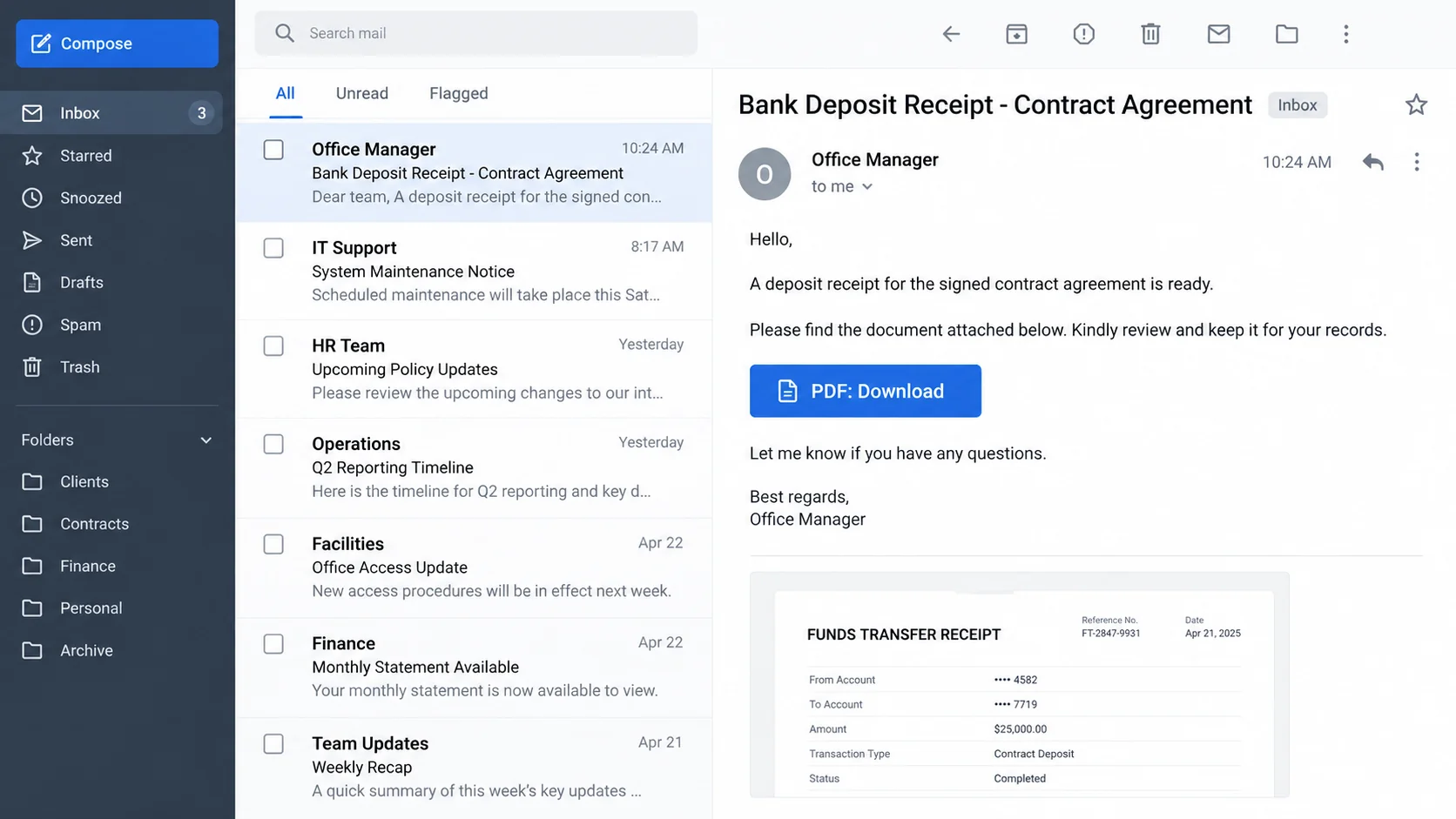
The body offered a bank receipt or SWIFT-style preview. It invited the recipient to download a PDF or save the supposed document to OneDrive.
Those details make the request feel connected to accounts payable, purchasing, or a project already underway. They are not proof that any deposit occurred.
An employee who handles several vendors may not immediately recognize every contracting name. That uncertainty is precisely what the email exploits.
The actual target is the recipient’s email account
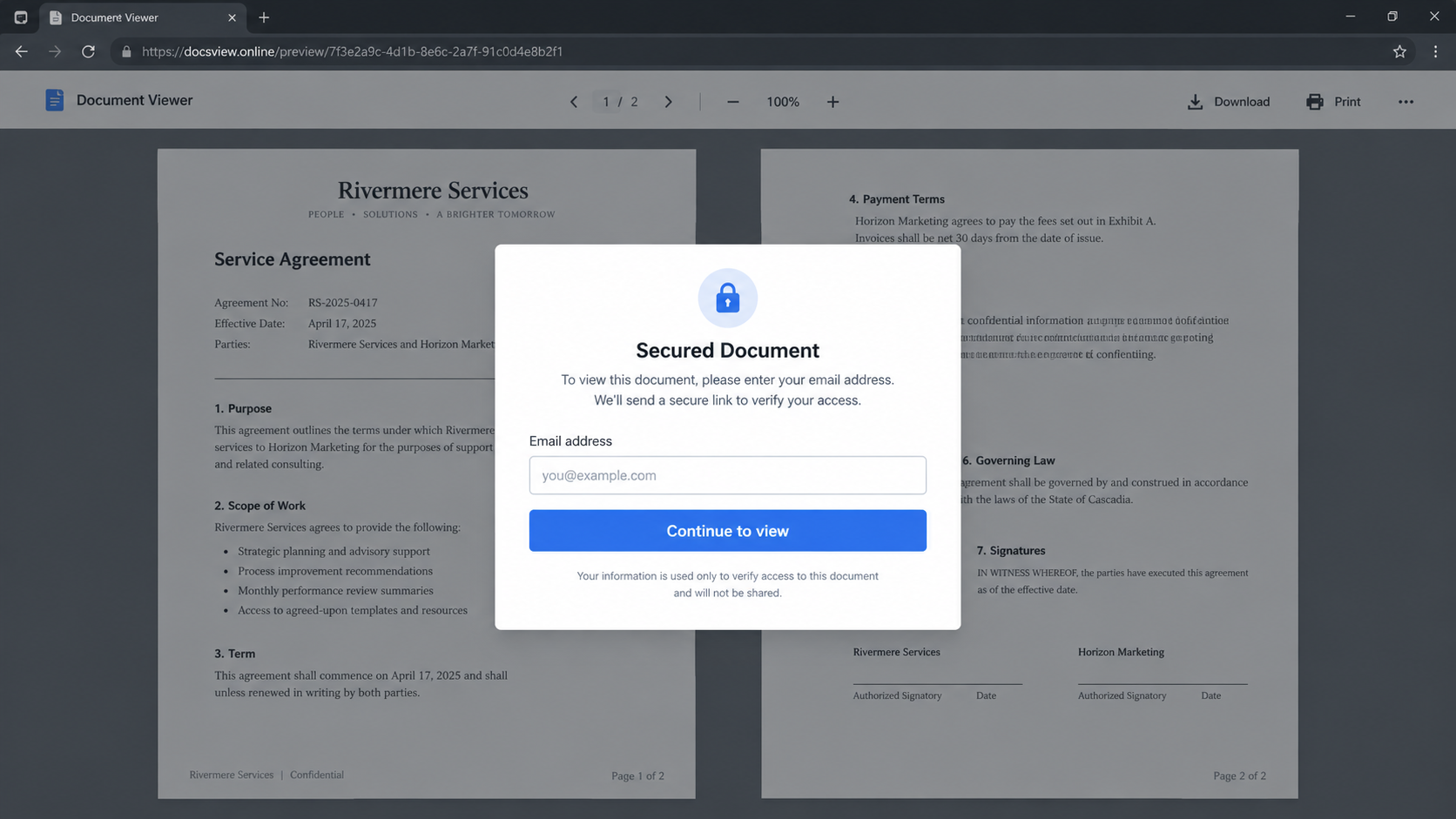
The link led to a hosted page displaying a document-like preview. A pop-up then presented the file as secured and requested an email sign-in.
That is the central switch. A bank receipt should not require your mailbox password to become readable in an unrelated browser window.
The page was hosted through a legitimate web-hosting service that can be misused by anyone. The service name alone did not make the document trustworthy.
Entering credentials on the imitation form could give the operator access to mail, stored correspondence, and password-reset messages.
The observed campaign is credential phishing. The examined material does not establish that the link installed malware or moved a real bank transfer.
What to check before opening anything
- Confirm the contract and deposit through a saved contact or your organization’s purchasing records.
- Compare the sender’s actual address with the organization they claim to represent.
- Inspect the destination of both the PDF and OneDrive-style links without signing in.
- Never type your email password into a document preview reached through an unexpected message.
If your company does have an M&M project, verify the message with the person who owns that project. Familiarity with a name is not authentication.
If there is no matching agreement, do not hunt for a hidden receipt. Treat the discrepancy as a reason to stop.
Why the Deposit Story Works
Invoices and contract notices arrive when people are busy. They often come from an assistant, coordinator, or outside vendor rather than the person who negotiated the deal.
A payment notice also creates a polite obligation. Recipients may feel they should acknowledge the deposit before someone asks why the file was ignored.
The message does not need a loud threat. It only needs a plausible document title and a familiar office workflow.
The supposed SWIFT receipt adds visual weight. Many readers know the term relates to international banking but cannot validate a transaction from an image.
In this case, the banking language is part of the lure. The observable objective comes later, when the document gate asks for mailbox credentials.
The first image above is a fictional reconstruction of that kind of email. Its invented transaction details are not evidence about a particular victim.
The second reconstruction shows the critical moment: the document viewer asks for account details before revealing anything useful.
How the Deposit for Contract Agreement Email Scam Works
Step 1: The sender claims a routine contract milestone
The email says a deposit has been made against a signed agreement. This places the message inside a process many businesses already recognize.
It may refer to an office manager, contracting firm, or document department. Those roles suggest administration, not an obvious consumer prize scam.
The claimed relationship matters more than the sender’s display name. Display names are easy to set and are not independent evidence of employment.
Open the full sender address if you need to assess it, but remember that even a believable address can belong to a compromised account.
The reliable check is external: locate the contract in your own system and ask the known contact whether a deposit notice was expected.
Step 2: A receipt preview makes the request feel concrete
The message includes or describes a bank deposit receipt. A SWIFT-style reference may suggest that the payment has already passed through formal channels.
Pictures of receipts are simple to fabricate. A visible reference number cannot tell you whether a bank actually processed a transfer.
Legitimate payment verification comes from your bank, accounting software, or established customer contact, not from an email image.
Readers should also separate the transaction claim from the document claim. A genuine deposit would not validate every link inside the email.
That distinction prevents one convincing detail from carrying the entire message across the trust boundary.
Step 3: The PDF and cloud-storage choices lead away from email
The examined message offered a PDF download and a Save to OneDrive-Personal option. Both gave the recipient a reasonable-looking next click.
These labels are part of the email’s presentation. They do not prove a PDF exists or that Microsoft hosts the destination.
A hyperlink can display one label and open a completely different address. Hovering may reveal the destination on desktop, although shortened links complicate inspection.
On mobile, use a long press only if you can preview the address without opening it. Do not paste suspicious links into another browser.
If your workplace uses an approved document system, open it through a saved bookmark and look for the file there instead.
Step 4: A hosted preview supplies borrowed credibility
The link in the investigated version reached a page on sharemyhtml.com. That is a hosting platform, not proof of a contract relationship.
Attackers can misuse legitimate hosting services because a recognizable platform name may seem safer than an obviously random domain.
The page displayed a multi-page document preview. It created a sense that the promised agreement was already present, just beyond one final step.
Do not assume the displayed pages contain the actual contract. A decorative preview can exist solely to make the authentication prompt seem reasonable.
Ask whether your organization normally receives deposits through that hosting site. Most finance teams have a known portal or direct bank workflow.
Step 5: The secured-document prompt asks for the real prize
A pop-up marked the document as secured and asked the visitor to sign in with an email account to unlock it.
Document access controls exist in real business tools, so the request may not feel strange at first. Context is what makes this one dangerous.
The email arrived unsolicited, the page came from an unrelated host, and the password request appeared only after the click.
If a page asks for your email password, it must be an independently verified sign-in page for your own provider or workplace identity system.
A vague promise that credentials are needed to view a PDF does not meet that test. Stop before entering anything.
Step 6: A stolen mailbox can support follow-on fraud
If the victim enters valid credentials, the operator may try to access the account, depending on multifactor protection and account controls.
They could search past contracts, read payment discussions, or send convincing follow-up messages to colleagues from a familiar address.
They may also create inbox rules that hide warnings or forward mail elsewhere. This is a potential consequence, not proof it occurred here.
Password-reset emails can widen the damage if the same mailbox is used to recover other services. That makes prompt account review important.
The best response is measured: secure the account, inspect activity, and notify the relevant finance contacts before another payment conversation is trusted.
How to Verify a Deposit Without Trusting the Email
Begin with the account that would receive the money. A payment should be traceable there, even if the email contains a polished receipt.
Ask your finance team which bank and reference number they expect. Do not supply the reference from the suspicious message as the only clue.
If the claimed sender is a new vendor, find the approved vendor record. A name on a deposit notice may not match the legal entity on a contract.
For an existing vendor, use the telephone number already saved in your procurement system. A number inside the message could route to the same operator.
One call can answer whether a contract was signed, whether a deposit was due, and whether the sender normally shares documents that way.
Do not ask only, “Did you send an email?” Read the subject, date, and claimed document type so the contact can check the right event.
If the vendor confirms a message, ask them to resend through your approved portal. That avoids making the original link the source of truth.
International transfers can take time to settle. A missing deposit today is not by itself proof of fraud, but it is no reason to sign into a strange document page.
There is also a difference between a bank receipt and a bank confirmation. A sender can attach an image without any bank validating it.
Organizations should keep a second-person approval for changes to payment instructions. Phishing often starts as document access and later becomes invoice redirection.
If the Email Reached Several Colleagues
A shared finance mailbox or group distribution list can expose more than one person to the same lure. Preserve the message before deleting copies.
Security staff can search for the subject, sender, and destination URL. They can then identify who clicked and who may have submitted credentials.
That distinction matters. A user who viewed a page may need reassurance and monitoring, while a user who typed a password needs immediate account action.
Do not circulate a screenshot of the phishing page with a clickable link embedded in it. Share the indicators through your organization’s reporting channel.
If a mailbox was compromised, warn colleagues that replies in the existing contract thread may also be untrustworthy until the account is secured.
After containment, review whether the same story could fool staff again. A short reminder about approved document-sharing channels is often more useful than blame.
Receipt, Sender, Link, and Account Checks
Find the agreement in your own records
Search the purchasing system for the company, agreement number, expected amount, and project owner. Do not rely on values supplied by the email.
A legitimate deposit should be visible through normal accounting channels. If no one recognizes the contract, that is a strong reason not to proceed.
Contact the supposed sender independently
Use a saved vendor record or known telephone number. Do not reply to the suspicious email and ask the same inbox to validate itself.
If the company confirms no message was sent, forward the original to your security team with full headers when possible.
Read the actual destination, not the button label
PDF and cloud-storage wording can hide a hosted HTML page. A page on a generic hosting service is not automatically malicious, but it requires verification.
Close the page if it requests a mailbox password outside your normal provider sign-in. Do not test it with a different password.
Check your mailbox if you already interacted
Review recent sign-ins, connected applications, forwarding rules, and sent messages. Look for changes made near the time you opened the document.
Preserve the original email, URL, and approximate time. Those details help administrators separate a harmless click from an actual account compromise.
What to Do if You Opened the Fake Contract Document
- If you only viewed the page, close it. Do not enter details. Report the email to your workplace security contact or mail provider, and retain the message for investigation.
- If you typed a password, change it from a trusted device. Go directly to your email provider or workplace login, not through the message. Use a unique replacement password.
- Revoke active sessions and review multifactor settings. Sign out other sessions where the provider allows it. Remove unfamiliar authentication methods, recovery addresses, and connected apps.
- Inspect mailbox rules and recent activity. Check forwarding, filters, deleted mail, sent items, and account sign-in history. Ask an administrator to review audit logs if this is a business account.
- Warn finance and contract owners. Tell them the deposit message may be fraudulent. Ask them to verify any later bank-detail changes or follow-up requests through known channels.
- Scan a downloaded file before reopening it. If you saved or ran anything, disconnect if unusual activity appears and run a reputable scan such as Malwarebytes. AdGuard can reduce exposure to malicious pages, but neither replaces account recovery.
- Watch for secondary phishing. Stolen correspondence can make the next message unusually specific. Verify payment instructions and password-reset requests independently over the following weeks.
Is Your Device Infected? Run a Free Malware Scan
Slow performance, constant pop-ups, or strange behavior? These are classic signs of a malware infection. A quick way to check is to scan your device with Malwarebytes Free, one of the most trusted malware removal tools available. If you only visited a scam page and didn’t download or install anything, this scan is optional.
The free version detects and removes the most common threats, including:
- Adware — the cause of those annoying pop-ups
- Browser hijackers — unwanted redirects and changed homepages
- Trojans and spyware — hidden programs stealing your data
- Potentially unwanted programs (PUPs) — software you never asked for
👉 Select your device below — Windows, Mac, or Android — then follow the simple steps to download Malwarebytes, scan your system, and remove any threats it finds. The scan usually takes 5 to 20 minutes.
Run a Malware Scan with Malwarebytes for Windows
Malwarebytes is one of the most popular and trusted anti-malware tools for Windows — and it’s completely free for removing infections. It catches threats that many antivirus programs miss, including adware, browser hijackers, and trojans. Follow the steps below to scan your PC and remove what Malwarebytes finds.
Download Malwarebytes
Click the button below to download the latest version of Malwarebytes for Windows from the official source. The free version is all you need — it will scan your computer and remove adware, browser hijackers, and other malicious software at no cost.
Download MalwarebytesOfficial installer for Windows 11 and 10. Your download starts right away.Want real-time protection? See Malwarebytes Premium Malwarebytes Free for WindowsScans and removes malware at no cost
-
Install Malwarebytes
When the download finishes, open your Downloads folder and double-click the MBSetup file. If Windows shows a User Account Control pop-up, click “Yes” to allow the installation.

Follow the On-Screen Prompts to Install Malwarebytes
The setup wizard will walk you through a few quick screens:
-
Choose where you’re installing the program — “Personal Computer” or “Work Computer” — then click Next.

-
Malwarebytes will now install on your device. This usually takes under a minute.

-
When installation is complete, the “Welcome to Malwarebytes” screen will open automatically.

-
On the final screen, click Open Malwarebytes to launch the program.

-
Optional: Check for rootkits with a Custom Scan
You don’t need to change any settings for a normal scan. The standard Threat Scan in the next step is enough for most problems, so you can go straight to it.
If you also want to check for rootkits, use a Custom Scan. In current versions of Malwarebytes, rootkit scanning is only available there:
- On the Scanner tile, click the three-dot menu and select Advanced Scan.
- Choose Custom Scan. In its options, check Scan for rootkits.
- Select your system drive (usually C:\) as the location to scan, then start the scan. It takes longer than a Threat Scan.
- When it finishes, review and quarantine the results as described in the steps below.
Rootkit scanning isn’t available on Windows devices with ARM processors.
Start the Scan
Click the blue Scan button. Malwarebytes will automatically update its virus database and start checking your computer for malware.

-
Wait for the Scan to Finish
The scan checks your entire system for browser hijackers and other malicious programs, so it can take 5 to 20 minutes depending on your computer. Feel free to do something else — just check back occasionally to see the progress.

-
Quarantine the Detected Threats
When the scan is done, you’ll see a list of everything Malwarebytes found — malware, adware, and potentially unwanted programs. Click the “Quarantine” button to remove all of them at once.

Malwarebytes will now remove the malicious files and registry entries and move them safely into quarantine.

-
Restart Your Computer
Some threats can only be fully removed after a reboot. If Malwarebytes asks you to restart, click Yes. Once you’re logged back in, Malwarebytes has finished removing the threats it found.

When the scan is done, check whether the problems you noticed have stopped. If they continue, see the options below.
If you are still having problems with your computer after completing these instructions, then please follow one of the steps:
- Run a computer scan with ESET Online Scanner
- Ask for help in our Windows Malware Removal Help & Support forum.
Run a Malware Scan with Malwarebytes for Mac
Malwarebytes for Mac is a free on-demand scanner that removes the malware other security software tends to miss — adware, browser hijackers, and unwanted programs included. Cleaning an infected Mac with Malwarebytes has always been completely free, and it’s our go-to recommendation. Follow the steps below to scan your Mac and remove what Malwarebytes finds.
-
Download Malwarebytes for Mac
Click the button below to download the latest version of Malwarebytes for Mac.
Download MalwarebytesOfficial installer for macOS. Your download starts right away.Want real-time protection? See Malwarebytes PremiumMalwarebytes Free for MacScans and removes malware at no cost -
Open the Malwarebytes setup file
When the download finishes, open your Downloads folder and double-click the setup file to begin the installation.

-
Follow the On-Screen Prompts to Install Malwarebytes
The Malwarebytes for Mac Installer will guide you through a few quick screens. Click “Continue” and keep following the prompts until the installation completes.



When the installation is complete, Malwarebytes opens to the Welcome to Malwarebytes screen. Click “Get started“.
Malwarebytes needs Full Disk Access to check your whole Mac. When it asks, open System Settings > Privacy & Security > Full Disk Access, turn on Malwarebytes (it may be listed as Malwarebytes Protection), and confirm with your password or Touch ID. Then return to Malwarebytes. On macOS Monterey and earlier, this setting is in System Preferences > Security & Privacy > Privacy.
-
Select “Personal Computer” or “Work Computer”
Malwarebytes will ask what type of computer you’re installing it on. Click either Personal Computer or Work Computer, whichever applies.

-
Start the Scan
Click the “Scan” button. Malwarebytes will automatically update its detection database and begin checking your Mac for malware.

-
Wait for the Scan to Finish
Malwarebytes will scan your Mac for adware, browser hijackers, and other malicious programs. This can take a few minutes, so feel free to do something else — just check back occasionally to see the progress.

-
Quarantine the Detected Threats
When the scan is done, you’ll see a list of everything Malwarebytes found. Click the “Quarantine” button to remove all the threats at once.

-
Restart Your Mac
Malwarebytes will now remove all the malicious files it found. Some threats can only be fully removed after a reboot — if Malwarebytes asks you to restart, allow it. Once you’re logged back in, check whether the problems you noticed have stopped. If they come back, save the scan report and ask for help in our forum.

If the problems you noticed continue after the scan, see the options below.
If you are still experiencing problems while trying to remove a malicious program from your computer, please ask for help in our Mac Malware Removal Help & Support forum.
Run a Malware Scan with Malwarebytes for Android
Malwarebytes for Android scans your phone or tablet for malware, adware, and potentially unwanted apps. The free version scans only when you start a scan. Real-time protection, which checks apps automatically, is part of the paid Premium version.
-
Download Malwarebytes for Android.
You can download Malwarebytes for Android by clicking the link below.
Get Malwarebytes for AndroidOpens Google Play in a new tab.Want real-time protection? See Malwarebytes Premium for AndroidMalwarebytes for AndroidScans your phone and removes malware at no cost -
Install Malwarebytes for Android on your phone.
In the Google Play Store, tap “Install” to install Malwarebytes for Android on your device.

When the installation process has finished, tap “Open” to begin using Malwarebytes for Android. You can also open Malwarebytes by tapping on its icon in your phone menu or home screen.

-
Follow the on-screen prompts to complete the setup process
When Malwarebytes opens, it walks you through a short setup. Tap Get started and follow the prompts. If you see an offer for a trial or a paid plan, read it before you accept. You can skip it and keep using the free scanner.
Malwarebytes will ask for permission to access the files on your phone so it can scan them. Tap Allow, or turn on the permission in the Android screen that opens, then return to Malwarebytes.
-
Run a scan with Malwarebytes for Android
On the main screen, tap Scan now. In some versions, you open the menu, tap Scanner, and then tap Run a scan.
-
Wait for the Malwarebytes scan to complete.
Malwarebytes will now start scanning your phone for adware and other malicious apps. This process can take a few minutes, so we suggest you do something else and periodically check on the status of the scan to see when it is finished.

-
Remove the detected apps.
When the scan has been completed, you will see a list of the threats that Malwarebytes for Android has detected. Next to each detected item, tap the menu icon (three dots), then choose to uninstall the app or delete the file. Android then asks you to confirm. Tap OK or Uninstall to remove the app.
-
Restart your phone.
When the detected apps are removed, restart your phone if Malwarebytes asks you to. Then check whether the problems you noticed have stopped.
If the problems you noticed continue after the scan, see the options below.
If you are still having problems with your phone after completing these instructions, then please follow one of the steps:
- Ask for help in our Mobile Malware Removal Help & Support forum.
- Only as a last resort, reset your phone to factory settings. Read the warning below first.
- Back up your photos, videos, files, and messages, for example to your Google account or a computer.
- Make sure you know your Google account email and password. The phone asks for them after the reset. If you changed the password recently, Google recommends waiting 24 hours before you reset.
- On a Samsung phone, also make sure you know your Samsung account password.
- If you use an authenticator app for two-step verification, move your accounts to another device or save your backup codes first.
Stay Protected: Block Ads and Malicious Sites
No scan can prove a device is completely clean, so it helps to block threats before they reach you. Most infections start with a malicious ad or a fake download button — so blocking them at the source is your best defense.
We recommend AdGuard, which blocks malicious ads, phishing pages, and dangerous redirects before they can reach you.
👉 Download AdGuard and browse safely
Frequently Asked Questions
Is M&M Contracting Ltd behind this message?
The examined email claimed that identity. The claim alone provides no evidence that the real company sent the message or knew about it.
Was there an actual bank deposit?
Nothing in the phishing email proves a payment occurred. Check your bank and accounting records through normal channels before acknowledging any transfer.
Does the OneDrive wording mean Microsoft hosted the file?
No. A button can use a familiar product name while opening an unrelated page. Read the actual destination and verify it independently.
Is sharemyhtml.com itself malicious?
A legitimate hosting platform can be abused to publish phishing content. The investigated page’s behavior matters more than labeling the entire service malicious.
Can a click alone steal my password?
Merely opening the observed login page is different from entering credentials. If you downloaded or ran a file, assess that separately.
Why would attackers want an employee mailbox?
Business mail contains relationships, invoices, and internal context. Access can help criminals craft believable follow-ups, though each account’s actual exposure varies.
The Bottom Line
The Deposit for Contract Agreement email turns a plausible payment receipt into a request for mailbox credentials. The document is bait, not payment verification.
Check the contract through your own records, refuse unexpected document sign-ins, and secure the account quickly if you submitted a password.

Join the discussion
0 commentsShare your experience or ask a question about this article.
Discussion
Start the conversation
Have a question or something useful to share? Add the first comment.