

DermaPure is being promoted online as a skin-support supplement that can supposedly improve hydration, firmness, texture, radiance, gut balance, digestion, metabolism and even broader wellness from the inside out. The product is advertised through social media ads, long-form sales pages, affiliate landing pages and promotional funnels that make it look like a breakthrough beauty supplement.
But after reviewing the DermaPure marketing, the sales structure and the claims used to promote it, there are serious red flags.
DermaPure appears to follow the same pattern as many supplement scams previously covered on MalwareTips.com: exaggerated health and beauty claims, AI-generated promotional videos or images, fake-looking testimonials, aggressive bundle offers, affiliate sales pages, unclear accountability, difficult returns and the risk of unwanted charges or extra shipments.
The biggest issue is not simply that DermaPure is a supplement. The problem is how it is being sold. The ads and landing pages appear designed to push people into buying quickly, often before they understand what they are ordering, who is actually selling it, whether the product is backed by real evidence, and whether they can realistically get their money back.
What Is DermaPure?
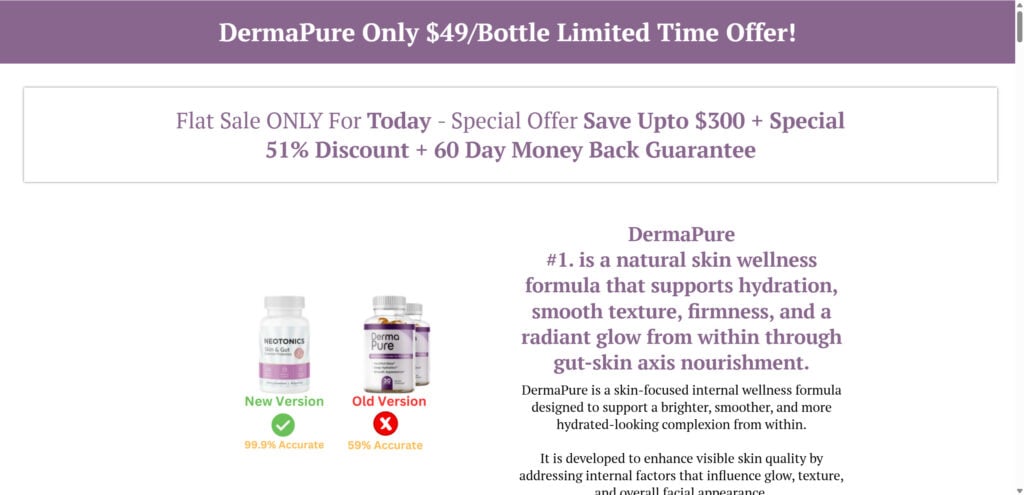
DermaPure is marketed as a skin wellness supplement that supposedly works through the “gut-skin axis.” The sales page claims the formula supports a brighter, smoother and more hydrated-looking complexion by improving internal balance, gut health and nutrient absorption.
The product is promoted as a natural, non-GMO, gluten-free supplement with ingredients such as probiotics, dandelion, fenugreek, lemon balm and other botanicals commonly seen in generic wellness formulas.
At first glance, the pitch sounds polished. It uses familiar wellness buzzwords like:
- Gut-skin connection
- Microbiome balance
- Natural skin renewal
- Cellular turnover
- Hydration support
- Firmness boost
- Radiant glow
- Internal cleansing
- Youthful complexion
These phrases are designed to sound scientific without proving that this specific product can deliver the dramatic results implied by the ads.
A real supplement may support general wellness in limited ways, depending on its ingredients and dosage. But that is very different from claiming or implying that a simple gummy can reverse aging, tighten skin, remove wrinkles, transform complexion, replace skincare routines or fix the “root cause” of aging skin.
Why DermaPure Raises Scam Concerns
DermaPure raises concern because its marketing appears to rely more on emotional persuasion than verifiable proof.
The sales funnel uses many of the same tactics seen in questionable supplement campaigns:
- Viral social media ads with dramatic before-and-after-style claims
- AI-looking videos and images that may not show real customers
- Generic testimonials that are difficult to verify
- “Limited time” discounts designed to create urgency
- Large bottle bundles pushed as the best-value option
- Claims that sound medical or scientific but are not supported by clear clinical proof for the product itself
- Affiliate-style websites that redirect buyers through other supplement offers
- Refund promises that may be difficult to use in practice
- Risk of upsells, subscriptions, refill programs or receiving more units than expected
This is the same ecosystem used by many questionable products in the weight loss, dental health, blood sugar, prostate, hearing, eyesight and anti-aging supplement niches. A product gets a new name, a new domain, a new social media ad angle and a new “scientific discovery” story, but the underlying strategy remains the same.
Fake or Exaggerated Claims in Social Media Ads
One of the most concerning parts of the DermaPure promotion is the type of claim commonly used in social media ads.
These ads often suggest that DermaPure can deliver visible skin results quickly and easily. Some versions may use AI-generated presenters, fake doctors, stock-style women, beauty influencer formats or dramatic visual edits to make the product look more credible.
The problem is that social media ads can make claims that are much stronger than what the checkout page or disclaimer later admits. The ad gets the user excited. The landing page adds urgency. The checkout page pushes bundles. The fine print then says results vary and the product is not intended to diagnose, treat, cure or prevent disease.
That structure is a major red flag.
When a supplement is real and properly marketed, the seller should be able to provide transparent evidence, clear labeling, real company details, realistic claims and straightforward customer support. DermaPure’s advertising style appears to rely on hype, scarcity and emotional pressure instead.
AI Videos and Fake-Looking Images
Many modern supplement scams now use AI-generated videos and images because they are cheap, fast and persuasive.
AI can create:
- Fake doctors
- Fake satisfied customers
- Fake news-style presenters
- Fake before-and-after images
- Fake “expert” videos
- Fake social media testimonials
- Fake product demonstrations
This matters because shoppers may believe they are seeing real people with real results. In reality, the faces, voices, images and testimonials may be synthetic, staged or reused from other campaigns.
DermaPure’s promotional ecosystem appears consistent with this newer AI-driven supplement marketing trend. The ads are designed to feel personal and trustworthy, but there is no reliable way for a customer to verify that the people shown in the ads actually used the product.
A trustworthy health or beauty product should not need fake urgency, AI presenters or unverifiable transformation stories to sell.
The “Cheap Product From China” Concern
DermaPure also appears to fit the pattern of low-cost, generic supplement products that are heavily marked up through affiliate funnels.
Many similar campaigns source inexpensive products, private-label formulas or generic inventory from low-cost manufacturers, then sell them through polished Western-facing sales pages at a much higher price. The product may be presented as a premium U.S. breakthrough, while the actual supply chain, formulation quality and manufacturer details remain unclear.
This does not automatically prove that every bottle is unsafe. But it creates a serious trust problem.
If a supplement is promoted as a premium formula, buyers should be able to verify:
- Who manufactures it
- Where it is manufactured
- What the exact supplement facts label says
- Whether each ingredient dosage is disclosed
- Whether third-party lab testing exists
- Whether the product has batch numbers
- Whether there is a real company behind it
- Whether refunds are actually honored
With DermaPure, the marketing focuses heavily on claims and discounts, not transparent verification.
Affiliate Funnel Red Flags
Another issue is that DermaPure appears to be sold through affiliate-style pages and related supplement funnels.
This means the website promoting the product may not be the actual merchant, manufacturer or support provider. Instead, it may act as a traffic page that earns commissions when users click through and purchase.
That creates several risks for consumers:
- The page that convinced you to buy may not handle support.
- The product name on the ad may not match the product name at checkout.
- The refund policy may belong to another company.
- The affiliate page may disappear after the campaign ends.
- Multiple domains may promote the same or similar offer.
- Customer complaints may be difficult to trace to one responsible seller.
This is common in supplement scam networks. A product is pushed across different domains, each using similar copy, similar claims and similar images. Once complaints build up, the campaign can shift to another domain or another product name.
“Limited Time” Discounts and Bundle Pressure
DermaPure’s sales page uses urgency tactics such as limited-time pricing, today-only discounts and large bottle bundles.
These tactics are designed to make buyers act quickly. Instead of calmly comparing the product, checking reviews and reading the return policy, users are pushed toward buying multiple bottles immediately.
This is risky because many supplement funnels make the largest bundle look like the “recommended” option. Some pages claim that most customers buy six bottles, or that the best results require several months of use.
That is not neutral advice. It is a sales tactic.
When a customer buys a large bundle, the refund process becomes harder. They may have to return every bottle, pay return shipping, contact multiple support channels and wait for approval. If the seller is overseas, unresponsive or hidden behind a third-party processor, getting the money back can be very difficult.
Refunds May Be Difficult or Practically Impossible
DermaPure-type sales funnels often advertise a “money-back guarantee,” but that does not mean refunds are easy.
In many similar supplement complaints, customers report problems such as:
- No response from customer support
- Support asking for repeated information
- Refund requests being delayed until the window expires
- Customers being told to return all bottles at their own cost
- Opened bottles being refused
- Return addresses being unclear
- International return shipping costing too much
- Partial refunds instead of full refunds
- Restocking fees or processing delays
- Difficulty finding the real merchant behind the order
Even when a page says “60-day guarantee,” the actual process may require the customer to ship products back, provide order details, wait for confirmation and deal with a separate payment processor.
That is why shoppers should not treat a guarantee as proof that the purchase is risk-free.
Risk of Receiving More Units Than Ordered
Another common issue with supplement funnels is that customers may receive more bottles than they believed they ordered.
This can happen because checkout pages use:
- Preselected bundles
- Confusing quantity buttons
- Upsell pages after payment information is entered
- “Add to order” offers that look like discounts
- Refill options that may be easy to miss
- One-click upsells that do not clearly explain the final total
A shopper may think they are ordering one bottle, then discover they were charged for three, six or more. In some cases, the package may include extra units the buyer did not knowingly approve.
This is a major red flag because the refund process becomes more complicated once the product ships. Sellers may claim the customer selected the bundle, while the customer believes the checkout was misleading.
Anyone who already ordered DermaPure should check the confirmation email, bank statement and package contents immediately.
Refill Subscription and Recurring Charge Risks
Another risk is hidden or confusing refill subscriptions.
Some supplement funnels use recurring billing, auto-ship programs or “VIP refill” plans. These may be presented as convenience features, discounts or membership options. In other cases, users may not realize they agreed to future shipments until another charge appears.
Even if the main FAQ says the order is one-time, buyers should still be cautious. Affiliate funnels can change, upsells can vary, and third-party checkout pages may introduce additional offers.
After ordering any supplement from a social media ad, check for:
- Monthly charges
- Auto-refill language
- Membership terms
- Trial offers
- “Subscribe and save” boxes
- Post-purchase upsells
- Emails mentioning future shipments
- Charges from unfamiliar billing names
If you see a recurring charge, contact your bank or card issuer quickly.
Fake Testimonials and Review Manipulation
The DermaPure sales pitch also uses testimonial-style reviews that are difficult to verify.
This is common in supplement funnels. The reviews usually have:
- First names only
- Generic locations
- Overly polished wording
- Perfectly positive results
- No verified purchase link
- No independent review platform
- No way to contact or verify the reviewer
- Photos that may be stock images, AI-generated or reused
Fake testimonials are dangerous because they create false confidence. A customer may believe that many people had amazing results, when the reviews may simply be marketing copy.
Real reviews should come from independent platforms where negative reviews are allowed, purchase verification exists and the seller cannot fully control the conversation.
FDA and “Approved Facility” Claims
Some supplement pages use phrases like “FDA approved facility” to create credibility.
This wording can be misleading. Dietary supplements are not approved by the FDA in the same way prescription drugs are. A facility may be registered or required to follow certain manufacturing practices, but that does not mean the FDA has approved the supplement’s effectiveness.
A supplement seller should not use FDA-related wording to imply that the product itself has been approved, proven or endorsed by the government.
If a product makes dramatic health or beauty claims but later hides behind a disclaimer saying the statements have not been evaluated by the FDA, that is a warning sign. The strong claims sell the product. The disclaimer protects the seller.
Why DermaPure Looks Like Previous MalwareTips Supplement Scams
DermaPure fits the same pattern seen in many previous supplement scams covered by MalwareTips.com.
The formula usually looks like this:
- A viral ad appears on Facebook, Instagram, TikTok or YouTube.
- The ad uses AI visuals, fake authority figures or exaggerated claims.
- The user is sent to a long landing page that looks like a breakthrough discovery.
- The page claims the product is natural, safe, limited and heavily discounted.
- The user is pushed toward buying multiple bottles.
- The checkout may include upsells, bundles or refill offers.
- The buyer receives a generic product that does not match the hype.
- Refunds become difficult, delayed or impossible.
- The same campaign reappears under another name or domain.
This is not how reputable supplement companies usually operate.
Is DermaPure Legit?
Based on the available warning signs, DermaPure should be treated as a high-risk supplement offer.
It may ship some form of product, so it is not necessarily a “take the money and send nothing” scam. However, that does not make it trustworthy. Many questionable supplement operations do ship a cheap bottle because shipping something helps them fight chargebacks and appear legitimate.
The real issue is that the marketing appears deceptive, exaggerated and difficult to verify.
DermaPure is not something we recommend buying from social media ads or affiliate landing pages. The claims are too broad, the sales structure is too aggressive, the testimonials are too hard to verify, and the refund risks are too high.
What To Do If You Already Ordered DermaPure
If you already bought DermaPure, act quickly.
1. Check the exact charge
Look at your card statement and identify the billing name, amount and date. Save screenshots of everything.
2. Review the confirmation email
Check whether you were charged for one bottle, multiple bottles, an upsell or a subscription.
3. Contact customer support immediately
Request cancellation and a refund in writing. Use clear wording:
“I did not authorize any additional bottles, refill subscription, membership or recurring charge. Cancel all future billing and confirm in writing.”
4. Contact your bank or card issuer
If the seller does not respond, ask your bank about a chargeback. Explain that the product was sold through misleading claims, unwanted quantities, unclear billing or impossible refund terms.
5. Cancel or replace the card if needed
If you see signs of recurring billing or unauthorized charges, ask your bank whether replacing the card is necessary.
6. Do not keep taking the supplement if you feel unwell
Stop using it and speak with a healthcare professional if you experience side effects, allergic reactions or interactions with medication.
7. Report the ad
Report the ad on the platform where you saw it. Include screenshots of the claims and checkout page.
8. Scan your device if you clicked suspicious redirects
If the ad or website opened pop-ups, suspicious downloads or browser redirects, scan your computer with Malwarebytes and consider using a reputable ad blocker such as AdGuard.
How To Avoid Similar Supplement Scams
Before buying any supplement from a social media ad, check for these red flags:
- The product claims to fix many unrelated problems
- The ad uses a fake doctor, celebrity or AI presenter
- The website has no clear company identity
- The product is only sold through “today only” discount pages
- The page pushes three- or six-bottle bundles
- The reviews are all perfect and impossible to verify
- The checkout includes upsells or confusing quantity options
- The seller uses “FDA approved facility” wording
- The refund policy requires complicated return steps
- The same product appears on multiple domains
- There is no independent clinical trial for the exact formula
A reputable supplement should have transparent labeling, realistic claims, accessible support, independent reviews and clear refund terms.
Final Verdict
DermaPure shows many warning signs of a questionable supplement funnel.
The product is promoted with exaggerated skin and gut-health claims, social media hype, AI-style promotional content, generic testimonials, bundle pressure and affiliate sales pages. Buyers also face risks such as receiving more units than expected, being pushed into refill subscriptions, struggling with refunds and ending up with a cheap generic supplement that does not match the marketing promises.
For those reasons, DermaPure is best avoided.
If you want help with skin concerns, speak with a dermatologist or licensed healthcare professional instead of trusting viral supplement ads. If you already ordered DermaPure and feel misled, contact the seller in writing, check for recurring charges and ask your bank about a chargeback if the company refuses to help.








