


A message saying your grant application is progressing can feel encouraging when your business needs funding and you have already paid for help.
The Grant Bae scam shows why reassuring updates deserve a closer look, especially when the person selling assistance also controls every explanation of progress.
Overview
Business owners paid for help obtaining grants
Grant Bae offered to assist minority business owners with government grants, collecting fees while telling clients it was obtaining funding on their behalf.
An owner paying for that service would reasonably expect identifiable opportunities, actual application work and a clear explanation of what the fee covered.
Those expectations matter because a grant being competitive does not excuse someone charging for work they never intended or attempted to perform.
A jury found the promised work had not happened
Treashonna Graham was convicted on all charges in a 13-count indictment, according to the Justice Department’s October 2026 verdict announcement describing the proven conduct.
The evidence showed that she never hired companies to locate or obtain grants and never helped write grant applications for her clients.
More than 1,000 people were victimized, and approximately $2.9 million was taken through the scheme, which went well beyond unsuccessful funding applications.
An update is useful only when it connects to real work
An application status message should connect to an actual grant program, an agreed service and a submission the relevant funding organization can recognize.
- Ask which grant is involved, who administers it and which eligibility requirements apply to your particular business before paying for outside assistance.
- Separate a consultant’s fee from any supposed payment to release government money, and require an explanation of the actual work being purchased.
- Keep copies of the promised deliverables and application records, rather than relying exclusively on the consultant’s summaries of what supposedly happened.
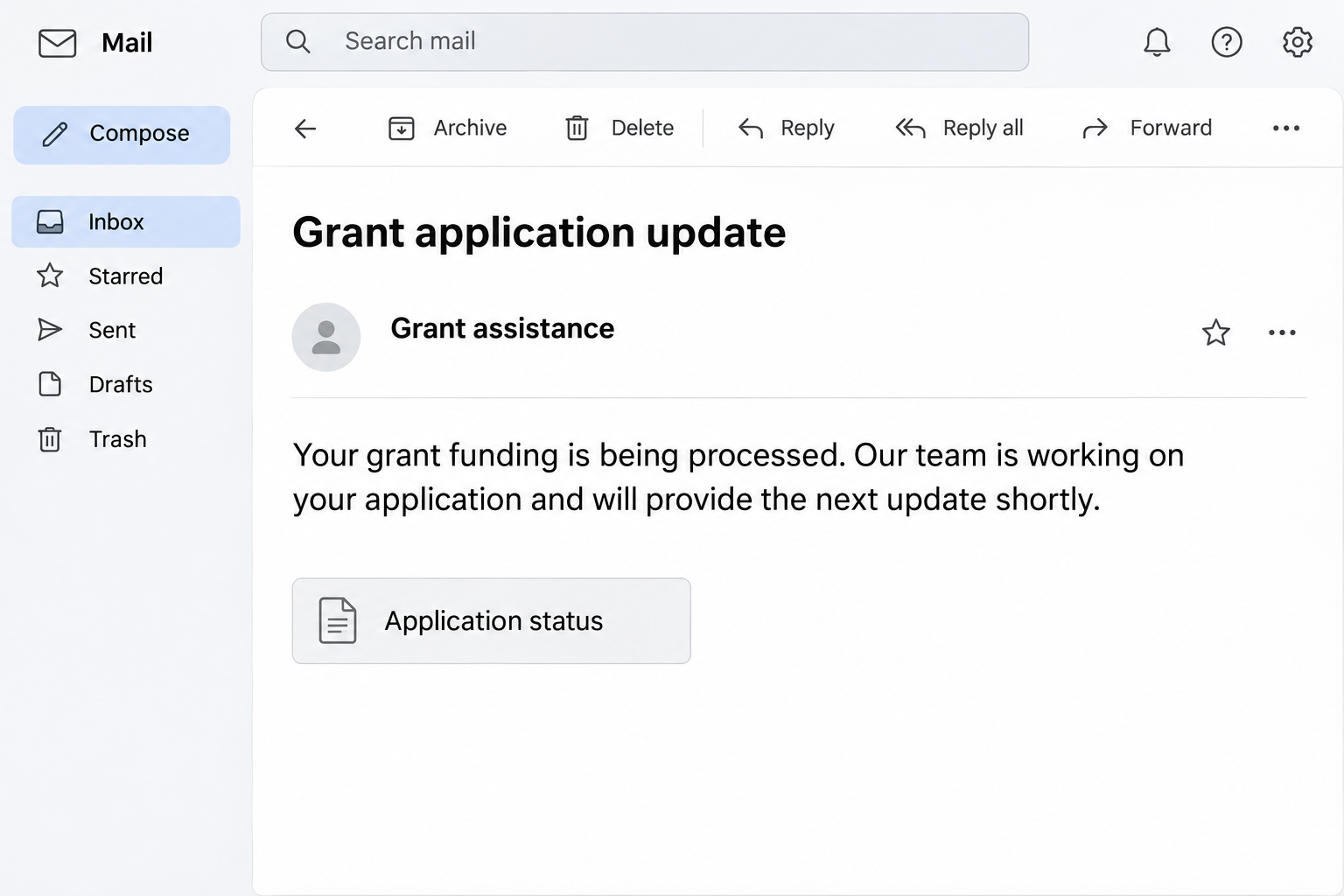
The image reconstructs a grant-service progress message; it is not original Grant Bae correspondence or evidence that any application was actually submitted.
Why the Grant Bae Case Was More Than a Failed Application
Legitimate grant applications can be rejected, and hiring a consultant does not guarantee that the funder will select a particular business for an award.
That ordinary uncertainty was not the basis for Graham’s conviction, which concerned deliberate deception about services that clients paid to receive from the company.
The gap was between the work customers believed was being performed and the absence of the application assistance described in the trial evidence.
An owner therefore does not need to prove that every application should have succeeded before questioning whether the promised service was ever delivered.
Look first for the work product: the funding opportunity, the agreed scope, draft materials and any submission record associated with your own business.
If none can be produced, another reassuring status update does not answer the underlying question of what happened after your payment was collected.
The FTC’s earlier Grant Bae case summary describes false promises of guaranteed funding, followed by civil orders barring grant-writing and business consulting services.
That civil enforcement history is separate from the later criminal verdict, which established Graham’s guilt on the charges considered by the jury.
Neither proceeding means every dissatisfied customer of an unrelated consultant has experienced fraud, nor does either create automatic compensation for every reader.
How the Grant Bae Scam Works
Step 1: A funding need becomes a promise of assistance
The offer targeted business owners seeking government grant funding, presenting Grant Bae as the service that could help obtain that money for clients.
A business facing bills or a difficult trading period may focus on the promised funding before examining how the proposed application work will happen.
The useful starting point is identifying the specific grant and the organization that decides awards, rather than accepting a general promise of available money.
Ask whether your business meets the actual eligibility rules and whether the opportunity is still accepting applications before buying services linked to it.
A consultant’s confidence cannot replace the funding organization’s requirements, and a promise to obtain money should not make those requirements disappear from the discussion.
Step 2: A fee commits the owner to the service
Graham charged clients for assistance and advised them that the company was in the process of obtaining grant money on their behalf.
Once an owner pays, waiting can feel more reasonable than starting again, particularly when the service continues providing explanations that sound like progress.
Before paying anyone for grant assistance, obtain the scope in writing and distinguish research, drafting and submission duties from promises about the eventual award.
The agreement should identify what you receive even if funding is refused, so the service can be assessed independently of the award decision.
Do not assume that an invoice proves an application exists, because a billing record and a funding submission document different parts of the arrangement.
Step 3: Claimed progress replaces evidence of an application
The company told clients that funding was being obtained, while the trial evidence showed the promised grant-writing and grant-locating work had not occurred.
That leaves the customer dependent on the same person who collected the fee to explain what happened to the supposed application and funding.
Ask for records tied to the named program, including the materials prepared for your business and any confirmation issued by the actual funder.
If the program uses a portal, reach it independently and check your business’s own records instead of following an unverified link supplied as proof.
A screenshot or forwarded message should be checked against the organization it claims to represent, especially when it is the only evidence of submission.
Step 4: The money serves the operator instead of the clients
The Justice Department says Graham used the proceeds for personal property and gambling, while clients received none of the grant-writing assistance described at trial.
This finding explains the criminal character of the scheme without requiring a reader to guess which individual purchase came from a particular client’s fee.
For an affected owner, the relevant records remain the payment, the promised service and the evidence showing what assistance was or was not provided.
Keep those records together rather than trying to reconstruct the operator’s personal spending, which investigators can assess through financial records and other evidence.
The absence of a grant award is only one part of the story; the more direct question concerns whether any promised application work existed.
Step 5: Further promises can prolong the owner’s exposure
An owner awaiting funding may be tempted to pay again when another explanation suggests that one remaining task stands between them and the award.
The verdict announcement does not establish every extra fee or renewal, so an unrelated new demand must be evaluated on its own documented terms.
Do not authorize another charge until the real funding organization and your existing service records establish what action is actually required from you.
If the supposed application cannot be identified, stop paying for its progress and ask your payment provider about the transaction already made for assistance.
Preserve new demands with your original agreement, rather than letting another conversation replace the terms and promises associated with the payment you already made.
Who Was Behind Grant Bae?
The brand connected to Graham and C Lee Enterprises
The FTC case identifies C Lee Enterprises LLC doing business as Grant Bae and Grant Bae Consulting and More, with Graham directing the operation.
The criminal announcement names Graham and her co-defendant Joey Williams, who previously pleaded guilty for his role and was awaiting sentencing in that announcement.
These records identify the operation involved, rather than connecting everyone with a similar business name or every consultant offering grant advice to its conduct.
The service needed identifiable application work
A grant-writing service should explain which materials it prepared, which program they concern and what the client was expected to approve before any submission.
The trial findings addressed the absence of that work, making a general claim of ongoing processing an inadequate explanation of the fees clients paid.
An owner should retain the actual draft or submission record, because a consultant’s description alone provides no independent way to assess the service delivered.
The consulting charge was separate from the funding decision
Paying for research or writing help does not give a private consultant control over a government agency’s decision to award money to your business.
The FTC’s grant scam guidance warns against paying to receive supposed government grant money, explaining that genuine grants have specific purposes and application requirements.
Evaluate the exact promise being sold, especially when someone treats the consultant’s fee as the reason funding can be guaranteed or released afterward.
The court outcome did not create a universal refund offer
Graham’s conviction and the civil orders are separate developments, and neither should be confused with an online message offering immediate repayment to every customer.
Do not pay an administrator or recovery service because it uses this case name to claim that your business now qualifies for immediate compensation.
Use verified agency information and your payment records to establish legitimate next steps, rather than accepting a new compensation offer from an unsolicited contact.
Questions That Separate Progress From Reassurance
The following checks focus on records a client can understand, instead of asking a business owner to judge a consultant’s confidence or online popularity.
| Promise or document | What to ask for | Why it helps |
|---|---|---|
| Funding is being obtained | Named program and actual funder | Connects the claim to a verifiable opportunity |
| Application is progressing | Your draft, submission and acknowledgment | Shows whether work exists beyond an update |
| Fee covers grant assistance | Written deliverables and payment terms | Separates the service from the award decision |
| Another payment is necessary | Verified reason from the relevant organization | Tests the demand before increasing the loss |
What to Do if You Have Fallen Victim to This Scam
-
Stop additional payments connected with an application you cannot identify, and preserve the offer, service agreement and updates associated with the amount already paid.
Write down the grant name and claimed funder, marking any details the consultant never supplied so your records distinguish facts from unverified promises.
Do not provide more financial documents to someone claiming another fee or new application will resolve the earlier failure to deliver the promised service.
-
Contact your card issuer, bank or payment service through established support and explain that you paid for grant assistance which was never provided.
Give the payment date, amount and recipient, describe the promised work and ask which dispute or recovery options remain available for that transaction.
Older payments may fall outside ordinary provider deadlines, so ask for the actual position instead of assuming a conviction automatically extends a refund window.
-
Gather invoices, receipts, messages and any supposed application records into a dated timeline showing what was promised before payment and what happened afterward.
Keep original files where possible and retain the exact company or recipient name on each transaction, even when it differs from the advertised brand.
Share private business or banking information only through verified reporting channels, rather than posting full documents publicly while trying to find other affected owners.
-
To report the online deception, visit IC3, select File A Complaint and read the terms before entering the business, promises and payment details.
Review the information before submitting it and keep the confirmation provided, making clear which statements are documented and which details remain unknown to you.
If the online form is unavailable, retain your prepared records and contact the agency through its independently verified website for an appropriate reporting route.
-
If a funder is named in the paperwork, reach it through its own website and ask whether it can verify the application claimed.
Do not use contact information supplied only by the disputed consultant, and avoid resubmitting sensitive information merely because a forwarded message asks for it.
Keep the funder’s response with your evidence, since it can help distinguish a rejected application from one the organization never received for your business.
-
Reject advance-fee recovery offers and promises to unlock compensation, especially when the new contact relies on your earlier loss to justify another payment.
Any legitimate case-related instructions should be verified independently with the relevant agency, without granting an unsolicited contact access to your accounts or business records.
Continue tracking provider responses and reporting references so you can follow up accurately without repeating payments or losing the original history of the service.
Frequently Asked Questions
Was the Grant Bae scam confirmed in criminal court?
Yes, a federal jury convicted Graham on all charges in the 13-count indictment, according to the Justice Department’s October 2026 announcement of the verdict.
That finding concerns proven deception and unperformed assistance, rather than treating an ordinary refusal of grant funding as evidence that a consultant committed fraud.
How many people were affected by the operation?
The verdict announcement describes more than 1,000 victims and approximately $2.9 million taken through the fraudulent grant-service scheme involving Graham.
Those figures describe this particular criminal case and should not be used to estimate losses at other grant-writing businesses or unrelated government programs.
Is every fee for grant-writing help a scam?
No, the critical findings were false promises and the absence of application work clients paid to receive from the operation described during the trial.
A legitimate service still needs clear deliverables, while the separate funding organization retains responsibility for deciding whether a business receives a grant award.
Does a progress email prove an application was submitted?
It shows only that someone sent an update, unless it connects to actual application materials and a record recognized by the relevant funding organization.
Ask for the named opportunity and your own submission evidence, then verify any material claim through a contact route independent of the disputed consultant.
Can I claim an automatic refund because Graham was convicted?
A conviction does not establish a current refund program, a payment-provider decision or an immediate distribution to every person who paid for the service.
Keep your transaction records and follow verified agency instructions, while asking your own payment provider what options remain for the specific amount you paid.
Should I pay another fee to finish the supposed application?
Do not pay again until the actual funder and your records establish a genuine requirement, particularly when the original application work cannot be identified.
If another demand repeats that funding is almost ready, preserve it and focus on stopping further payments while documenting the earlier fee.
The Bottom Line
Do not pay for Grant Bae’s promised funding or an unsolicited offer to revive its application process without verified instructions from a legitimate authority.
Clients paid for grant assistance that never happened, while reassuring claims kept them expecting funding that the service was not obtaining on their behalf.
If you paid, stop additional charges, organize the deliverables and payment records, and ask your provider about available recovery options before reporting the deception.

Join the discussion
0 commentsShare your experience or ask a question about this article.
Community experiences
Did this happen to you?
Your experience could help someone recognize the same scam. Submit a private report for our team to review.
I experienced this tooReports are reviewed before publication. Sharing publicly is always your choice.
Discussion
Start the conversation
Have a question or something useful to share? Add the first comment.