


A recorded voice announces a €4,000 payment through your bank. You haven’t bought anything, and the message offers one button to stop it.
Then comes the unsettling part: hanging up supposedly confirms the payment. Suddenly, the obvious way out feels like the dangerous choice.
Overview
The recording makes ending the call sound expensive
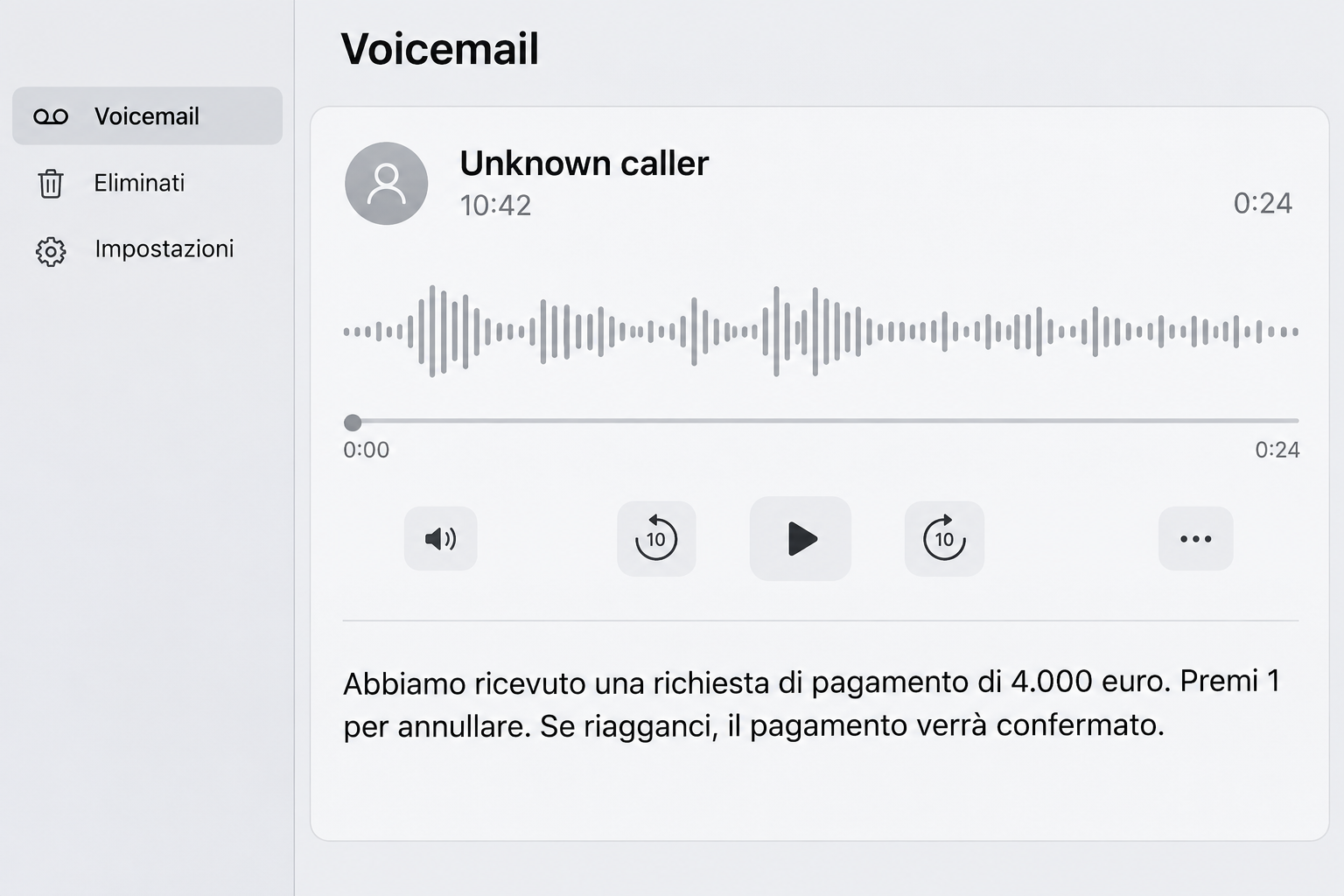
This bank robocall scam begins with an invented payment emergency. Its distinctive threat is that disconnecting will supposedly authorize the transaction you want to stop.
The caller offers a competing instruction: press 1 to cancel. That steers a worried person toward further interaction before they check their actual account.
The amount can vary, as can the bank named. The key detail is the attempt to make you accept the caller’s rules for protecting your money.
A bank warning confirms the cancellation pretext
Raiffeisen’s Italian fraud warnings describe recorded calls demanding that customers press 1 to block a supposed payment.
In that documented campaign, a fake operator then requests sensitive banking information. The bank specifically tells customers to hang up rather than follow the recording.
A separate Italian account described the added threat about hanging up. That recipient disconnected and reported no unusual online-banking activity afterward.
Your response depends on what you actually disclosed
Hearing an alarming recording, pressing a key, revealing a password, and approving a payment are different events. Tell genuine bank staff exactly which happened.
- You only heard the recording: disconnect and check through your bank’s genuine app or established contact channel.
- You pressed 1 without sharing anything: stop the conversation and ignore instructions from the supposed operator.
- You disclosed a password, PIN, or security code: contact the real bank promptly and describe the information exposed.
- You approved an unfamiliar transaction: report it immediately and ask what blocking, recall, or dispute options remain available.
Why the Threat About Hanging Up Is Misleading
A stranger cannot establish your bank’s payment rules simply by reciting them. Their recording is a claim about your account, not reliable access to it.
The trick works because the offered choices sound complete. Either stay and cancel, or leave and pay, with no mention of independently checking the account.
There is another choice: end this contact and reach the institution yourself. That removes the caller’s control over the conversation and the verification route.
Do not interpret a disconnected scam call as consent to the transaction it describes. Equally, do not assume everything is safe without checking genuine banking records.
Actual account fraud could exist separately from a fabricated recording. Your bank can investigate real activity without requiring you to cooperate with an unsolicited caller.
The voicemail image above is an illustrative reconstruction. It depicts the reported threat without presenting a real bank’s recording or a victim’s private call history.
Nothing in the recipient’s account establishes that the caller accessed their balance. Naming the correct bank did not demonstrate control over the account.
A payment far larger than your balance can still sound frightening. You may wonder about an overdraft, credit facility, or a transaction you cannot yet see.
That uncertainty is precisely why verification belongs with the bank. You do not need to solve the caller’s story while the recording is running.
How the Hang-Up-to-Confirm Bank Robocall Scam Works
Step 1: A recorded announcement supplies the emergency
The call arrives with a ready-made explanation: a payment request has supposedly been received and is being processed. The voice borrows the authority of banking automation.
A specific amount makes the announcement feel less generic. It gives your mind something concrete to worry about before you have established who is calling.
Bank names can also make a broad fraud attempt feel personal. Recognizing yours is a reason to verify independently, not a reason to trust the caller.
Caller identification provides no substitute for that check. Raiffeisen also warns about fraudulent calls displaying numbers associated with its banking institutions.
Step 2: The recording turns disconnection into a threat
Ordinary advice says to hang up on suspicious calls. This version anticipates that response and claims hanging up will confirm the payment instead.
The threat places responsibility on you for a transaction you never requested. Pressing a button begins to feel like damage prevention rather than cooperation.
You may also hesitate because doing nothing appears irreversible. The recording offers no time to compare its claim with a statement or trusted notification.
That pressure is part of the deception. An unsolicited recording should not decide when you can stop talking or how you must authenticate a concern.
Step 3: Pressing 1 leads toward the supposed cancellation team
In the Raiffeisen campaign, the button connects the recipient with a false operator. The person presents requests for sensitive information as necessary cancellation checks.
The Italian recipient who described the €4,000 threat never reached that stage. They disconnected, so their account does not establish the operator’s exact script.
Pressing a keypad button should not be confused with automatically surrendering every banking credential. The financial danger depends on what the caller persuades you to do next.
That distinction matters if you already pressed it. You can still end the call before providing secrets or authorizing anything through another channel.
Step 4: The operator recasts sensitive information as protection
A request for an access code can sound reasonable after someone promises to prevent a loss. The caller has supplied both the problem and the supposed solution.
In the documented bank warning, requested information includes PINs, access credentials, and one-time codes. These are sensitive tools for account access or verification.
Read any genuine bank message for yourself. If it describes a login, enrollment, or payment you did not initiate, do not approve it to satisfy the caller.
Do not let the word cancellation override the action shown on your screen. Someone’s spoken explanation cannot change what a banking confirmation actually authorizes.
Step 5: The victim is kept inside the caller’s version of events
The recording’s original threat can continue shaping the conversation. A person worried about confirming a payment may tolerate increasingly intrusive requests rather than disconnect.
Stop when the instructions move beyond independently checking your account. New codes, unfamiliar approvals, or requests to keep talking require verification with the real institution.
You do not have to prove the caller is dishonest before ending contact. Protecting your ability to verify is enough reason to leave the conversation.
Afterward, describe the sequence accurately to the bank. Include what you entered or approved, rather than relying only on the label scam call.
How to Check the Payment Without Following the Caller
Start with a route you already trust. Open the bank’s existing app directly, or use contact details from your physical card or established banking paperwork.
Do not open a fresh link supplied during the call. A convincing page reached through the same stranger would give you another version of their story.
Look at recent activity, pending transactions, and security notices available in the genuine account. Write down anything unfamiliar before contacting the bank’s fraud team.
If no payment appears, explain the call anyway when sensitive information was exposed. A stolen login or new device enrollment may require action before money disappears.
Use the institution’s own process to check whether a genuine fraud alert exists. Banks can have legitimate automated systems, so judge the verified channel and requested action.
Raiffeisen’s warning concerns its own impersonation campaign and stated practices. It should not be stretched into a claim that every automated banking call worldwide is fraudulent.
When you contact support, keep the discussion separate from the suspicious call. Do not accept a warm transfer offered by the person whose identity is disputed.
If the bank is closed, consult its genuine emergency card or fraud instructions. Avoid choosing a replacement support number merely because it appears prominently in search results.
For an older relative, help establish this route before another call arrives. A saved genuine contact is more useful than trying to judge accents or background noise.
What to Do if You Have Fallen Victim to This Scam
-
End the contact and stop following its instructions. Disconnect even if the recording or operator insists that leaving will confirm the alleged payment.
Do not call the displayed number back to argue. Keep any voicemail and record the approximate call time without returning to the caller’s instructions.
-
Contact the real bank through an independently trusted route. Explain that someone used a cancellation story to obtain information or direct an action.
Tell staff whether you merely pressed a key, revealed a code, approved a notification, or moved money. Those details determine which safeguards need attention.
Ask for a case reference and the next action required from you. Record the time and channel of this genuine contact for later follow-up.
-
Protect exposed access without returning to the caller. If you revealed banking credentials, follow the bank’s recovery instructions from a trusted device.
Ask staff to review unknown devices, sessions, changed contact details, and unfamiliar payment recipients. Do not assume replacing one password reverses every account change.
Change reused passwords on other affected services separately. Keep replacement secrets and verification codes out of further calls, messages, or recovery offers.
-
Identify each transaction that needs investigation. Give the bank its date, amount, destination, and whether you approved anything while following the caller.
Request the appropriate fraud report, transfer recall, or payment-dispute process. Availability and outcomes depend on the transaction and applicable rules, so a refund cannot be promised.
If a payment is still pending, report that status immediately. Do not wait for the caller’s promised cancellation confirmation before contacting the institution.
-
Preserve the useful evidence while protecting private information. Keep the voicemail, call log, relevant bank notifications, transaction references, and any messages sent afterward.
Write a short timeline while the conversation is fresh. Include the threat about hanging up, because it explains why you continued interacting.
Share sensitive banking records only through verified institutional or police channels. Public posts should conceal account identifiers, security codes, addresses, and other personal information.
-
Match device checks to what actually happened. Hearing a recording or pressing 1 does not by itself establish that malware was installed.
If the caller also induced a software installation or remote-control session, tell the bank and seek device-specific cleanup advice before using that device for banking.
For a managed work device, contact the administrator before removing software or resetting anything. Evidence and organizational access may need preservation first.
-
Keep follow-up inside the genuine recovery process. Report the incident through the police or cybercrime reporting channel appropriate to your location.
Reject unsolicited offers to recover money for an upfront payment. A second caller knowing about the first incident does not establish any authority.
Check later statements and bank correspondence for unresolved activity. Use your existing case reference when following up instead of starting over with an unknown contact.
Helping Someone Who Is Afraid to Hang Up
MalwareTips’ broader press-1 robocall guide explains the general pattern. Here, a frightened recipient may need immediate help leaving the supposed cancellation process.
Explain calmly that you can check the account together through the real bank. Avoid turning the moment into an argument about why they answered.
If someone is still following instructions, ask them to stop entering information. Use a separate trusted device to locate the genuine fraud contact.
Let them describe what happened in their own words before organizing the timeline. Embarrassment can otherwise hide the detail the bank most needs to know.
Do not take over their banking credentials or ask them to read security codes aloud. Help them reach authorized support while keeping control of their account.
After the incident, write down the genuine contact route somewhere accessible. A clear plan is easier to follow than improvised decisions during another alarming call.
Frequently Asked Questions
Will hanging up actually confirm the €4,000 payment?
The scam recording’s claim does not establish a genuine authorization. End the contact and ask your real bank to verify any actual transaction.
What if I already pressed 1?
End the conversation and identify what happened afterward. Pressing the key is different from revealing credentials, sharing a security code, or approving a payment.
How did the caller know which bank I use?
The available account does not explain how the bank name was chosen. A correct name alone does not prove account access or authenticate the caller.
Should I trust the number displayed on my screen?
Verify through independently established bank contact details instead. The bank’s warnings include fraudulent callers displaying numbers associated with its institutions.
Does answering this robocall mean my phone has malware?
Answering alone does not establish an infection. Software installation, granted access, exposed credentials, and financial approvals require their own checks and appropriate responses.
Can my bank recover money already transferred?
Report the transfer immediately and request the relevant investigation or recall process. Recovery depends on the circumstances, and nobody can guarantee a refund.
The Bottom Line
Do not reveal banking secrets because a recording threatens to confirm a payment when you hang up. End the bank robocall and verify through your established, genuine banking channel.
If you already shared information or approved anything, contact the real bank immediately. Give a precise account of your actions so staff can protect the right access.

Join the discussion
0 commentsShare your experience or ask a question about this article.
Community experiences
Did this happen to you?
Your experience could help someone recognize the same scam. Submit a private report for our team to review.
I experienced this tooReports are reviewed before publication. Sharing publicly is always your choice.
Discussion
Start the conversation
Have a question or something useful to share? Add the first comment.