


Your phone displays a federal office’s number. The caller gives an agent’s name, and the next conversation appears to take place inside an official office.
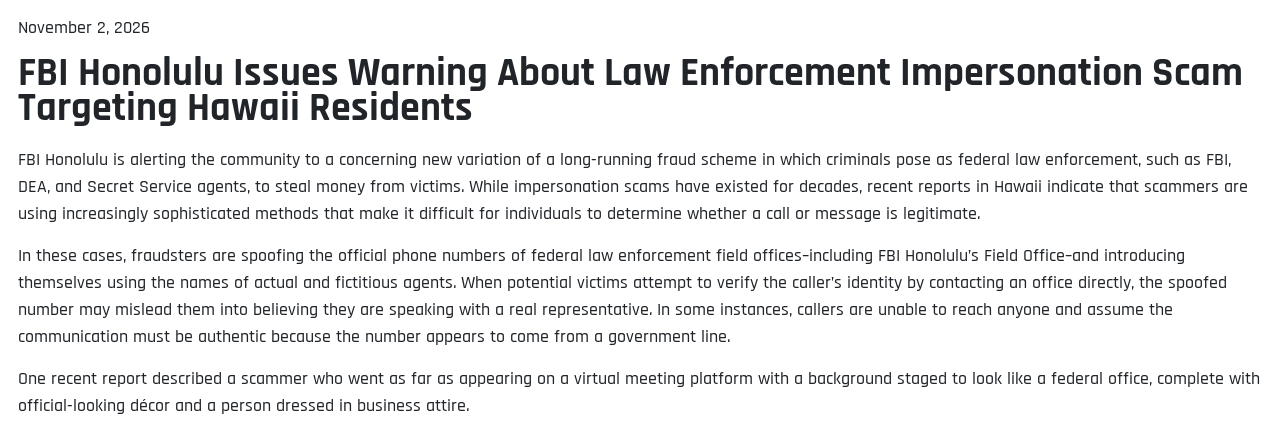
The Hawaii FBI impersonation scam warning describes one such video call. The November alert explains why neither the number nor the room settles who is calling.
Overview
The number can be real while the caller is not
FBI Honolulu says callers impersonating federal agents displayed numbers belonging to field offices, including its own. They introduced themselves using both genuine and invented agent names.
The number printed on your screen is not enough to identify who is speaking. A name that belongs to a real employee is not enough either.
- The Hawaii alert describes the use of genuine field-office numbers as false caller identification.
- One report described a video background arranged to look like a federal office.
- Verification should begin with an agency number you find independently, after ending the original contact.
What the reported video call proves
The November 2 FBI Honolulu warning describes a businesslike appearance and official-looking decor. It does not establish that this particular video used a deepfake or automated voice.
The person on video might be real while the job, office and story are false. More realistic visuals do not change how you should verify the contact.
What to do before sending anything
End the call and look up the agency using an official source. If nobody answers, that is not confirmation and does not make the initial demand valid.
Do not move money, give personal information or join another meeting while you are waiting. The caller cannot verify themselves by repeating their original story.
How the Hawaii FBI Impersonation Scam Builds Credibility
Step 1: Start with the agency’s apparent number
A number matching the local FBI office can feel more reliable than an unfamiliar number. The Honolulu bulletin says the displayed office numbers were spoofed.
Pay attention to the distinction between a listed number and an incoming call displaying it. Looking up the number can confirm the listing, but not the caller.
Do not use the recent call entry as the basis for verification. Look up an agency contact yourself and place a fresh call once the conversation has ended.
If the line is unanswered or unavailable, wait for a way to verify independently. An unanswered call tells you nothing about the earlier caller’s affiliation.
Step 2: Supply an agent’s name or credentials
The warning says the people behind these calls used names of actual agents as well as invented names. A legitimate name can be part of a false introduction.
Write down the name and any claimed office or case number. Use the information when you speak to the agency you called yourself, not as proof on its own.
If a caller sends a badge photo or document, you do not need to decide whether it looks convincing. Ask the actual office about the claimed contact.
Do not confirm your full address, identity number or date of birth to help the stranger “find” your case. Verify the caller through the agency first.
Step 3: Move the conversation to video
A virtual meeting changes what you see but not who invited you. The Hawaii report describes a setting made to look like an official office.
The FBI announcement reports one such example. It does not say every impersonation call used video, and it does not identify the person in the reported meeting.
The practical clue is not a blurry face, awkward lighting or a particular background. It is the absence of confirmation through an official route you started.
Leave the meeting if you are already in it. Use any invitation details you still have to report the event rather than rejoining for more proof.
Step 4: Use the claimed authority to demand action
In the FBI’s broader reporting, callers have used accusations or supposed legal consequences to pressure people into payments. That context is separate from the specific Hawaii video report.
Demands for a wire, gift cards, cryptocurrency or a cash courier are not a way to verify or resolve charges over an unexpected phone call.
Do not transfer funds to “protect” them and do not hand cash to someone the caller sends. Confirm any claim directly with the actual agency first.
If somebody orders you not to speak with family or your bank, end the call. Get independent help instead of treating secrecy as proof of an investigation.
What the FBI Data Says and What It Does Not Say
The FBI’s separate September 2026 national advisory records nearly 61,000 complaints about government or law enforcement impersonation between January 2025 and July 2026.
The reported losses exceeded $1.6 billion for that broad category and period. That is not a Hawaii estimate or a loss total for staged video calls.
The national advisory discusses fake legal threats, payment demands and impersonation on video. It also notes that artificial intelligence can be used in some cases.
None of that proves how the backdrop in the specific Hawaii call was created. The local alert describes what the caller showed, not how they made it.
Take the same first action whether the picture is edited or the room physically staged. Stop taking instructions from the caller and verify the contact independently.
How to Ask the Actual Agency About the Call
Use a known official website to locate the office rather than clicking a link in the message. Check the actual agency domain before using its information.
Start the conversation by saying someone claimed to represent the agency and you want to verify that contact. Give the claimed name and case reference if requested.
Ask whether a specific person or department is trying to reach you. A legitimate office number on a website is an entry point, not proof about the first call.
Do not demand that the person who answers disclose protected details. Ask how the agency wants you to confirm the contact and what information it actually needs.
If another office is responsible, use official public information to find it. Do not switch back to the phone number, social account or video link the caller provided.
If an official channel cannot confirm contact immediately, do not send a payment to keep the caller waiting. Leave the original conversation closed and follow independent instructions.
If the threat is about a court appearance, verify that issue with the actual court through a known channel. Do not let the caller arrange the verification.
Keep verification independent even if the caller offers a transfer
A transfer during the same call is not a fresh contact. The first caller can still control who you speak with next and what you are told.
If a second person claims to be a supervisor, ask the agency separately whether it knows about the contact. Two voices do not mean two independent sources.
Apply the same test to emails and meeting invitations. A document sent by the person who made the claim does not independently verify that claim.
Do not let a deadline turn a contact check into a payment decision. An actual issue can be taken up through the agency after you end the call.
If the caller asks you to show something on camera
Keep your identity documents and payment records out of the camera’s view. Do not share your screen to prove a balance or show an account.
If your address or employer is mentioned in the meeting, don’t supply missing details. An impostor can know facts about you without having authority to ask for more.
If a caller contacts you at work, use your organization’s security process as a separate channel. Do not forward the original meeting invitation to coworkers as a warning.
For a household member who depends on you for assistance, agree who will handle calls like this. A trusted second person can interrupt the pressure to act immediately.
What to Do After the Hawaii FBI Impersonation Call
-
End the call or meeting and stop answering the stranger’s messages. Do not rejoin the meeting just to record better evidence or confront the person.
-
Call your bank or payment provider immediately if money moved or financial details were disclosed. Ask what can be stopped and which accounts need attention now.
-
Save existing messages, the number displayed, the claimed name and the time. Mark the displayed number as caller ID, not as a verified number belonging to the caller.
-
Keep references for transfers or gift cards if any were sent. Do not send evidence containing passwords or codes to a person who contacted you unexpectedly.
-
Report the contact through the official FBI Internet Crime Complaint Center and local law enforcement as appropriate. Use a fresh browser tab, not a reporting link from the caller.
-
Tell the genuine agency if you have evidence of the staged video. Submit existing screenshots or meeting details through the reporting channels named in the Honolulu alert.
If you gave personal information but did not pay
List what you disclosed before choosing a response. A first name, a financial account number and an identity document do not create the same exposure.
If you gave banking credentials or approved a code, contact the financial institution immediately. Report the exact type of information without sending the code again.
If you shared an identity document, tell the organization that issued it and ask about steps appropriate to that document. Use genuine government identity recovery guidance.
If you did not send money or information, report the attempt without describing it as a completed theft. The details are still useful for identifying the impersonation.
If somebody in the household is still on the call
Tell them they can end the conversation and verify it independently. Do not ask them to argue with someone who has already made a frightening accusation.
Help them locate a number from an official site. Make the call together if it helps, but leave the stranger out of that conversation entirely.
Use plain descriptions when recording what happened. Saying “the person asked for a transfer” is more useful than asserting that the agency called when that isn’t verified.
Help the bank and investigators distinguish what happened
Start with the amount and method requested, then state whether anything was actually sent. A demand for payment and a completed transfer belong in separate parts of the report.
If a transaction is pending, tell the payment provider that when you first contact it. Do not wait for a police case number to request help.
Keep the bank’s case reference somewhere safe. If someone calls back claiming that your callback proved the first call was genuine, do not reopen the original conversation.
Use the genuine reporting route for sensitive evidence. Posting an unredacted screenshot publicly can share your information again without helping you verify the supposed agent.
Preserve any visible names from a video meeting, but describe them as entered display names. Do not assume that a participant’s account name identifies the person on camera.
What to do if the same person calls again
Do not provide updates about your bank, police report or identity checks. Use your existing official channels to add the new contact to the record.
If a message promises to refund money for a new fee, report that message separately. A recovery pitch does not become credible because it references your first loss.
Tell family members what to watch for in a second contact. Leave out the clickable link and stress that they should not pay to verify a claim.
Frequently Asked Questions
Can a scam call display FBI Honolulu’s genuine number?
The FBI Honolulu alert says numbers of actual federal offices were spoofed. Use a number sourced independently to check whether the office is trying to contact you.
Did the person in the reported video use a deepfake?
The Honolulu alert describes a staged office background but does not establish that the video used a deepfake. A convincing room is not evidence of federal employment.
What if the agent’s name is real?
A real name can be copied. Use it as information to give the official office you contact yourself, not as a reason to trust the call.
Should I send money to clear an investigation?
Do not send money because someone claiming to be a federal agent demands it on a call. End contact and verify the alleged issue independently.
What if there is no answer when I call to verify?
No answer does not verify anything. Wait until you can reach an official route and make no payment or further disclosure to the original caller.
How much money was lost in the reported Hawaii video case?
The Honolulu release does not give a loss figure for that incident. National fraud totals describe many reports, not the outcome of the particular video call.
The Bottom Line
The Hawaii FBI impersonation scam alert describes a real field-office number used as false caller identification and a convincing background. Neither gives a stranger authority over your money.
End the call, find the actual agency and verify the contact on your own. If anything was paid or disclosed, contact the bank promptly and keep your evidence.

Join the discussion
0 commentsShare your experience or ask a question about this article.
Community experiences
Did this happen to you?
Your experience could help someone recognize the same scam. Submit a private report for our team to review.
I experienced this tooReports are reviewed before publication. Sharing publicly is always your choice.
Discussion
Start the conversation
Have a question or something useful to share? Add the first comment.