


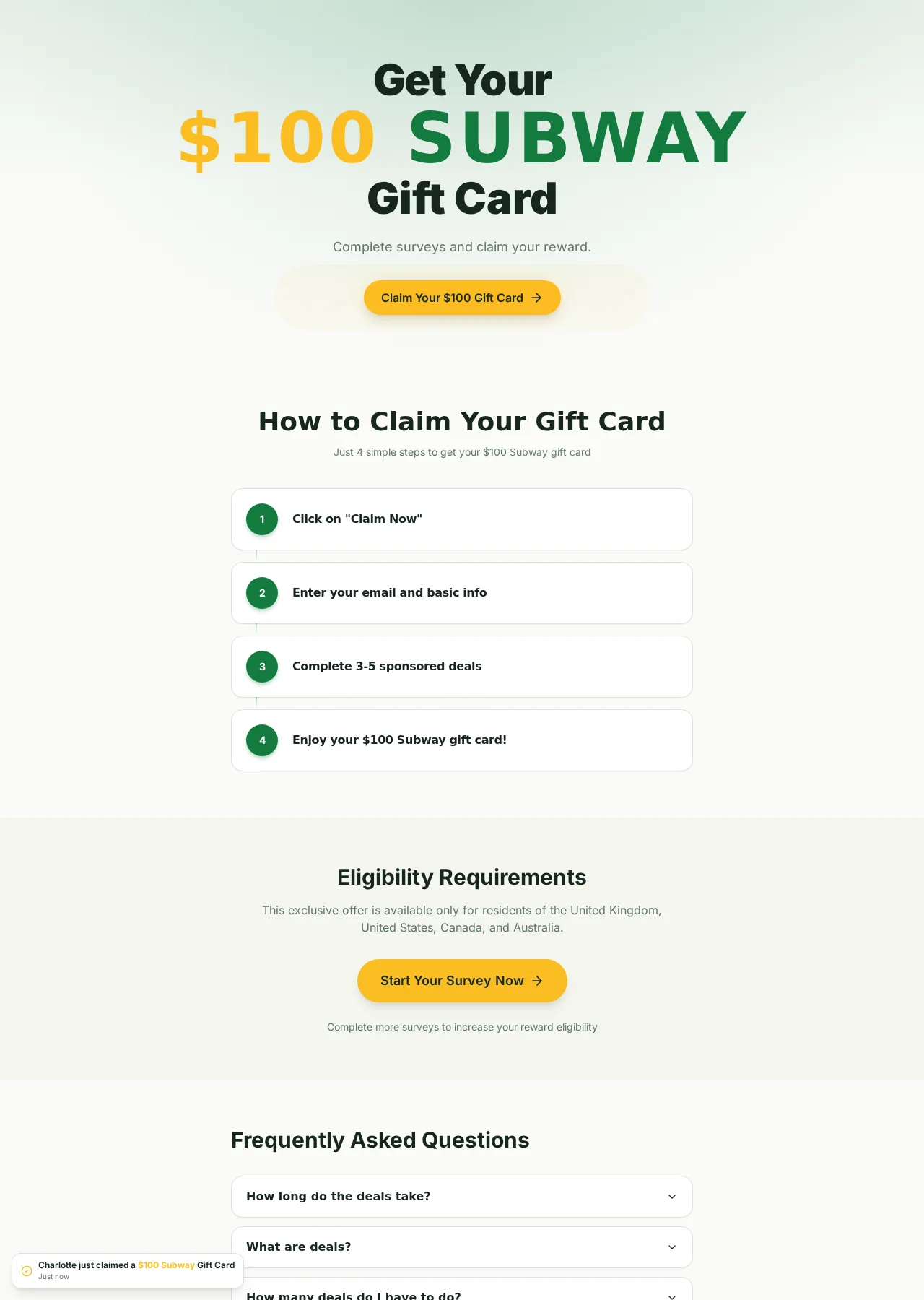
Subdeal.online offers a $100 Subway gift card for a handful of tasks. A little notification announces that somebody else has just claimed theirs.
It looks like a reassuring glimpse of another customer’s success. That detail deserves a closer look before you follow the button or hand over your information.
Overview
A restaurant gift card sits at the end of sponsored tasks
The offer begins with surveys, then describes completing sponsored deals. It lists trials, downloads, surveys, and registrations as examples of what those deals might involve.
Those are not interchangeable commitments. Answering a question, installing software, and enrolling with another business can carry very different requirements and consequences.
The success notification is not a customer payout record
Subdeal’s notification selects a first name from a fixed list. Its code repeats the claim announcement without checking whether anybody received a card.
That manufactured social proof is the confirmed deception. It presents a scripted success story as a fresh event, making the reward appear independently validated.
The landing page cannot guarantee the result
The buttons lead through affiliate tracking rather than Subway’s own gift-card pages. The accessible promotion does not clearly identify the business responsible for its advertised reward.
- Do not treat the popup as a verified customer testimonial.
- A partner registration can create obligations separate from any reward claim.
- Eligibility in a country does not explain which regional gift card would be issued.
- Do not purchase more offers simply to rescue time already spent pursuing this promotion.
The Popup That Gives Subdeal Away
The notification chooses from ten stored names, including James, Sophie, Oliver, and Emily. The name changes roughly every five seconds.
Its message says the selected person has just claimed a $100 Subway gift card. A second line reinforces the impression that it happened moments ago.
But the routine obtains its name using a random selection. It does not consult a completed-claim record before presenting the announcement.
This is more than an attractive design or an unverifiable rating. The supplied code explains how the supposed success story is manufactured.
A visitor can mistake that little message for evidence that the requirements work. In reality, the notification supplies no information about qualification, verification, or delivery.
Its position also matters: the message follows you while the page describes the offer. It lends apparent reassurance at the moment you are deciding whether to proceed.
Ignore that reassurance. A website’s ability to display a plausible first name does not turn a reward promise into a completed transaction.
How the Subdeal.online Gift Card Scam Is Presented
Step 1: The headline makes the card feel like the starting point
The large Subway-themed heading emphasizes the amount. The qualification details appear farther down, after the visitor has already seen the invitation to claim.
That ordering encourages you to think about spending the card before understanding the work, permissions, or purchases that a separate offer might require.
No gift card has been issued merely because a page displays its value. A claim button is an invitation into another process, not a stored balance.
Step 2: Invented recent claimants supply apparent confirmation
The popup suggests that someone has already navigated the process successfully. It makes the offer feel less uncertain without providing a verifiable transaction.
The script’s fixed-name routine is the reason to reject that suggestion. It is not a live feed of recipients whose cards were checked.
Step 3: A survey becomes several sponsored deals
The page’s checklist calls for three to five sponsored deals, while another line encourages more surveys to improve eligibility. Its FAQ adds the other possible activities.
Before following such instructions, you would need a precise definition of completion. Opening an advertiser’s page is not necessarily the same as meeting that advertiser’s conditions.
A trial can have a cancellation deadline; a download can require permissions; a registration can authorize marketing. These are possible commitments, not outcomes demonstrated for every Subdeal visitor.
Step 4: The button passes the visitor to outside tracking
The visible buttons use linkthem.net, with an offer identifier and an affiliate identifier. That address is not Subway’s published card-purchase or balance-check route.
A public request reached a related tracking address but returned no readable offer content. It did not reveal a qualifying-deals agreement, payment form, or reward account.
That limited result is not evidence that every visitor sees a blank page. It means the downstream obligations cannot responsibly be filled in from the landing-page slogan.
The Missing Details Behind the Delivery Promise
Subdeal says a verified reward will arrive by email within 24 to 48 hours. The important missing question is what starts that clock.
Completing your last task, submitting a claim, and receiving verification are different events. A delivery promise tied to verification needs a clear verification procedure.
Who decides whether a deal counted? How is a failed tracking event challenged? Is there a claim deadline? Where does the participant obtain written support?
The accessible offer does not resolve those questions through a clearly identified reward administrator. An optimistic timeline cannot stand in for a workable agreement.
This is why another deal is not a sensible response to uncertainty. Adding commitments without knowing which requirement remains unmet can increase your costs without improving your position.
No account, paid enrollment, or redemption was tested. The warning concerns the fabricated success announcements and opaque offer, not a claim that every incentive program withholds every reward.
Four Different Responsibilities Behind One Claim Button
The publisher displaying the promotion
Subdeal.online controls the message you can see, including its success notification. The accessible landing page does not clearly name a legal promoter with an address and claim-contact procedure.
That absence matters when somebody must explain the promise. A domain name and a restaurant brand in large lettering are not equivalent to an accountable business identity.
The administrator expected to approve the reward
A conditional rewards program needs someone to verify completion and deliver the incentive. That role should be explained before a participant starts accepting unrelated offers.
The tracking fields do not supply those missing terms. An affiliate identifier can attribute traffic, but it cannot establish who legally owes you a card.
A merchant accepting a separate enrollment
If you subscribe to a service after clicking through, its receipt should identify that transaction. Its cancellation rules can apply even while a reward claim remains unresolved.
The merchant accepting a purchase and the party promising a bonus may be different. When unwinding an enrollment, contact the business that actually accepted it.
The issuer of a genuine Subway gift card
Subway’s US and Canadian card terms identify separate issuing entities and explain card usage. Those published terms do not authenticate Subdeal’s promotion.
A restaurant cashier cannot determine whether an outside advertiser owes you an incentive. Keep an unissued promotional reward separate from a genuine card already supplied.
Four Countries, but Which Gift Card?
The eligibility section names the United Kingdom, United States, Canada, and Australia. That list does not explain the currency, issuing region, or acceptance rules of the promised card.
A familiar restaurant name does not make every gift card interchangeable internationally. Before valuing an incentive, you need to know where that exact card can be used.
The official US and Canadian terms describe use at participating restaurants in those markets and explain how loaded currency is handled. They are not worldwide acceptance guarantees.
Do not assume a $100 headline means a particular local currency or a card usable in your nearest restaurant. The promotion should state those details explicitly.
Subway’s own gift-card page provides purchase, reload, and balance-check links. Reach those services independently rather than trusting a link inside a reward message.
Be especially careful with an existing card number and PIN. Entering them on an unrelated promotion does not verify your eligibility for another card.
What If a Later Message Includes a Voucher?
Examine what it actually provides. A discount code requiring another purchase is different from a gift card with a usable prepaid balance.
Read any minimum-spend requirement, participating-location restriction, or condition attached to the code. Do not value a conditional discount as though it were cash already available.
For a genuine Subway card, open the retailer’s card page yourself and follow its published balance-check instructions. Do not use an unfamiliar checker supplied by a reward message.
Keep the delivery email and card details private. A legitimate balance inquiry does not require publishing the number and PIN in a social-media comment or public support thread.
A card successfully delivered in one case would establish that particular delivery. It would not turn Subdeal’s automatically generated announcements into genuine customer records.
If the supplied item is invalid or different from what was promised, save both versions of the offer. Describe that specific mismatch when seeking assistance.
If You Started the Deals, Separate Them Now
Make a short inventory before taking another step. List each website you reached, what you submitted, what you agreed to, and any confirmation you received.
This prevents two different mistakes: overlooking a real renewal, and assuming a mailing-list signup created a paid subscription when it did not.
A browser-history entry can help reconstruct the route, but a receipt or enrollment confirmation is stronger evidence of a transaction. Save those documents somewhere you can retrieve them.
For each actual purchase, identify the full amount and whether another charge is scheduled. Do not rely on the advertised gift-card value to offset an uncertain commitment.
If you completed a free survey without buying anything, focus on the information shared and any permissions granted. There is no payment dispute to invent.
If you paid, explain the problem accurately to the merchant. Ask about cancellation or a refund without treating an outside promotion’s promise as that merchant’s guarantee.
What to Do After Responding to Subdeal.online
- Stop adding new commitments. Leave the sponsored-deal sequence rather than buying another offer because you hope it will make previous effort worthwhile.
- Preserve the actual offer. Save the page address, the success popup, the advertised qualification steps, and any message that sent you there.
- Review each enrollment confirmation. Identify the merchant, start date, trial end, renewal amount, and cancellation instructions. Keep paid services separate from ordinary marketing registrations.
- Cancel services you do not want. Use the relevant merchant’s established account or support channel. Save its response and verify which future charge the cancellation stops.
- Raise disputed payments quickly. Contact the issuer through its banking app or card-back number. Distinguish an unauthorized charge from a purchase whose advertising or cancellation you dispute.
- Protect credentials you exposed. Replace passwords entered on an untrusted page, including matching passwords elsewhere. Review account sessions and enable an additional authentication factor where available.
- Limit unwanted contact. Treat unexpected reward-update messages cautiously. Do not provide bank details, identity documents, or an existing gift-card PIN to release the advertised incentive.
- Report what you can document. Describe the scripted claimed-card notification and the actual route. Include receipts or cancellation problems only if they occurred.
US readers can report deceptive promotions at ReportFraud.ftc.gov. Canadian readers can find reporting instructions through the Canadian Anti-Fraud Centre.
Australian readers can report suspicious contact to Scamwatch. A report helps document the activity; it does not itself cancel a contract or reverse a payment.
In England, Wales, or Northern Ireland, Report Fraud separates suspicious-contact reports from reports of actual fraud or cybercrime. Choose the route matching what occurred.
For fraud in Scotland, the service directs readers to Police Scotland. Reporting a suspicious page does not require completing its offers first.
Someone who only opened the promotion does not need to replace every password or bank card. Match protective steps to information actually disclosed and transactions actually made.
If you gave a stranger remote access or installed unfamiliar software, handle that as a separate security incident. Do not accept more unsolicited assistance from the reward contact.
Never pay a recovery agent who promises to deliver the card or recover your spending for an advance fee. Keep communication with established merchants and your payment provider.
Frequently Asked Questions
Is Subdeal.online’s Subway gift-card offer trustworthy?
No. Its apparent recent-claim notifications are produced from a fixed list of names, while the visible offer leaves important qualification and accountability questions unanswered.
Did the people in the popup really claim cards?
The popup provides no verified recipient record. Its code chooses a name and repeats the announcement independently of a completed reward transaction.
Are sponsored deals always fraudulent?
No. Conditional incentives can exist, but they need honest advertising and clear terms. They do not justify manufacturing announcements about other people’s supposed success.
Will the card arrive within 24 to 48 hours?
That is the site’s stated promise after verification, not a demonstrated delivery result. The accessible promotion does not establish a dependable claim procedure.
Is the $100 card usable in every listed country?
The page does not clearly identify the card’s issuing region or currency. Country eligibility alone cannot establish international acceptance or the value you would receive.
Should I finish more deals if I already started?
Do not add further enrollments chasing this offer. Review existing confirmations, cancel unwanted renewals, and address any real charge with the relevant merchant or issuer.
The Bottom Line
Skip Subdeal.online’s gift-card promotion. Its claimed-recipient popup is manufactured, not evidence that people are receiving the advertised reward through a reliable, clearly explained process.
If you responded, separate actual enrollments from the promised incentive. Stop unnecessary renewals, protect disclosed information, and preserve any genuine payment dispute. Another deal is not the solution.

Join the discussion
0 commentsShare your experience or ask a question about this article.
Discussion
Start the conversation
Have a question or something useful to share? Add the first comment.