


A post says Jonathan, the famously long-lived tortoise on St Helena, has died. It appears to come from someone who would know, and the tributes start arriving.
Among the condolences is a request involving cryptocurrency. Before sending anything, it helps to understand who really announced the news and who asked for money.
Overview
A real tortoise and a real veterinarian, but a false account
The April 2026 rumor centered on Jonathan, a giant tortoise who lives at Plantation House on St Helena. His remarkable age had made him known far beyond the island.
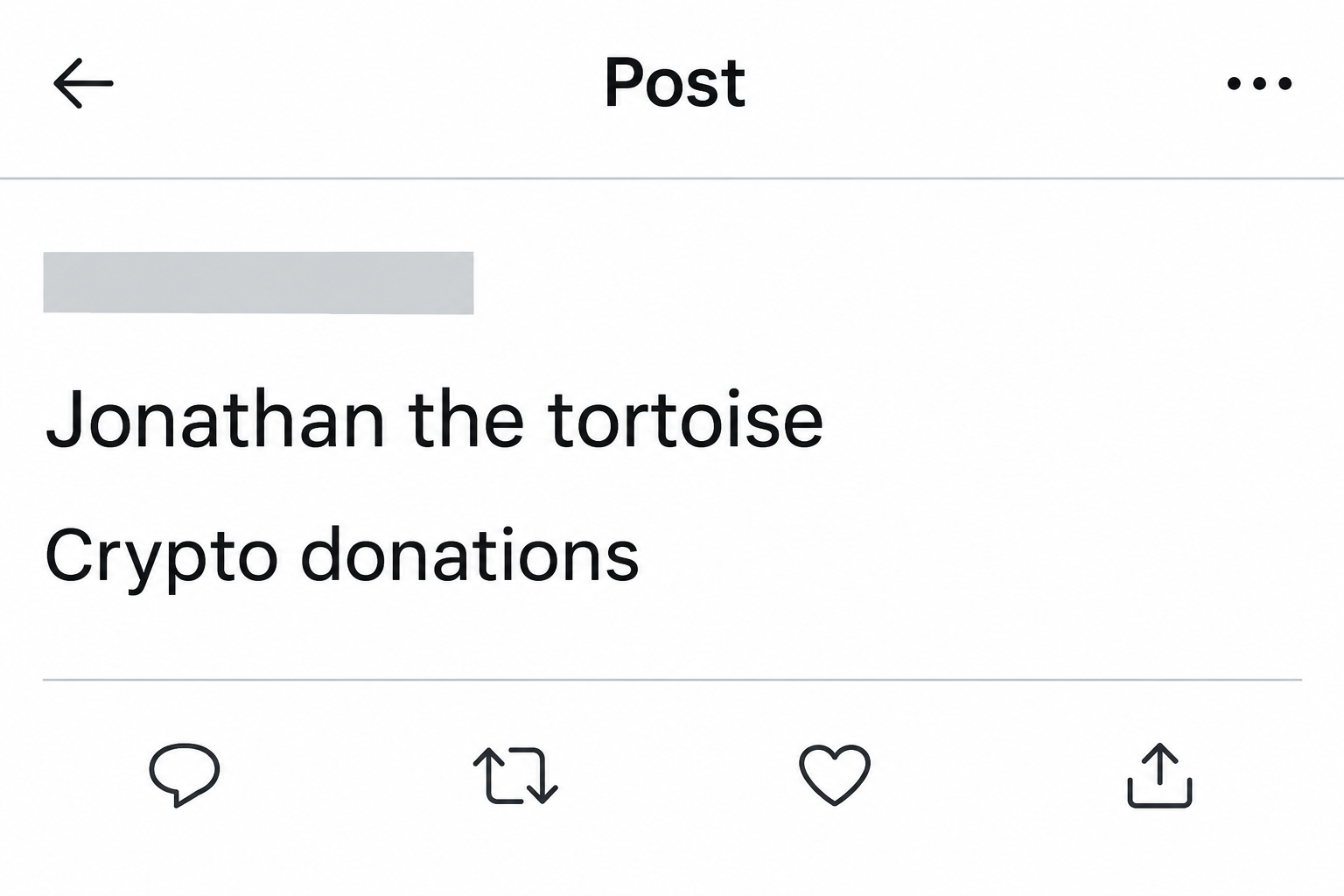
The Guardian found that an account on X was impersonating Joe Hollins, the veterinarian who had cared for Jonathan. The account was also asking for cryptocurrency donations.
Hollins told the Guardian the report was false and that the X account was not his. An account using his name wasn’t speaking for him or Jonathan’s keepers.
The St Helena Government’s dated statement confirmed that Jonathan was alive on April 2. It pointed readers to its own channels for reliable information.
The false announcement drove attention toward a payment request
People seeing the story didn’t just get the wrong news. They could also be directed toward a cryptocurrency payment that no genuine authority had requested in that post.
Some news outlets repeated the death claim before it was corrected. The fact that a headline appeared elsewhere didn’t establish that anyone had verified the payment appeal.
This is why it helps to evaluate a story and a donation separately. Even real news can be paired with an unrelated demand for money.
The reporting identifies an impostor and a solicitation. It doesn’t show how much money, if any, went to the person making that request.
Three questions before you share or donate
- Who confirmed the event independently of the social account that first posted it?
- Did an official channel announce a fundraiser, or is the payment tied only to a post?
- Does the person asking for funds represent an organization you can reach through a route you chose?
If you can’t answer those questions, you can still acknowledge the sentiment without sending money. A quick payment is not the only way to be kind.
How the Jonathan the Tortoise Crypto Scam Works
Step 1: An account borrows the authority of someone close to the story
A veterinarian who worked with Jonathan sounds like a plausible person to share personal news about him. Recognizing the name can make a reader skip checking the account.
A profile and its biography are claims, not proof of who is behind the keyboard. Someone can enter a real person’s name without having that person’s consent.
Take the same care even if an account has a long-looking history or many reactions. Neither is the route through which the government or the keeper confirmed the news.
For a story about somebody else’s animal or organization, check the people responsible for it. An outside observer may be honest but may not know what happened.
Step 2: An emotional announcement travels further than its source
A post about an unusually old animal can reach people who never followed the original account. They may see a screenshot or headline without knowing where it came from.
A large number of reactions shows that many people saw it, not that they had separate evidence. Copies can make one claim feel like several confirmations.
In Jonathan’s case, the government’s correction came from the people responsible for his care. Guinness World Records also checked the story with an island spokesperson.
Look at publication dates when a correction and the earlier claim appear together. A popular older screenshot doesn’t override what the responsible source said afterward.
Step 3: The attention turns into a request for cryptocurrency
Someone who wants to remember an animal may not think to check who would receive a donation. The emotional reason to help can feel clearer than the recipient’s identity.
A wallet address by itself tells you where the assets would go on a network. It doesn’t tell you who controls them or whether the spending would benefit a cause.
Don’t rely on a second social comment that repeats the payment details. It may merely repeat the same unverified request that prompted you to look.
If a charity you already support is mentioned, visit its own website independently. Look for the campaign there or ask it through a verified contact.
Step 4: Later posts can borrow the story without running the same scam
In a separate April warning, officials described a possible scheme involving a meme coin that used Jonathan’s name. The government and tourism authority said they did not endorse it.
A meme coin purchase is not a donation. It trades one asset for another, usually without giving the buyer a claim on a charitable project.
The later warning did not establish that the token came from the same people as the death hoax. Keep each payment request attached to the evidence you have.
A new account may revive the same story when people have forgotten the correction. Check which date and account it refers to before sharing or replying.
How to Check an Online Memorial Request
Verify the news with whoever is responsible for the subject
Go to an established government, institution, or confirmed representative rather than following a link attached to a payment demand. Look for an update dated around the claimed event.
If all the articles point back to the same social post, that isn’t independent confirmation. Look for an original statement or direct contact with a named authority.
An official channel has a history you can check outside the post that led you there. A domain that merely resembles the government’s name doesn’t get that status.
Avoid sending a link to a fake announcement when warning others. Mention the false claim in plain words and point people directly to the authentic correction.
Verify the fundraiser even after confirming the event
A genuine announcement may never ask for money. If someone starts a campaign, identify the organizer and the beneficiary rather than treating the two as interchangeable.
Check whether the intended recipient has publicly confirmed the fundraiser. A private message from the person who asked you to pay doesn’t independently confirm it.
If the organization accepts donations, use the donation option it publishes itself. That is safer than relying on a wallet shown in an image or pasted into replies.
The FTC’s crypto donation guidance also says to verify the recipient and warns that crypto payments ordinarily cannot be reversed. That matters even if the amount seems small.
Match your next step to what you did
If you only saw a post, don’t send it out for a wider vote. Check it elsewhere and report the account or payment appeal when appropriate.
If you shared it, make the correction where the same readers can see it. Remove any original payment information so your warning doesn’t keep the request circulating.
If you sent money from an exchange, contact it through your normal account. It may investigate activity on its service without being able to reverse the transfer.
If you connected a wallet or approved something, the problem may involve account access or permissions rather than only an outgoing payment. Use trusted wallet-provider guidance for your exact exposure.
What a Transaction Record Can and Cannot Tell You
A transfer record can show the amount, time, destination, and network involved. It doesn’t show that an organizer is genuine or that your payment bought what they promised.
If you found payment details in several versions of a post, keep the one you actually used. Do not assume that every copied appeal used the same destination.
Save any message promising to match or return your contribution. A large promised match does not justify paying a verification fee or providing further personal information.
A stranger who mentions your transaction may have seen information available outside your account. They haven’t proved they can bring your funds back.
The receiving service may have a reporting route, but don’t try to withdraw or collect money on behalf of anybody else. Let the relevant providers and authorities evaluate it.
When the Same Rumor Appears Again
Check the date as carefully as the claim
The government statement answered a specific rumor in April. It’s a record of what island officials confirmed then, not an automatic answer to every future post.
Look at what the source actually says and when it was published. A screenshot cropped to hide the date is hard to place even if the words are genuine.
Guinness World Records later published an October interview with Hollins about Jonathan’s care and revisited the earlier hoax. A later article describing the hoax is not a new death announcement.
Distinguish an authentic correction from an invitation to pay
A correction may describe the false appeal so readers can identify it. That context isn’t a recommendation to use payment details from the appeal.
If a reply below the correction says the fundraiser moved, treat it as a separate unverified claim. The display position doesn’t make the reply part of an official statement.
If someone offers a token instead of requesting a donation, stop and check the actual terms. A reference to a memorial doesn’t make the purchase charitable or endorsed.
Change what reaches the people who trusted your post
If the original story went to a small group, post the correction to that group too. An update on a different account may never reach the same readers.
When somebody tells you they paid because of your share, point them toward their exchange or other provider. Avoid suggesting payment recovery services whose identity you haven’t verified.
You can leave a simple factual note after removing a false post. Give the original date and what the officials confirmed without repeating the appeal or its payment details.
What to Do if You Have Fallen Victim to This Scam
Stop responding to payment or withdrawal demands.
Don’t send a second transfer to cancel the first one. If the person requests a recovery fee or a wallet secret, stop the conversation.
If you want to support a real cause, find an independently verified way to give after you have addressed the possible fraud.
Save what identifies the post and the transaction.
Keep the original date, account name, payment request, receipt or transaction ID, and the sending service’s record. Save where you found the social post.
Keep wallet recovery information out of all screenshots and reports. Do not publish the destination or payment instruction where others might use it.
Contact the platform or exchange that handled your payment.
Open its official app or site yourself. Explain what you sent, when you sent it, and that the solicitation used a fake identity.
Ask what reporting or account-security actions are available. Avoid anyone who guarantees they can undo an on-chain transfer on payment of a fee.
Review account or wallet exposure separately from the donation.
If you entered a password, protect that account through the provider’s real site. Check for logins or changes you don’t recognize.
If you connected a wallet or shared private recovery information, use trusted wallet-provider guidance promptly. Never type a recovery phrase into a site that promises to restore your funds.
Report the impersonation and correct what you shared.
Flag the account or post to the social platform, and share the official correction without reproducing the payment request. Keep a copy of what you filed.
If money was lost, report it to the appropriate fraud service for your location. Provide the transaction details privately instead of putting them in the correction.
Frequently Asked Questions
Was the April announcement made by Jonathan’s real veterinarian?
No, the account was impersonating Joe Hollins. The St Helena Government separately confirmed that Jonathan was alive after the false story circulated.
Were newspapers repeating the story proof that it was true?
Some outlets initially picked up the same false claim. Follow the original authority and dated corrections instead of counting how many headlines repeat a story.
Was the later Jonathan meme coin the same operation?
The government did not endorse the coin and warned of a possible separate scam. The public warning did not link its organizers to the earlier impostor.
Can a crypto transaction prove the donation was legitimate?
It can record a transfer, but not who controls the address or how the money will be used. Verify the recipient before sending funds.
What if I shared the post but did not pay?
Remove or correct your own post and let recipients know about the genuine update. You do not need to make a payment or contact the impostor.
What if someone offers to recover my crypto?
Treat an unsolicited recovery offer as a new risk. Use official support for the service you used and never pay a stranger who promises a guaranteed return.
The Bottom Line
Don’t send cryptocurrency based on the April Jonathan death post or a copy of it. The account wasn’t the veterinarian, and the island government refuted the claim.
If you sent money, preserve the transfer record and report the impersonation through the affected services. If you shared the post, replace it with the dated correction.

Reviews & discussion
0 commentsShare a firsthand experience, or ask a question.
Community reviews
Jonathan the Tortoise
Moderated reader experiences, not an editorial verdict.
Start the conversation
Have a question or something useful to share? Add the first comment.