


The pitch offers a place in a private company before everyone else can buy its shares. Better still, the salesperson says there are no upfront commissions.
That last promise deserves more attention than the company’s name. The Legend Venture Partners case shows how a seemingly attractive fee arrangement concealed a much more expensive purchase.
Overview
The promise was early access without upfront charges
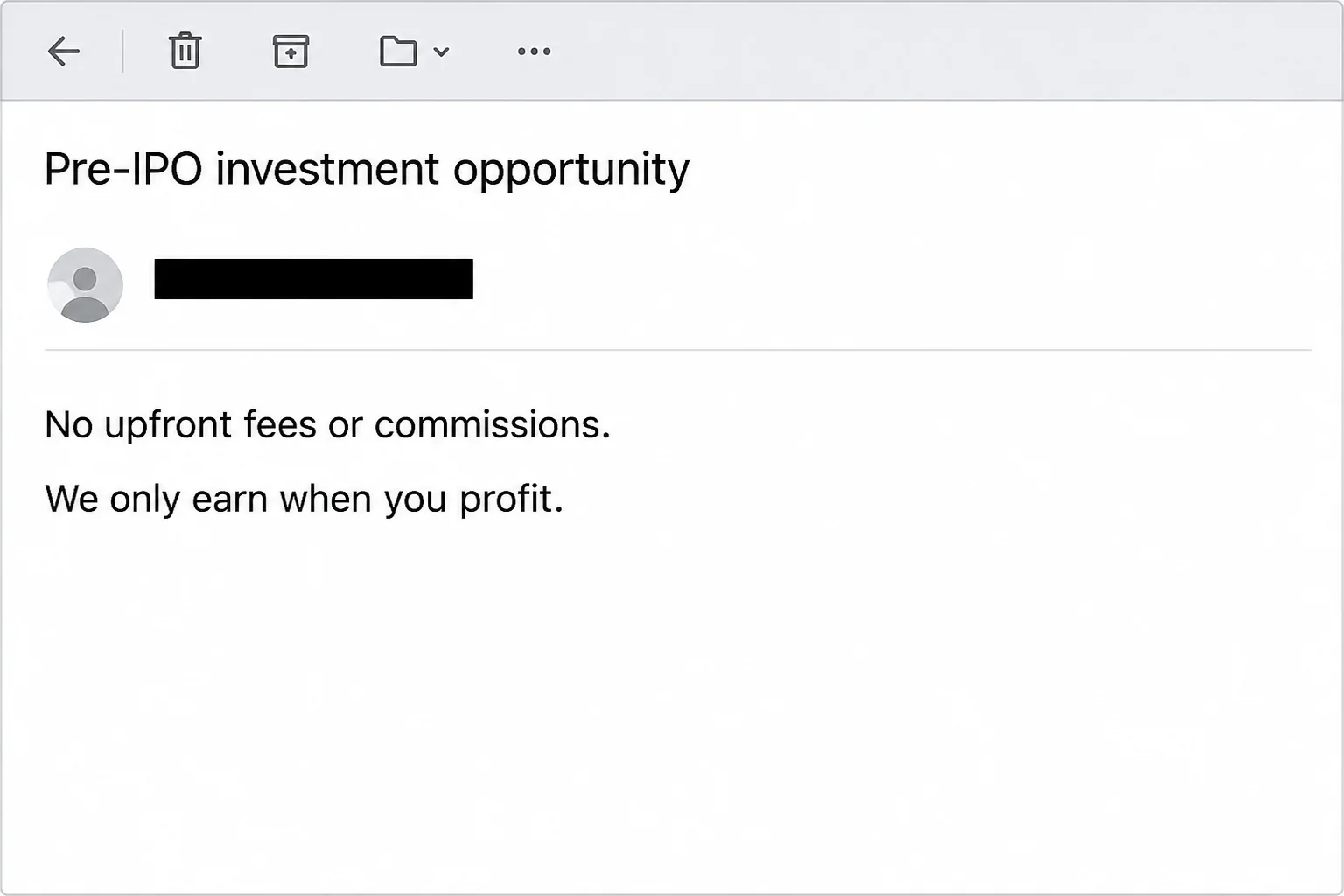
Legend’s operators marketed investments connected with private companies expected to go public. Prospective investors were told that the operators would not get paid until investors made money.
Instead, investors were charged excessive undisclosed markups, and sales representatives received substantial upfront compensation. The deception concerned what buyers were paying and how the people selling it earned money.
The email image is a reconstruction of that sales promise. It is not an original investor communication, a current offer, or a capture of a functioning investment website.
Guilty pleas were followed by prison sentences
The September 2026 DOJ announcement reports prison sentences for Mario Gogliormella, Steven Lacaj, and Karim Ibrahim. All three pleaded guilty in the case.
Gogliormella received 52 months, while Lacaj and Ibrahim each received 42 months. The announcement describes approximately $185 million raised from hundreds of investors and $46 million in ordered restitution.
Those figures describe different parts of the case. The amount raised is not automatically the amount lost, and ordered restitution is not confirmation that investors have received payment.
The investment’s name could distract from its actual price
The pitch focused on access to desirable companies before a public listing. Buyers also needed to understand the fund structure, acquisition cost, markup, and compensation hidden behind that access.
- Ask what legal interest you would own, rather than relying on the underlying company’s name.
- Obtain the acquisition cost and every layer of compensation in writing before investing.
- Do not treat a possible public listing as a guaranteed event or exit date.
- Existing investors should preserve documents and verify any recovery instructions through an authorized case contact.
How the Legend Venture Partners Scam Works
Step 1: A desirable private company supplies the attraction
The operators offered access to companies that had not yet listed publicly. Their sales pitch emphasized the possibility that shares would become more valuable after an anticipated offering.
That creates an appealing comparison: buy now at an attractive price, then benefit when the broader market gains access. The comparison depends on what is actually being purchased.
A familiar business name cannot answer that ownership question. Investors need to identify their own contractual interest and the entity responsible for holding or acquiring the underlying assets.
The possibility of an eventual listing also leaves timing uncertain. A salesperson’s expectation should not be treated as the issuer’s binding commitment to conduct an offering.
Step 2: Cold callers make the opportunity feel personal
The scheme used boiler-room call centers and referral agents to reach prospective investors. Salespeople delivered aggressive pitches using prepared scripts, including to people without professional investing experience.
A repeated conversation can make a caller seem like a trusted guide through an unfamiliar market. That relationship may draw attention away from the economic terms being proposed.
Keep written notes of the promises made during the pitch. Ask how each promise appears in the documents you would sign, especially the description of charges and compensation.
If important terms change between conversation and contract, pause before committing funds. A salesperson’s reassurance should not replace a clear explanation of the discrepancy from an independent professional.
Step 3: The seller promises to earn only after the investor
Investors were told there were no upfront fees or commissions and that the operators would not get paid until investors profited. That represented a particular alignment of interests.
Someone hearing that promise could reasonably believe the seller needed a successful investment outcome before receiving compensation. The actual arrangement allowed significant money to be collected upfront.
The issue was therefore more than a disagreement about whether a price was attractive. Buyers were misled about how their payments were divided and when the sellers benefited.
An investment can contain a genuine asset while its marketing contains fraud. The presence of real holdings does not cure false representations about the terms of buying them.
Step 4: A hidden markup changes the economics
The defendants sold investment interests at arbitrarily inflated prices without disclosing the nature and extent of the markups. That gap provided money before investors realized any investment profit.
Imagine a hypothetical underlying interest acquired for $100 and sold to a buyer for $200. The buyer pays twice the acquisition cost before considering any later charges.
If the underlying asset subsequently becomes worth $150, the asset has increased in value, but that buyer remains below their $200 entry price before additional costs.
Those figures illustrate the arithmetic, rather than a specific Legend transaction. They show why a promising company and a profitable purchase are not the same thing.
Step 5: Upfront payments reward the sales operation
Prosecutors described nearly $28 million diverted to the defendants and at least $17.5 million paid to sales representatives. The sales payments contradicted the promise that fees were not charged.
Referral agents typically received 10% to 15% of the investment amount upfront, along with a possible share of later carried interest. Their compensation was not limited to investor profits.
That structure gave the sales operation an immediate financial interest in obtaining another investment. A prospective buyer needed to know about that incentive when considering the recommendation.
Ask who gets paid from your contribution and when payment occurs. If the answer is unclear or conflicts with the sales pitch, do not authorize the investment.
Step 6: A new entity continues the same selling approach
The defendants first operated as a marketing arm for StraightPath. When StraightPath stopped operating in approximately February 2022, they continued the scheme through Legend Venture Partners.
The continuity concerned the sales operation and its deception, rather than proof that every similarly named investment firm belonged to it. Match your own records to the specific entities.
For an investor receiving a new proposal, a changed company name should trigger fresh examination of ownership, compensation, and payment arrangements. A familiar salesperson cannot answer those questions alone.
For an existing investor, keep the original and subsequent documents together. They may show how a relationship moved between entities and which promises accompanied each payment.
Who Was Selling the Investment, and What Did Buyers Own?
Legend and StraightPath were distinct entities with connected conduct
The criminal announcement describes the defendants’ work across StraightPath and Legend. The civil cases and investment documents also identify separate funds and entities within those operations.
That distinction matters when assembling an investor’s records. Money paid into one fund should not be casually attributed to another fund merely because some salespeople overlapped.
List the entity named on each subscription agreement and wire receipt. Add the salesperson and investment series beside it, so the relationship between documents remains visible.
The history of a salesperson can be relevant, but the actual contract still needs its own examination. Do not let a familiar person substitute for identifying the investment.
Fund interests can sit between buyers and company shares
The SEC’s Legend case announcement describes private Legend funds investing in shares or interests associated with private companies. That is different from every investor holding company shares directly.
The important questions are who owns the underlying interest and what rights your fund interest provides. A company’s potential success does not answer those contractual questions for you.
The SEC civil announcement concerned a narrower Legend offering and earlier allegations. Its figures should not be added to the criminal case’s broader totals as another independent loss.
Current and prospective investors need their actual agreements, rather than a simplified description from a telephone pitch. An independent securities professional can help identify the rights those documents provide.
Referral agents received money before investors realized profits
The people pitching the investments served as primary contacts for many investors. Their role could therefore appear advisory even while commissions rewarded successful sales.
The criminal case describes concealed upfront compensation and hidden involvement by principals with disciplinary histories. Those facts bear directly on whether buyers received an honest explanation of the sellers’ interests.
For any new proposal, request the names and roles of the people arranging it. Ask for compensation details tied to your specific contribution and retain their written answers.
A reference to eventual profit sharing does not resolve a separate upfront payment. Both can exist within an arrangement, and both need to be disclosed accurately.
Receivership is a separate process from criminal sentencing
The September 2026 DOJ announcement says the StraightPath and Legend entities were no longer operational and were under a court-appointed receiver’s control. Existing investors therefore need authorized case information.
A prison sentence addresses the defendants’ criminal conduct. A receivership deals with assets, records, and court-directed administration; its procedures should not be guessed from the sentence announcement.
Do not assume that a restitution order opened a new claims window or guaranteed a particular distribution. Verify what applies to your investment through an established case contact.
Keep any existing receiver notices and references with your fund documents. If a new message changes payment or submission instructions, confirm the change independently before providing sensitive material.
The Questions a No-Commission Pitch Still Needs to Answer
Start with the amount you would contribute and identify where every part goes. A promise about commissions leaves other possible costs unresolved unless the full purchase economics are explained.
Ask what the seller paid or will pay for the underlying interest. Then ask how the price offered to you relates to that acquisition cost and any additional expenses.
You also need to know whether the interest is already owned or would be acquired later. Access promised after receiving your funds is different from an existing position.
Ask what happens if the anticipated listing never occurs, is delayed, or does not produce the expected price. An exit described optimistically during a call may have restrictions.
These are ordinary questions about understanding an investment, not a claim that every private-company opportunity is fraudulent. Legend’s confirmed deception concerned false statements and concealed financial arrangements.
The FINRA guidance on pre-IPO funds identifies uncertain listings, valuation problems, indirect ownership, and limited exit options. Those risks remain relevant even outside a criminal scheme.
An independent review should address the contract you would actually sign. Advice from someone receiving compensation for arranging the same investment does not provide that independence.
If the salesperson insists that asking these questions will cost you the opportunity, preserve the offer rather than rushing the transfer. An unexplained price remains unexplained under pressure.
What to Do if You Have Fallen Victim to This Scam
-
Preserve the agreements that identify your actual investment. Gather subscription documents, fund and series names, wire confirmations, account statements, and any later notices.
Separate each contribution by date, amount, and receiving entity. Keep the original files alongside a short timeline, rather than merging multiple investments into one unsupported total.
Record the sales promises about price, fees, commissions, and expected listings. Emails and contemporaneous notes may explain differences between the pitch and the signed documents.
-
Check whether any new payment instruction is genuinely authorized. Do not send additional money to someone merely claiming they can release an investment or accelerate recovery.
If a transfer you recently authorized remains pending, contact your bank’s wire team and explain the concern. Provide the exact beneficiary and transaction reference before asking about available action.
For completed payments, ask what investigation or recovery measures remain possible. Keep the response with your records without treating a requested recall as a completed refund.
-
Verify the appropriate case contact before sending sensitive documents. The Southern District of New York lists Victim and Witness Services at 1-866-874-8900.
Identify the Legend or StraightPath investment, the defendants’ names, and the documents you hold. Ask how to obtain the authorized current receiver contact and applicable victim-information instructions.
Write down the referral and confirm its destination before submitting financial records. Reporting information to prosecutors is separate from satisfying any receiver’s claim or verification procedure.
-
Clarify the status of any claim you already submitted. Using a verified receiver contact, provide your existing reference and ask which steps remain outstanding.
Do not assume an old deadline has reopened because a sentencing announcement is recent. If you never filed, ask what options exist and obtain independent legal advice when needed.
Keep written confirmation of any accepted submission, required correction, or stated deadline. A conversation about eligibility is not the same as an accepted claim or promised distribution.
-
Keep recovery communications with the original investment records. Record who contacted you, which entity they represented, and whether they requested money or confidential information.
Verify a changed address or payment instruction through an existing authorized route. Reject guaranteed-recovery offers that require sending funds to an unrelated account.
If you remain unsure how your documents establish ownership or a claim, consult an independent securities attorney. Their role is to assess your records, not sell another investment.
Frequently Asked Questions
Was the fraud simply that a private investment performed badly?
The criminal case involved guilty pleas and deception about markups, commissions, and the sellers’ involvement. Those false statements distinguish it from an honest investment that later loses value.
Did every buyer own shares in a company directly?
The Legend structure included interests in private funds associated with underlying company shares. Your subscription agreement identifies your actual interest and should not be replaced by a salesperson’s shorthand.
Does no upfront commission mean there cannot be a markup?
A seller can earn money through the price charged for an investment. The Legend operators falsely described their compensation while concealing substantial markups and upfront sales payments.
Was the entire $185 million definitely lost?
That figure describes money raised in the criminal announcement. The restitution order and individual investment outcomes are separate matters, so the raised amount should not be relabeled as total loss.
Does the $46 million restitution order guarantee my payment?
An order establishes an obligation, rather than proof that money has reached every investor. Verify the process applicable to your records through authorized victim-services and receiver contacts.
Can I assume a new recovery message came from the receiver?
Confirm it through contact details you independently verified. A genuine case gives impersonators useful names and events, so accurate information in a message does not establish the sender’s authority.
The Bottom Line
Do not accept a no-commission promise without understanding the actual purchase price and who gets paid. Legend’s operators concealed compensation while selling access to companies that attracted investors’ attention.
If you invested, preserve the fund documents and verify the applicable receiver and victim-information routes. A recent sentence does not replace those procedures or guarantee that recovery money is available.

Join the discussion
0 commentsShare your experience or ask a question about this article.
Community experiences
Did this happen to you?
Your experience could help someone recognize the same scam. Submit a private report for our team to review.
I experienced this tooReports are reviewed before publication. Sharing publicly is always your choice.
Discussion
Start the conversation
Have a question or something useful to share? Add the first comment.