

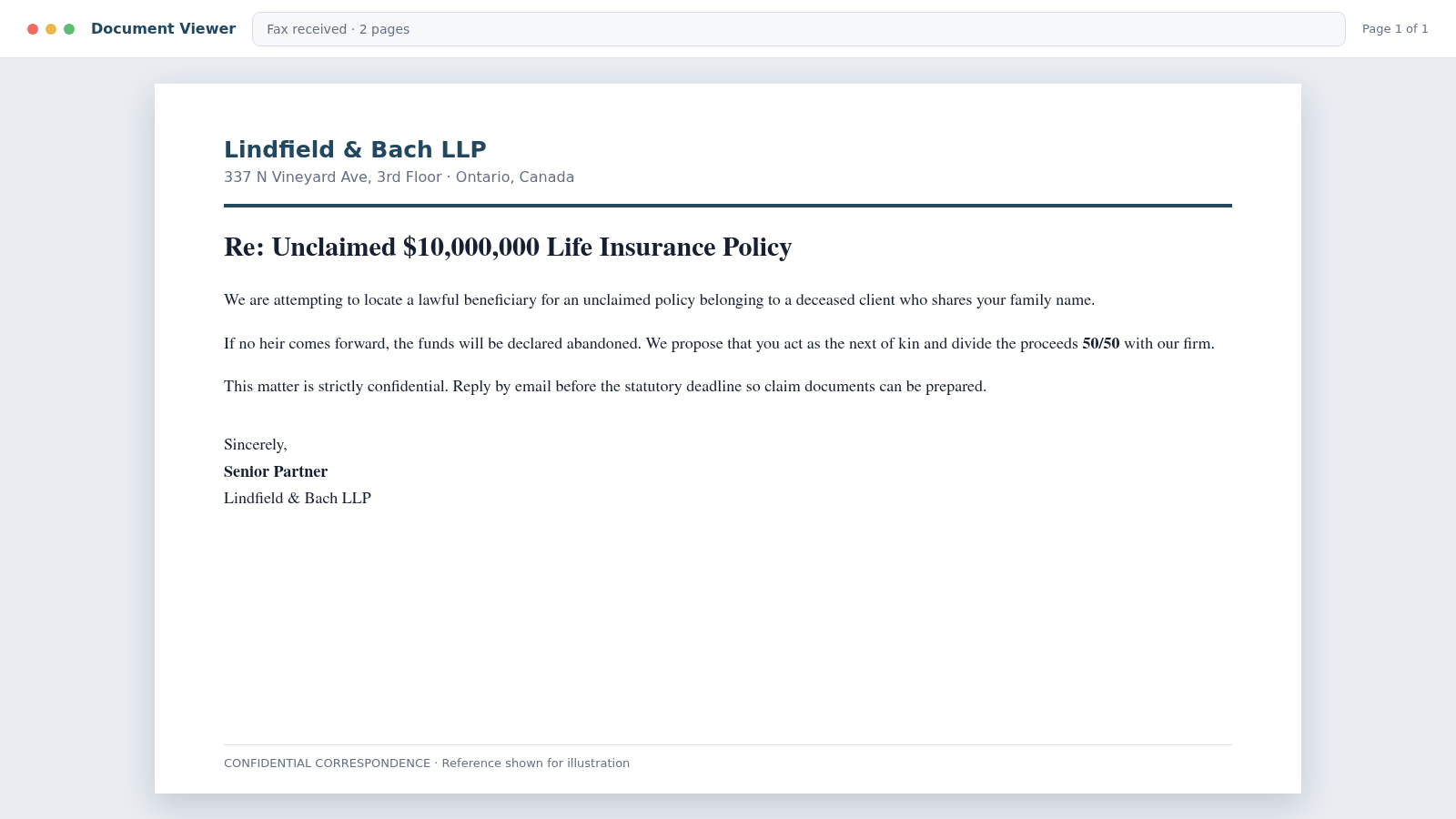
A formal letter from a Canadian law firm says a person with your surname left a $10 million life insurance policy. No heir has come forward, and the firm proposes an unusual solution: claim the money and split it 50/50.
The letter may look more serious than an ordinary spam email, but the proposal is not a legal shortcut. It is an inheritance scam designed to collect identity documents, bank details, and a sequence of invented fees.
Overview
The law-firm identity does not withstand basic checks
The name Lindfield and Bach LLP, sometimes paired with linfieldbachllp.com, has appeared in unsolicited inheritance communications. The firm claims a long operating history while the associated website is far newer.
The address, telephone number, attorneys, and regulator membership must all be verified independently. A professional website and formal letterhead can be assembled quickly.
A search result is not enough. Fake-firm websites can appear in search engines, and criminals may copy biographies, case descriptions, office photos, or registration details from unrelated lawyers.
The $10 million policy follows a known inheritance script
The letter says a deceased client shares the recipient’s surname and left a life insurance policy without a known beneficiary. The supposed lawyer fears that the money will be declared abandoned.
The recipient is invited to pose as the next of kin, submit a claim, and divide the proceeds with the firm. Secrecy is described as necessary because the matter is sensitive.
The FTC has warned about letters using this same long-lost-relative and multimillion insurance story. The inheritance does not exist.
The first reply opens the identity and fee phase
The opening letter may not ask for money. Its immediate purpose is to find someone willing to believe the story and respond.
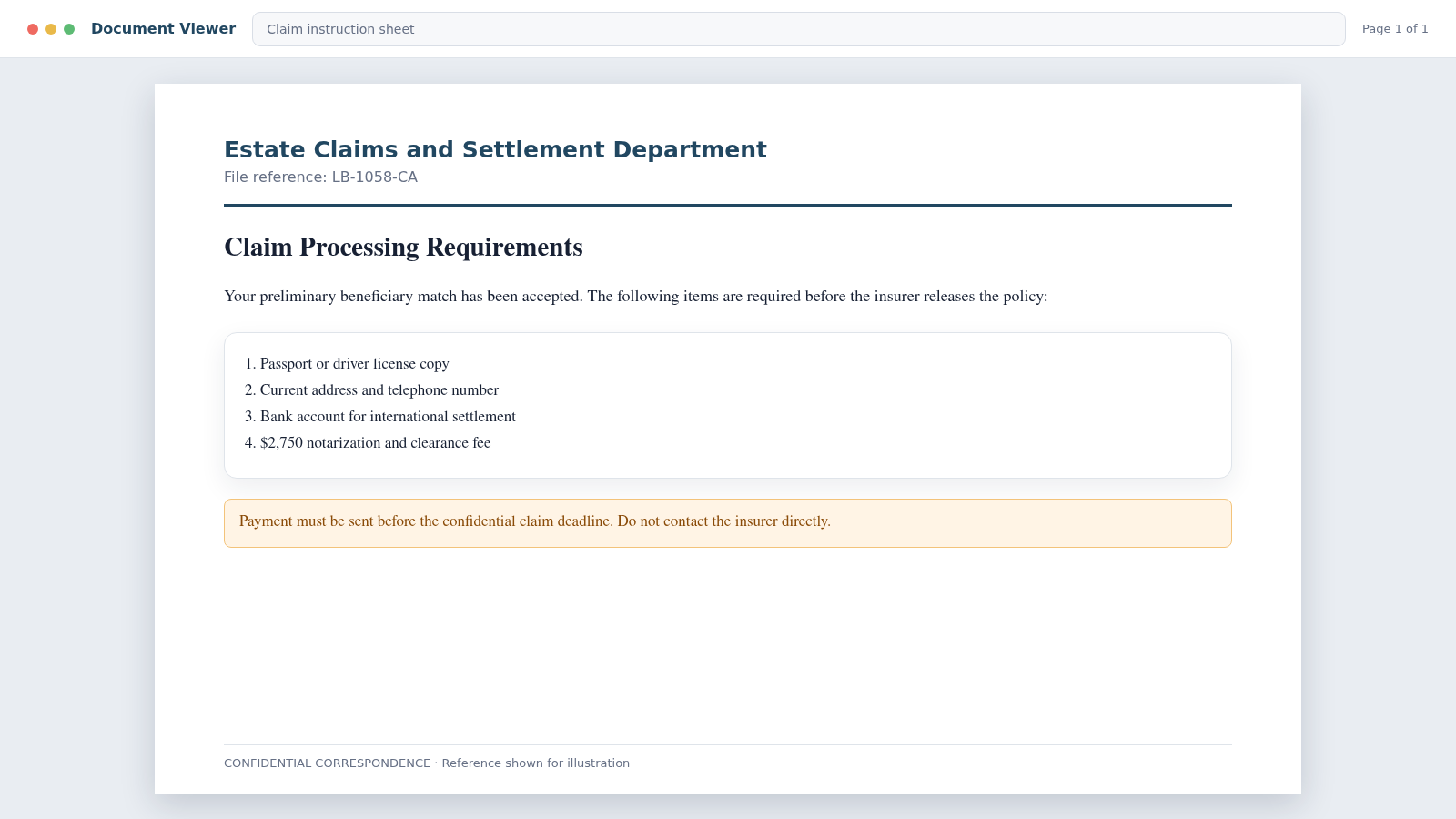
After contact, the supposed firm requests identity documents and financial information to prepare the claim. A fee eventually appears for notarization, insurance, tax, legal clearance, or an international transfer.
The scam can collect:
- Passport or driver’s license images
- Social Security or tax identification numbers
- Home address, phone number, and date of birth
- Bank account and routing details
- Signatures placed on fake claim forms
- Wire transfers, gift cards, or cryptocurrency
- Email credentials entered into fake document portals
- Additional fees demanded by invented officials
Why a Printed Letter or Fax Can Lower Suspicion
People associate phishing with badly written email. A physical letter or fax feels expensive, targeted, and harder to fake.
In reality, names and addresses can be purchased from marketing lists, property records, breached databases, or public directories. Mail-merge tools can personalize thousands of letters.
Letterhead, signatures, file numbers, seals, and legal language are visual elements, not proof. A scammer can reproduce them without being licensed or handling a real estate.
The surname match is also weak. Common surnames allow the same script to be mailed widely, and the sender may never identify a genuine family connection.
A real lawyer would not ask a stranger to falsely claim kinship and secretly divide insurance money. That proposal describes fraud, not legitimate estate administration.
The Fake Firm Website Problem
Scammers know recipients will search the firm name. They build a website before sending letters so the search appears to confirm the story.
The site may claim decades of experience, show attorney portraits, list practice areas, and publish an office address. Much of that material can be copied from real firms.
Compare the claimed history with domain-registration timing and archived pages. A firm that says it has served clients since 1974 should have a substantial verifiable footprint beyond a recently created website.
Search the provincial or state law-society directory for each named attorney. Then contact the regulator using details found on its official domain.
If a real lawyer’s identity was copied, call that lawyer through the regulator’s listing. Do not use the number printed in the suspicious letter.
Company, Address, and Fulfillment Checks
Search the official lawyer directory
Use the provincial law society or another official regulator to search the firm and each named lawyer. Match the status, office, email domain, and telephone number rather than stopping when a similar professional name appears.
Verify the office without using the letter
Look up the address and main telephone number independently. A real building may be copied into a fake letter, so ask the listed office whether the firm or lawyer occupies the location and sent the approach.
Examine the website and email domain as one identity
Compare spelling, domain age, contact details, staff biographies, and legal notices. A recently created website with copied profiles and inconsistent mail addresses does not become credible because it uses polished design and legal language.
Confirm the policy through an independent professional
Do not let the sender choose every participant in the claim. Your own attorney can contact the insurer, court, executor, or regulator using independently verified information and determine whether any lawful estate process exists.
How the Lindfield and Bach LLP Scam Works
Step 1: A letter identifies the recipient as a possible heir
The sender claims to represent a deceased client with the same surname. A $10 million life insurance policy or estate has supposedly remained unclaimed.
The wording is flattering and cautious. It suggests the firm conducted research before selecting the recipient, even though the message may be mass-produced.
Step 2: A 50/50 split makes the proposal feel mutually beneficial
The supposed lawyer offers to handle every legal step in exchange for half the proceeds. Charity may also be mentioned to make the arrangement sound less greedy.
The recipient is not being invited into a lawful claim. They are being asked to accept a false identity as next of kin.
Step 3: Confidentiality isolates the target
The letter warns that contacting the insurer, another lawyer, or family members could cause the claim to fail. An urgent deadline reinforces the instruction.
Secrecy prevents the recipient from hearing the obvious objection: legitimate estate work can withstand independent legal review.
Step 4: The fake website and staff answer verification attempts
The recipient finds a matching website or calls the number in the letter. The same criminal operation answers and confirms the file.
This is circular verification. Every source originates with the person making the claim.
Step 5: Documents are collected for beneficiary processing
The supposed firm sends forms requesting identity, address, signature, tax, and banking information. A passport selfie may be required for compliance.
The data can be used for identity theft, account recovery, or more convincing financial impersonation.
Step 6: A clearance fee appears
A new document says the insurer, court, government, or bank requires payment before funds can be released. The fee may begin at $500 or climb beyond $5,000.
Payment is directed to an individual, overseas account, crypto wallet, gift card, or money-transfer service. The beneficiary is promised reimbursement from the inheritance.
Step 7: New obstacles keep the payments coming
After one fee, the claim encounters another problem. A tax certificate, anti-money-laundering bond, courier charge, exchange fee, or court stamp becomes necessary.
Each payment is called the last. The $10 million remains a number in forged documents and fake account screens.
Step 8: Threats and recovery offers follow the collapse
If the victim resists, the scammers may threaten legal action for abandoning the claim or accuse the victim of money laundering. The goal is to frighten them back into cooperation.
Later, a supposed regulator or recovery lawyer may offer reimbursement for another fee. Information from the original scam makes the second approach highly personal.
How to Verify a Canadian Law Firm Properly
Identify the province in which the lawyer claims to practice. Search the official provincial law-society directory for the lawyer’s full name and current status.
Compare the official listing with the letter’s phone number, email domain, address, and firm name. Small spelling differences can reveal an impersonation.
Call the number in the regulator’s directory, not the letter. Ask whether the lawyer sent the communication and whether the file reference is real.
Verify the deceased person, insurer, policy, probate court, and estate through separate records. A legitimate claim will not depend on one newly created website.
Ask an independent attorney to review the letter. Do not hire an adviser recommended by the sender, because that person may be another identity in the same scheme.
Any proposal requiring you to lie about kinship should end the conversation. The possibility of a large payout does not make false beneficiary documents lawful.
Warning Signs in the Lindfield and Bach Letter
- A stranger identifies you as heir based mainly on a surname
- The supposed policy is worth exactly $10 million
- The firm offers to split the money 50/50
- You are asked to claim a relationship that is not documented
- The matter must remain secret
- The website is far newer than the firm’s claimed history
- Named lawyers cannot be verified with the regulator
- Identity and bank documents are requested by email
- Fees must be paid before the inheritance is released
- Independent contact with the insurer is discouraged
What to Do if You Have Fallen Victim to This Scam
- End communication immediately. Do not send another document or fee, even if the sender says the claim will be lost or legal action will follow.
- Contact the payment provider. Call your bank, wire service, card issuer, crypto exchange, or gift-card company immediately and ask whether the transaction can be stopped or traced.
- Notify the real regulator. Report the fake firm and copied lawyer identities to the appropriate law society. Use contact details from the regulator’s official website.
- Protect exposed identity documents. If you sent ID, Social Security, tax, or signature information, create a recovery plan at IdentityTheft.gov and consider credit freezes.
- Secure banking accounts. Tell the fraud team what information was disclosed. Ask whether account numbers, online access, cards, or verbal passwords should be changed.
- Secure your email. Change the password from a clean device, enable multi-factor authentication, revoke unknown sessions, and inspect forwarding and deletion rules.
- Scan devices used for claim files. Remove suspicious attachments and remote tools, then run a full scan with Malwarebytes.
- Report malicious pages. Submit the fake domain to its registrar, host, browser safety services, and the impersonated organizations. AdGuard may help block known scam destinations.
- Preserve the originals. Keep envelopes, fax headers, full emails, attachments, website captures, bank instructions, receipts, telephone numbers, and cryptocurrency addresses.
- File fraud reports. Report to the FTC, FBI IC3, postal inspector when physical mail was used, and Canadian authorities or the relevant national agency.
- Tell a trusted person. Secrecy is part of the scam. Share the situation with family, an independent lawyer, or a financial professional before making further decisions.
- Reject recovery fees. Treat unsolicited promises to retrieve the inheritance payment as another scam, especially when payment is required first.
What Evidence to Preserve From the Fake Firm
Keep the original envelope, letter, fax, and email files. Postal markings, fax headers, document metadata, and full email headers may reveal infrastructure that the polished letterhead and website were designed to conceal.
Capture the fake firm’s website before reporting it, but do not submit information through its forms. Save pages showing lawyer names, addresses, telephone numbers, registration claims, privacy language, and payment instructions.
Make a list of every professional identity used in the approach. Scammers may copy the name of a real lawyer while inventing a firm, or copy an entire firm profile while substituting their own phone number and email address.
Preserve every beneficiary form, nondisclosure agreement, certificate, insurance record, bank instruction, and fee invoice. A document can look official while containing inconsistent dates, jurisdictions, signatures, reference numbers, and company names.
- The physical envelope and all postal markings
- Original emails, attachments, and complete headers
- Website screenshots and the exact domain name
- Telephone numbers and messaging accounts
- Payment instructions, receipts, and destination accounts
- Copies of every identity document disclosed
Create a chronological summary beginning with the first contact. Note each promise, deadline, new official, fee, and explanation. A timeline makes it easier for a bank, regulator, or investigator to see the pattern quickly.
Do not warn the sender that you are collecting evidence or contacting regulators. End the conversation, secure your accounts, and let the relevant institutions decide whether further contact could help an investigation.
If the scammers referenced a real deceased person, save that information too. Public obituaries and genealogy records can provide believable family details without proving any legal connection between the recipient and the supposed estate.
Tell investigators whether the approach arrived by email, post, fax, telephone, or several channels. Multiple contact methods can make a fake firm appear established, but they may also reveal accounts and service providers capable of preserving records.
Frequently Asked Questions
Is Lindfield and Bach LLP a legitimate law firm?
The identity used in the inheritance approach shows serious inconsistencies and should not be trusted. Verify every named lawyer through the official law-society directory and independent contact details.
Could a real law firm offer to split an inheritance 50/50?
A legitimate lawyer would not ask a stranger to falsely claim kinship and secretly divide unclaimed money. That proposal is a core sign of the scam.
Why did the letter know my full name and address?
Names and addresses can come from public records, marketing lists, or data breaches. Personalization proves that the sender found data, not that an inheritance exists.
What if the website lists lawyers and a Toronto office?
Websites can copy biographies, addresses, and photos. Confirm the individual lawyers in the official regulator’s directory and call using the number listed there.
Should I reply just to ask for more proof?
No. Replying confirms your interest and gives the criminals an opportunity to collect details. Preserve the letter and verify independently without using the sender’s channels.
Can I recover a fee already sent?
Recovery is not guaranteed, but contact the payment provider immediately. Provide complete evidence to law enforcement and ignore anyone who promises a guaranteed return for another fee.
The Bottom Line
The Lindfield and Bach LLP scam dresses a familiar inheritance fraud in professional letterhead, a fake law-firm identity, and a $10 million insurance story.
There is no lawful 50/50 shortcut. Do not reply, submit documents, or pay fees. Verify lawyers through official regulators and discuss any genuine estate claim with an independent professional.

Join the discussion
0 commentsShare your experience or ask a question about this article.
Discussion
Start the conversation
Have a question or something useful to share? Add the first comment.