


The bank’s message says it will not refund the money you sent. You already explained the scam once, and now it feels like you have to start over.
Before you do, find out what the bank actually decided. The wording can tell you which evidence to gather and which deadline is running.
Overview
A bank’s fraud decision is not always the final word
A Monzo customer who was tricked into making a transfer can report the scam and seek reimbursement. If the claim is refused, a formal complaint is a separate step.
The Guardian reported that the Financial Ombudsman Service sided against Monzo in 34% of 3,372 referred fraud and scam complaints it closed in 2025.
That figure covers a selected group of disputes, not all reimbursement claims Monzo dealt with. It includes more than one kind of fraud, and it cannot predict your outcome.
Monzo told the newspaper some cases related to older incidents. The rules applied to an individual transfer depend partly on when and how it was made.
What an actual decision tells you about mixed payments
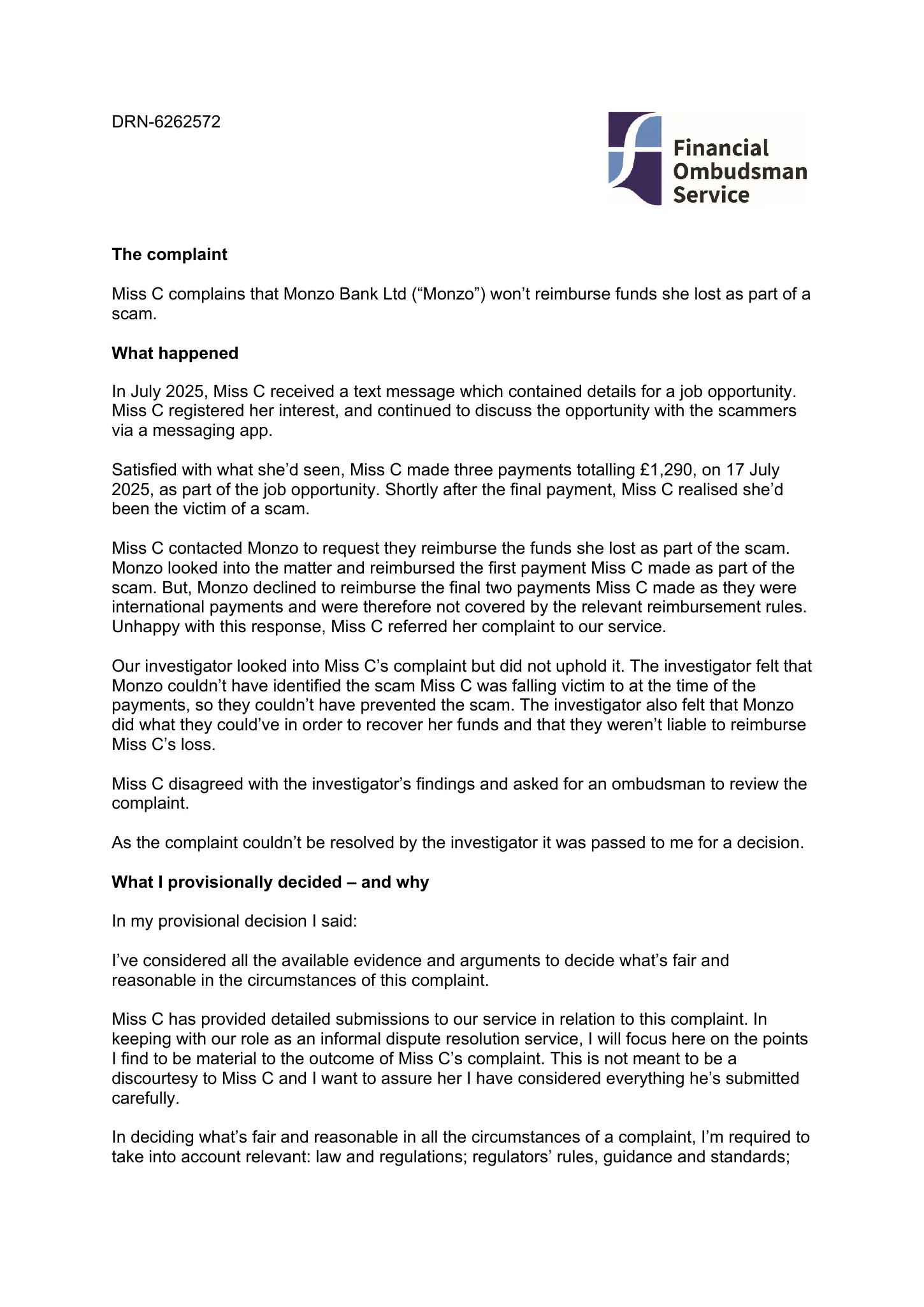
In decision DRN-6262572, a customer made three transfers totaling £1,290 after falling for a fake job offer. The first went to a UK account; the others went overseas.
Monzo reimbursed the first transfer but not the two overseas ones. The ombudsman directed it to pay £150 for its handling, not repay those transfers.
A complaint can succeed on poor communication without establishing that the bank should repay all the money lost to the scam.
The best evidence is often already in your account
Before you ask for a decision to be reconsidered, make a list of the actual payments. Use the bank’s records rather than estimating a total from the scammer’s messages.
- The date, amount, currency, and transaction reference of each transfer.
- Which account sent the money and whether the named recipient was you or another person.
- The offer or warning you saw before you approved the payment.
- The date you first told the sending bank about the scam.
- The written outcome and any distinction it makes between covered and uncovered payments.
A formal complaint is not just a chance to repeat the story. It lets you identify a clear issue in the bank’s response and say what should happen next.
How a Monzo Scam Refund Dispute Moves Forward
Step 1: The fraud report starts with the sending bank
If you approved a bank transfer after being deceived, say so clearly. This is different from claiming that you never authorized a transaction at all.
In the Monzo app, tap Help, search Reporting a scam, and open the article. Select Get in touch at the bottom and give the fraud team the affected payments.
Use Monzo’s official reporting instructions if you need to confirm those labels. If you sent the money from another bank, contact that bank even if the recipient used Monzo.
Keep the reference or in-app conversation. If you cannot access the app, use Monzo’s own site to get its current contact details.
Step 2: The provider identifies which payment rules apply
An authorized push payment scam, or APP scam, is one where you were tricked into authorizing a transfer. It does not cover every payment that follows a scam.
The Payment Systems Regulator’s reimbursement guidance describes protection for eligible UK transfers under the rules introduced on October 7, 2024. A card payment is not that kind of transfer.
Ask the bank to identify the route and date for each payment. In a mixed case, some transfers can qualify under the rules even if other payments do not.
Report the scam as soon as you know. The ombudsman describes a 13-month limit for eligible claims, counted from the last payment in the scam.
Step 3: The bank gives a decision you can read and challenge
A bank might approve all or part of a claim, deduct a permitted excess, or say the reimbursement rules do not apply. Ask which reason it used for each payment.
Do not interpret a partial credit by guessing from the amount. Look for the bank’s breakdown and match it to the statement so you know which parts remain disputed.
For an eligible claim, the regulator says the bank can sometimes pause its usual five-business-day process to gather information. It must still reach an outcome within 35 business days.
The time to decide a reimbursement claim isn’t always the same as the time to send a response to a formal complaint. Note which process any estimate refers to.
Step 4: A formal complaint can address the remaining disagreement
If you disagree with the decision, open Monzo’s published complaint route or start a fresh in-app chat and ask to make a formal complaint.
State the date of the original report and what you are challenging. Ask the bank to acknowledge the complaint and to explain its decision in a written final response.
A final response is the document that normally starts the ombudsman referral clock. Check the date on the response, not just the day you happened to read it.
If you are unhappy with it, or the bank misses the applicable complaint response time, check the ombudsman’s eligibility and referral route. You do not have to pay a representative.
How to Make the Complaint Easier to Assess
Start with what the bank says it decided
Note the reason in the final response. It might concern an overseas payment, a permitted deduction, or the date you notified the bank.
Then compare that reason with a concrete record. If you think the bank has the wrong payment date or amount, attach the statement entry and explain the difference.
Do not assume a complaint about customer service will automatically reopen the question of financial loss. Say whether you dispute the refusal, the way it was handled, or both.
Ask for a clear outcome, such as reconsideration of a payment. If you received a partial credit, show how you calculated the remaining amount.
Put different payment methods into separate rows
A scam can involve domestic transfers, overseas transfers, card payments, and payments to your own account. List each separately rather than applying one rule to all of them.
This is especially useful if the total loss includes funds that passed through an exchange. Mark the transfer into your own account and what happened afterward as different events.
The ombudsman can review some payments outside the mandatory rules. It may ask whether the provider could have prevented or recovered the loss.
If the provider invokes an exception, ask which one and why. Verify its submission route before sending any evidence about sensitive circumstances.
Know which clock you are looking at
The Financial Ombudsman’s time limits distinguish the bank’s time to respond from your time to take a final response to the ombudsman.
The usual referral window is six months from the date the business sends its final response. Save that letter or email and mark the date before continuing informal conversations.
Ask the bank whether its message is final if you are not sure. If a deadline is close, contact the ombudsman instead of waiting.
Check the amount and the exception the bank used
The standard mandatory reimbursement cap is £85,000 for eligible claims. If you lost more, the ombudsman says it can still consider your complaint on the facts.
If the bank relies on something you did or did not do, ask which requirement it says you failed to meet. Ask it to identify any warning it relies on.
Write down what you remember seeing before paying. Separate your own recollection from any warning the bank describes later.
If the bank says a warning appeared, ask where and when it was displayed. Give the ombudsman both accounts if the recollections differ.
Keep a copy of the first fraud report if you can. It may record information you supplied while the events were still fresh.
When the scam affected more than one provider, list which decision came from each. The bank that sent money did not necessarily control later payments from a different account.
What to Do If Monzo Refuses or Reduces Your Refund
Report new or continuing risk before arguing the decision
If the scammer can contact you or access your account, stop dealing with them. Open the bank app yourself to report fresh activity and identify any affected cards or transfers.
Ask whether any money can be traced and which immediate controls are needed. A formal complaint is not a replacement for reporting money that is moving right now.
Make a list of payments and earlier decisions
Pull the transaction details from Monzo and record each amount, route, recipient and time. Match each line to the messages that explain why you approved it.
Add the date you first reported the scam and any refunds already credited. Keep copies of the evidence and ask the bank to confirm which transactions its decision covers.
Submit a formal complaint through the official channel
Use in-app chat or the contact route on Monzo’s official complaint page. State that you want to make a formal complaint about the decision and provide the original reference.
Describe the specific finding you dispute and request a written final response. Keep the acknowledgment, and follow up through the same official channel if you are missing one.
File with the ombudsman if the matter stays unresolved
Go to the ombudsman’s scam payment guide and open its complaint form. Select the relevant complaint about the financial provider.
Enter the provider, dates and disputed payments, then attach the final response or explain why it has not arrived. Include the records that support the discrepancy you identified.
Save the confirmation and keep the case reference in your notes. If the form is inaccessible or you need adjustments, contact the ombudsman through its published details.
Keep your fraud report separate from the dispute
When you report to police, preserve its reference for your bank or the ombudsman. You may be asked what happened and whether other accounts or payments were involved.
Do not assume a police report automatically causes the bank to refund you. Conversely, do not wait for a police investigation to end before checking your complaint deadline.
Ignore anyone offering to collect your refund for a fee
Do not hand over a banking login or pay a stranger to unlock your reimbursement. The ombudsman’s service is free for someone bringing an eligible complaint.
If somebody quotes your case number, verify their claim using the bank or ombudsman contact you obtained independently. Save the message if you want to report it separately.
Frequently Asked Questions
Does authorizing the transfer rule out a refund?
No, authorization is part of what distinguishes an APP scam from an unauthorized payment. A qualifying transfer may still be covered when you approved it because someone deceived you.
Ask the bank which payment scheme applies and what facts it relied on. Do not say that you never sent a payment you actually approved.
Can I dispute a deduction of £100?
An excess of up to £100 can be permitted. It is not an upfront charge, and it cannot be applied to consumers covered by the vulnerability exception.
Ask why the deduction was applied and tell the bank about relevant vulnerabilities at the time of the scam. Do not send a fee to remove an excess.
Will the ombudsman refund an overseas payment?
Overseas payments are not covered by the domestic reimbursement rules simply because the sending account was British. The ombudsman can still consider certain complaints about how a provider acted.
Send the exact route and evidence rather than assuming the domestic rules control the outcome. The decision depends on the facts of the individual payment and the bank’s handling.
Can an ombudsman complaint address poor communication?
Yes, the decision discussed above found fault in Monzo’s handling without ordering repayment of the overseas transfers. That kind of outcome is different from reimbursement of the original loss.
Explain how the communication affected you and keep the correspondence. The reviewer can assess that issue separately from whether the transfer should have been stopped or recovered.
What if the bank says it reached its final decision?
Save the final response, check its date, and read the section explaining your right to go to the ombudsman. Do not rely on an informal chat to extend the deadline.
If you want a review, prepare the payment records and reasons now. Use the official complaint form and retain confirmation that you sent it.
Does the 34% figure tell me my odds?
That percentage describes referred disputes examined by the ombudsman in the period reported. It is not the proportion of all Monzo scam claims that should have been refunded.
Your application depends on the payment, dates and evidence. Use the published cases to understand what questions get asked, not to predict your own result.
The Bottom Line
If Monzo refuses a scam reimbursement, ask for its reason for each payment in writing. Check whether it rejected eligibility, applied an excess, or addressed only part of the claim.
If you still disagree, make a formal complaint and keep the final response. Take it to the ombudsman before the applicable deadline, without paying someone to do it for you.

Join the discussion
0 commentsShare your experience or ask a question about this article.
Community experiences
Did this happen to you?
Your experience could help someone recognize the same scam. Submit a private report for our team to review.
I experienced this tooReports are reviewed before publication. Sharing publicly is always your choice.
Discussion
Start the conversation
Have a question or something useful to share? Add the first comment.