


An email account kept for years can hold old contacts, recovery messages, and services its owner rarely visits. A sudden update warning can therefore feel unusually important.
The message uses a familiar provider name, but familiarity should begin a verification process, not end one.
Overview
A Fake Service Update Impersonates NetZero
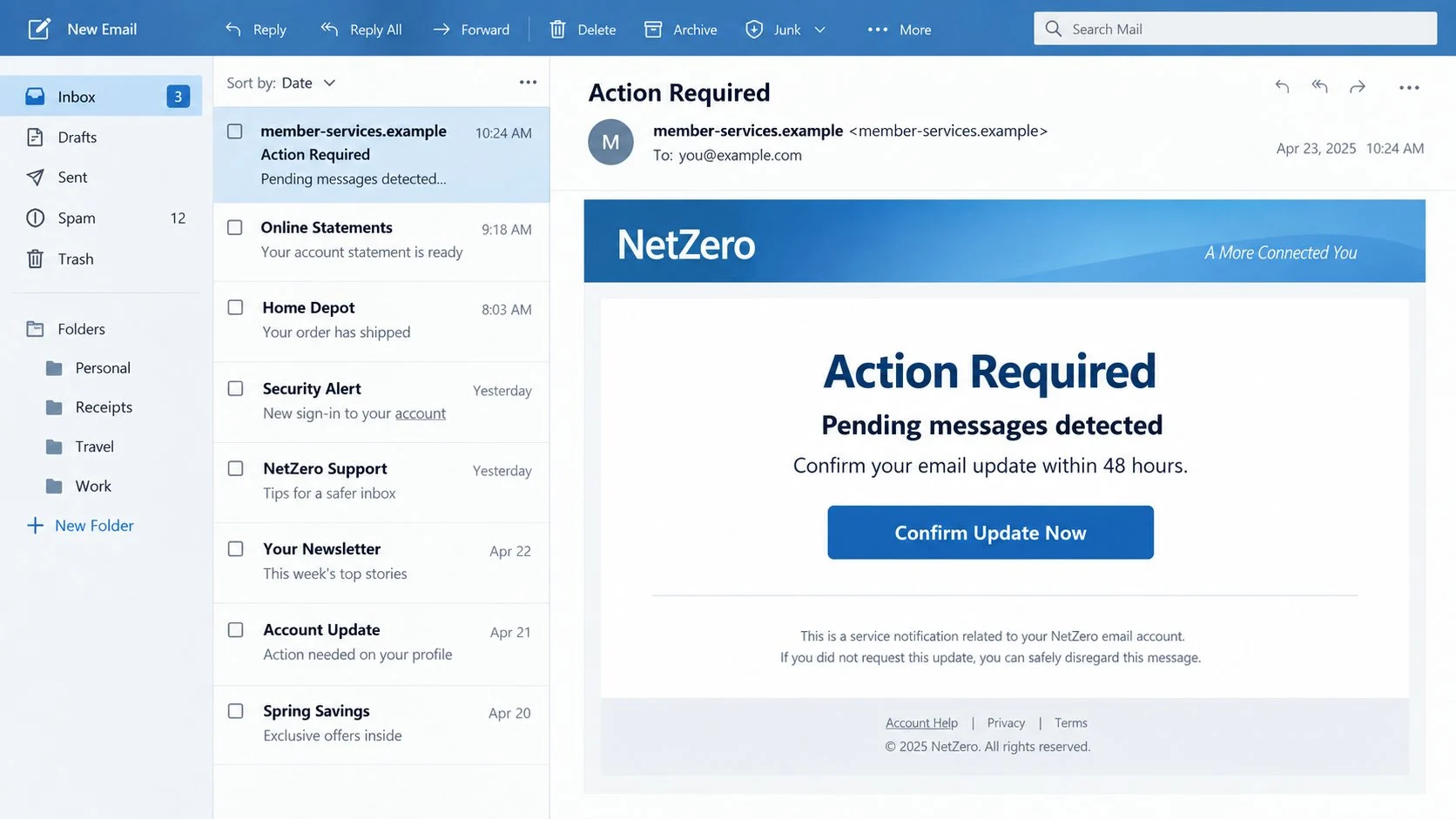
The NetZero Email Update scam poses as an automated notice from the legitimate internet and email provider.
It says pending messages were detected and demands an account update within 48 hours. Failure supposedly causes logout or deletion of stored information.
The subject can combine invoice language with an “important email update.” That unusual mixture helps the campaign attract both billing and account-security attention.
NetZero did not send the fraudulent notice. Criminals use the recognizable name because long-standing accounts can carry valuable personal history.
The “Confirm Update Now” button is not an account-maintenance tool. It is the bridge between the message and a credential-harvesting site.
The Landing Page Changes to Match the Victim
Observed links directed visitors to a page hosted on an unrelated EdgeOne-style domain. The address had no ownership connection with NetZero.
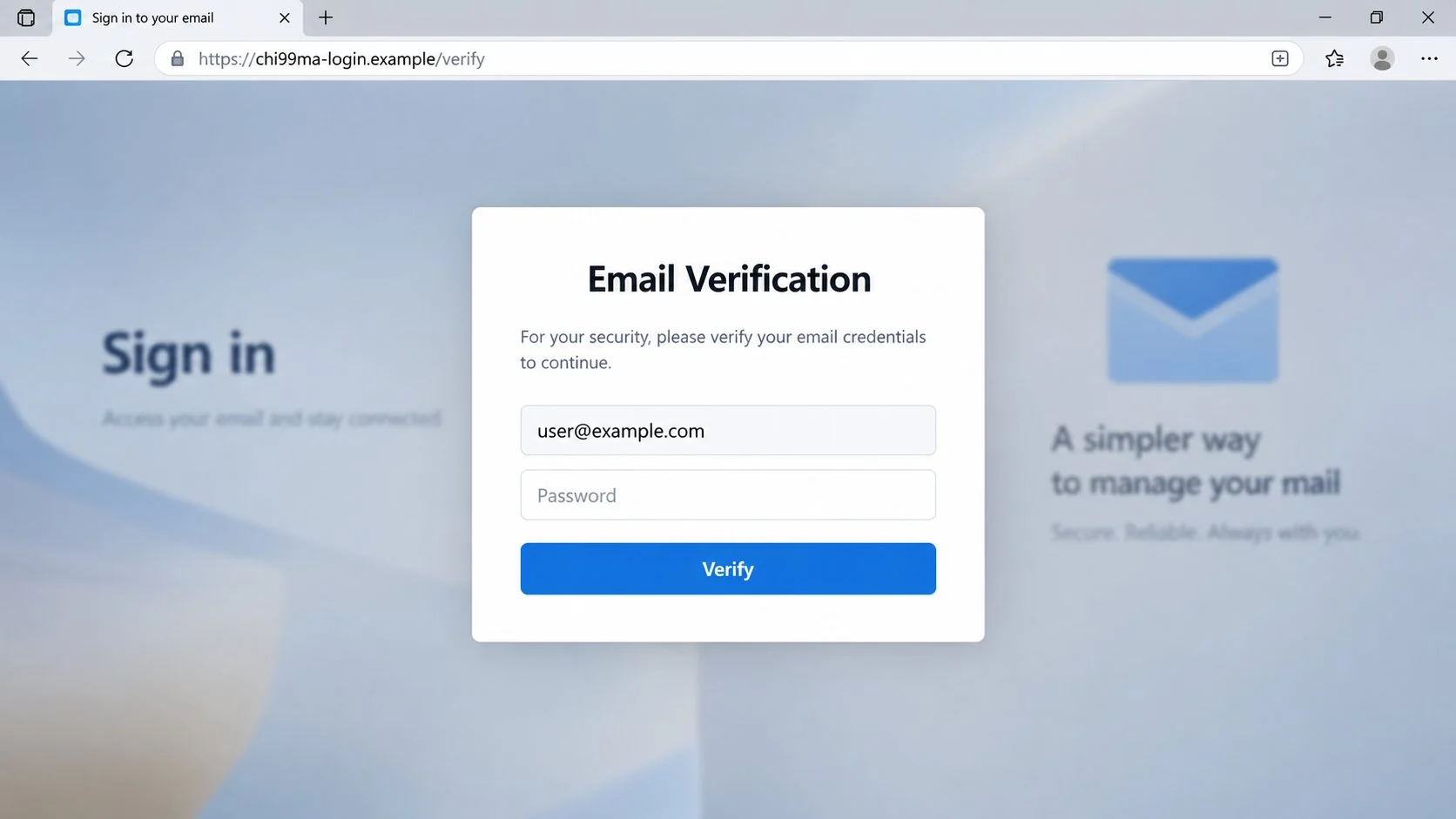
The page displayed an Email Verification card and could adjust its appearance according to the recipient’s email provider.
A familiar sign-in screen appeared behind the fraudulent overlay. This layered presentation made the form look like part of a genuine provider workflow.
The email address could already be present, leaving a single password field. That personalization was derived from targeting data, not a secure session.
Submitting the form exposed the password to the campaign operator. No legitimate update occurred because the site lacked access to provider systems.
Older Accounts Still Carry Modern Risk
People sometimes underestimate accounts they use infrequently. Yet an older address may remain the recovery destination for shopping, social, financial, or subscription services.
Archived messages can reveal names, addresses, telephone numbers, invoices, and relationships. That information supports identity theft and targeted impersonation.
- The campaign borrows the identity of a real provider.
- Pending messages create concern about missed communication.
- A 48-hour deadline pressures recipients to act quickly.
- The sender domain does not belong to the provider.
- The landing page adapts to different email services.
- A prefilled address makes the login appear established.
- Stolen access can expose linked accounts and contacts.
Receiving the email alone does not normally compromise an account. The main danger begins when credentials or other information are submitted.
Related messages can also distribute harmful files, so attachments and downloads require separate attention. Never assume every variant follows one exact path.
Users can resolve uncertainty without touching the button. Open NetZero through a known address and inspect the real account for any service notice.
How the NetZero Email Update Scam Works
Step 1: Scammers Gather Active and Older Addresses
Email addresses circulate through data breaches, marketing lists, public directories, and compromised contact books. Older accounts can remain reachable for decades.
The criminals do not need a list of confirmed NetZero customers. Broad delivery still reaches enough genuine users to make the campaign worthwhile.
Some batches may target domains associated with particular services. Others simply present provider branding to every recipient.
A working address is valuable even when the lure fails. Tracking can reveal which recipients open messages and become targets for later campaigns.
Step 2: The Notice Claims Messages Are Pending
Missing email is difficult to disprove from the warning itself. A recipient cannot see messages that supposedly remain on an unseen server.
The campaign turns that uncertainty into pressure. Updating appears necessary to release mail and preserve information.
A 48-hour countdown suggests irreversible consequences. Real providers may send policy notices, but they also show account status inside the official portal.
The wording may contain unusual grammar and instructions to move the message into the Inbox. That request can help links bypass protections applied to spam.
Step 3: The Message Uses Provider Branding Without Provider Infrastructure
A blue header and familiar name create recognition. Neither requires access to NetZero or permission from the company.
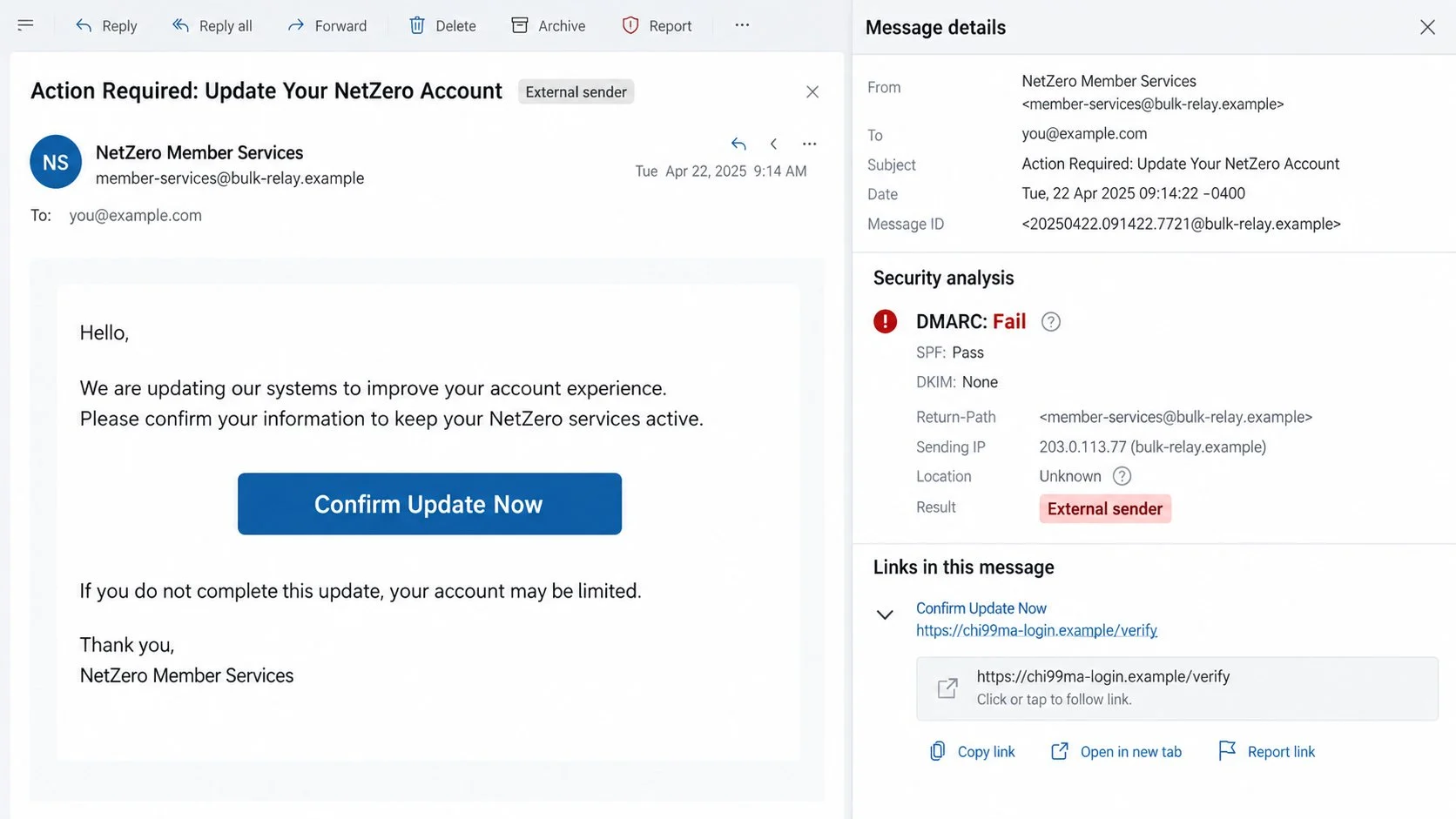
The visible sender name can say Member Services while the real address belongs to an unrelated relay or disposable domain.
Expanded headers may show failed DMARC or inconsistent return paths. Even passing authentication would only validate the attacker’s own domain.
A genuine provider relationship should connect the sender, destination, account page, privacy information, and support route. The scam cannot maintain that consistency.
Step 4: The Button Opens Unrelated Hosting
The confirmation link leaves the provider’s recognized website and loads a page under an unfamiliar content-delivery or static-hosting address.
Attackers favor dependable infrastructure because it offers HTTPS and fast loading. Those technical qualities say nothing about the uploaded page’s honesty.
Parameters can carry the recipient’s email address and campaign identifier. The site uses them to personalize the form and record which message produced a visit.
Users who focus on copied artwork may overlook the domain. The address bar offers stronger evidence than any image inside the page.
Step 5: The Verification Overlay Records the Password
The fake form asks for a password under the explanation that identity confirmation is required before the update.
A blurred or genuine-looking sign-in page behind the overlay lends depth. The foreground card remains controlled by the attacker.
Browser code can transmit the password immediately after submission. A visible error is not required for theft to occur.
The page may redirect to a real provider afterward. That final destination cannot undo the earlier submission or legitimize the first form.
Step 6: Access Supports Account and Identity Abuse
The stolen password is tested against the real mailbox and other services. Reused credentials expand the potential damage significantly.
Inside the account, criminals search for reset links, financial receipts, identity details, and correspondence with trusted contacts.
They may register forwarding, change recovery information, or create application passwords. These changes can survive an incomplete password reset.
The account can then distribute phishing, request money, or support recovery attempts against other identities associated with the address.
How to Verify a NetZero Account Update
Open the Real Account Without the Email Link
Use a saved bookmark or type the known provider address. Sign in only after confirming the registered domain.
Review service notifications, mailbox status, storage, and recent activity. A genuine update requirement should appear within the account.
If access fails, start recovery from the official site. Do not search for a convenient login advertisement, since deceptive ads can imitate support.
Document any warning shown by the real portal. Compare its language and timing with the unexpected email.
Compare Sender Details With Trusted History
Find an older verified statement or service message. Compare From addresses, return paths, footer language, and account-specific references.
Open the full headers of the questionable message. An external relay, failed authentication, or unrelated Reply-To address provides strong contrary evidence.
Remember that attackers can register domains containing provider words. Similar spelling is not the same as legal ownership.
Messages requesting inbox placement are particularly concerning. Legitimate companies do not ask customers to manipulate spam classification before clicking.
Examine the Confirmation Link
Hover over the button without loading it. Identify the domain immediately before the first single slash in the path.
Ignore provider names placed inside subdomains, directories, or query strings. Those sections can be chosen by an unrelated site owner.
Content-delivery domains and free hosting are not appropriate substitutes for a known account portal. Close the message when ownership cannot be confirmed.
Ask Official Support About the Exact Notice
Reach customer support from the independently opened provider website or a trusted billing document. Do not call numbers found inside the suspicious email.
Provide the subject, sending domain, date, and claimed deadline. Ask whether any update or pending-message condition exists.
Support should not request the mailbox password. Representatives can verify status through account information and approved authentication methods.
If the provider confirms phishing, use the email client’s report function. Reporting improves filtering and helps hosting services remove the page.
What to Do If You Fell Victim to the NetZero Update Scam
Take action even when the account seems quiet. A rarely used mailbox can remain connected to important services and old personal records.
- Record the message and your interaction.
Keep the subject, sender address, complete headers, landing address, and approximate submission time. Screenshot errors without reopening the link.
List every credential, code, recovery answer, or personal detail entered. Accurate notes make the remaining response more efficient.
- Reset the password through the official account.
Open the provider independently and choose a new secret used nowhere else. If locked out, follow the genuine recovery process.
Change matching passwords on other websites. Begin with personal email, financial accounts, stores, cloud storage, and social networks.
- Review security and recovery settings.
Remove unknown devices, sessions, forwarding destinations, application passwords, delegates, and connected apps. Confirm recovery contacts still belong to you.
Enable multifactor authentication when available. Store recovery codes somewhere separate from the mailbox.
- Search the inbox for evidence of misuse.
Look through Sent, Trash, Spam, Archive, and rule settings. Watch for deleted security alerts or messages you never wrote.
Search recent password-reset emails. Contact affected services directly when resets or profile changes appear unfamiliar.
- Inform contacts who received suspicious mail.
Warn them through another verified channel. Ask them to ignore update links, payment requests, or files sent during the compromise window.
Do not forward the live phishing message casually. Use provider reporting tools that preserve headers safely.
- Run a security scan when files were involved.
If the page downloaded anything or an attachment was opened, scan the computer with Malwarebytes and remove confirmed threats.
AdGuard can filter many hostile advertising and phishing destinations. Keep it updated alongside browser and operating-system security.
- Watch identity and financial accounts.
Monitor purchases, password changes, and new-account notices associated with the address. Place fraud alerts where local services support them.
Report financial loss promptly to the institution and relevant authority. Save confirmation numbers and written responses.
Is Your Device Infected? Run a Free Malware Scan
Slow performance, constant pop-ups, or strange behavior? These are classic signs of a malware infection. A quick way to check is to scan your device with Malwarebytes Free, one of the most trusted malware removal tools available. If you only visited a scam page and didn’t download or install anything, this scan is optional.
The free version detects and removes the most common threats, including:
- Adware — the cause of those annoying pop-ups
- Browser hijackers — unwanted redirects and changed homepages
- Trojans and spyware — hidden programs stealing your data
- Potentially unwanted programs (PUPs) — software you never asked for
👉 Select your device below — Windows, Mac, or Android — then follow the simple steps to download Malwarebytes, scan your system, and remove any threats it finds. The scan usually takes 5 to 20 minutes.
Run a Malware Scan with Malwarebytes for Windows
Malwarebytes is one of the most popular and trusted anti-malware tools for Windows — and it’s completely free for removing infections. It catches threats that many antivirus programs miss, including adware, browser hijackers, and trojans. Follow the steps below to scan your PC and remove what Malwarebytes finds.
Download Malwarebytes
Click the button below to download the latest version of Malwarebytes for Windows from the official source. The free version is all you need — it will scan your computer and remove adware, browser hijackers, and other malicious software at no cost.
Download MalwarebytesOfficial installer for Windows 11 and 10. Your download starts right away.Want real-time protection? See Malwarebytes Premium Malwarebytes Free for WindowsScans and removes malware at no cost
-
Install Malwarebytes
When the download finishes, open your Downloads folder and double-click the MBSetup file. If Windows shows a User Account Control pop-up, click “Yes” to allow the installation.

Follow the On-Screen Prompts to Install Malwarebytes
The setup wizard will walk you through a few quick screens:
-
Choose where you’re installing the program — “Personal Computer” or “Work Computer” — then click Next.

-
Malwarebytes will now install on your device. This usually takes under a minute.

-
When installation is complete, the “Welcome to Malwarebytes” screen will open automatically.

-
On the final screen, click Open Malwarebytes to launch the program.

-
Optional: Check for rootkits with a Custom Scan
You don’t need to change any settings for a normal scan. The standard Threat Scan in the next step is enough for most problems, so you can go straight to it.
If you also want to check for rootkits, use a Custom Scan. In current versions of Malwarebytes, rootkit scanning is only available there:
- On the Scanner tile, click the three-dot menu and select Advanced Scan.
- Choose Custom Scan. In its options, check Scan for rootkits.
- Select your system drive (usually C:\) as the location to scan, then start the scan. It takes longer than a Threat Scan.
- When it finishes, review and quarantine the results as described in the steps below.
Rootkit scanning isn’t available on Windows devices with ARM processors.
Start the Scan
Click the blue Scan button. Malwarebytes will automatically update its virus database and start checking your computer for malware.

-
Wait for the Scan to Finish
The scan checks your entire system for browser hijackers and other malicious programs, so it can take 5 to 20 minutes depending on your computer. Feel free to do something else — just check back occasionally to see the progress.

-
Quarantine the Detected Threats
When the scan is done, you’ll see a list of everything Malwarebytes found — malware, adware, and potentially unwanted programs. Click the “Quarantine” button to remove all of them at once.

Malwarebytes will now remove the malicious files and registry entries and move them safely into quarantine.

-
Restart Your Computer
Some threats can only be fully removed after a reboot. If Malwarebytes asks you to restart, click Yes. Once you’re logged back in, Malwarebytes has finished removing the threats it found.

When the scan is done, check whether the problems you noticed have stopped. If they continue, see the options below.
If you are still having problems with your computer after completing these instructions, then please follow one of the steps:
- Run a computer scan with ESET Online Scanner
- Ask for help in our Windows Malware Removal Help & Support forum.
Run a Malware Scan with Malwarebytes for Mac
Malwarebytes for Mac is a free on-demand scanner that removes the malware other security software tends to miss — adware, browser hijackers, and unwanted programs included. Cleaning an infected Mac with Malwarebytes has always been completely free, and it’s our go-to recommendation. Follow the steps below to scan your Mac and remove what Malwarebytes finds.
-
Download Malwarebytes for Mac
Click the button below to download the latest version of Malwarebytes for Mac.
Download MalwarebytesOfficial installer for macOS. Your download starts right away.Want real-time protection? See Malwarebytes PremiumMalwarebytes Free for MacScans and removes malware at no cost -
Open the Malwarebytes setup file
When the download finishes, open your Downloads folder and double-click the setup file to begin the installation.

-
Follow the On-Screen Prompts to Install Malwarebytes
The Malwarebytes for Mac Installer will guide you through a few quick screens. Click “Continue” and keep following the prompts until the installation completes.



When the installation is complete, Malwarebytes opens to the Welcome to Malwarebytes screen. Click “Get started“.
Malwarebytes needs Full Disk Access to check your whole Mac. When it asks, open System Settings > Privacy & Security > Full Disk Access, turn on Malwarebytes (it may be listed as Malwarebytes Protection), and confirm with your password or Touch ID. Then return to Malwarebytes. On macOS Monterey and earlier, this setting is in System Preferences > Security & Privacy > Privacy.
-
Select “Personal Computer” or “Work Computer”
Malwarebytes will ask what type of computer you’re installing it on. Click either Personal Computer or Work Computer, whichever applies.

-
Start the Scan
Click the “Scan” button. Malwarebytes will automatically update its detection database and begin checking your Mac for malware.

-
Wait for the Scan to Finish
Malwarebytes will scan your Mac for adware, browser hijackers, and other malicious programs. This can take a few minutes, so feel free to do something else — just check back occasionally to see the progress.

-
Quarantine the Detected Threats
When the scan is done, you’ll see a list of everything Malwarebytes found. Click the “Quarantine” button to remove all the threats at once.

-
Restart Your Mac
Malwarebytes will now remove all the malicious files it found. Some threats can only be fully removed after a reboot — if Malwarebytes asks you to restart, allow it. Once you’re logged back in, check whether the problems you noticed have stopped. If they come back, save the scan report and ask for help in our forum.

If the problems you noticed continue after the scan, see the options below.
If you are still experiencing problems while trying to remove a malicious program from your computer, please ask for help in our Mac Malware Removal Help & Support forum.
Run a Malware Scan with Malwarebytes for Android
Malwarebytes for Android scans your phone or tablet for malware, adware, and potentially unwanted apps. The free version scans only when you start a scan. Real-time protection, which checks apps automatically, is part of the paid Premium version.
-
Download Malwarebytes for Android.
You can download Malwarebytes for Android by clicking the link below.
Get Malwarebytes for AndroidOpens Google Play in a new tab.Want real-time protection? See Malwarebytes Premium for AndroidMalwarebytes for AndroidScans your phone and removes malware at no cost -
Install Malwarebytes for Android on your phone.
In the Google Play Store, tap “Install” to install Malwarebytes for Android on your device.

When the installation process has finished, tap “Open” to begin using Malwarebytes for Android. You can also open Malwarebytes by tapping on its icon in your phone menu or home screen.

-
Follow the on-screen prompts to complete the setup process
When Malwarebytes opens, it walks you through a short setup. Tap Get started and follow the prompts. If you see an offer for a trial or a paid plan, read it before you accept. You can skip it and keep using the free scanner.
Malwarebytes will ask for permission to access the files on your phone so it can scan them. Tap Allow, or turn on the permission in the Android screen that opens, then return to Malwarebytes.
-
Run a scan with Malwarebytes for Android
On the main screen, tap Scan now. In some versions, you open the menu, tap Scanner, and then tap Run a scan.
-
Wait for the Malwarebytes scan to complete.
Malwarebytes will now start scanning your phone for adware and other malicious apps. This process can take a few minutes, so we suggest you do something else and periodically check on the status of the scan to see when it is finished.

-
Remove the detected apps.
When the scan has been completed, you will see a list of the threats that Malwarebytes for Android has detected. Next to each detected item, tap the menu icon (three dots), then choose to uninstall the app or delete the file. Android then asks you to confirm. Tap OK or Uninstall to remove the app.
-
Restart your phone.
When the detected apps are removed, restart your phone if Malwarebytes asks you to. Then check whether the problems you noticed have stopped.
If the problems you noticed continue after the scan, see the options below.
If you are still having problems with your phone after completing these instructions, then please follow one of the steps:
- Ask for help in our Mobile Malware Removal Help & Support forum.
- Only as a last resort, reset your phone to factory settings. Read the warning below first.
- Back up your photos, videos, files, and messages, for example to your Google account or a computer.
- Make sure you know your Google account email and password. The phone asks for them after the reset. If you changed the password recently, Google recommends waiting 24 hours before you reset.
- On a Samsung phone, also make sure you know your Samsung account password.
- If you use an authenticator app for two-step verification, move your accounts to another device or save your backup codes first.
Stay Protected: Block Ads and Malicious Sites
No scan can prove a device is completely clean, so it helps to block threats before they reach you. Most infections start with a malicious ad or a fake download button — so blocking them at the source is your best defense.
We recommend AdGuard, which blocks malicious ads, phishing pages, and dangerous redirects before they can reach you.
👉 Download AdGuard and browse safely
Details That Expose the Fake Update
The subject combines an invoice agreement with an account update, two unrelated ideas designed to capture broader attention.
The body claims pending mail without showing any sender, subject, queue record, or storage measurement.
Its 48-hour threat is unsupported. Genuine account policies should be documented in the service and customer agreement.
The message may say information will be deleted but never identifies which data, policy, or retention period applies.
An instruction to move the email into the Inbox is highly unusual. It may be intended to weaken filtering or activate blocked links.
The button opens a domain unrelated to NetZero. This mismatch remains decisive even when the page contains familiar colors.
The landing page adapts to other providers, revealing that it is not a dedicated NetZero account function.
The form asks for a reusable password rather than directing the user through a known provider authentication flow.
Protecting Long-Standing Email Accounts
Review which services still use the address for recovery. Remove obsolete links and update important accounts to a mailbox you actively monitor.
Create a unique password even when the account is rarely used. Old passwords are more likely to appear in historical breach collections.
Enable the strongest authentication option the provider supports. Do not treat low activity as protection from automated credential testing.
Check forwarding and recovery settings periodically. Quiet persistence can remain unnoticed inside an account that receives little daily attention.
Delete sensitive messages that no longer need retention, while preserving records required for legal, tax, or warranty purposes.
Use a password manager to avoid reuse. It also helps identify lookalike domains because credentials will not autofill on unfamiliar sites.
Keep recovery details current. An outdated phone number or inaccessible secondary address can make legitimate account recovery difficult.
Treat every update notice as a pointer, never as the route itself. Open the account independently and look for matching information.
How Provider Impersonation Changes Over Time
Criminals reuse successful stories while replacing sender addresses, hosting services, colors, and button labels. One blocked domain rarely ends a campaign.
The next version may mention storage, billing, account migration, security settings, or discontinued features instead of pending messages.
Provider branding can also be removed entirely. A generic webmail notice reaches more people but sacrifices the recognition of a named service.
Some campaigns redirect users according to their email domain. The same link can therefore display different login artwork to different recipients.
This flexibility explains why screenshot matching alone is unreliable. A safe decision must consider ownership, context, and the requested action.
Search results may reveal reports, but they should not become the login route. Sponsored advertisements can also lead to deceptive support pages.
Bookmarked account pages and password-manager matching provide stronger daily safeguards. They reduce dependence on memory during an urgent warning.
When a provider truly changes its process, the official account and help center should explain it consistently across trusted channels.
Frequently Asked Questions
Is NetZero a real company?
Yes. The provider is legitimate, but it has no connection with phishing messages that misuse its name and direct users elsewhere.
Can a real provider ask customers to update an account?
Yes. Confirm the request inside the official portal. Avoid account actions through links in unexpected messages.
Why does the landing page resemble another email service?
The phishing kit can change artwork based on the victim’s address. That flexibility exposes its purpose as broad credential collection.
What if my NetZero account is rarely used?
Secure it anyway. Old mail and recovery links can reveal personal information or provide access to services you still use.
Is moving the message into the Inbox safe?
No. That instruction is suspicious and may bypass protective restrictions. Report the message without changing its classification.
Can I trust a login page with HTTPS?
Not solely. HTTPS encrypts the connection but does not prove that the domain belongs to NetZero or another claimed provider.
The Bottom Line
The NetZero Email Update scam pairs a familiar provider name with a false deadline, then uses an adaptive verification page to steal mailbox passwords.
Open the provider directly, compare the real account with the email’s claim, and treat any unrelated login destination as credential theft.

Join the discussion
0 commentsShare your experience or ask a question about this article.
Community experiences
Did this happen to you?
Your experience could help someone recognize the same scam. Submit a private report for our team to review.
I experienced this tooReports are reviewed before publication. Sharing publicly is always your choice.
Discussion
Start the conversation
Have a question or something useful to share? Add the first comment.