


Qtadly.com appeared in mid-2025 as an online store with an Australian-themed logo and a fashion banner. Within a year, the domain had lapsed and the store was gone.
If you are searching for Qtadly reviews, there is little left to find. Here is what the store showed, why it disappeared and what to do if you paid it.
Overview
What Qtadly.com Was
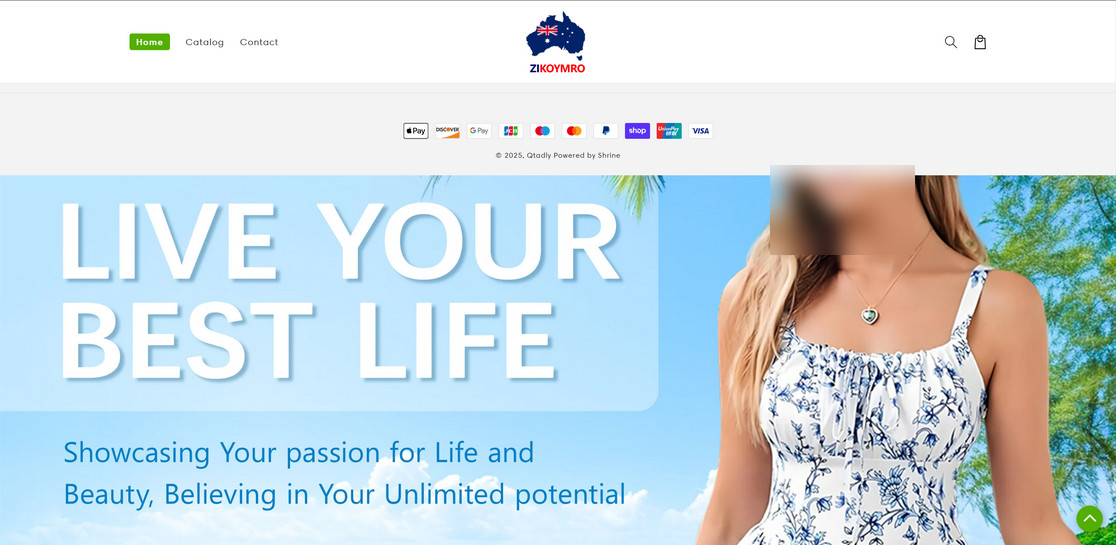
Qtadly.com was an online store that launched in 2025. Our July 2025 screenshot shows its homepage branded “ZIKOYMRO,” with a map of Australia carrying the Australian flag.
The footer named the store differently, reading “© 2025, Qtadly Powered by Shrine.” The menu offered only Home, Catalog and Contact, above a large lifestyle banner.
No company name, address or registration number appears anywhere in that screenshot.
Why Qtadly.com Is Gone
The domain qtadly.com was created on May 28, 2025, with a one-year registration.
That date comes from a WHOIS record published by the review site De-Reviews in June 2025.
Today the .com registry has no record of qtadly.com, and the name has no DNS records. The registration lapsed after its first year and wasn’t renewed.
No sign of the store at a new address has turned up.
Our Verdict
Qtadly.com was a high-risk store that no longer exists. There is nothing to buy there now, and any store reusing its name or ZIKOYMRO logo deserves the same caution.
- The store showed one brand on its logo and another in its footer.
- Its homepage showed no company name, address or registration number.
- Its domain was registered for a single year and has now lapsed.
- No Trustpilot page or readable archive copy of the store exists.
- If you paid it, your card issuer or bank is the only realistic route to a refund.
Is Qtadly.com Still Online?
No. Qtadly.com doesn’t load, and neither does www.qtadly.com. Neither name returns any DNS records.
The registry lookup for qtadly.com returns “not found.” A .com name usually drops out of the registry when its registration isn’t renewed.
According to the WHOIS record published in June 2025, the registration was due to expire on May 28, 2026.
The domain was registered through NameSilo. A registry record like this never lists the owner, and the store’s homepage didn’t name a company either.
The Wayback Machine lists a single capture of qtadly.com, from July 12, 2025. That copy can’t be opened today, so our own screenshot is the main record of the store.
Is ZIKOYMRO Linked to Other Stores?
No live store using the ZIKOYMRO or Qtadly name appears in web search results. Lookalike addresses such as zikoymro.com, zikoymro.com.au, qtadly.shop and qtadly.net don’t resolve.
Trustpilot has no company under either name. There is no known clone to warn about, but the name could still return on a new domain.
If you see the ZIKOYMRO logo or the Qtadly name again, check the web address, the registration date and the company details before you buy.
Qtadly Reviews: What Exists and What Doesn’t
Qtadly reviews are scarce because the store lived only a short time. Trustpilot has no page for qtadly.com, and searching Trustpilot for ZIKOYMRO returns no companies.
That absence cuts both ways. There are no buyer complaints on record, but there are no satisfied customers either.
One automated rating site scored the store poorly while it was online.
In June 2025, De-Reviews gave Qtadly.com a 3% trust score and noted its domain was less than a year old.
That score comes from automated checks rather than buyer experiences. On its own, it doesn’t prove what happened to orders.
What the missing reviews do show is that Qtadly never built a public track record.
A store with real customers usually leaves some trace, such as reviews, social media pages or a support history.
What the Qtadly Storefront Showed
Our July 2025 screenshot is small, but it reveals several details worth checking on any similar store.
A Name That Didn’t Match
The logo read “ZIKOYMRO,” while the footer and web address said “Qtadly.” A real brand rarely trades under two unrelated names on the same page.
Neither name matches any company in the screenshot, and neither has a Trustpilot profile.
An Australian Flag With No Australian Details
The logo placed the Australian flag on a map of Australia. That suggests the store targeted Australian shoppers or wanted to look local to them.
Yet the screenshot shows no Australian Business Number, address or phone number. A flag in a logo is decoration, not proof of where a business operates.
A Shopify Theme Credit and Payment Badges
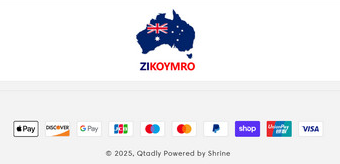
The footer credited Shrine, a commercial Shopify theme, and displayed a Shop Pay icon, which appears on stores using Shopify’s checkout.
It also showed nine other payment logos, from Apple Pay to Visa.
Those logos are images that any store can display, and they don’t mean a payment company vetted the seller.
A Slogan Instead of Products
The banner promised to help shoppers “LIVE YOUR BEST LIFE.” It didn’t name a single product, collection or price in the captured view.
Without product names in view, the screenshot can’t show what Qtadly sold or at what price. Buyers who kept their order emails hold that detail.
How Short-Lived Stores Like Qtadly Operate
Qtadly shares a pattern with many stores that appear and vanish within a year. Each step below matches something visible in its record.
Step 1: A Fresh Domain on a One-Year Registration
The domain was created on May 28, 2025 and registered for one year. Short registrations cost little and leave nothing behind when they lapse.
Step 2: A Ready-Made Theme and an Unknown Brand
A commercial theme lets a store look polished within hours. Qtadly paired its theme with a brand name, ZIKOYMRO, that appears nowhere else in the record.
Step 3: Payment Badges and a Local Look
The row of payment icons and the Australian flag create a sense of safety and familiarity. Neither tells you who will ship your order.
Step 4: A Short Selling Window
Our report went live on July 4, 2025, about five weeks after the domain was created. The only archive capture followed on July 12.
Step 5: The Store Disappears
By November 2026, the domain had dropped out of the registry. Anyone who ordered can no longer reach the website, its contact page or its order tracking.
What Happens to Orders When a Store Disappears
When a store’s domain lapses, everything tied to it goes dark at once. The website, the order-tracking page and the contact form all stop working.
Any email address ending in @qtadly.com can’t receive mail either, because the domain no longer exists. Messages sent to a store address on that domain will bounce.
That is why records matter. Order confirmations, card statements and screenshots are what a bank needs to decide a dispute once the seller has vanished.
If you still have an order email from Qtadly, keep it with your statement. It is the strongest proof that you paid and what you expected to receive.
Qtadly.com Timeline
The record of Qtadly.com is short, which is itself a warning sign:
- May 28, 2025: qtadly.com is registered through NameSilo for one year, and its first security certificates are issued.
- June 30, 2025: De-Reviews publishes an automated review scoring the site at 3%.
- July 2025: MalwareTips captures the ZIKOYMRO storefront and publishes a warning on July 4.
- July 12, 2025: the Wayback Machine records its only capture of the domain.
- December 2, 2025: the site’s security certificates are renewed for the last time.
- May 28, 2026: the one-year registration reaches its expiry date.
- November 2026: the .com registry has no record of qtadly.com, and the site doesn’t load.
What Qtadly’s Domain Record Tells You
A domain’s registration record is one of the few facts a store can’t easily fake. Qtadly’s record showed a brand-new name registered for the minimum one year.
Its name servers, NS1 to NS3.DNSOWL.COM, are NameSilo’s own DNS service. That setup is cheap and quick to configure, and it reveals nothing about who runs the store.
You can check any store’s record yourself with ICANN’s free registration data lookup. Enter the domain and look at the creation and expiry dates.
A store created weeks ago, with a one-year expiry and no company named on its pages, hasn’t earned your trust yet. Very new domains deserve extra checks.
What Qtadly’s Certificate Record Shows
Every HTTPS website needs a security certificate, and each one issued is published in public certificate transparency logs. Those logs give Qtadly a second timeline beside its domain record.
The first certificates for qtadly.com were issued on May 28, 2025, the same day the published WHOIS record gives as the domain’s creation date.
New certificates followed about every two months, from Google Trust Services and Let’s Encrypt. Automatic renewals like these normally continue only while a domain still points to a working site.
The last renewals came on December 1 and 2, 2025. Those certificates expired in early March 2026, and no new ones appeared until the registration’s expiry date.
That gap suggests the store stopped running between December 2025 and March 2026, months before the domain lapsed. Orders from those months are now past the usual 120-day card window.
A final set of certificates was issued on May 28, 2026, the day the registration expired. The domain wasn’t renewed and has since dropped out of the registry.
If You Gave Qtadly Your Details
Anyone who ordered from Qtadly handed over a name, delivery address, email and possibly a phone number. Those details can outlive the store itself.
Be wary of texts or emails about a “held parcel” or “failed delivery” that ask for a fee or card details, even if they mention Qtadly.
Qtadly’s header showed search and cart icons but no account sign-in link. If you did create a Qtadly password and reused it elsewhere, change it on those sites.
Why Australian Shoppers Should Look Twice
Qtadly’s logo put the Australian flag on a map of Australia. That kind of branding makes a store feel local, even when nothing else on the page backs it up.
Australian businesses are issued an Australian Business Number. If a store claims to be Australian, you can look up its business name or ABN on the government’s ABN Lookup.
Qtadly’s homepage gave no ABN or business name, so there was nothing to check on ABN Lookup. That alone was reason to wait before ordering.
How Qtadly Compares With Other Short-Lived Stores
Qtadly fits a wider pattern of stores that borrow a local look. Our report on Coral Bloom Boutique Australia covers an Australian-branded store built around flash-sale promotions.
Some stores lean on a shared business address instead of a flag. Our investigation into 30 N Gould St, Sheridan, WY shows how one address appears on many store sites.
Our report on Comstylish.com covers a discount store we flagged as a scam. Qtadly’s record is thinner, with no buyer complaints on file.
Not every young store is a scam. Our review of Lassloom shows a store that ships real clothing but makes returns hard.
How to Check an Unfamiliar Store Before You Buy
Qtadly’s record suggests a few quick checks that apply to any new store:
- Compare the logo, the footer and the web address. They should all name the same business.
- Read the footer. A theme credit such as “Powered by Shrine” names the store’s template, not the business behind it.
- If a store uses two names, search for reviews under both, since complaints may be filed under either one.
- Treat a flag or local-sounding name as decoration until the store proves where it operates.
- Save the order confirmation and a screenshot of the product page until your parcel arrives. Qtadly’s pages vanished with its domain.
Fraudulent shopping websites often share common patterns that make them easier to detect once you know what to look for. Before entering personal information or making a payment, take a few minutes to check for these warning signs:
- Unrealistic prices and discounts
If a website offers products at prices far below trusted retailers, it’s often a red flag. Many of these sites advertise luxury or high-demand products at massive discounts to create a sense of urgency. A $300 product listed for $49.99 should immediately raise suspicion. - Recently registered or suspicious domain names
Many fraudulent websites operate on newly created domains that disappear after a few weeks. Look for signs like random characters in the URL, misspellings of well-known brands, or hyphenated domains.
You can check a site’s age using tools like WHOIS lookups or ScamAdviser. - Missing or vague company details
Legitimate businesses clearly display their company name, tax information, phone numbers, physical address, and return policies. Fraudulent sites often provide incomplete, fake, or no company details at all. A lack of verifiable contact information is a major warning sign. - No reliable customer service
Real businesses provide clear ways to contact support—email, phone, live chat, or physical return addresses. Fake stores often list nonfunctional contact forms, invalid phone numbers, or reply with generic automated messages. - Poor website quality and structure
Many fake stores are set up quickly with low-effort templates. Look for poor grammar, spelling errors, low-resolution product images, broken links, or missing legal pages (Terms of Service, Privacy Policy, Return Policy). A sloppy website often signals something isn’t right. - Copied product descriptions and images
Fraudulent sites often lift product listings directly from real retailers or marketplaces. If you reverse image search a product photo and find it on multiple unrelated websites, the listing is likely not original. - Lack of credible reviews or suspicious review patterns
A real store will usually have a mix of customer reviews across different platforms. Warning signs include no reviews at all, obviously fake five-star reviews, or multiple identical reviews posted on the same day. Searching “[website name] reviews” or “[website name] scam” on Google often reveals warnings from other consumers. - Unclear or unfair return and refund policies
Fake stores often use vague language around returns and refunds—or avoid the topic entirely. If you can’t easily find clear instructions for how to return an item or get a refund, proceed with caution. - Aggressive urgency and pressure tactics
Fraudulent websites commonly use fake scarcity (e.g., “Only 2 left in stock!”) or countdown timers (“Sale ends in 10 minutes!”) to push you to buy before you think it through. Legitimate stores don’t rely on fabricated urgency to make sales.
Quick Steps to Verify a Website’s Legitimacy
Before entering payment or personal details on a new shopping website, take a few simple precautions:
- Search for the store’s name along with words like “reviews” or “complaints” on Google and Trustpilot.
- Check the website’s domain registration using Whois.com.
- Use trusted tools to scan for malicious or fraudulent links:
- Malwarebytes ScamGuard – detect scams and unsafe links before they reach you on Android and iOS phone.
- Malwarebytes Browser Guard – block dangerous or fake websites on Windows and macOS browsers.
- Verify the business address on Google Maps to ensure it’s a legitimate location.
- Review the store’s accepted payment methods – credit cards and PayPal are traceable and safer than cryptocurrency or bank transfers.
- Trust your instincts; if something feels off, it’s better not to proceed.
How to Spot Similar Scams on Social Media
Many fraudulent shopping websites rely heavily on sponsored social media ads to draw in large numbers of potential buyers. These ads often promise extraordinary discounts—sometimes up to 90% off—and use emotionally charged language to push users into buying immediately.
They frequently appear on Facebook, Instagram, and TikTok, blending in with legitimate content. However, these ads follow predictable patterns that make them easier to identify once you know what to look for.
Spotting Fraudulent Facebook Ads
Facebook’s advertising platform is a favorite tool for fake online stores because of its massive reach. These ads often feature “unbelievable” offers designed to create urgency and bypass critical thinking. Warning signs include:
- Extreme, unrealistic discounts such as “90% OFF,” “Store Closing Sale,” or “Final Liquidation.” Real retailers rarely discount new products this aggressively.
- Poor grammar, awkward phrasing, or inconsistent language throughout the ad or website, indicating low-effort, mass-produced content.
- Generic stock photos or images with watermarks, suggesting the images were taken from legitimate brands or stolen from other sources.
- Recently created Facebook Pages, which is common for temporary fraudulent campaigns. Check the “Page Transparency” section to see when the page was created.
- Limited or no engagement from real customers. Authentic brands usually have reviews, comments, and visible user interaction.
If an ad raises doubts, search for reviews of the website or reverse image search the product photos to see if they’re copied from elsewhere. Never provide payment information until the site is verified.
Spotting Fraudulent Instagram Ads
Instagram is another major platform used to promote fake shopping sites through eye-catching visuals and short-lived “flash sale” captions. Warning signs to look for:
- New or disposable accounts with few posts and followers, often created just weeks or days before launching ads.
- Lack of tagged users in product posts. Legitimate stores often feature real customers, influencers, or product usage.
- Unsecured checkout pages. If the website linked in the bio does not use HTTPS, do not enter payment information.
- Fake or missing customer reviews. Fraudulent stores rarely have authentic purchase feedback.
- Unclear or restrictive return policies, often hidden or written vaguely to make refunds difficult.
When in doubt, search for independent reviews before buying, and only enter payment details on verified, secure websites.
Catching Fake TikTok Ads
TikTok is increasingly used to promote questionable shopping deals through short, persuasive videos. While many ads look polished, the same red flags apply:
- Links to unknown stores that don’t appear in search results or have no external reputation. Many of these sites are temporary and disappear after a short time.
- No verification badge on the TikTok account. While not every legitimate store is verified, the lack of a badge is one more indicator to check further.
- Aggressive countdown timers or “one-day only” promotions designed to rush decision-making.
- Lack of genuine customer reviews or real user content demonstrating the product in actual use.
- Comment sections filled with complaints or warnings from other users. This is often the first place victims speak up.
TikTok scams often rely on impulse buying. Take a moment to verify the website, read independent reviews, and use trusted browser protection before visiting external links.
What to Do If You Ordered From Qtadly
- If your order never arrived or didn’t match the listing, dispute the charge with your card issuer or bank. Give the order date, amount and any emails.
- Card disputes often must be filed within about 120 days of the charge or expected delivery. Ask anyway if you’re past that, and note the call date.
- PayPal disputes close 180 days after payment, so that window has passed for 2025 Qtadly orders. Your card issuer may still help if PayPal was funded by a card.
- If you paid with Apple Pay, Google Pay or Shop Pay, raise the dispute with the bank that issued the linked card.
- If you see charges you don’t recognize after a Qtadly order, ask your bank to cancel the card and issue a new number.
- Ignore anyone who offers to recover your money for a fee. Refund recovery offers are a common follow-up scam.
- Australian buyers can report to Scamwatch at Scamwatch.gov.au. US buyers can report to the FTC at ReportFraud.ftc.gov.
Frequently Asked Questions
Is Qtadly.com legit?
Treat it as high risk. Its homepage showed no company details, the store used two names, and it left no track record before its domain lapsed.
Is Qtadly.com still working?
No. The domain is no longer registered and doesn’t load. The .com registry returns no record for qtadly.com.
What are Qtadly reviews like?
There are almost none. Trustpilot has no Qtadly page, and one automated rating site scored it 3% in June 2025.
What was ZIKOYMRO?
ZIKOYMRO was the brand name in the Qtadly.com logo in July 2025, shown on a map of Australia. The homepage named no company behind it.
Can I get my money back from Qtadly?
Possibly, through your card issuer or bank. Dispute the charge as goods not received or not as described. The usual deadlines have likely passed, so ask anyway.
How can I avoid stores like Qtadly?
Check that the logo, footer and web address match, look for real company details and search for reviews before you pay. Use a credit card for the strongest protection.
The Bottom Line
Don’t buy from Qtadly.com or any store that reappears with its name or ZIKOYMRO logo. Its homepage named no company, it used two brand names and its domain has lapsed.
If you paid Qtadly, ask your card issuer or bank to dispute the charge now, even if the usual deadline has passed. Keep your order emails as proof.
This article is for informational purposes only and should not be relied upon for financial or business decisions. We identify potential scams using research, user experiences, and expert analysis. However, all claims should be independently verified. Mistakes may occur, and legitimate products could be flagged. We strive for accuracy but make no warranties regarding the completeness or reliability of the information.

If you are the owner of the website or product in question and wish to offer clarifications regarding your business or website, please reach out to us via our Contact form.

Reviews & discussion
0 commentsShare a firsthand experience, or ask a question.
Community reviews
qtadly.com
Moderated reader experiences, not an editorial verdict.
Start the conversation
Have a question or something useful to share? Add the first comment.