


The email says your parcel is on hold. It gives you a tracking number and asks for a small payment, the sort of amount you might approve without thinking much.
If it claims to come from RAM Courier, take a moment to find the order you’re expecting. That will tell you more than the email’s delivery timeline.
Overview
A parcel on hold and a fee of R16.13
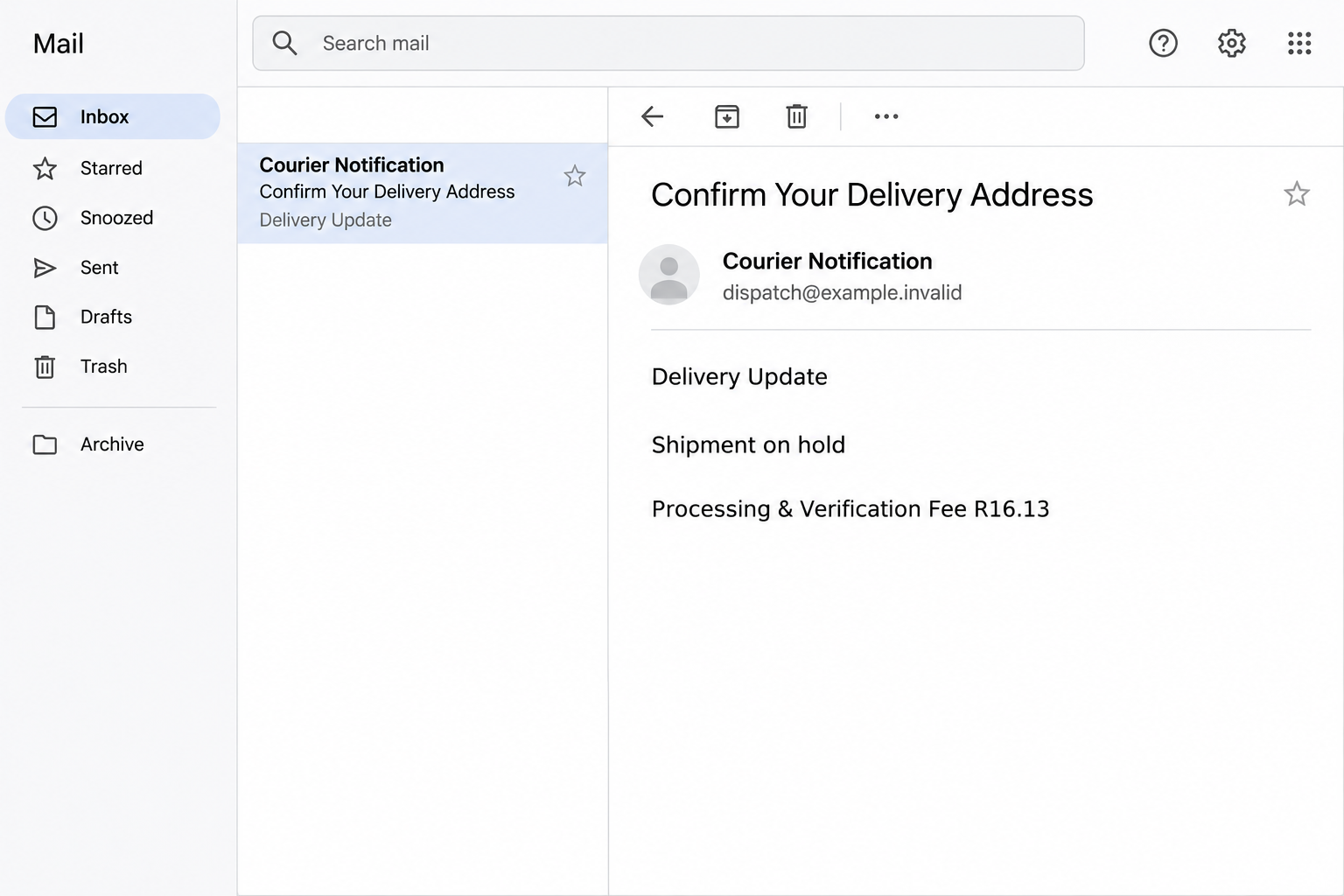
The RAM Shipment On Hold email scam impersonates RAM, the South African courier. The message says an address needs confirmation and asks for a R16.13 processing and verification fee.
The fee is in South African rand. The small amount makes it sound like a simple delivery issue, not the kind of transaction most people would investigate at length.
The email shows a waybill-style number and uses a delivery-status sequence. That presentation makes the request look linked to an individual package rather than a general notice.
The image above reconstructs the opening email. It leaves out the supplied tracking number and action, neither of which should be used to check your own shipment.
The payment page wanted much more than an address correction
The reported destination copied the courier’s identity and laid out a bill with line items for charges and tax. It looked more detailed than the original fee notice.
The next stage requested identity and contact information, including an ID number. After that came a form for card details. Neither form was a verified RAM service.
This is not only about losing R16.13. The information requested could be much more valuable to an impersonator than the advertised fee.
The recorded screens establish the requests, not a successful payment or a specific theft. Think about what you personally submitted before deciding what to secure.
A real package does not confirm a message about it
Someone may be waiting for a mobile phone, a replacement bank card, or goods from a shop that uses RAM. That makes an unexpected courier email feel timely.
Start with the business or person that sent the parcel. Their dispatch confirmation is a better source for a tracking number than a demand for payment.
These checks give you something concrete to compare:
- Find the order or dispatch record in the merchant account you already use.
- Confirm the courier and waybill independently if the original order doesn’t show both.
- Look up the number through RAM’s official tracking page, not a page opened by the message.
- Use RAM’s official contact page to ask about a genuine hold without sending card details or a full identity document.
How the RAM Shipment On Hold Scam Works
Step 1: The message makes a shipping issue feel personal
The opening message gives a specific tracking number and says the parcel has stopped moving. Those details can make it sound as if someone looked at your shipment.
A tracking number alone doesn’t do that. The number in an email could be made up, copied, or associated with another sender or delivery.
The recipient is left to supply the context. Anyone who bought something recently can picture which package might be stuck and why they should act.
Compare the details with the order you actually placed. If you don’t know what the message refers to, avoid clicking simply to identify the shipment.
If it might be a gift, ask the person you know sent it. A conversation started from an established contact is safer than a mystery parcel investigation inside the email.
Step 2: An address correction becomes a tiny payment
The email frames the hold as a routine administrative problem. A small fee looks like the final nuisance between you and delivery.
The number can make an important difference to how the reader thinks about it. Many people check an expensive purchase but wave through a small charge.
The message doesn’t prove that either the courier or the seller assessed that charge. Find out who is responsible before paying anyone.
If the issue genuinely is an incomplete address, the merchant or verified courier can explain what is wrong and how to correct it.
Some shipments carry legitimate charges under particular arrangements. That possibility is a reason to verify the balance through an independent route, not a reason to trust this one.
Step 3: A detailed bill gives the fake page a professional appearance
The link opens a RAM lookalike that itemizes costs. The reported screen included transport-related line items and VAT.
A detailed breakdown can make a page look connected to real systems. But it’s easy to display an invoice-style layout without producing an actual shipment record.
Check whether the same charge exists in the carrier’s independently verified records. A web address reached only from the message isn’t a second source.
A real charge should have a clear explanation attached to a real waybill. If the receipt or order says another party pays, ask the merchant and carrier to reconcile it.
Step 4: The address check asks for identity information
The imitation page requests details such as the recipient’s name, ID number, contact information and home address. That goes beyond confirming a misspelled street or missing unit number.
It’s especially easy to supply those details once you believe the parcel is already attached to you. The form looks like a continuation of something you started.
Sometimes a courier legitimately needs specific information for a shipment. The right test isn’t whether the question is imaginable. It’s whether the genuine carrier requires it through a verified route.
If you already typed an ID number or contact details, keep a note of which fields you completed. There’s no need to return to the page to recreate the experience.
Step 5: The fee leads to a card details screen
After the identity request, the documented site asks for card details and contact information. The original R16.13 headline is still the reason you’re there.
A person who sees a declined payment or error message shouldn’t assume the card data stayed private. The result on screen doesn’t establish what the site received.
No confirmed later purchase is needed before you talk to the issuer. If you gave up card data, report that fact and take the measures the issuer recommends.
The real delivery and this card exposure are now separate problems. Tracking the parcel won’t close a security incident, and freezing the card won’t fix the parcel’s address.
How to Check Whether RAM Really Has Your Parcel
Trace the number back to the person who sent it
Open the seller’s account or receipt yourself. Check the dispatch date, courier and destination information you originally gave them.
If the seller shipped through a marketplace, go through its ordinary support channel. Ask for the confirmed waybill instead of pasting the suspicious link into a new chat.
A valid number displayed on the fake page might still belong to a different delivery. Compare the details carefully and let the carrier explain any mismatch.
If you receive repeated hold notices after your order has already arrived, don’t treat a new message as evidence of a second shipment. Establish that a second shipment exists first.
Verify the hold and the requested action separately
An actual tracking page can confirm a shipment status. It may not explain why the address is incomplete or whether a charge is owed.
When the reason is unclear, contact the courier or seller using information from a trusted source. Ask who can update an address and whether there is a charge.
If the sender says only they can make a correction, follow the merchant’s verified process. It can differ from the instructions in an unsolicited email.
If a legitimate fee applies, ask how to pay it safely. Don’t return to the message just because some parts of the shipment story turned out to be true.
Don’t prove a delivery by giving away more data
A merchant usually has at least some order information already. Find out why anything new is needed before you provide a full ID number or copy of a document.
Keep the original alert separate from the official ticket. You can explain the suspected impersonation without giving a private service agent every piece of information requested by the fake form.
Check whether you are handling the delivery as the sender or the receiver. If someone else arranged it, the carrier may need instructions from that person or account.
If you have a shop or business that sends many parcels, use its transaction records to match the waybill before anybody authorizes a charge.
Don’t rely on a shared inbox alone.
Use the same rule for refunds. A refund should tie back to a verified payment, not to a new website asking to confirm another card.
If a second message calls itself a refund or support notice, start a new conversation with the actual company. Don’t give it a chance to explain away the first request.
If a package contains something sensitive, ask the real sender what to do if tracking shows delivery you cannot confirm. Don’t post the waybill and your address together publicly.
If you need to send an order confirmation to verified support, check what it contains first. An ordinary parcel inquiry doesn’t require your full bank statement.
What to Do If You Fell Victim
-
Close the page and work out what you submitted.
Reading the email or seeing the page doesn’t mean your card was charged. If you stopped before typing anything, report the notice and verify the genuine shipment separately.
If you typed or submitted information, write down the fields and the approximate time. Don’t put card details, codes or a full ID number in an incident note.
Use your email provider’s report feature. Share the original privately only if the real bank, carrier or reporting body says it needs it.
-
Contact the card issuer if you entered payment details.
Open the banking app yourself or use the number on the card. Say that the card was entered on a site impersonating a courier.
Ask what to do about locking or replacing the card and monitoring transactions. Mention any banking code or verification prompt you used, even if the page showed a failure.
If a charge is pending or has posted, tell the issuer the time and amount. Don’t assume the advertised amount is the only activity worth checking.
-
If you disclosed identity information, explain exactly what was exposed.
Check the guidance from your bank and the relevant identity-document or fraud-reporting authority. Let them know whether you supplied a number, a copy or additional personal information.
If someone contacts you later using your address, phone number or a parcel reference, don’t treat that familiarity as proof. Contact the real organization independently.
Use a trusted local process to report signs of impersonation. Avoid sending an unredacted copy of your identity to a service you found through a follow-up message.
-
Report unauthorized activity and keep the evidence.
Save the subject, timestamp, transaction record and relevant communications if you have them. Follow your bank’s verified reporting process for any suspected payment fraud.
If a request to send a code, approve a prompt or install something came later, describe that separate action. The documented offer itself showed identity and card forms.
Don’t pay anyone who says another courier fee is needed to reverse the first one. Ask the issuer what can actually be investigated or disputed.
-
Resolve the real shipment through its actual sender.
Verify the genuine waybill and whether a hold exists. If the delay is real, ask what needs correcting and who can do it safely.
Don’t let the fear of losing an order delay a bank report. You can deal with the parcel and a card disclosure independently.
If another household member is expecting the parcel, tell them not to use the email. Send them the verified tracking route rather than forwarding the fake notice.
Frequently Asked Questions
Is the R16.13 RAM processing fee legitimate?
That amount appeared in a fake hold email that led to identity and payment forms. Verify any genuine charge through RAM or the seller before paying.
Does a tracking number make the email safe?
No. Verify the waybill using the merchant’s dispatch record and RAM’s own site. A number in a message does not prove that message came from the courier.
Why would the page ask for my ID number?
The fake site used an address correction as a reason to ask for identity and contact information. Don’t submit it unless the genuine carrier verifies the requirement.
What if my bank shows no payment?
If you entered card details, contact the issuer anyway. An empty transaction list or a checkout error does not show whether the details were exposed.
Does the scam mean my parcel won’t be delivered?
Not necessarily. The genuine shipment may still go ahead. Check its status separately rather than treating the email’s hold claim as a tracking update.
Is the actual RAM courier responsible for the fake form?
The documented website impersonated the courier. Use RAM’s independent tracking and support channels for a real shipment and your bank for any card disclosure.
The Bottom Line
Don’t pay the R16.13 fee through the email. Check the waybill from your order and confirm any genuine hold directly with RAM or the sender.
If you entered card or identity details, act on that exposure now. An actual parcel can wait while you contact your issuer and protect your information.

Join the discussion
0 commentsShare your experience or ask a question about this article.
Discussion
Start the conversation
Have a question or something useful to share? Add the first comment.