

Snidin presents a fashionable facial serum combining bakuchiol, vitamin C, peptides, ceramides, rose water, and other familiar skincare ingredients.
The deeper you read, the stranger the page becomes. Facial claims give way to hair-growth surveys, scalp instructions, and unfinished store policies.
Overview
The Product Starts as a Facial Serum
The item is titled Snidin Bakuchiol Facial Serum with Vitamin C and Peptides, sold in a 30-milliliter bottle.
The upper page describes fine lines, dark spots, uneven tone, elasticity, hydration, and barrier support.
It references bakuchiol, acetyl hexapeptide-8, palmitoyl pentapeptide-4, niacinamide, red wine extract, ceramides, squalane, and hyaluronic acid.
Those are recognizable skincare terms, and the presentation initially resembles an ordinary anti-aging cosmetic page.
The Copy Then Switches to a Hair Product
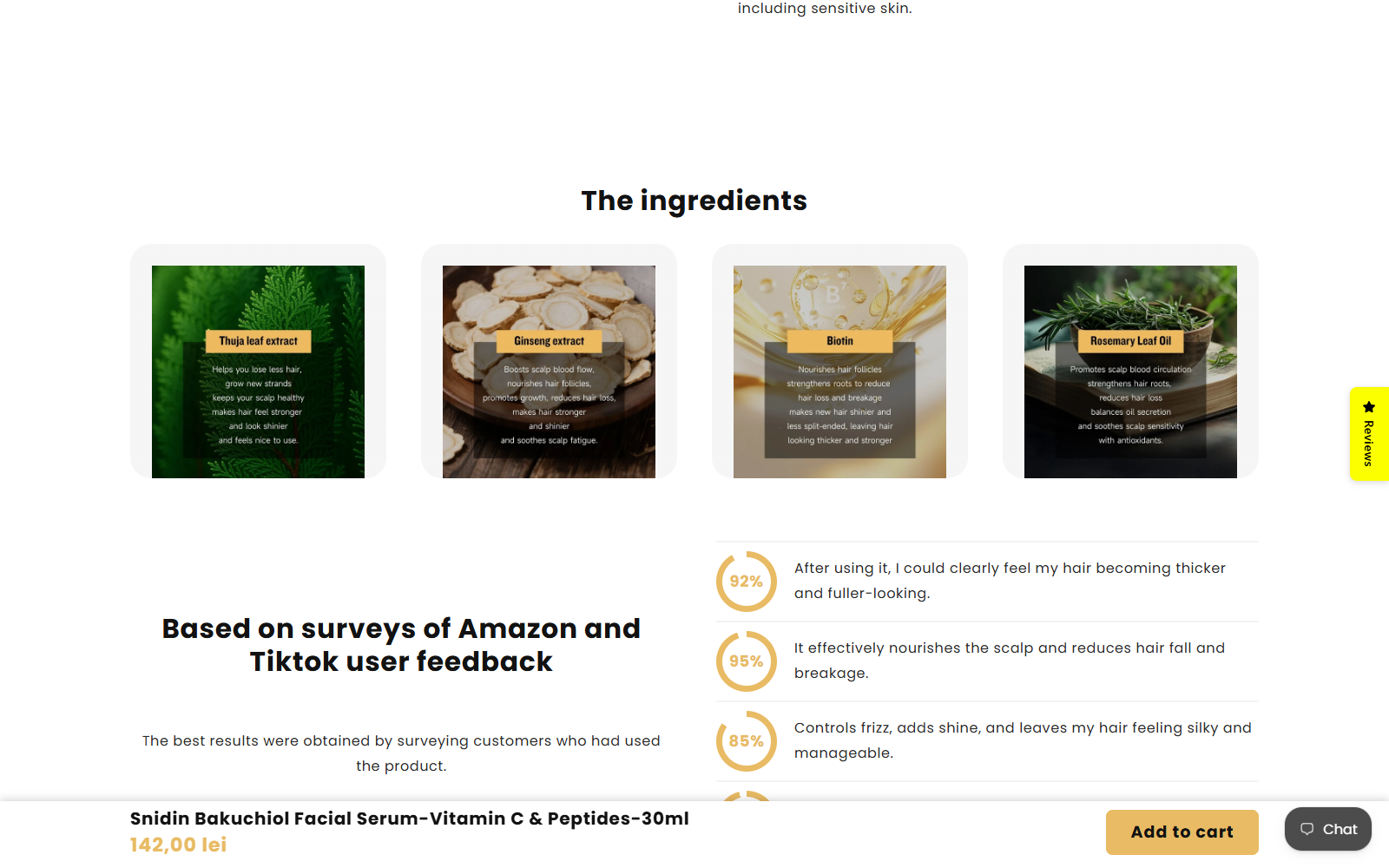
Farther down, the same page claims 92% felt their hair becoming thicker and 95% experienced less hair fall and breakage.
Its ingredient cards discuss thuja, ginseng, biotin, and rosemary for scalp circulation and hair follicles.
Application directions tell customers to mist the formula onto clean hair, focus on the scalp, massage it, and avoid rinsing.
The product title and bottle describe a facial serum. Those hair instructions plainly belong to something else.
The Store Contains Unfinished Template Material
The contact page still addresses shoppers as customers of “[Your company].” The about page repeatedly calls the business “my store.”
The refund policy tells customers to send returns to “[INSERT RETURN ADDRESS],” meaning no usable return destination was completed.
These are not subtle editorial slips. They affect who operates the shop, how support works, and whether a buyer can exercise return rights.
Our primary warning signs include:
- A facial serum page contains hair-growth claims and scalp directions.
- The scientific explanation switches to moisturizing cotton pads.
- The FAQ asks what a hydrating cotton pad is.
- The contact page retains a company-name placeholder.
- The refund page retains a return-address placeholder.
- Sale items and beauty products may be excluded from returns.
- The page claims an FDA-certified cotton pad, not the displayed serum.
- Made in China is disclosed, but the responsible manufacturer is not clearly named.
A Copy-Paste Product Page Is a Serious Warning
Retail pages sometimes contain small mistakes. Snidin’s errors are different because they change the identity, use, evidence, and science of the product.
A facial serum is applied to the face. A scalp mist is sprayed through hair. A cotton pad is a separate product format.
Combining all three on one page makes it impossible to know which claims, ingredients, survey figures, and instructions apply to the bottle being sold.
Incorrect instructions can create safety problems. A formula suitable for facial application may not be designed as an aerosol or leave-in scalp treatment.
The reverse is also true. Hair-product directions should not be used to justify prolonged facial exposure.
A responsible seller should stop sales until the label, page, safety directions, and evidence all describe the same item.
The Survey Figures Do Not Establish Results
Snidin says its results came from 1,884 users between December 2025 and February 2026.
The surrounding heading says the figures are based on Amazon and TikTok user feedback.
No study protocol, product identifier, recruitment method, raw responses, control group, or independent analysis is supplied.
Most importantly, the reported outcomes concern thicker hair, reduced hair fall, frizz control, shine, and scalp nourishment.
Those outcomes cannot validate a facial serum marketed for fine lines, dark spots, and uneven tone.
The mismatch suggests copied promotional material rather than a study conducted on the displayed product.
How the Snidin Copy-Paste Store Works
Step 1: The Store Uses Trending Skincare Ingredients
Bakuchiol is often promoted as a plant-derived alternative to retinoids. Vitamin C and peptides are familiar anti-aging search terms.
Combining them produces a product title that sounds current, scientific, and easy to discover through social media advertising.
A fashionable ingredient list can capture attention even when the seller provides little evidence about the actual formula.
Step 2: The Page Builds a Premium Skincare Story
Early sections discuss radiance, firmness, hydration, fine lines, dark spots, and the skin barrier.
The language is detailed enough to feel authoritative, but it does not provide concentrations or testing for the exact finished formula.
Without amounts, compatibility testing, and a complete label, ingredient names alone reveal little about performance.
Step 3: Copied Modules Introduce a Different Product
The page abruptly moves to botanicals described for scalp circulation, stronger roots, hair growth, and less breakage.
Survey percentages also measure hair outcomes. Directions tell users to mist the scalp once or twice daily.
These sections contradict the product title and expose a store-building process that was not properly reviewed.
Step 4: Scientific Language Changes Again
A later section explains how moisturizing cotton pads retain water and strengthen the skin barrier.
The FAQ asks about a hydrating cotton pad, even though the item for sale is a bottled serum.
Reusing scientific copy from unrelated products creates authority without supplying evidence for the one in the cart.
Step 5: Urgency Pushes the Buyer Forward
The store repeatedly displays a 25% summer sale, a last-48-hours message, and another 10% offer for adding products to the cart.
Persistent urgency encourages checkout before the buyer reads the inconsistent lower sections.
When the product page is internally contradictory, no countdown is a good reason to proceed.
Step 6: Returns Depend on an Incomplete Policy
The policy advertises 30 days but requires the item to remain unused, tagged, and in original packaging.
It excludes personal-care goods and sale items, both of which may describe the serum.
Most critically, the return address is still a placeholder, so the policy does not tell customers where to send an approved return.
Company, Address, and Fulfillment Checks
The Legal Company Is Not Properly Identified
The reviewed contact, about, privacy, and refund pages do not clearly name the legal entity responsible for Snidin orders.
The about page uses generic phrases about “my store” and a worldwide collection for every passion.
That copy resembles a template for a broad dropshipping shop, not a transparent cosmetics manufacturer.
The Return Address Is Literally Missing
The refund policy instructs shoppers to send packages to “[INSERT RETURN ADDRESS].”
This makes the published process unusable unless support later provides a real location.
A buyer should never ship a return to an unverified address supplied through an unexpected message.
Support Looks Partly Finished
The contact page says “[Your company]” instead of Snidin. It offers a web form but does not provide a visible business telephone number or address.
The refund page uses info@snidin.com, while older policy text elsewhere on the store has retained generic placeholder wording.
Test support before buying. Ask who the legal seller is and where opened cosmetic complaints are handled.
The Label Must Identify the Real Supply Chain
The page states that the product is made in China. Country of origin alone does not decide quality or safety.
The important missing details are the named manufacturer, responsible importer, batch number, complete ingredients, safety assessment, and traceable quality records.
Do not rely on generic claims about professional suppliers. Inspect the delivered bottle and box before applying anything.
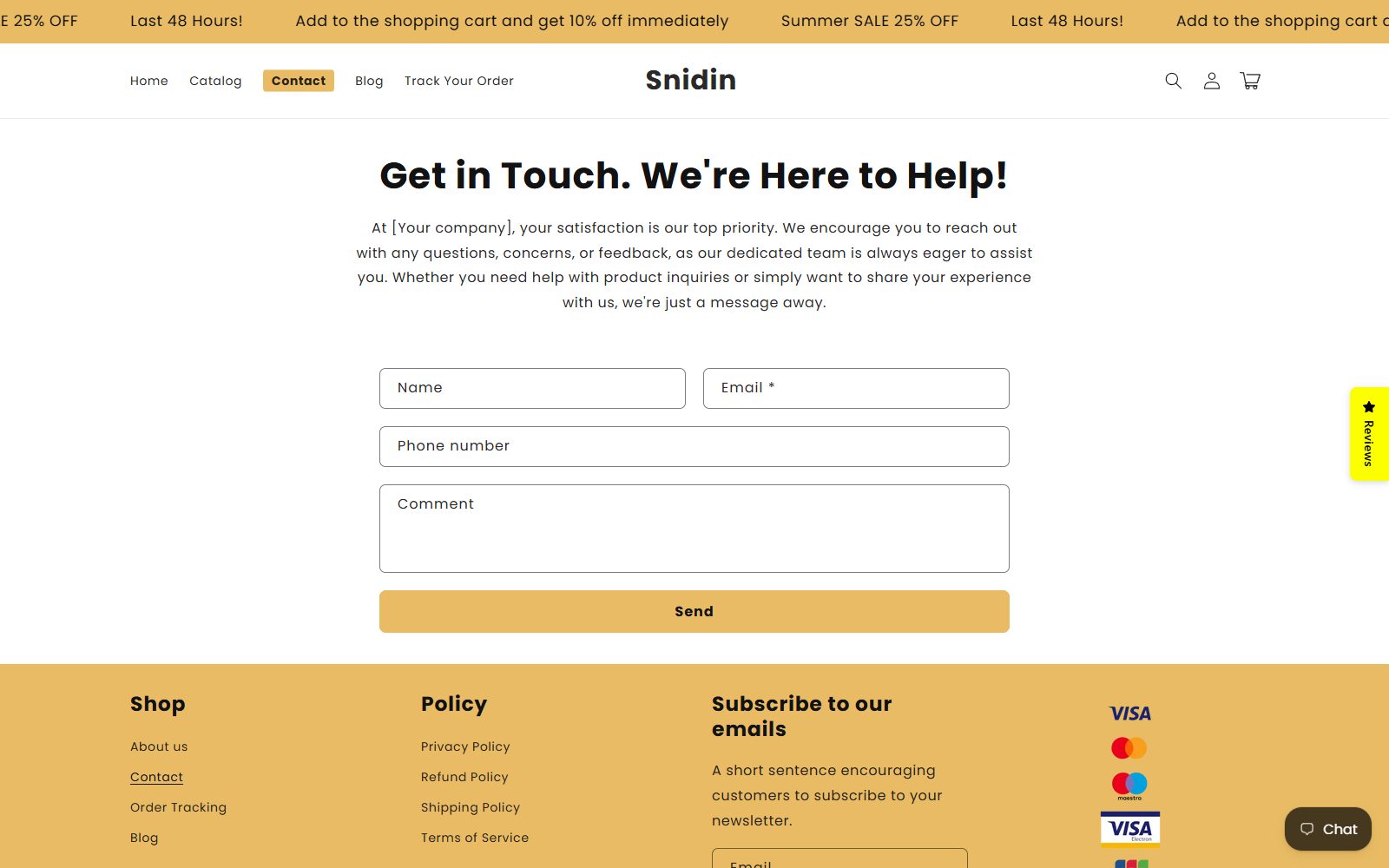
The Contact Page Confirms the Store Was Not Finished
The placeholder shown above is visible on a customer-facing page that collects names, email addresses, telephone numbers, and messages.
That is especially troubling because the form asks for personal information while failing to identify the company receiving it.
An unfinished contact template does not prove that no parcels are delivered. It does show weak operational care and poor accountability.
For a cosmetic applied to skin, buyers need a responsible party who can answer ingredient, allergy, batch, and adverse-reaction questions.
FDA Language Does Not Repair the Evidence
The page says a hydration cotton pad is certified by the U.S. FDA.
First, that statement concerns another product format. Second, ordinary cosmetics are not preapproved by the FDA, except for certain color additives.
Companies remain responsible for cosmetic safety and truthful labeling. Registration or regulatory compliance should never be presented as approval of performance claims.
A shopper should request the exact certificate, issuing body, product name, and verification link.
If the document identifies a factory, ingredient, cotton pad, or unrelated item, it does not validate Snidin Bakuchiol Facial Serum.
The Refund Policy May Exclude the Product
Snidin promises a 30-day return request period, but eligibility requires unused condition and original packaging.
The exceptions include personal-care goods such as beauty products. The policy also refuses returns for sale items.
The store simultaneously runs a 25% promotion and another cart discount, making the sale-item exclusion particularly important.
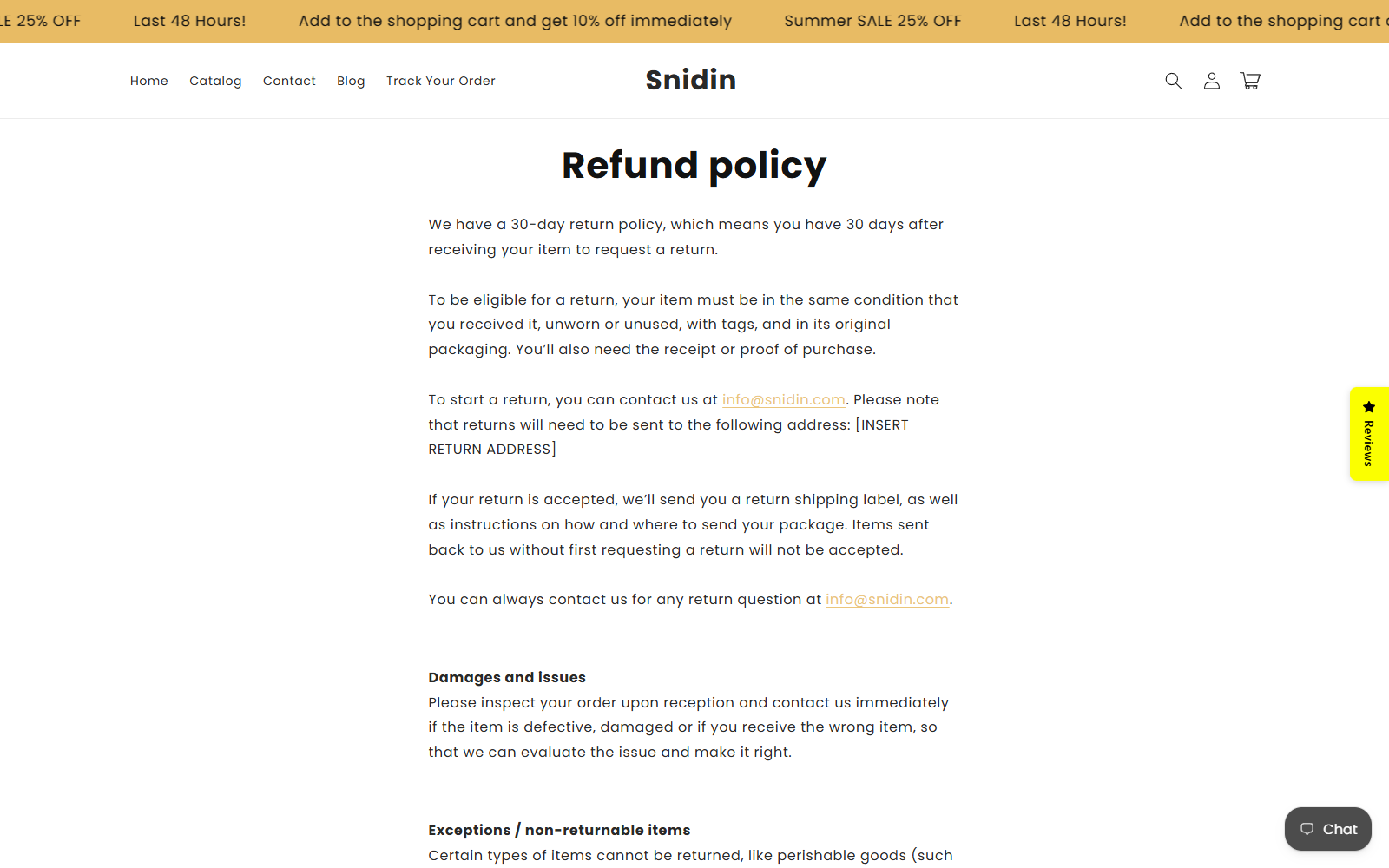
The missing address prevents a customer from independently checking shipping cost, jurisdiction, or whether the location accepts parcels.
Do not assume the 30-day headline guarantees a refund after trying the serum.
Ask whether this exact product is returnable after opening, whether discounted purchases qualify, and who pays shipping.
Require the answer in writing before purchase. A vague reply should be treated as a refusal to clarify.
How to Check a Cosmetic Store Before Paying
- Read the entire page for changes in product type or instructions.
- Compare the online ingredient list with clear photographs of the packaging.
- Search the legal company name, not only the brand.
- Verify the return address before checkout.
- Ask whether opened and discounted items can be returned.
- Look for batch numbers, responsible-person details, and country of origin.
- Demand evidence for surveys and certification claims.
- Use a credit card or another payment method with dispute rights.
Copy-paste mistakes are not cosmetic when they alter application instructions or describe a different product.
If a seller cannot keep the product identity consistent on its sales page, buyers should not guess what is inside the bottle.
How to Inspect the Bottle That Arrives
Do not assume the delivered serum matches the photographed bottle. Compare its name, volume, ingredients, directions, warnings, and responsible company.
Check whether the box and bottle share one batch code. Look for broken seals, leakage, unusual odor, spelling errors, or labels covering older text.
A cosmetic should not arrive as an anonymous liquid. Missing batch information makes complaints, recalls, and adverse-event investigations harder.
Photograph the unopened package from every side before testing it. Include the mailing label without posting personal details publicly.
If the ingredients differ from the sales page, do not use it merely because returning feels inconvenient.
Why Confused Copy Can Become a Safety Problem
Copy-paste mistakes are not only embarrassing. They leave customers unsure which directions and precautions belong to the product in their hands.
A scalp treatment may use a different amount, contact time, frequency, and application area from a facial serum.
Instructions for a cotton-pad mask introduce another method entirely. Combining mismatched directions could increase exposure or place ingredients near the eyes.
The seller should correct the page and provide product-specific instructions before asking customers to experiment.
When a store cannot explain its own item consistently, buyers should not fill gaps with guesses from unrelated beauty videos.
What to Do if You Have Fallen Victim to This Scam
- Do not apply an uncertain product. Compare the bottle, box, ingredients, directions, and manufacturer with the webpage. Stop if they conflict.
- Respond quickly to any reaction. Rinse as appropriate, stop use, keep the package, and seek medical advice for persistent irritation, swelling, burns, or breathing problems.
- Save the broken pages. Capture the hair survey, scalp directions, cotton-pad claims, company placeholder, missing return address, promotion, and checkout total.
- Request a written refund. State the exact contradictions and ask for a valid return address, authorization, prepaid label, and confirmation that the serum qualifies.
- Escalate if support fails. Provide the card issuer with screenshots, correspondence, package label, tracking, and proof that the published return process was incomplete.
- Protect personal information. Change reused passwords and monitor payment activity if you created an account on the unfinished store.
- Scan the device used for checkout. Malwarebytes can identify unwanted software. AdGuard can block many malicious ads and redirect pages.
- Report misleading cosmetics claims. Contact the relevant consumer and cosmetics regulator, advertising network, e-commerce host, and payment provider.
- Ignore recovery scammers. No stranger can guarantee a chargeback or refund in exchange for an upfront fee or remote access.
Frequently Asked Questions
Is Snidin Bakuchiol Serum a scam?
The unfinished company and return pages, plus unrelated hair and cotton-pad copy, create a very high-risk store profile. Avoid ordering until corrected and verified.
Why does the serum page discuss hair growth?
Those sections appear copied from a scalp product. They do not provide valid evidence for the facial serum being sold.
Is the product really FDA certified?
The page references a hydrating cotton pad, not the serum. Ordinary cosmetics are not FDA approved, and any certificate needs exact independent verification.
Can I return the serum after opening it?
The policy requires unused condition and may exclude beauty products and sale items. It also lacks a completed return address.
Does Made in China mean the serum is unsafe?
No. Manufacturing country alone is not a safety verdict. The problem is missing traceability, inconsistent instructions, and absent responsible-company information.
What should a legitimate serum page provide?
It should identify one product, full ingredients, accurate directions, responsible company, manufacturer or importer, batch details, warnings, and a workable return process.
The Bottom Line
Snidin’s Bakuchiol Serum page is not merely untidy. It mixes facial, scalp, hair-growth, and cotton-pad material while its support and return pages remain unfinished.
That level of inconsistency makes the product impossible to evaluate responsibly. Do not order until the seller identifies itself, fixes the policy, and proves what the bottle contains.

Reviews & discussion
0 commentsShare a firsthand experience, or ask a question.
Community reviews
Snidin Bakuchiol Serum
Moderated reader experiences, not an editorial verdict.
Start the conversation
Have a question or something useful to share? Add the first comment.