


A Stacks proposal asks you to vote on a rewards date. The page offers bonus STX for participating, which makes the decision sound simple.
Before choosing a side, see whether you can find the proposal outside the site that sent you there. A ballot isn’t its own proof.
Overview
The pitch makes voting and earning sound like the same action
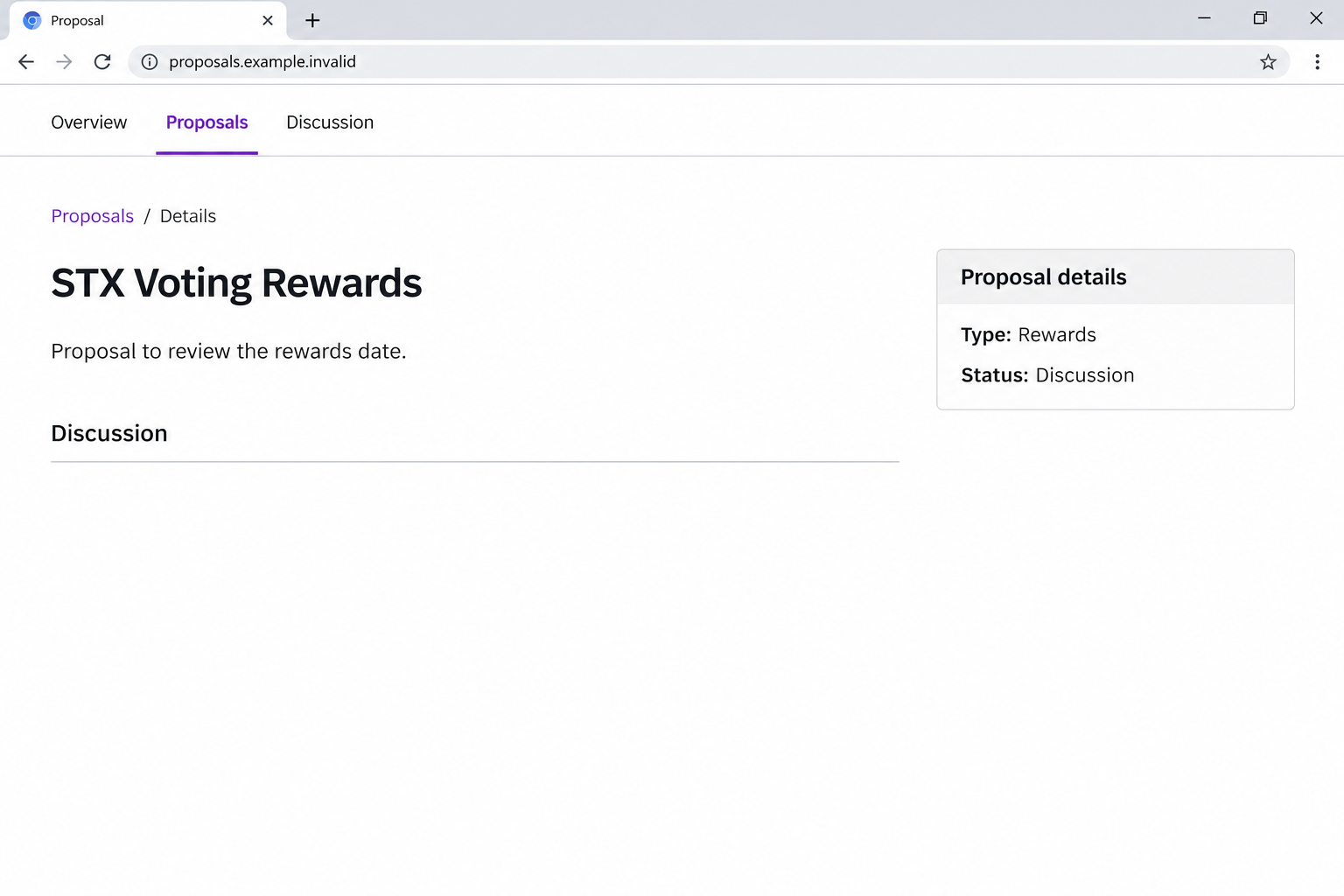
The Stacks STX Voting Rewards scam advertises a vote about when rewards will arrive. It says participants qualify for a bonus token allocation when the program launches.
That is more specific than a random giveaway. The page presents itself as part of governance, asking a community member to do something that sounds ordinary.
The documented site copied the real Stacks design but used a separate lookalike domain. The offer should not be attributed to Stacks just because the branding looks familiar.
Real Stacking doesn’t verify a vote-for-STX offer
Stacks documentation describes locking STX to participate in the network. It discusses rewards in Bitcoin, not the bonus STX promised by this page.
Projects can have separate votes or incentives. The existence of Stacking doesn’t rule all of those out. It also doesn’t validate this particular promotion.
Ask four concrete questions before you consider any wallet request:
- Who published the proposal, and where can you read it independently?
- What does the proposal actually change, and when does voting occur?
- Who administers the promised reward, and what are its terms?
- What will the wallet action do beyond recording a choice?
The documented vote button leads to a wallet request
The example moved from the supposed ballot to a connection prompt. That confirms a request to involve a wallet, not the exact effect of every subsequent approval.
The dangerous part is giving an unverified site authority it doesn’t need. Depending on the wallet and requested action, that can mean approving a transaction or exposing a secret.
Seeing the page alone does not prove a transfer happened. If you did interact, use the wallet and chain records to find out which action, if any, took effect.
How the Stacks STX Voting Rewards Scam Works
Step 1: The page asks for a civic-looking decision
A community vote sounds like a chance to have a say. It’s a softer opening than being asked to buy a token or send a verification payment.
The promotion uses a date as the subject of the supposed vote. That sounds concrete enough to trust while leaving out the details you would need to verify the proposal.
Real governance is not always run through one site. Some projects publish discussions, proposal identifiers, and voting procedures in different places. Find those through channels you already know.
If the invitation gives you no way to find a proposal except by using its button, don’t let it define both the question and the source of truth.
Step 2: The promised bonus changes what you pay attention to
The offer tells you participation will earn an allocation. That gives you a reason to rush even if the actual vote isn’t something you care about.
A familiar project’s name can make the reward sound inevitable. But the promise still needs a source, a budget or distribution plan, and rules someone can point you to.
Don’t assume that a real Stacking reward is what the page is talking about. A reward for locking STX in the network is not evidence of bonus STX for voting.
Ask whether you can read the terms without an account connection. A project that wants you to make an informed choice should not hide the proposal behind a wallet prompt.
Step 3: The site shifts from a ballot to your wallet
The visible action changes from voting to connecting. That can feel reasonable if you think the site must check eligibility. It is still a request from an unverified site.
A wallet interface may be genuine even when the request isn’t. If the panel shows an unfamiliar address, app, network, or transaction, decline it and verify the proposal separately.
Don’t use your wallet as a detector to see how far the page goes. The page already lacks independent proof. Further interaction doesn’t make it more reliable.
If a recovery phrase or private key is requested at any point, stop. Those secrets aren’t needed to verify whether a proposal exists.
Step 4: An approval can do more than mark a choice
A transaction can change on-chain state. Some prompts involve transfers or other permissions, while others do not. The website’s vote label doesn’t tell you which one the wallet received.
If you already approved something, read the transaction from a trusted wallet or established explorer. Check which account and network it used and whether anything actually left.
Don’t infer a particular drainer technique from the page screenshot. What matters for you is whether there is an unauthorized transaction, an ongoing permission, or a disclosed secret.
Preserve the evidence even if you caught the problem early. A transaction identifier or a time can be more useful to support than a screenshot of a generic confirmation screen.
How to Verify a Stacks Proposal on Your Own
Find a public discussion or proposal reference
Go through the official Stacks site or an established community channel that you didn’t reach through the offer. Look for the proposal’s exact title and a stable reference.
Read enough to know what participants are being asked to decide. A title about the rewards date is not a substitute for a description of the program.
Check whether the party running the vote also describes the reward. A proposal can be real while a separate promotional page invents a bonus for participating in it.
If another person forwarded the invitation, ask where they got it. They may have shared it in good faith without checking the original source.
Distinguish the chain, the wallet, and the organizer
The Stacks network is not responsible for every page that mentions STX. Wallet companies likewise don’t operate every website their software can connect to.
Find out which party runs the proposal, what wallet action is expected, and whether the destination matches the documentation. A logo can’t answer those questions.
If an offer asks you to switch networks or use a wallet unrelated to the activity you expected, pause. Check which account is being asked to do what.
Never create a new wallet through a link supplied by the page. If you need a wallet for a genuine activity, install it through the publisher’s independently verified route.
Read the record instead of trusting the vote screen
The page can display a vote confirmation without recording any genuine result. Verify activity through your own wallet and an established explorer such as the Hiro Stacks Explorer.
Select the correct network when reviewing a record. A test network transaction is not the same as activity on the live network where your assets are held.
If you have more than one account, look up the account you used rather than assuming the currently selected one is the same. Write down the address and time.
Where the wallet shows a contract interaction you can’t interpret, ask its official support team for help. Share the public identifier, not any secret used to authorize a transaction.
What to Do if You Have Fallen Victim to This Scam
-
Stop using the vote page.
Close it and reject any request still pending. If you only viewed it, do not go back to verify that it was fake.
Find any real proposal through a trusted Stacks channel. Don’t take a chat moderator linked by the page as independent confirmation.
-
If you connected, remove the site’s session.
Use your wallet’s settings, not a disconnect control on the suspicious site. Record the account and chain you used.
A session removal stops future communication through that connection. It does not cancel an action that already went through.
-
If you signed or approved something, identify it.
Check the transaction history and any supported permission view. Save the transaction identifier, asset, and amount if you see activity you didn’t intend.
Ask the wallet vendor how to remove any continuing authority. Don’t sign an unexplained cleanup request or follow a service promoted by the same page.
-
If you gave away a recovery phrase, treat it as exposed.
Disconnecting will not change the phrase. Get official wallet guidance on using a new wallet with a newly generated phrase to protect remaining assets.
Don’t paste the phrase into a recovery form, remote support chat, or supposed refund tool. Nobody needs it to review a public transaction.
-
Report loss with verified details.
Note the network, public address, transaction, and when you interacted. Contact relevant support or fraud reporting channels and provide the evidence securely.
If a custodial service may be involved, reach out through its official support. Be wary of anyone promising an automatic refund for another payment.
-
Check the device only if you did something that exposed it.
If the page also prompted you to install a wallet, extension, or application, stop using that device for sensitive activity until you get help.
A device scan cannot undo a signed transaction. Handle the wallet and computer as separate problems.
What to Save Before the Page Disappears
Keep the message or post where you first saw the invitation, if one exists. The posting account and time may be more helpful than another look at the page.
Record whether you saw the vote, connected, rejected a prompt, or approved an action. Each detail helps distinguish suspicion from an actual change in the account.
If a friend forwarded the offer, warn them through the same trusted conversation without pasting the live link. They may not know other people received it too.
Don’t include your recovery phrase in a report. If a screenshot shows addresses connected to your identity, share it privately with the people handling the incident.
Check the vote and the reward on separate tracks
A genuine proposal might discuss a schedule without offering any payment for participation. Check whether the bonus appears in the actual proposal or only on the page pushing the vote.
If the reward is supposedly distributed later, ask where that timetable was announced. A date in a screenshot isn’t evidence that a distribution has been approved.
Look for a way to read the proposal without authorizing anything. That doesn’t guarantee a real vote is safe, but it gives you time to understand what is at stake.
If the voting page is legitimate but the bonus comes from an unrelated link, don’t follow the bonus. The two offers may not be connected.
If a vote was recorded, check what else the request did
A familiar proposal title doesn’t explain a transaction’s contents. Review the operation that was actually sent, including any transfer that wasn’t part of your intended choice.
If activity took place on a test network, don’t confuse that with movement of assets on the live chain. Check the network before deciding which account needs attention.
If someone else manages the wallet, contact them promptly. A community or treasury wallet may have several people who need to know an unexpected request was approved.
The wallet’s history is more useful than a screenshot showing a winning vote. Check whether the record matches the account and action you intended.
If a site says your vote failed, don’t retry it through the same page. Verify the proposal and the transaction status independently before doing anything else.
If a screenshot of the proposal keeps circulating, share the verified project announcement instead of forwarding the imitation. That gives other voters somewhere safer to check.
Frequently Asked Questions
Is the Stacks STX Voting Rewards page legitimate?
The documented page was a lookalike. Check any genuine governance proposal and reward through independently reached Stacks channels instead of using its wallet prompt.
Is Stacking the same as voting for bonus STX?
No. The real Stacking process has its own rules, including locking STX and earning Bitcoin rewards. That is not the vote-for-STX offer shown here.
Can a fake vote lead to a real transaction?
Yes, if you approve a request with that effect. The text on a website does not control or explain what you authorize through a wallet.
What if my wallet connected but I rejected the next prompt?
Disconnect the site through the wallet and check the activity. Don’t assume you lost funds unless you see a relevant action or there was another exposure.
Does a chain explorer need my wallet password?
No. Looking up a public transaction does not require a password or recovery phrase. Use a known explorer independently rather than the link that promoted the vote.
Can a promise of bonus STX prove a vote is official?
No. Find the proposal and the reward rules separately. A claim about payment is not proof that the organization authorized the vote.
The Bottom Line
Skip the Stacks-branded voting offer. The promise of bonus STX is not evidence of a genuine proposal or a reason to connect a wallet.
If you already approved an action, check the real transaction and remove any continuing access through trusted guidance. Keep the fake offer separate from legitimate Stacks participation.

Join the discussion
0 commentsShare your experience or ask a question about this article.
Discussion
Start the conversation
Have a question or something useful to share? Add the first comment.