

TikLei.com promotes an unusually simple way to make money online, claiming users can earn $450 to $850 per week by watching TikTok videos. With a polished design and a quick eligibility check, the offer can look convincing at first glance.
But before trusting the promise, there are several important details worth examining. In this article, we take a closer look at TikLei.com, how the platform operates, and the warning signs users should know about.
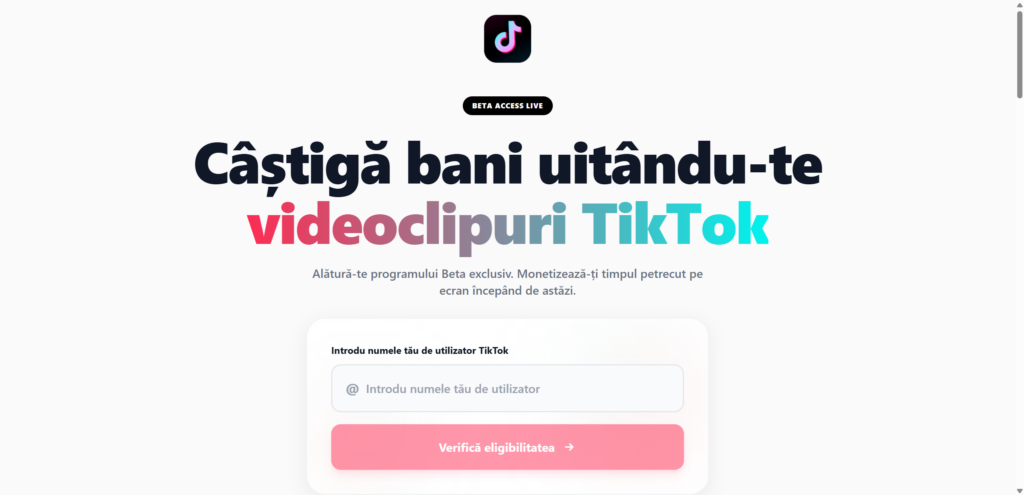
TikLei Scam Overview
TikLei.com uses a familiar online earning scam formula: attach an attractive financial promise to a famous brand, make the first few steps feel harmless, and only reveal the real monetization method after the visitor is already invested in the process.
The website may use TikTok-style branding, references to monetization, language suggesting beta access, and a form asking for a TikTok username. None of those elements prove that the website is affiliated with TikTok or that it has access to TikTok’s internal monetization systems.
The username request is particularly effective because it does not immediately feel dangerous. Most TikTok usernames are already public, so entering one into a form can seem like a low-risk action. At the same time, asking for a username makes the page feel personalized and creates the impression that the website is checking a real TikTok account.
After the username is entered, TikLei.com presents what appears to be an eligibility result. The visitor may see a success message, a check mark, or another visual cue indicating that their account qualifies for the supposed program.
Then comes the part designed to grab attention: the website displays estimated earnings of approximately $450 to $850 per week.
There is no reason to treat that number as a genuine TikTok earnings estimate. It is shown before the visitor has performed any paid activity, before any official monetization account has been created, and before the website has demonstrated any legitimate connection to TikTok.
The earnings figure works because it is aggressive without being completely unbelievable. A promise of $50,000 a week would immediately trigger skepticism, while $450 to $850 can sound like a plausible amount for a new online side hustle.
For someone looking for extra income, that number can be extremely persuasive. It is enough money to cover bills, groceries, rent, debt payments, or a vacation, yet the website suggests that earning it requires almost no effort.
The Fake Eligibility Check Creates the Illusion of a Real Program
Legitimate monetization programs normally have clear rules. They explain who can participate, what countries are supported, what activity generates revenue, how payments are calculated, what verification is required, and how withdrawals work.
TikLei.com’s process is far more convenient. Enter a username, receive a positive result, see a large earnings estimate, and move immediately toward a call-to-action such as “Start Earning Now.”
That sequence is useful for conversion because it minimizes the amount of time the visitor has to investigate the offer. The website gives people the exciting part first and leaves the difficult questions unanswered.
A username field and an animated eligibility result are not proof that a genuine account check took place. Any website can display a loading animation, insert the username you typed into the next screen, and return a predetermined result.
The important question is not whether the page looks convincing. The important question is whether the website can prove that TikTok actually recognizes the program.
The $450–$850 Earnings Estimate Is the Main Hook
The large weekly income estimate performs an important psychological function. Once visitors are told they could earn several hundred dollars, every subsequent request can feel like a small obstacle standing between them and that money.
Instead of asking themselves, “Why does this website want me to complete a random offer?”, some people begin thinking, “If completing this one step unlocks $850 a week, maybe it is worth doing.”
That is how the funnel changes the visitor’s decision-making process. The displayed balance or earnings estimate makes money that does not actually exist begin to feel obtainable.
Legitimate platforms do not normally promise a specific weekly income simply because somebody entered a social media username. Earnings depend on measurable activity, eligibility requirements, advertising revenue, content performance, contracts, or other defined factors.
TikLei.com provides the attractive number first because the number is what keeps people moving through the funnel.
The Biggest Red Flag: “Complete an Offer to Unlock Monetization”
The most revealing part of the TikLei.com process appears when visitors are told that they need to complete an offer before monetization can be activated.
This requirement has no obvious connection to getting paid for watching TikTok videos. Completing a survey, starting a product trial, downloading a game, signing up for a subscription, or providing personal information to another company does not establish eligibility for an official TikTok monetization program.
It does, however, make perfect sense within an affiliate marketing funnel.
Affiliate publishers can be paid when visitors complete specific actions. Depending on the advertiser and campaign, those actions may include:
- Creating an account
- Providing an email address
- Submitting a phone number
- Completing a survey
- Installing an app
- Signing up for a free trial
- Entering payment information
- Purchasing a product
- Starting a recurring subscription
The exact payment model can vary, but the underlying idea is simple: the person or company sending the visitor may receive compensation when the visitor completes the required action.
Affiliate marketing itself is not inherently fraudulent. Thousands of legitimate companies use affiliate programs every day.
The problem is how the visitor is brought into the offer. Someone arriving at TikLei.com believes they are attempting to qualify for a TikTok earning program. If that person is then pushed into unrelated commercial offers under the impression that those offers are necessary to unlock TikTok income, the presentation becomes highly deceptive.
You Are the Conversion
The economics behind a funnel like TikLei.com are much easier to understand once you stop focusing on the advertised payout.
Imagine that a campaign sends 100,000 visitors to a page promising easy TikTok income. Most visitors leave immediately, but some enter their username, some click the next button, and a smaller percentage eventually complete a third-party offer.
The operator does not need every visitor to fall for the pitch. A relatively small conversion rate can still produce substantial revenue when enough traffic is involved.
This is why the real value of the visitor may not be how many TikTok videos they watch. The valuable action may be signing up for the trial, installing the app, submitting contact information, or completing another advertiser-defined conversion.
The website therefore creates a clever reversal of expectations. The visitor arrives because they expect to be paid, while the funnel may actually be designed so that someone else gets paid when the visitor completes an offer.
Fake Social Proof Makes TikLei.com Look More Convincing
TikLei.com may reinforce its earning claims with elements that resemble real-time activity. These can include recent payout notifications, usernames, earning amounts, star ratings, claims about active members, or statistics suggesting that large amounts of money have already been distributed.
These elements are extremely common on questionable landing pages because social proof reduces hesitation. If a visitor sees dozens of other people supposedly earning money, the opportunity can feel less risky.
The problem is that anything displayed directly by the website can also be created by the website. A scrolling list of names and payout amounts does not independently prove that those people exist or that the payments occurred.
The same applies to claims such as:
- “15,000+ active earners”
- “$2.4 million paid”
- “Recent payout: $612”
- “Verified users”
- “Live earning activity”
Without independent verification, these statements should be treated as marketing claims rather than proof.
Why TikTok Branding Makes the Scheme More Effective
TikTok is an ideal brand for this type of promotion because genuine TikTok monetization already exists. Creators can earn money through various legitimate programs, sponsorships, commerce opportunities, livestream features, and other official channels.
Scammers and aggressive affiliate marketers can exploit that familiarity. They do not need to convince visitors that TikTok pays anyone; they only need to convince them that TikTok has launched one more monetization program.
That makes a claim such as “Get paid to watch TikTok videos” sound more believable than it otherwise would.
The use of terms like beta access, monetization, eligibility, and earnings can strengthen the illusion. Calling something a beta program also gives the website a convenient explanation for why most visitors have never heard of it.
A legitimate beta program from a company as large as TikTok should still be verifiable through official TikTok channels. A random third-party domain does not become an official TikTok service simply because its design looks similar or it uses TikTok terminology.
How The TikLei.com Scam Works
The entire process is easier to recognize when viewed as one funnel instead of several unrelated pages.
Step 1: You See an Ad Promising Easy TikTok Income
Most visitors probably do not type TikLei.com directly into their browser. They are more likely to arrive through social media promotions, short-form videos, advertisements, spam comments, direct messages, or websites discussing easy online side hustles.
The pitch is intentionally simple. Instead of promising complicated work, it suggests that TikTok will pay ordinary users for watching videos.
That immediately lowers the perceived barrier to entry. The visitor does not need experience, qualifications, an audience, or even content to publish.
Step 2: TikLei.com Makes the Opportunity Look Official
After clicking the promotional link, visitors arrive on a clean landing page that uses TikTok-related imagery or terminology.
The design is usually simple because simplicity helps conversions. Large buttons, bold earning claims, progress indicators, and short instructions keep people focused on moving forward rather than researching the company.
The visitor is invited to check whether they qualify.
Step 3: You Enter Your TikTok Username
TikLei.com asks for a TikTok username rather than immediately requesting sensitive information.
This makes the initial action feel relatively safe while still creating the impression that the website knows something about the visitor’s TikTok account.
After the username is entered, the page appears to process it.
Step 4: You Receive a Positive Eligibility Result
The result is encouraging. The visitor supposedly qualifies for the program and is shown an estimated weekly income.
This is where the $450–$850 figure becomes important. The website has now given the visitor a reason to continue even if the next steps begin to look unusual.
Instead of investigating whether the program exists, people may focus on obtaining the promised payout.
Step 5: Social Proof Pushes the Visitor Forward
The website may display recent activity, payout notifications, testimonials, or claims about thousands of other participants.
These elements create urgency and fear of missing out. A skeptical visitor may decide to continue simply because the website makes it appear that many other people are already successfully using the program.
Step 6: The Website Introduces a Simple “How It Works” Process
The supposed earning system may be presented as a straightforward process such as creating an account, watching videos, and withdrawing money.
The structure makes TikLei.com look more like a functioning platform with real onboarding rather than a simple advertisement.
Then the important condition appears: monetization must supposedly be activated by completing an offer.
Step 7: You Are Redirected Away From TikLei.com
After clicking “Start Earning Now” or a similar button, visitors may be sent through one or more redirect URLs before reaching another website.
The final destination may have little or nothing to do with TikTok.
Examples can include:
- Survey websites
- Sweepstakes pages
- App download pages
- Games
- Subscription services
- Product trials
- Lead-generation forms
- Other reward websites
This is the point where the original TikTok story begins to fall apart.
If TikTok is supposedly paying you to watch videos, there is no logical reason you should need to subscribe to an unrelated service first.
Step 8: The Offer Attempts to Generate a Valuable Action
The third-party page now asks the visitor to do something commercially valuable.
A relatively harmless version might request an email address. More aggressive offers can ask for phone numbers, payment information, detailed personal data, app installations, or trial registrations.
The action completed on this page may be the actual event that generates affiliate revenue.
This also explains why some visitors encounter one offer after another. Completing the first task does not necessarily unlock anything because the system may simply present additional opportunities to generate more conversions.
Step 9: A Free Trial Can Turn Into a Subscription
One of the biggest financial risks appears when an offer requests payment information.
Some promotions begin with terms such as:
- “Free trial”
- “Only $1 today”
- “Verify your payment method”
- “Activate for a small fee”
Visitors may concentrate on the advertised introductory price and overlook the renewal terms.
A free or low-cost trial can later become a recurring weekly or monthly subscription. Depending on the offer, multiple merchants may also be involved, which can make later charges difficult to identify.
Always check the actual billing terms before submitting payment details. You should know the initial charge, renewal amount, billing frequency, cancellation procedure, and merchant name before agreeing to anything.
Step 10: The TikTok Earnings Never Appear
After completing an offer, visitors expect to reach the promised earning platform.
Instead, they may see another requirement, another offer, another verification process, or no useful result at all.
Typical additional obstacles include:
- Completing another offer
- Referring friends
- Reaching a withdrawal threshold
- Verifying an account again
- Installing another app
- Paying a supposed processing fee
At this stage, the pattern becomes clear. The promised TikTok income keeps moving further away while the visitor continues providing commercially valuable actions.
Step 11: Charges May Appear Later
Not every problem becomes visible immediately.
Someone can leave the website believing nothing happened and then notice an unfamiliar card transaction days or weeks later. Others may receive subscription emails or discover that a free trial has renewed.
The merchant name appearing on the bank statement may also be completely different from TikLei.com because the payment is processed by whichever third-party offer the visitor completed.
This can make the situation particularly confusing for victims who remember visiting TikLei.com but cannot recognize the company charging their card.
Step 12: Your Information Can Lead to More Scams
Payment information is not the only valuable data collected through these funnels.
Email addresses, phone numbers, demographic information, and survey responses can be used for marketing or additional targeting.
People who show interest in easy-money offers may later receive:
- Fake job opportunities
- More “get paid online” schemes
- Phishing emails
- Scam text messages
- Fake PayPal notifications
- Cryptocurrency promotions
- Fake withdrawal notices
A particularly dangerous follow-up scam tells victims that their TikTok earnings are waiting but that they must pay a small fee before the money can be released.
Do not pay it.
Why This Scam Is So Convincing
TikLei.com’s pitch combines several psychological triggers that work particularly well together.
First, TikTok is a familiar platform with genuine monetization programs. That makes a fake new program easier to believe.
Second, the advertised activity requires almost no effort. People already watch TikTok videos every day, so earning hundreds of dollars for the same behavior sounds incredibly attractive.
Third, the website provides a positive eligibility result before the visitor has earned anything. That can make the imaginary payout feel like something they have already qualified for rather than an unverified advertising claim.
Finally, the process uses gradual commitment. Visitors are not immediately asked to spend hundreds of dollars. They are asked to enter a username, click a button, complete an offer, and perhaps start a low-cost trial.
Each step seems small when viewed on its own. Combined, those small decisions can lead a visitor much further into the funnel than they originally intended.
Major TikLei.com Red Flags
Several warning signs make this offer easy to identify once you know what to look for:
- TikLei.com is not an official TikTok domain. TikTok branding on a third-party website does not prove affiliation.
- The website claims to check eligibility using little more than a username. That is not evidence of access to TikTok’s monetization systems.
- You are shown a large earnings estimate immediately. Legitimate programs do not normally promise hundreds of dollars before any work has taken place.
- The site uses unverifiable payout feeds and activity counters. These can be generated directly by the website.
- You must complete unrelated offers. Surveys, subscriptions, trials, and app installations have no legitimate connection to watching TikTok videos for money.
- Visitors are redirected through multiple domains. This is common in affiliate funnels and can make the final advertiser harder to identify.
- Payment information may be requested before any earnings exist. You should never have to buy or subscribe to unrelated services to unlock wages.
- Requirements can keep multiplying. One offer may lead to another rather than to a real payout system.
Any one of these signals should justify additional investigation. When several appear together, the risk is significantly higher.
What If You Only Entered Your TikTok Username?
If you entered only a public TikTok username and did not provide a password, email address, phone number, payment details, or other private information, the immediate risk is relatively low.
A public username alone does not normally allow someone to take control of your TikTok account. You should still be cautious about any messages you receive afterward, especially if they claim your TikTok earnings are ready or ask you to log in through another website.
Never share your TikTok password, authentication codes, recovery codes, or email credentials with anyone contacting you through a supposed earning program.
What If You Entered Your Email Address or Phone Number?
You may receive more spam, marketing messages, or phishing attempts after submitting contact details.
Pay particular attention to messages claiming that:
- Your TikTok payment is ready
- Your withdrawal failed
- Your account needs verification
- You qualify for another easy-money program
- PayPal or Cash App needs confirmation
- You won a prize
- You must pay a fee to receive earnings
Do not use links inside unexpected messages to access important accounts. Open the official app or website directly instead.
What If You Entered Your Credit or Debit Card?
If you entered card information anywhere in the TikLei.com funnel, check your bank account immediately.
Review both completed and pending transactions, including very small charges. Subscription offers sometimes start with inexpensive introductory payments or authorization checks before larger recurring charges appear.
Next, search your email inbox for confirmation messages using terms such as:
- Subscription
- Trial
- Receipt
- Membership
- Welcome
- Billing
- Renewal
- Order
Identify every company you may have registered with and cancel anything you do not want.
If you see an unfamiliar transaction or cannot determine which company has your payment information, contact your bank or card issuer. Explain that your card details were entered after you were redirected through a questionable online earning promotion.
Your bank can advise whether the best response is to block the merchant, dispute a transaction, stop recurring billing, freeze the card, or issue a replacement.
What To Do If You Fell Victim to TikLei.com
If you went beyond the initial landing page and completed offers, take the following steps.
1. Stop interacting with the funnel
Do not complete additional offers because the website claims you are one step away from receiving money.
If one requirement keeps turning into another, continuing is unlikely to solve the problem.
2. Save evidence
Take screenshots of TikLei.com, the earnings estimate, eligibility screen, offer pages, confirmation pages, and any suspicious emails or transactions.
Save the URLs where possible. This information can help if you later need to dispute a charge or explain the situation to a bank.
3. Review your card and bank activity
Look for both large and small unfamiliar charges.
Also check for recurring transactions because subscription traps may initially appear inexpensive.
4. Cancel unwanted subscriptions
Use the legitimate website of the merchant that actually enrolled you rather than returning through TikLei.com.
Save the cancellation confirmation in case the company bills you again.
5. Contact your bank when necessary
If you see an unauthorized charge or believe your card details were exposed to an untrustworthy page, contact your bank promptly.
Ask about merchant blocks, recurring payment cancellation, disputes, and card replacement.
6. Change passwords you entered on offer pages
If you reused a password while creating an account through the funnel, change it everywhere it was reused.
Protect your email account first because access to email can often be used to reset passwords for other services.
7. Enable two-factor authentication
Enable 2FA on your email, TikTok, banking accounts, PayPal, and other important services.
Never give an authentication code to somebody who contacts you unexpectedly.
8. Remove suspicious apps and browser extensions
If an offer required an app or extension installation, remove anything you no longer trust.
Review permissions carefully, particularly access to messages, contacts, notifications, accessibility services, browsing data, microphone, or camera.
9. Run a security scan if you installed software
Simply visiting TikLei.com does not automatically mean your device is infected.
A security scan becomes more important if you downloaded software, installed browser extensions, sideloaded applications, or opened suspicious files during the offer process.
10. Monitor your accounts for several weeks
Trials may renew later, so continue checking card statements, PayPal activity, digital wallets, and mobile phone bills.
Do not assume the issue is over simply because nothing was charged on the first day.
11. Ignore “recovery” or “withdrawal” scams
If someone later tells you that hundreds of dollars are waiting but you must pay a fee to receive them, do not send money.
This is a common way to target people who already interacted with an online earning scam.
How to Avoid Similar TikTok Earning Scams
The domain name may change, but the basic funnel is easy to recognize.
Verify monetization opportunities through the company supposedly offering them. If TikTok launches a major new earning feature, there should be information available through official TikTok channels rather than only through an unfamiliar third-party website.
Never enter payment information just because a website claims you need to activate a payout. A legitimate job or monetization program should explain its payment structure clearly rather than requiring participants to purchase unrelated products.
You should also leave immediately when the story changes. If you arrived because you were promised money for watching TikTok videos but suddenly find yourself taking surveys, downloading games, signing up for subscriptions, or entering a credit card number, the original opportunity is no longer what was advertised.
The Bottom Line
TikLei.com should not be treated as an official TikTok program that pays users $450 to $850 per week for watching videos.
The website uses TikTok-related branding, an apparent eligibility check, a large weekly earnings estimate, and social-proof elements to persuade visitors that a genuine monetization opportunity exists. Once visitors continue, however, the process shifts toward completing unrelated third-party offers.
Those offers can include surveys, app installations, lead-generation forms, free trials, and subscriptions. Some may collect personal information, while others can lead to recurring charges.
The key warning sign is simple: a legitimate TikTok monetization program should not require you to complete unrelated commercial offers before you can get paid.
If you only entered a public username and left, your risk is relatively low. If you provided payment details, started trials, installed software, or submitted additional personal information, check your accounts, cancel unwanted subscriptions, secure your credentials, and monitor for follow-up scams.
Frequently Asked Questions
Is TikLei.com legit?
TikLei.com should not be treated as a legitimate TikTok monetization platform. The website’s earning flow directs visitors toward third-party offers rather than an official TikTok payment system.
Is TikLei.com affiliated with TikTok?
Using TikTok logos, colors, terminology, or usernames does not establish an official relationship with TikTok. Any legitimate monetization program should be independently verifiable through TikTok’s official channels.
Does TikLei.com really pay $450–$850 per week?
The $450–$850 weekly figure displayed by TikLei.com should not be considered verified income. It appears as part of the funnel before visitors perform legitimate paid work or gain access to an official TikTok monetization platform.
Why does TikLei.com ask for my TikTok username?
Requesting a username makes the process feel personalized and can create the impression that TikLei.com is checking a real TikTok account. A username alone does not prove that the website has access to TikTok’s internal systems.
What does “Complete an offer to unlock monetization” mean?
It means visitors are being asked to complete a third-party promotional action such as a survey, app installation, account registration, trial, or subscription. These actions can generate affiliate revenue but are not normal requirements for official TikTok monetization.
Why am I redirected to other websites?
Affiliate funnels frequently use redirect chains for tracking, attribution, geographic targeting, and offer selection. This is why the final page asking for personal or payment information may have a completely different domain from TikLei.com.
Can TikLei.com charge my credit card?
The original landing page may not be the merchant that charges you. However, third-party offers reached through the TikLei.com funnel may request card information and can potentially create paid or recurring subscriptions.
I entered my card details. What should I do?
Check pending and completed transactions, search your email for subscription confirmations, cancel unwanted trials, and contact your card issuer if you see unfamiliar charges or believe recurring billing may have been activated.
Why is the charge under a different company name?
The billing company may be the third-party advertiser whose offer you completed rather than TikLei.com. Compare merchant names on your statement with confirmation emails and ask your bank for more information if you cannot identify a transaction.
I only entered my TikTok username. Am I safe?
The risk is significantly lower if you entered only a public username. Do not provide your password, authentication codes, recovery codes, or other account credentials if you receive follow-up messages.
Can TikLei.com steal my TikTok account?
A public username alone is not enough to access your TikTok account. The danger increases if another page in the funnel asks for your TikTok password, email credentials, or two-factor authentication codes.
What if I installed an app?
Remove applications you installed solely to complete an offer if you no longer trust or need them. Review their permissions and run a reputable security scan if the application came from an unfamiliar source.
Is TikLei.com malware?
TikLei.com is better described as a questionable earning and affiliate-offer funnel rather than malware by itself. Malware risk becomes more relevant if one of the third-party offers convinces you to install suspicious software, browser extensions, or unofficial mobile apps.
Why does TikLei.com show recent payouts?
Payout notifications and activity feeds create social proof. Because those elements are controlled by the website displaying them, they should not be considered independent evidence that real users received money.
What if I completed an offer but did not get paid?
Do not complete additional offers simply because the website says another step is required. Instead, check whether you created any subscriptions or exposed payment information and take steps to secure your accounts.
Someone says I need to pay a fee to receive my TikTok earnings. Should I pay?
No. Requests for activation, processing, withdrawal, verification, or release fees are major scam warning signs, particularly when the supposed earnings came from an unverified platform.
Can a free trial charge me later?
Yes. Many trials automatically convert into paid subscriptions unless canceled before the trial period ends. Always check the renewal price, billing frequency, merchant name, and cancellation terms.
How can I find subscriptions I accidentally started?
Search your email for words such as “trial,” “subscription,” “membership,” “receipt,” “billing,” “renewal,” and “welcome.” Compare any results with merchant names appearing on your card statement.
Should I cancel my card?
That depends on what information you entered and whether suspicious activity has appeared. Contact your card issuer and let them determine whether blocking the merchant or replacing the card is appropriate.
How can I avoid scams like TikLei.com?
Verify earning opportunities through official company websites, never pay to unlock supposed wages, and leave when an advertised job suddenly turns into unrelated surveys, subscriptions, or app installations.
What is the biggest warning sign?
The biggest warning sign is the requirement to complete unrelated third-party offers in order to supposedly unlock TikTok monetization. That requirement makes sense for an affiliate funnel but not for a genuine program paying people to watch TikTok videos.








